
Palm sugar has a long history in Southeast Asian food culture, but today it is also becoming an interesting ingredient for international food and beverage manufacturers. Buyers use it in coffee, bakery products, sauces, confectionery, snacks, desserts, and many other applications. Behind the finished product, however, there is a detailed process. The quality of palm sugar depends on the palm sap, harvesting practices, cooking, concentration, cooling, drying, packaging, and storage. For this reason, understanding palm sugar processing methods can help B2B buyers make better purchasing decisions.
Processing methods can vary between regions and suppliers. Some producers rely heavily on traditional processing, while others combine traditional knowledge with more controlled modern processing. Neither approach should be judged only by how old or new it is. What matters most is whether the process produces a safe, stable, consistent product that matches the buyer’s specification.
This guide explains how palm sugar is processed, how traditional and modern methods differ, what happens at each stage, and what international buyers should look for when selecting a supplier.
Where Palm Sugar Processing Begins: The Palm Sap
Palm sugar processing starts long before the sugar reaches a factory. It begins with the palm tree and the collection of its sap. Farmers carefully prepare the flower stalk or inflorescence so that sap can be collected regularly.
The quality of the fresh sap matters because it becomes the raw material for the finished sugar. Farmers need to collect it at the right time and handle it carefully. Fresh sap is naturally rich in sugars and can change relatively quickly if it is not processed properly.
The collection process also requires experience. Farmers understand the condition of the palm and know how to manage the flower stalk to encourage sap flow. This traditional knowledge remains an important part of palm sugar production.
For B2B buyers, this is a useful reminder that processing quality starts at the farm. Even sophisticated equipment cannot completely compensate for poor raw material handling.
Traditional Processing: Knowledge Passed From Generation to Generation
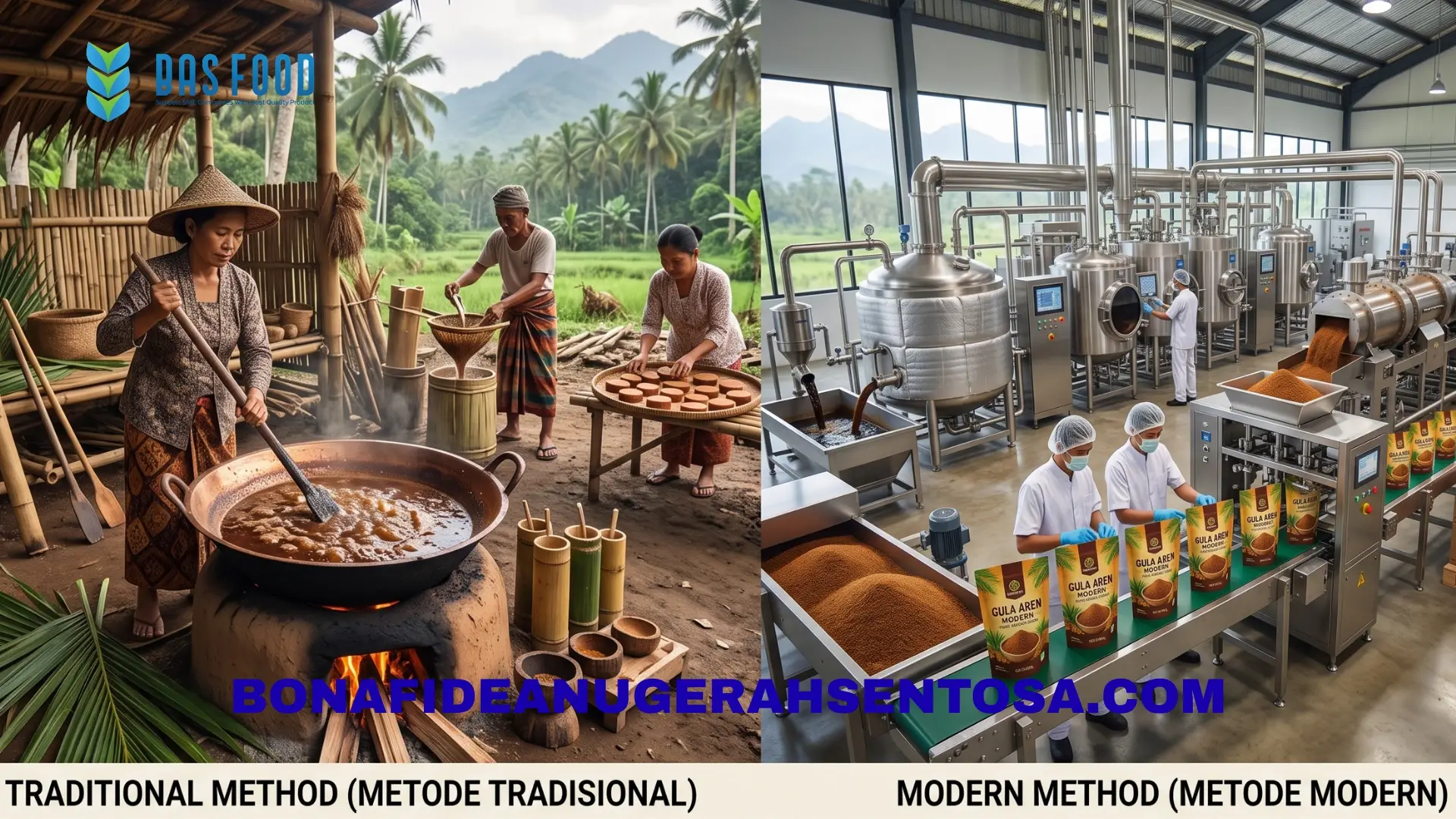
Traditional processing is still widely associated with palm sugar production in Indonesia and other Southeast Asian regions. In a traditional system, farmers collect fresh palm sap and transfer it to a cooking area where it is heated in large containers.
The sap is gradually heated to reduce its water content. During this process, the liquid becomes more concentrated and develops a deeper color and characteristic caramel-like aroma. The exact color and flavor can depend on the raw material, heating conditions, cooking time, and other factors.
Traditional production often relies on simple equipment and practical knowledge developed over many generations. Farmers and processors learn how to recognize changes in the sap during cooking by observing its appearance, thickness, aroma, and behavior.
This knowledge has real value. However, traditional processing can also create variation if different producers use different cooking conditions. For export markets, suppliers may therefore need additional quality controls to keep the finished product within an agreed specification.
The Cooking Stage and Concentration
Cooking is one of the most important steps in palm sugar production. The goal is to remove enough water from the sap and concentrate the sugars until the desired consistency is reached.
During heating, the processor needs to manage temperature and cooking time. If the process is too short, the product may retain excessive moisture. If the process is too intense or prolonged, it can affect color, aroma, flavor, and texture.
The right cooking conditions depend on the type of palm sugar being produced. Molded palm sugar, granulated palm sugar, and powdered palm sugar may require different processing approaches after concentration.
This is where process control becomes important. A supplier serving international B2B customers should have a clear understanding of its processing parameters and product specifications.
Modern Processing: More Control Over the Production Line
Modern processing does not necessarily mean replacing traditional methods completely. In many cases, producers can combine traditional knowledge with modern equipment and quality-control systems.
Modern facilities may use improved filtration, controlled heating systems, stainless-steel equipment, mechanical drying, temperature monitoring, moisture testing, sieving, and better packaging systems. These tools can help reduce variation and improve hygiene.
The main advantage is greater process control. Instead of relying only on visual observations, processors can use measurable parameters to monitor the product.
For B2B buyers, this can be valuable because food manufacturers often require predictable specifications. A supplier that can control moisture, particle size, packaging, and batch consistency may be better positioned to support regular industrial orders.
Filtration and Raw Material Preparation
Before or during processing, the sap may need to be filtered to remove physical impurities. The exact filtration process depends on the supplier and production system.
Clean raw material preparation is important because palm sugar is a food ingredient. Producers need to maintain appropriate hygiene from sap collection through processing and packaging.
In a well-managed production system, raw material handling should reduce the risk of unwanted foreign material entering the finished product.
For exporters, this stage should be connected to broader food safety practices. Clean equipment, suitable processing areas, trained workers, and controlled handling can all contribute to a safer product.
Controlling Moisture for Better Quality
Moisture is one of the key quality factors in palm sugar. Too much moisture can affect texture, storage stability, and shelf life. It can also make some forms of palm sugar more likely to clump or change during storage.
For this reason, moisture control is an important part of quality preservation. Suppliers need to establish appropriate moisture specifications based on the product form and intended application.
Granulated and powdered palm sugar may require particular attention because moisture can affect flowability and particle behavior. Packaging also becomes important because the product can be exposed to humidity during storage and transportation.
B2B buyers should therefore ask suppliers about moisture specifications and testing methods. If the product will travel long distances by sea, packaging and storage conditions should also be considered together with moisture control.
Producing Molded Palm Sugar
Molded palm sugar is one of the traditional forms of the product. After cooking, the concentrated sugar is transferred into molds and allowed to cool and solidify.
The shape and size can vary according to local traditions and buyer requirements. Some markets prefer traditional shapes, while food manufacturers may prefer formats that are easier to break, weigh, or process.
Cooling conditions can influence the final texture. Once the product has solidified, it can be removed from the molds, inspected, packed, and stored.
For export buyers, molded palm sugar may be suitable for traditional food products, food service, or applications where the sugar will be dissolved or processed before use.
Producing Granulated Palm Sugar
Granulated palm sugar requires additional processing to create small, free-flowing particles. The concentrated palm sugar is processed and dried until it reaches a suitable texture.
After drying, the product can be broken down and sieved according to particle size. Suppliers may offer different granulation specifications depending on customer requirements.
Particle size matters in industrial applications. A beverage manufacturer may prefer a smaller particle size for faster dissolution, while another application may require larger granules for a particular texture.
Therefore, buyers should avoid asking only for “granulated palm sugar.” A more useful specification includes the desired particle size or mesh range, moisture level, color, flavor, and packaging.
Producing Palm Sugar Powder
Palm sugar powder is another form designed for convenient handling and precise dosing. It can be useful in food manufacturing, beverage mixes, bakery applications, and other processed foods.
The powder needs careful drying and handling because fine particles can absorb moisture and form lumps under unsuitable storage conditions.
Sieving and particle control can help produce a more uniform powder. However, packaging remains important after processing because humidity can affect the product during transportation.
For international buyers, the best specification should reflect the production process and final application. A supplier should be able to explain the available powder characteristics rather than offering a generic product without technical information.
Drying and Cooling: Protecting the Finished Product
Drying and cooling are particularly important when producing granulated or powdered palm sugar. The product needs to reach an appropriate condition before packaging.
If packaging occurs while the product is still too warm or contains excessive moisture, condensation or other quality problems may occur. Therefore, controlled cooling and moisture checks can support product stability.
Modern equipment can make this process more predictable, but the basic principle remains simple: the product needs to be sufficiently dry, stable, and cool before it enters its final packaging.
This stage contributes directly to quality preservation, especially for products that may spend weeks in storage or several weeks in international transportation.
Sieving and Particle Size Control
Once palm sugar has been dried, suppliers may sieve it to separate particles according to size. This step is useful when buyers require specific granule specifications.
Particle size can affect how quickly the sugar dissolves, how easily it flows through processing equipment, and how evenly it mixes with other ingredients.
For example, a beverage manufacturer may prefer a relatively fine granule, while a food producer may want a different size for blending or dry mixes.
Buyers should therefore include particle size in their purchase specification when it affects the application. The supplier can then use the appropriate sieving process and quality checks.
Quality Preservation During Packaging
Processing does not end when the sugar reaches the desired form. Packaging plays an important role in quality preservation.
Palm sugar needs protection from moisture, contamination, physical damage, and unsuitable storage conditions. Packaging should also be appropriate for the transportation route and final market.
Bulk B2B buyers may request 20 kg, 25 kg, or other packaging formats. Retail customers may require smaller pouches, while private-label buyers may need customized packaging.
A good packaging specification should cover the inner packaging, outer packaging, net weight, batch identification, labeling, and storage instructions where required.
Traditional Processing vs. Modern Processing
It is tempting to say that modern processing is always better than traditional processing. In reality, the answer depends on the product and the quality system behind it.
Traditional processing can preserve local knowledge and characteristic production practices. It can also produce distinctive flavor and aroma profiles that buyers may value.
Modern processing can improve control, hygiene, consistency, testing, and production capacity. For large B2B orders, these advantages can be important.
The strongest approach can combine the two. Traditional knowledge can guide raw material handling and product character, while modern controls can help maintain consistent specifications.
| Processing Approach | Main Strength | Possible Challenge |
|---|---|---|
| Traditional processing | Heritage, local knowledge, distinctive character | Greater batch variation |
| Modern processing | Better control and consistency | Higher equipment and process requirements |
| Combined approach | Balances tradition and process control | Requires good management |
For exporters, the goal should be a process that consistently delivers the buyer’s required specification.
Food Safety During Palm Sugar Processing
Food safety should be considered throughout the entire process. Raw material handling, equipment hygiene, worker practices, water quality where relevant, processing areas, packaging, and storage all matter.
A supplier should have suitable procedures for controlling contamination risks. The exact food safety system will depend on the facility, market, customer requirements, and applicable regulations.
B2B buyers may request quality documents, laboratory results, certifications, or production information as part of supplier qualification.
However, buyers should focus on requirements that actually matter for their product and destination market. A long list of documents does not automatically mean better quality.
How Processing Affects Color and Flavor
Palm sugar’s color and flavor are closely connected to its raw material and processing conditions. Heating naturally concentrates the sugar and can contribute to the development of its characteristic aroma and darker color.
However, excessive heating can produce an overly dark product or change the desired flavor profile. Differences in raw sap can also influence the final appearance.
For buyers, this means that color should be specified carefully. Terms such as “light,” “medium,” or “dark” can mean different things to different suppliers.
An approved physical sample can therefore be useful. Buyers can use the sample together with written specifications to communicate their expectations more clearly.
The Role of Quality Testing
Testing helps suppliers confirm that the finished product meets agreed requirements. The exact tests depend on the buyer’s specification and market.
Common quality parameters may include moisture, microbiological characteristics, particle size, appearance, and other product-specific criteria.
Testing should support the production process rather than simply happen at the end. When suppliers monitor critical parameters during production, they can identify problems earlier.
For international buyers, requesting a Certificate of Analysis for relevant batches can provide additional information. However, the COA should contain parameters that are meaningful for the buyer’s product specification.
Working With a Palm Sugar Supplier
A reliable palm sugar supplier should be able to explain its processing methods clearly. Buyers can ask where the raw material comes from, how sap is handled, what processing steps are used, and how the finished product is tested.
Buyers should also request samples before placing large orders. The sample can be tested in the actual application, whether that is coffee, bakery, beverages, sauces, confectionery, or another food product.
After approval, the buyer and supplier should maintain a clear specification. This helps ensure that future batches remain aligned with the approved product.
Long-term communication also helps suppliers plan production. Buyers that provide forecasts can make it easier for suppliers to manage raw materials, processing schedules, packaging, and shipping.
Working With a Palm Sugar Exporter
For international buyers, an experienced palm sugar exporter can provide additional support with packaging, documentation, shipment coordination, and export procedures.
However, export experience should not replace technical evaluation. Buyers should still review product quality, samples, specifications, food safety information, capacity, lead time, and commercial terms.
An exporter that understands the complete supply chain can help bridge the gap between traditional agricultural production and international B2B requirements.
For Indonesian palm sugar, buyers may evaluate CV Bonafide Anugerah Sentosa as one potential supplier and exporter. As with any sourcing decision, buyers should conduct their own due diligence and confirm that the product and commercial arrangement meet their specific requirements.
Palm Sugar and Coconut Sugar Sourcing
Some businesses source both palm sugar and coconut sugar because they serve related applications. In these cases, a coconut sugar supplier may become part of the buyer’s wider natural sweetener sourcing strategy.
However, palm sugar and coconut sugar should not automatically be treated as identical products. Their raw materials, flavor profiles, processing methods, and specifications can differ.
If a supplier offers both products, buyers should request separate samples and technical specifications. This allows the purchasing and product-development teams to evaluate each ingredient properly.
A clear product specification also makes it easier to communicate with customers and maintain consistency across future shipments.
Choosing the Right Processing Method for B2B Markets
The “best” palm sugar processing method depends on the product’s intended use. A traditional molded product may be ideal for one market, while a manufacturer may need granulated or powdered palm sugar for automated production.
Food manufacturers should therefore start with the application. Ask how the sugar will be used, how it will be stored, how it will be transported, and what characteristics are important.
From there, the buyer can define the required product form, moisture level, particle size, color, flavor, packaging, and shelf-life expectations.
This application-first approach helps suppliers recommend a suitable product rather than simply selling whatever format they currently have available.
Final Thoughts on Palm Sugar Processing Methods
Understanding palm sugar processing methods gives B2B buyers a better view of what happens before the product reaches the warehouse. From sap collection and filtration to cooking, drying, cooling, sieving, testing, and packaging, each stage can influence the final product.
Traditional processing remains valuable because it carries practical knowledge and local production experience. Modern processing adds stronger control, measurement, hygiene, and consistency. In many cases, combining both approaches offers a practical path for export-quality production.
For international buyers, the most important question is not whether a supplier uses traditional or modern processing alone. The better question is whether the supplier can consistently deliver a safe product that meets the agreed specification.
By working with a capable palm sugar supplier, communicating clear requirements, approving samples, and monitoring quality, buyers can build a more reliable supply chain. For exporters such as CV Bonafide Anugerah Sentosa, understanding these processing expectations can also help connect Indonesian palm sugar production with the needs of global B2B customers.