
Coconut sugar has moved beyond traditional kitchens and is now used by food brands, bakeries, beverage companies, distributors, and manufacturers around the world. One format that has become especially practical for commercial use is coconut sugar granules. But what exactly are coconut sugar granules? In simple terms, they are coconut sugar processed into small, free-flowing particles that are easier to measure, blend, pack, and use than large molded pieces. The size and appearance can vary depending on the processing method and supplier specification.
For B2B buyers, understanding this product is important before placing an order. Granulation affects how the sugar behaves during production, packaging, storage, and final use. Therefore, buyers should look beyond the product name and evaluate specifications such as particle size, moisture, color, aroma, taste, packaging, and consistency.
This guide explains what coconut sugar granules are, how they are made, how they compare with other coconut sugar formats, and what international buyers should consider when sourcing them from Indonesia.
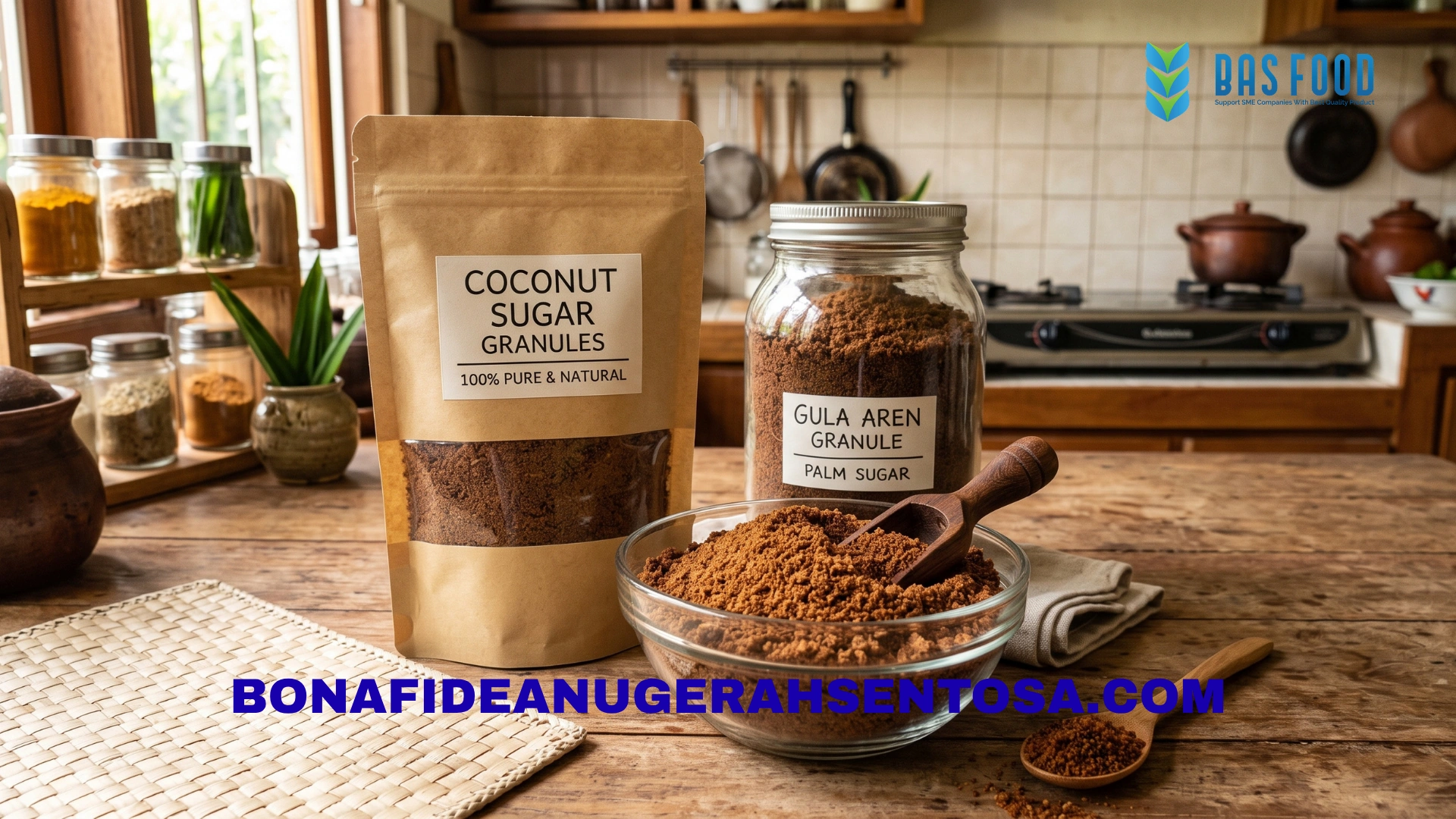
What Are Coconut Sugar Granules?
Coconut sugar granules are small particles of sugar made from coconut palm sap. The sap is collected from coconut flower stalks and then processed by controlled heating to reduce its water content and concentrate the natural sugars.
Once the coconut sugar reaches the desired consistency, it can be processed into a granular form. The final product usually has a brown to golden-brown appearance and a characteristic sweet aroma. However, color and flavor can vary according to raw material, processing conditions, and product specifications.
Unlike molded coconut sugar, granules are not supplied as large blocks. This makes them easier to weigh and dose, especially for food manufacturers that use coconut sugar as an ingredient.
For example, a bakery can measure a specific amount of granulated coconut sugar directly into a mixing system. A beverage manufacturer can also use measured quantities when developing a recipe.
This convenience is one of the main reasons granulated products are attractive to B2B customers.
How Is Granulated Coconut Sugar Made?
The production process starts with collecting fresh coconut palm sap. Farmers carefully collect the sap from coconut flower stalks and bring it for processing.
The sap needs to be handled properly because it is naturally rich in sugars and can change over time. Producers therefore process the sap according to their established production methods.
The sap is heated to reduce its water content. During this process, the liquid gradually becomes thicker and more concentrated. The heating process also contributes to the characteristic color and flavor associated with coconut sugar.
After concentration, the product is cooled and processed into the required form. For granulated products, the sugar is prepared and processed into particles according to the agreed specification.
The final step may include screening or sieving to help achieve a more consistent particle size.
For commercial buyers, this consistency matters. A manufacturer using coconut sugar in a food formulation needs the ingredient to perform in a predictable way from one batch to another.
Understanding Coconut Sugar Texture
One of the easiest ways to understand the difference between coconut sugar formats is to look at coconut sugar texture.
Molded coconut sugar is compact and solid. Depending on the product, it may need to be broken, chopped, shaved, or grated before use.
Granulated coconut sugar has a different physical structure. The small particles can be scooped, weighed, and blended more easily.
This makes granules particularly practical for commercial kitchens and food factories. They can be added directly to dry mixes or other ingredients without requiring the extra preparation needed for large blocks.
However, not every granulated coconut sugar product has exactly the same texture.
Particle size, moisture, processing conditions, and screening can all influence the final texture. Some products may have finer particles, while others may have larger granules.
Therefore, buyers should request a product specification and sample before committing to a large order.
Why Coconut Sugar Granules Are Useful for Food Manufacturers
Food manufacturers need ingredients that are easy to handle and consistent. This is where coconut sugar granules can offer a practical advantage.
A granulated product can be easier to measure than molded sugar. This is useful when a production team follows a recipe that requires precise ingredient quantities.
Granules can also simplify blending. For example, a manufacturer producing bakery mixes may combine coconut sugar with flour, spices, cocoa, or other dry ingredients.
The format can also be useful for beverage mixes, snack products, sauces, desserts, and other applications.
However, the ideal granule size depends on the production process.
A company using automated dosing equipment may have different requirements from a small bakery. Therefore, buyers should explain the intended application to the coconut sugar supplier before selecting a specification.
Coconut Sugar Granules as a Natural Sweetener
Coconut sugar is commonly used as a natural sweetener in food and beverage products. It provides sweetness along with its own flavor and color characteristics.
This makes it different from refined white sugar, which has a relatively neutral taste and appearance.
Coconut sugar can provide warm, caramel-like notes that work well with ingredients such as coffee, chocolate, coconut, spices, nuts, and tropical fruits.
For this reason, brands may use coconut sugar in products where they want a distinctive flavor profile.
However, businesses should be careful with marketing claims. Calling coconut sugar a natural sweetener describes its ingredient category, but brands should not automatically make health claims without appropriate evidence and compliance with the regulations of their target market.
For B2B buyers, product quality and technical suitability should remain the primary considerations.
Coconut Sugar Granules vs. Molded Coconut Sugar
Both granulated and molded coconut sugar come from coconut palm sap, but their physical forms are different.
Molded coconut sugar is traditionally shaped into blocks, discs, or other forms. It can be suitable for traditional cooking, foodservice, and applications where the user is comfortable breaking or grating the sugar.
Coconut sugar granule, on the other hand, is already divided into small particles. This can make it more convenient for weighing, blending, filling, and industrial processing.
For retail brands, granules can also be easier to package into pouches or bags.
Neither format is automatically better. The right choice depends on the buyer’s application.
A traditional-food company may prefer molded coconut sugar because the format fits its recipes. A bakery ingredient manufacturer may prefer granules because they are easier to dose.
Therefore, product format should always be selected according to actual use.
Coconut Sugar Granules vs. Coconut Sugar Powder
Another common comparison is between granulated coconut sugar and powdered coconut sugar.
Granules generally have a larger particle size than powder. This difference can affect how quickly the product mixes or dissolves.
Powder may be useful in formulations that require very fine particles. Granules can be more practical when the manufacturer wants easier handling and measurement without using an extremely fine product.
The choice depends on the production system and final product.
For example, a dry beverage mix may require a particular particle size for proper blending. A bakery may have different requirements based on its mixing equipment.
Food manufacturers should therefore test the actual product before finalizing the specification.
Where Are Coconut Sugar Granules Used?
The versatility of coconut sugar granules is one reason they are attractive to commercial buyers.
They can be used in:
- Bakery products
- Cookies
- Cakes
- Muffins
- Bread
- Coffee
- Tea
- Smoothies
- Dessert beverages
- Sauces
- Marinades
- Breakfast products
- Snack bars
- Granola
- Desserts
- Chocolate products
- Foodservice recipes
- Dry ingredient blends
For manufacturers, the most important step is application testing. A product that works well in a cookie may not behave exactly the same way in a beverage or sauce.
What Determines Coconut Sugar Granule Quality?
Not all coconut sugar granules are identical. Several factors can affect quality and performance.
Particle Size
Particle size influences handling, mixing, packaging, and dissolution. Buyers should request a defined particle-size specification rather than relying only on the word “granule.”
Moisture
Moisture can affect texture and storage stability. Excess moisture may contribute to clumping or other handling issues.
Color
Coconut sugar can range from lighter golden-brown shades to deeper brown tones. Color can vary depending on raw material and processing.
Aroma and Flavor
A good product should have the expected coconut sugar aroma and flavor profile without unwanted odors.
Cleanliness
The product should meet the agreed food safety and quality specifications and be free from unwanted foreign material.
For B2B purchasing, these characteristics should be defined before the commercial order.
Why Consistency Matters for B2B Buyers
A food manufacturer can successfully develop a recipe using one batch of coconut sugar. The bigger challenge is reproducing the same result six months later.
This is why consistency matters.
If the color changes significantly between shipments, the final food product may also look different. If particle size changes, mixing or dosing performance may change as well.
For this reason, buyers should establish a product specification with their coconut sugar supplier.
The specification can include particle size, moisture, color, aroma, taste, packaging, and other relevant quality parameters.
Sample approval can also provide a useful reference point.
A long-term supply relationship becomes much easier when both buyer and supplier understand what “the same product” means.
How to Source Coconut Sugar Granules From Indonesia
Indonesia is an important origin for coconut-based products. Its large coconut-growing areas and established processing networks make it a relevant sourcing destination for international buyers.
However, choosing a supplier requires more than searching for the lowest price.
Buyers should evaluate product quality, processing capabilities, export experience, packaging, MOQ, lead time, documentation, and communication.
Request samples before placing a large order. Compare the sample with the intended application and ask for a detailed product specification.
It is also useful to discuss the final destination country. Export requirements can vary depending on the market.
An experienced supplier should understand the practical needs of international B2B buyers.
Choosing the Right Coconut Sugar Supplier
Choosing a reliable coconut sugar supplier is one of the most important steps in an international sourcing project.
Start by evaluating the product. Request samples, specifications, packaging details, and available formats.
Next, evaluate the supplier’s commercial capabilities. Ask about MOQ, production capacity, lead time, payment terms, shipping arrangements, and export documentation.
Communication also matters.
A supplier may have a good product, but if communication is slow or specifications are unclear, problems can occur during production and shipment.
For long-term B2B relationships, buyers should look for a supplier that can support both product quality and reliable supply.
Working With CV Bonafide Anugerah Sentosa
For businesses looking for Indonesian suppliers, CV Bonafide Anugerah Sentosa is associated with coconut sugar and other Indonesian agricultural commodities.
The company also works with palm sugar and other products, making it relevant for buyers that are developing a broader natural sweetener portfolio.
When discussing coconut sugar granules with a supplier, buyers should provide clear information about the intended application, quantity, granulation, packaging, destination country, and required documentation.
This gives the supplier enough information to recommend a suitable specification.
Buyers should confirm current product availability, MOQ, packaging options, certifications, lead times, and export terms directly before placing an order.
Packaging Coconut Sugar Granules for Export
Packaging plays an important role in protecting granulated coconut sugar.
Because the product can be affected by moisture, buyers should select packaging that is suitable for the product specification and expected transportation conditions.
Retail products may use pouches, bags, or other consumer-friendly formats. Industrial customers may prefer larger food-grade bags.
Packaging should also be strong enough for international transportation.
Buyers should discuss palletization, stacking, container loading, and storage conditions with their supplier.
For private-label businesses, custom packaging can also help create a consistent brand identity.
However, the package should not only look attractive. It must protect the product and comply with the requirements of the destination market.
Coconut Sugar Granules for Private Label Products
Private-label brands can use granulated coconut sugar to develop their own branded sweetener products.
A supplier may be able to support packaging, labeling, and export preparation depending on its capabilities.
For example, a brand could sell coconut sugar in 250 g, 500 g, or larger packages under its own name.
B2B buyers should discuss packaging MOQ before finalizing the project. Custom printed packaging can have a separate minimum quantity from the coconut sugar itself.
Artwork and labeling should also be reviewed carefully before printing.
A well-planned private-label project can turn a bulk ingredient into a finished retail product.
Conclusion: Understanding Coconut Sugar Granules Before You Source
So, what are coconut sugar granules? They are coconut sugar processed into small particles that make the product convenient for measuring, blending, packaging, and food manufacturing.
Their practical format makes them useful in bakery products, beverages, sauces, desserts, snacks, foodservice, and many other applications.
However, the term “granule” does not describe every important quality characteristic. Buyers should also evaluate particle size, moisture, color, aroma, flavor, packaging, and consistency.
For international B2B customers, supplier selection is equally important. A reliable coconut sugar supplier should be able to provide clear specifications, samples, suitable packaging, and dependable export support.
Businesses interested in related products can also explore palm sugar granule through an experienced palm sugar supplier or palm sugar exporter.
For Indonesian sourcing, CV Bonafide Anugerah Sentosa can be considered as one potential supplier for coconut sugar and related agricultural products. Buyers should confirm current specifications, availability, MOQ, packaging, and export terms directly.
Ultimately, choosing coconut sugar granules is not simply about buying a sweetener. It is about finding a product specification that fits your recipe, production system, packaging requirements, and target market.
When those elements are aligned, coconut sugar granules can become a practical ingredient for both traditional food products and modern global food brands.