
Coconut sugar has become an interesting ingredient for food manufacturers, bakeries, beverage companies, distributors, and private-label brands. However, buying coconut sugar is not only about choosing the right origin or supplier. The granule size can also affect how the product performs. When comparing fine coconut sugar and coarse coconut sugar, the difference may look simple at first. One has smaller particles, while the other has larger particles. Yet, particle size can influence mixing, dissolving, measuring, processing, packaging, and the final appearance of a food product.
For B2B buyers, this distinction matters. A bakery may prefer one specification, while a beverage manufacturer may need another. Likewise, a retail brand may choose a particular granule size based on consumer expectations and packaging design.
This guide explains the differences between fine and coarse coconut sugar granules, how granule size affects food applications, what buyers should consider when sourcing from Indonesia, and how to choose a specification that matches your production needs.
What Is Granule Size in Coconut Sugar?
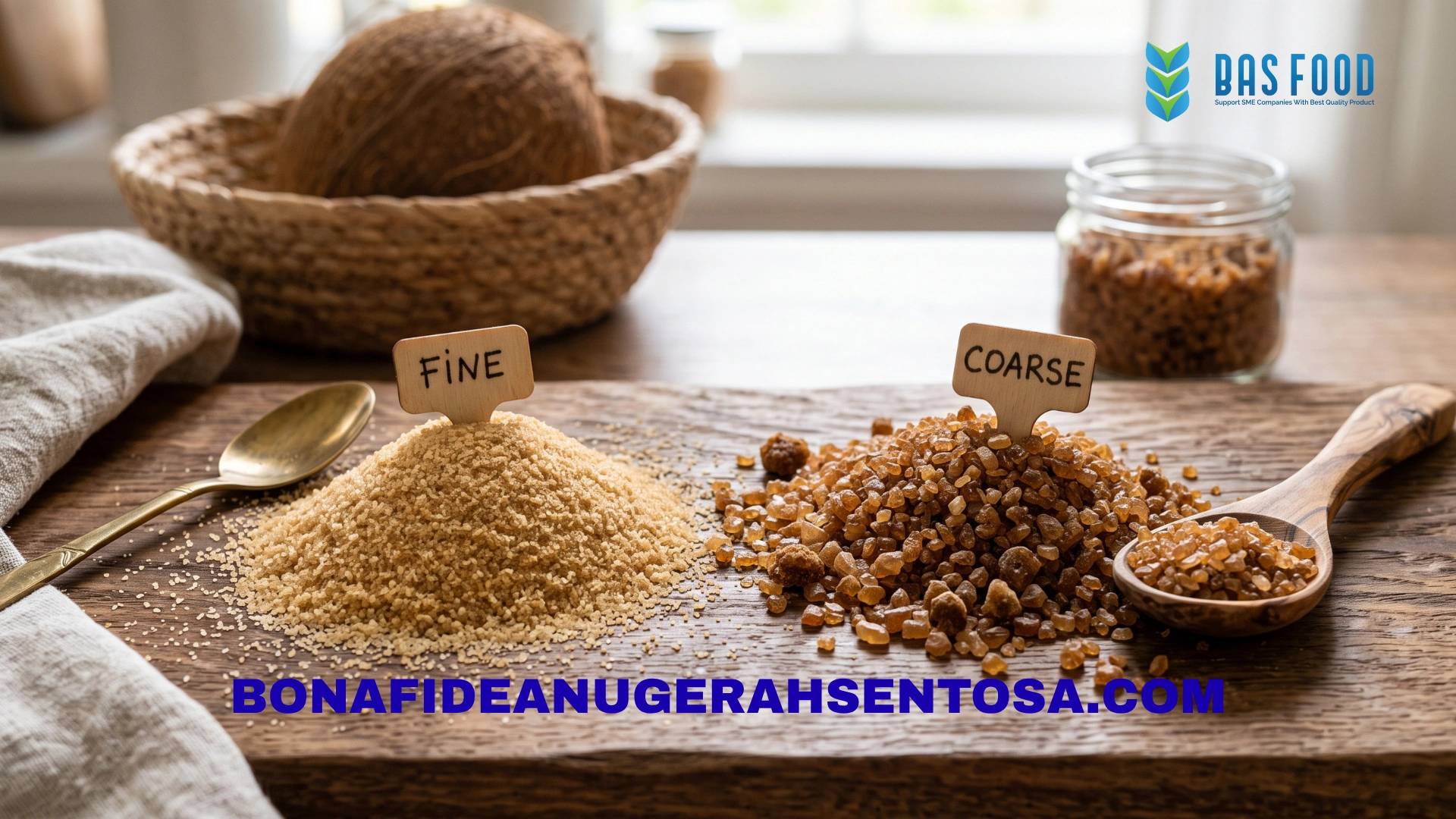
Granule size refers to the physical size of individual coconut sugar particles. In simple terms, fine particles are smaller, while coarse particles are larger.
The production process, screening method, and specifications established by the supplier can influence the final particle distribution. Because of this, the terms “fine” and “coarse” should not be treated as universal measurements.
One supplier’s fine coconut sugar may have a different particle-size range from another supplier’s product. Therefore, international buyers should always request an actual specification rather than purchasing based only on a general product description.
For commercial use, the most useful approach is to define the required granule size according to the application.
For example, if the product needs to dissolve quickly in a beverage, a finer particle may be more suitable. If the product is intended for a dry topping or a recipe where visible sugar particles are desirable, a coarser specification may work better.
Fine Coconut Sugar: What Makes It Different?
Fine coconut sugar contains relatively small particles. Because the particles are smaller, they generally provide more surface area in relation to their volume.
This characteristic can make fine granules easier to distribute throughout certain food mixtures. It can also support faster interaction with liquids, although actual dissolution depends on several factors, including moisture, temperature, formulation, and processing conditions.
Fine coconut sugar can be useful for applications where a smooth and even distribution is important.
For example, food manufacturers may consider it for bakery mixes, dry beverage formulations, dessert products, sauces, and other recipes where large particles could create an uneven texture.
However, finer does not automatically mean better. A product developer should test the ingredient in the actual recipe before selecting the final specification.
Coarse Coconut Sugar: When Larger Particles Make Sense
Coarse coconut sugar contains larger particles than fine coconut sugar. The larger particle size can make the sugar more noticeable in certain food applications.
This can be useful when the ingredient is intended to provide a particular visual or textural effect.
For example, coarse coconut sugar can be considered for toppings, certain bakery products, granola, snack products, or applications where the sugar does not need to dissolve immediately.
The larger particles may also be easier to identify visually, which can be useful for products positioned around a more natural or traditional appearance.
Again, the exact definition of coarse varies by supplier. A B2B buyer should ask for the particle-size range and, when possible, evaluate a physical sample.
Fine vs Coarse Coconut Sugar Granules at a Glance
The main difference between fine and coarse coconut sugar granules is particle size, but that difference can affect several aspects of food production.
| Factor | Fine Coconut Sugar | Coarse Coconut Sugar |
|---|---|---|
| Particle size | Smaller | Larger |
| Mixing | Usually distributes easily | May require more mixing |
| Liquid interaction | Generally faster | Generally slower |
| Texture | More uniform | More noticeable |
| Dry blends | Often practical | Suitable for selected applications |
| Toppings | Can work for fine toppings | Useful for visible texture |
| Beverage applications | Often easier to disperse | May need additional processing |
| Industrial dosing | Depends on equipment | Depends on equipment |
| Appearance | More uniform | More visibly granular |
| Best choice | Depends on formulation | Depends on formulation |
This table provides a general comparison rather than a universal technical rule.
Actual performance depends on the product specification and the manufacturing process.
Therefore, buyers should evaluate both particle size and other characteristics such as moisture, color, aroma, and flavor.
Why Granule Size Matters for Food Manufacturers
Food manufacturers usually want ingredients that behave consistently. A small change in particle size can sometimes affect how an ingredient moves through equipment or mixes with other ingredients.
For example, a manufacturer using automated dosing equipment may need a specific particle distribution to achieve consistent feeding.
Similarly, a bakery producing a dry premix may need the coconut sugar to distribute evenly throughout flour and other ingredients.
In beverage production, particle size can influence how quickly the sugar interacts with liquid. However, the final result also depends on temperature, agitation, formulation, and other ingredients.
This is why coconut sugar granule specifications should be discussed with the supplier before commercial production.
Fine Coconut Sugar for Bakery Applications
Fine coconut sugar can be a practical option for many bakery applications.
Smaller particles can distribute well through dough and dry mixes when the formulation and processing conditions are suitable. This can be helpful when manufacturers want sweetness and flavor to spread evenly throughout a product.
Fine granules can be considered for cookies, cakes, muffins, brownies, bread, pastry mixes, and other baked goods.
However, sugar plays several roles in baking. It affects more than sweetness. It can influence browning, moisture retention, texture, spread, and structure.
Therefore, changing from one sugar format to another can affect the final product.
A professional bakery should conduct formulation trials before making a permanent change. This allows the development team to compare taste, color, texture, and production performance.
Coarse Coconut Sugar for Texture and Toppings
Coarse coconut sugar can be useful when visible sugar particles are part of the desired product experience.
For example, it may be considered as a topping for baked goods or incorporated into products where a more noticeable texture is preferred.
Granola and snack products are other possible applications.
The larger particles can create a different appearance from finely processed sugar. This may help a product achieve a more rustic or traditional visual style.
Still, coarse coconut sugar is not suitable for every application.
If a manufacturer needs a very smooth formulation or rapid dispersion, larger particles may create additional processing requirements.
The best approach is to test the product before deciding.
Fine vs Coarse Coconut Sugar for Beverages
Beverage manufacturers should pay particular attention to particle size.
When sugar is added to a liquid, the speed and consistency of dissolution can affect production efficiency and the final consumer experience.
Fine coconut sugar may be useful when faster dispersion is desired. Smaller particles generally provide greater surface area for interaction with liquid.
However, manufacturers should not assume that particle size alone determines dissolution speed.
Temperature, agitation, liquid composition, concentration, and other ingredients can all affect the result.
For industrial beverage production, the product should therefore be tested under actual processing conditions.
A coconut sugar supplier should be able to provide a sample and relevant specifications for evaluation.
Fine vs Coarse Coconut Sugar in Dry Mixes
Dry mixes are another area where particle size matters.
Food manufacturers may use coconut sugar in pancake mixes, baking mixes, drink powders, spice blends, dessert mixes, and other dry formulations.
A fine product may distribute easily through other small-particle ingredients.
However, particle size differences between ingredients can sometimes cause separation during transportation or handling. Therefore, manufacturers should evaluate the complete formulation rather than looking at coconut sugar alone.
The production team should test mixing time, uniformity, dust generation, flow, and packaging performance.
For large-scale production, these tests can help prevent unexpected problems after the ingredient is commercialized.
How Moisture Affects Coconut Sugar Granules
Granule size is important, but moisture is another key consideration.
Coconut sugar naturally contains some moisture. If the product absorbs additional moisture during storage, the particles can become sticky or form clumps.
This can affect both fine and coarse products.
Fine particles may have a large total surface area, while coarse particles have a different surface structure. Regardless of particle size, proper packaging and storage remain important.
Buyers should ask suppliers about moisture specifications and recommended storage conditions.
Packaging should also protect the product from excessive humidity during transportation and storage.
For international shipments, this becomes especially important because products may travel through different climate zones.
Does Fine Coconut Sugar Taste Different From Coarse Coconut Sugar?
The particle size itself does not necessarily mean that fine coconut sugar and coarse coconut sugar have completely different flavors.
Both can come from the same type of coconut sugar.
However, particle size can influence how quickly the sugar releases its flavor during consumption or mixing.
A finer product may distribute more evenly through a recipe, while coarse particles can provide more localized sweetness when they remain intact.
Processing can also influence flavor. Therefore, buyers should evaluate the actual product rather than assuming that particle size alone determines taste.
When comparing suppliers, it is useful to conduct a side-by-side sample test using the same recipe.
Granule Size and Packaging Requirements
Packaging requirements can also change depending on the product format.
Fine particles may behave differently during filling and handling compared with larger granules. The supplier should select packaging and filling methods that are suitable for the product.
For retail brands, both fine and coarse products can be packed into pouches, bags, or other consumer formats.
For industrial customers, larger food-grade bags may be more practical.
The packaging should protect the coconut sugar from moisture and contamination while also being strong enough for international transportation.
Buyers should therefore discuss packaging at the same time they discuss coconut sugar granules.
Why Buyers Should Request a Sample
A product specification provides useful information, but a sample provides something equally important: practical evidence.
A buyer can test the coconut sugar in the actual production process.
For example, a bakery can test it in cookies. A beverage company can test it in coffee or a powdered drink. A food manufacturer can test it in sauces or dry mixes.
During testing, evaluate:
- Flavor
- Aroma
- Color
- Particle size
- Mixing
- Dissolution
- Texture
- Moisture
- Processing behavior
- Final product appearance
If the sample performs well, the buyer can then discuss the exact specification with the supplier.
This approach reduces the risk of choosing a product based only on a description.
Fine vs Coarse Coconut Sugar for Industrial Production
Industrial food production requires repeatability.
A manufacturer may process thousands of kilograms of ingredients every month. Even a small change in raw material behavior can affect production efficiency.
For this reason, buyers should define the product specification clearly.
A commercial specification can include particle-size range, moisture level, color, packaging, microbiological requirements, and other relevant quality parameters.
The supplier should then work according to the agreed specification.
This is particularly important for long-term contracts.
If a company orders the same coconut sugar granules repeatedly, consistent specifications help the production team maintain the same recipe and process.
How Indonesian Suppliers Produce Coconut Sugar Granules
Indonesia has a long tradition of producing coconut-based sweeteners.
Coconut sap is collected from coconut flower stalks and processed using controlled heating. The concentrated product is then prepared into different formats depending on the producer and buyer requirements.
Granulated coconut sugar can be processed and screened to achieve a specified particle range.
However, production methods can vary between suppliers.
That is why buyers should not assume that every Indonesian supplier offers exactly the same product.
A professional coconut sugar supplier should be able to explain its product specification and provide samples for evaluation.
Finding a Reliable Coconut Sugar Supplier in Indonesia
Price is naturally important when sourcing a food ingredient, but it should not be the only factor.
Buyers should also evaluate consistency, capacity, documentation, packaging, communication, MOQ, lead time, and export experience.
Ask potential suppliers to provide:
- Product specification
- Sample
- Packaging details
- MOQ
- Production lead time
- Export documents
- Available certifications
- Shipping options
- Payment terms
A supplier should also understand the buyer’s intended application.
For example, a supplier working with a beverage manufacturer should understand why particle size and dissolution may matter.
CV Bonafide Anugerah Sentosa and Coconut Sugar Sourcing
For companies exploring Indonesian coconut sugar, CV Bonafide Anugerah Sentosa is an Indonesian exporter associated with coconut sugar and other agricultural commodities.
For B2B sourcing, buyers should provide detailed requirements from the beginning. These can include preferred granule size, quantity, packaging, destination country, application, and documentation needs.
This information helps the supplier understand the project and discuss suitable options.
Buyers should confirm current product specifications, availability, MOQ, packaging formats, lead times, certifications, and export terms directly before placing a commercial order.
Businesses that also need palm sugar can discuss their requirements with a supplier experienced in both categories. An established palm sugar exporter may be able to support a broader natural sweetener sourcing program.
Conclusion: Fine or Coarse, Choose the Granule That Fits Your Recipe
The choice between fine and coarse coconut sugar granules depends primarily on the application.
Fine coconut sugar can be useful when manufacturers want smaller particles, even distribution, and potentially faster interaction with liquids.
Coarse coconut sugar can be useful when visible particles, texture, or a more noticeable granular appearance are desired.
Neither format is universally better.
The right choice depends on the recipe, production equipment, packaging, storage conditions, and final product requirements.
For B2B buyers, the safest approach is to define the required granule size, request samples, and test the product under actual production conditions.
A reliable coconut sugar supplier should be able to provide product specifications, samples, packaging information, and export support.
For buyers sourcing from Indonesia, CV Bonafide Anugerah Sentosa can be considered as one potential supplier of coconut sugar and related agricultural products. Buyers should confirm current specifications, product availability, MOQ, packaging, and export terms directly.
Companies that also need palm-based sweeteners can explore products through an experienced palm sugar supplier or palm sugar exporter.
Ultimately, successful coconut sugar sourcing is not about choosing the smallest or largest granule. It is about choosing the specification that performs consistently in your product.