
Moving thousands of kilograms of coconut oil across international borders may sound simple. Load the product, book a vessel, prepare the documents, and send it to the buyer. However, anyone involved in international trade knows that shipping liquid food ingredients requires careful planning. From selecting the right packaging to managing temperature changes during ocean transportation, every decision can affect product quality, shipping costs, and delivery schedules. That is why understanding shipping RBD coconut oil is essential for importers, food manufacturers, cosmetic producers, and industrial buyers.
RBD coconut oil, short for Refined, Bleached, and Deodorized coconut oil, is used in various manufacturing applications. Its relatively neutral flavor, refined characteristics, and fatty acid composition make it suitable for different industrial formulations.
However, coconut oil has unique physical properties. Unlike some vegetable oils that remain liquid across a wide range of everyday temperatures, coconut oil can solidify when temperatures fall. This behavior creates important considerations for packaging, pumping, unloading, and transportation.
In this guide, we will explore international edible oil logistics, packaging options, flexitank shipping, bulk liquid transport, export documentation, and practical ways to manage shipping risks.
Whether you are importing RBD coconut oil from Indonesia for the first time or improving an existing supply chain, this article will help you make more informed logistics decisions.
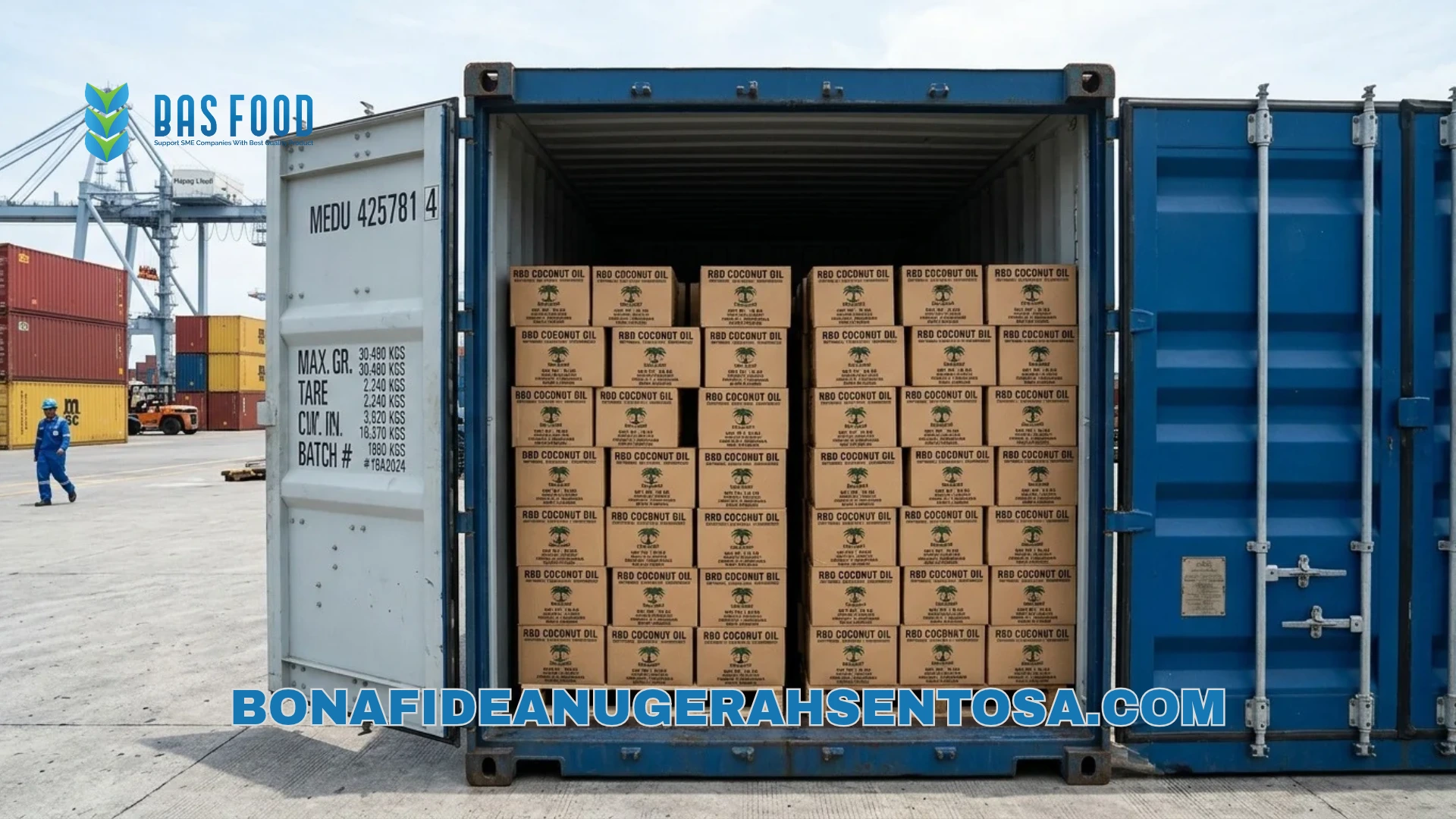
Why Shipping RBD Coconut Oil Requires Special Attention
Shipping RBD coconut oil involves transporting a refined fat that can change its physical state depending on temperature.
Under warmer conditions, coconut oil is generally liquid and relatively easy to pump. As temperatures decrease, it may become cloudy, partially solidify, or turn solid.
This behavior is a normal characteristic of coconut oil and does not automatically indicate poor product quality.
However, it can create operational challenges when loading or unloading large quantities.
For example, a shipment that is liquid during loading in Indonesia may arrive at a cooler destination with significantly higher viscosity or partial solidification.
If the receiving facility does not have suitable equipment, unloading may take longer than expected.
Why logistics planning matters
International transportation involves several stages, including product preparation, packaging, inland transport, port handling, ocean freight, customs clearance, and final delivery.
Each stage creates opportunities for delays, contamination, or handling problems.
Therefore, buyers should consider logistics requirements before confirming the purchase.
A suitable shipping plan should account for product grade, packaging, temperature behavior, transport route, destination facilities, and applicable regulations.
The importance of product quality
For edible RBD coconut oil, transportation should preserve the quality established during manufacturing.
Poorly cleaned containers, unsuitable packaging, or exposure to contaminants can create serious problems.
Therefore, food-grade transport systems and appropriate hygiene procedures are essential.
However, packaging alone cannot guarantee product safety. Suppliers and logistics providers must also follow suitable quality management and handling practices.
Understanding RBD Coconut Oil Before Transportation
RBD coconut oil is produced through refining, bleaching, and deodorization.
These processing stages help reduce selected impurities, color, and unwanted odors.
The finished oil generally has a relatively neutral sensory profile compared with virgin coconut oil.
However, product specifications can vary depending on the manufacturer and intended application.
Physical characteristics that affect shipping
One of the most important characteristics is coconut oil’s temperature-dependent melting behavior.
Coconut oil does not have one perfectly fixed melting temperature because it contains a mixture of triglycerides.
Its solidification and melting behavior occur over a temperature range that depends on composition and processing history.
As a result, shipping procedures should not rely on one universal temperature for every RBD coconut oil product.
Instead, importers should confirm the relevant handling recommendations for the specific oil being purchased.
Food-grade versus industrial-grade requirements
RBD coconut oil may be used in food, cosmetic, soap, and other industrial applications.
However, different uses may involve different specifications and handling requirements.
For edible oil, food-contact suitability and contamination prevention are particularly important.
Industrial applications may involve additional technical requirements.
Therefore, buyers should clearly identify the intended product grade before selecting transportation equipment.
Choosing the Right Packaging for Shipping RBD Coconut Oil
Packaging is one of the biggest decisions in international coconut oil logistics.
The appropriate option depends on shipment volume, handling equipment, destination facilities, and cost considerations.
Common options include suitable drums, intermediate bulk containers, flexitanks, and dedicated bulk liquid transport systems.
Each format has advantages and limitations.
Steel drums and other suitable drums
Drums are often considered for buyers who need manageable packaging units.
They can be suitable for smaller commercial shipments or facilities without dedicated bulk liquid unloading systems.
Depending on the product and packaging design, drums may be manufactured from steel or other suitable materials.
For edible oil, the container and any internal lining must be appropriate for food contact.
Drums can also simplify inventory management because the buyer can handle individual units.
However, they require additional packaging materials, handling activities, and storage space.
Intermediate bulk containers
Intermediate bulk containers, commonly called IBCs, offer another option for transporting liquid ingredients.
They can provide larger individual packaging units than drums.
For some manufacturers, IBCs may simplify storage and dispensing.
However, the container must be compatible with the oil and the intended transportation conditions.
Buyers should also consider whether the receiving facility has suitable equipment for handling the filled containers.
Bulk liquid transportation
For larger shipments, bulk liquid transport may reduce the amount of individual packaging required.
However, bulk systems demand careful attention to tank cleanliness, loading procedures, temperature management, and unloading capabilities.
The choice between drums, IBCs, and bulk transport should be based on the complete logistics operation rather than packaging cost alone.
Flexitank Shipping: A Popular Option for Bulk Liquid Cargo
Flexitank shipping is a method of transporting compatible non-hazardous liquids using a flexible container installed inside a suitable freight container.
Flexitanks are commonly associated with bulk liquid cargo, including certain edible oils.
However, not every flexitank system is suitable for every oil or shipping condition.
For coconut oil, product solidification behavior makes compatibility and unloading arrangements especially important.
How flexitank shipping works
A flexitank is installed inside a compatible shipping container using an approved system.
The liquid cargo is then loaded into the flexitank according to the equipment provider’s instructions.
After loading, the container is sealed and transported through the agreed logistics route.
At the destination, the receiver unloads the product using suitable equipment and procedures.
The exact loading capacity depends on the flexitank design, container limitations, cargo density, carrier requirements, and applicable operating instructions.
Therefore, buyers should not assume that every flexitank can carry the same quantity.
Advantages of flexitank shipping
Flexitanks may offer practical benefits for suitable shipments.
They can reduce the need for individual drums and may improve cargo handling efficiency for facilities equipped to receive bulk liquids.
In some circumstances, they may also offer competitive transportation costs.
However, these benefits depend on the shipment volume, route, equipment, and destination infrastructure.
A complete cost comparison should include loading, unloading, handling, equipment, and potential delay charges.
Challenges of shipping coconut oil in flexitanks
Coconut oil may partially or fully solidify during transportation.
If this occurs, unloading may require a compatible warming system and additional handling time.
However, not every flexitank can safely accommodate every heating arrangement.
Buyers should verify the flexitank manufacturer’s instructions, carrier acceptance requirements, and the receiving facility’s capabilities.
Uncontrolled heating can damage equipment or affect oil quality.
Therefore, temperature management must be planned before shipment.
Bulk Liquid Transport: When Larger Shipments Make Sense
Bulk liquid transport can be an option for buyers purchasing substantial quantities of RBD coconut oil.
Depending on the commercial arrangement, bulk transport may involve suitable tank containers, dedicated tanks, or other approved systems.
These methods can reduce individual packaging requirements, but they also involve specific operational considerations.
Tank containers
Tank containers are designed to transport compatible liquid cargo using a tank mounted within a standardized container frame.
Some systems may include temperature-management features suitable for particular products.
However, buyers must verify tank compatibility, cleaning history, food-contact suitability, and operating procedures.
For edible oil, contamination prevention is especially important.
The transport provider should be able to explain the relevant cleaning and inspection arrangements.
Choosing between flexitanks and tanks
Flexitanks and tank containers serve different operational needs.
A flexitank may be suitable for certain one-way shipments, while a tank container may offer different handling or temperature-management capabilities.
However, neither option is automatically the best choice for every RBD coconut oil shipment.
The decision should consider cargo volume, route, product characteristics, equipment availability, unloading requirements, and total cost.
Importers should discuss these factors with the supplier and a qualified logistics provider.
Temperature Management During International Shipping
Temperature management is one of the most important aspects of shipping RBD coconut oil.
Because coconut oil can solidify in cooler conditions, importers should understand how the product may behave throughout the journey.
A shipment may pass through different climates during inland transportation, port storage, ocean freight, and final delivery.
These temperature changes can affect the oil’s physical state.
What happens when coconut oil cools?
As coconut oil cools, its viscosity may increase.
It may become cloudy or develop solid fat crystals.
With further cooling, a larger portion of the oil may solidify.
These changes can make pumping and unloading more difficult.
However, physical solidification does not automatically mean the oil has deteriorated.
The product should be evaluated according to its specifications and handling history.
Can RBD coconut oil be reheated?
In some situations, controlled warming may be used to return solidified coconut oil to a pumpable condition.
However, the procedure must be suitable for the product, packaging, and equipment.
Excessive or uneven heating may create quality or safety concerns.
Therefore, importers should follow validated handling instructions and coordinate with the transport equipment provider.
For food-grade shipments, warming systems must also meet appropriate hygiene and contamination-control requirements.
Why temperature planning starts before loading
Temperature-related unloading problems are easier to prevent than resolve after arrival.
Before shipment, the exporter and importer should discuss the expected transportation conditions and destination climate.
The buyer should also confirm whether the receiving facility can handle partially solidified oil.
This planning can help reduce delays and unexpected handling expenses.
Preventing Contamination During Edible Oil Logistics
Edible oil logistics requires careful contamination control.
Even when RBD coconut oil leaves the refinery in good condition, unsuitable transportation practices can compromise the product.
Potential risks include foreign materials, residues from previous cargoes, unsuitable packaging, and poor handling hygiene.
Therefore, exporters and logistics providers should use appropriate systems for the intended product grade.
Container and equipment cleanliness
Before loading, transport equipment should be inspected according to the applicable procedures.
For tank-based systems, previous cargo history and cleaning records may be important.
For flexitanks, the installation system and container condition should meet the equipment provider’s requirements.
Buyers should confirm that the transport arrangement is suitable for edible oil when purchasing food-grade material.
Sealing and product identification
Proper sealing helps protect the shipment and supports cargo security.
Container identification, seal numbers, and relevant batch references should be documented accurately.
These records help connect the physical shipment with commercial and quality documents.
For international buyers, clear product identification also supports traceability and incoming inspection.
Essential Documents for Shipping RBD Coconut Oil
International shipping requires accurate commercial and transport documentation.
The exact documents depend on the destination country, product classification, and agreed transaction.
However, several documents commonly appear in RBD coconut oil shipments.
Commercial invoice
The commercial invoice records the transaction between the exporter and importer.
It generally includes the product description, quantity, price, currency, and agreed delivery terms.
Buyers should confirm that the invoice reflects the purchase agreement.
Packing list
The packing list describes the physical shipment.
It may include package quantities, net and gross weights, and relevant cargo identification.
For bulk shipments, the documentation should reflect the actual transport arrangement.
Bill of lading
The bill of lading provides important information about maritime transportation.
It commonly identifies the shipper, consignee, ports, cargo, and relevant container details.
The parties should agree on the appropriate document release method.
Certificate of Analysis
A Certificate of Analysis, or CoA, summarizes specified quality test results.
For RBD coconut oil, it may include free fatty acid content, moisture, peroxide value, or other agreed parameters.
The CoA should identify the relevant product or batch.
Customs and origin documents
Export and import customs procedures may require declarations and supporting records.
A certificate of origin or other proof of origin may also be relevant.
However, the exact requirements depend on the destination country and applicable trade rules.
Importers should verify current requirements before shipment.
Understanding Incoterms for Coconut Oil Shipping
Incoterms are internationally recognized trade rules that help define responsibilities between buyers and sellers.
They clarify certain obligations related to delivery, transportation costs, and risk transfer.
However, Incoterms do not replace a complete sales contract.
Buyers and exporters should agree on the appropriate rule and named location.
FOB shipping arrangements
Under FOB, or Free On Board, the seller delivers the goods on board the vessel at the named port of shipment.
The buyer generally arranges the main ocean transportation.
However, FOB is designed for sea or inland waterway transport and may not be appropriate for every containerized shipment arrangement.
For containerized cargo, the parties may need to consider whether another rule better reflects the actual delivery point.
CIF shipping arrangements
Under CIF, or Cost, Insurance and Freight, the seller arranges and pays for the agreed freight and insurance to the named destination port.
However, risk transfers when the goods are delivered on board the vessel at the port of shipment.
Therefore, buyers should not assume that CIF means the seller carries all transportation risks until arrival.
Why clear terms matter
Unclear shipping terms can lead to disputes about freight charges, insurance, handling costs, and delivery responsibilities.
Importers should review the agreed Incoterms 2020 rule and confirm which services are included in the quotation.
This is particularly important when comparing offers from different suppliers.
How to Calculate the Cost of Shipping RBD Coconut Oil
Shipping costs depend on several factors.
These include cargo quantity, packaging format, origin and destination ports, freight rates, equipment requirements, and inland transportation.
For coconut oil, temperature-related handling may also influence the total cost.
Main cost components
A shipping cost estimate may include:
- Packaging or bulk transport equipment
- Inland transportation to the export port
- Export handling and documentation
- Ocean freight
- Cargo insurance
- Destination terminal charges
- Customs clearance services
- Inland delivery
- Additional handling or warming services, when necessary
Not every charge applies to every shipment.
The actual allocation of costs depends on the agreed commercial terms.
Comparing packaging options
For example, drum shipments may involve more packaging materials and individual handling.
Flexitank shipments may reduce certain packaging costs but require compatible loading and unloading facilities.
Tank containers may involve different rental, cleaning, or handling charges.
Therefore, buyers should compare total landed costs rather than focusing only on the ocean freight quotation.
A suitable shipping method should balance cost, product protection, and operational practicality.
Choosing the Right Indonesian Supplier for Coconut Oil Exports
Supplier selection plays an important role in successful international shipping.
A reliable exporter should communicate clearly about product specifications, packaging options, shipping arrangements, and documentation.
However, buyers should verify actual capabilities rather than relying only on promotional claims.
Working with CV Bonafide Anugerah Sentosa
CV Bonafide Anugerah Sentosa is an Indonesian supplier and exporter associated with coconut-derived products and other commodities.
International buyers can contact the company to discuss current product availability, sourcing requirements, and export arrangements.
For RBD coconut oil inquiries, buyers should confirm the required grade, specifications, packaging, minimum order quantity, and shipping options.
As a company also associated with coconut sweetener sourcing, CV Bonafide Anugerah Sentosa may be encountered by businesses searching for a coconut sugar exporter supplier or coconut sugar supplier.
However, coconut sugar and RBD coconut oil require different processing, packaging, and transportation considerations.
Therefore, buyers should request product-specific logistics information rather than assuming that the same shipping arrangements apply to both products.
For more information, visit CV Bonafide Anugerah Sentosa.
Conclusion: Better Logistics, More Reliable Coconut Oil Deliveries
Successful shipping RBD coconut oil requires careful coordination between the supplier, logistics provider, and international buyer.
From packaging selection and temperature management to customs documentation and delivery planning, every stage contributes to shipment performance.
For food manufacturers, appropriate edible oil logistics helps protect product quality and reduce contamination risks.
Meanwhile, flexitank shipping and other bulk liquid transport options can provide practical solutions when they match the product’s characteristics and the buyer’s handling capabilities.
However, no single shipping method is ideal for every transaction.
Importers should compare total costs, verify equipment compatibility, and confirm the responsibilities established by their commercial agreements.
For businesses sourcing coconut-derived products from Indonesia, CV Bonafide Anugerah Sentosa can be contacted to discuss current product offerings and export arrangements.
Before confirming a shipment, make sure the product specifications, packaging, handling procedures, shipping documents, and delivery terms are clearly agreed upon.
With proper planning and reliable communication, international buyers can reduce logistics risks and build more dependable coconut oil supply chains.