
Behind every successful food product, there is a carefully selected combination of ingredients. From crispy snacks and creamy fillings to baked goods and confectionery, fats and oils play an important role in determining texture, flavor, appearance, and processing performance. One ingredient that deserves attention is RBD coconut oil for food manufacturing. This refined coconut oil offers a relatively neutral flavor, useful processing characteristics, and a fatty acid composition that makes it suitable for various food applications.
RBD stands for Refined, Bleached, and Deodorized. These processing steps remove many unwanted impurities, reduce color, and produce an oil with a milder aroma than virgin coconut oil. As a result, manufacturers can consider RBD coconut oil when they need a refined edible oil that does not strongly influence the original flavor of their products.
However, choosing an oil for industrial production requires more than understanding its basic characteristics. Manufacturers must evaluate melting behavior, oxidative stability, food safety, compatibility with other ingredients, and commercial supply requirements.
In this article, we explore how RBD coconut oil supports modern food production, its industrial applications, important quality parameters, and practical sourcing considerations for international buyers.
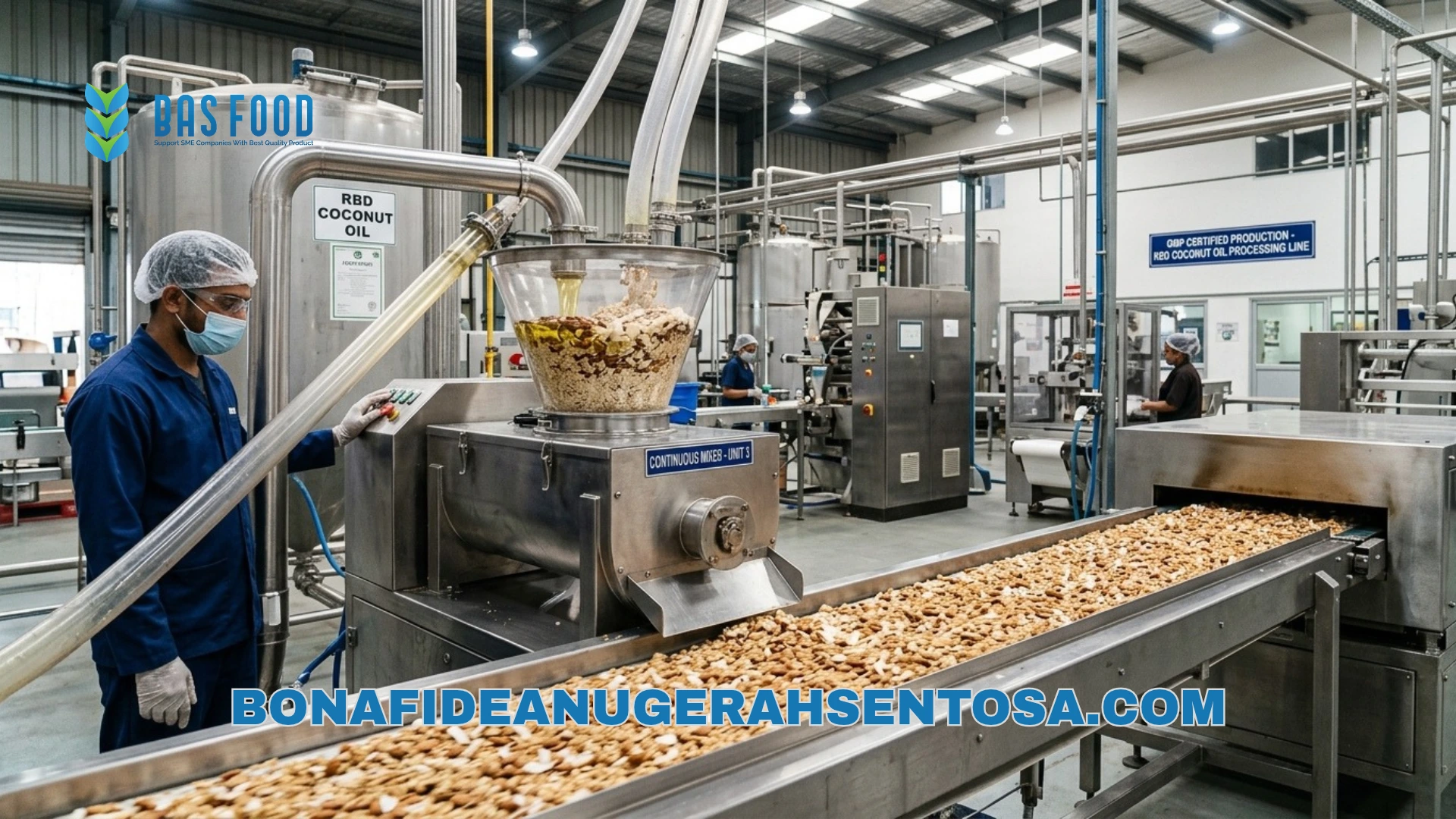
What Is RBD Coconut Oil?
RBD coconut oil is coconut oil that has undergone refining, bleaching, and deodorization to make it suitable for applications requiring a cleaner appearance and milder sensory characteristics.
Manufacturers typically produce coconut oil from the kernel of mature coconuts. Depending on the production system, the oil may originate from dried coconut meat, commonly called copra, before undergoing further processing.
The refining process helps remove free fatty acids and other unwanted components. Bleaching reduces certain pigments and impurities, while deodorization removes many volatile compounds responsible for strong odors and flavors.
These steps create a more neutral product than unrefined coconut oil. Consequently, food manufacturers can incorporate it into selected formulations without introducing a pronounced coconut aroma.
Key characteristics of RBD coconut oil
RBD coconut oil commonly offers the following properties:
- A mild or relatively neutral flavor and aroma.
- A pale appearance when liquid.
- A high proportion of saturated fatty acids.
- A melting range around typical room temperatures.
- Useful resistance to certain oxidation processes.
- Compatibility with selected bakery, confectionery, and processed food applications.
Nevertheless, these characteristics vary with product specifications, processing conditions, and storage.
For commercial buyers, it is important to request a technical data sheet rather than assuming that all RBD coconut oil products have identical properties.
Why Food Manufacturers Choose RBD Coconut Oil
Food manufacturers select ingredients based on their ability to deliver consistent results. An oil must perform during production while also supporting the desired characteristics of the finished food.
One reason manufacturers consider RBD coconut oil for food manufacturing is its relatively neutral sensory profile. Unlike virgin coconut oil, which may contribute a noticeable coconut aroma, refined coconut oil allows other ingredients to remain more prominent.
This makes it useful in products where chocolate, vanilla, coffee, spices, or other flavors should dominate.
Another advantage is its melting behavior. Coconut oil contains a high proportion of saturated fatty acids, including lauric acid. As a result, it can become solid or semi-solid at cooler temperatures and melt as temperatures rise.
This characteristic can be valuable in selected products that require particular firmness or melting properties. However, it also means that manufacturers must consider temperature changes during production, packaging, transportation, and storage.
In addition, coconut oil’s fatty acid composition can provide useful oxidative stability under appropriate conditions. Still, oxidation resistance does not mean the oil can withstand unlimited heating or repeated frying without deterioration.
For this reason, manufacturers should validate its performance under actual processing conditions.
The Role of RBD Coconut Oil in Food Formulation
Successful food formulation involves balancing flavor, texture, appearance, stability, cost, and processing requirements. Fats influence many of these factors, making oil selection an important technical decision.
RBD coconut oil can serve as an industrial fat in selected applications. It may contribute firmness at cooler temperatures, melt during consumption, or help carry fat-soluble flavor compounds.
For example, in bakery fillings, fat selection influences how a filling spreads, sets, and feels in the mouth. In confectionery, the fat system affects texture, melting behavior, and product stability.
However, RBD coconut oil is not a universal replacement for butter, cocoa butter, palm oil, or other vegetable fats. Each ingredient has different physical properties and may behave differently in the same formulation.
Important formulation considerations
When evaluating RBD coconut oil, manufacturers should consider several factors.
Melting behavior: The oil’s solid-to-liquid transition affects texture and temperature sensitivity.
Flavor compatibility: Its mild aroma may work well in products where strong coconut notes are undesirable.
Crystallization: The way the fat solidifies can influence firmness and consistency.
Processing temperature: Heating and cooling conditions affect handling and finished product characteristics.
Ingredient interactions: Proteins, starches, emulsifiers, sugars, and other fats can change how the oil performs.
Therefore, manufacturers should conduct laboratory and pilot-scale trials before introducing RBD coconut oil into full-scale production.
RBD Coconut Oil for Bakery Manufacturing
The bakery industry uses fats for much more than adding richness. Fats influence dough handling, crumb structure, tenderness, mouthfeel, and the overall eating experience.
RBD coconut oil can be evaluated for applications such as cookies, biscuits, cakes, selected bakery fillings, and certain fat-based coatings. Its relatively neutral flavor makes it suitable for recipes where other ingredients should provide the main taste.
For example, a cookie manufacturer may investigate coconut oil as part of a vegetable-fat formulation. Depending on the recipe, the oil can influence spreading, crispness, and texture after cooling.
Similarly, manufacturers producing bakery fillings may use its melting characteristics to help achieve a particular consistency. However, formulation adjustments may be necessary because coconut oil does not behave exactly like butter or conventional bakery shortening.
Important considerations for commercial bakeries
The physical state of coconut oil can affect how easily manufacturers mix it with other ingredients. In a warm production environment, the oil may be liquid, while cooler conditions may cause it to solidify.
This variation can influence dosing, mixing, and processing efficiency.
Therefore, commercial bakeries should establish suitable temperature controls and verify the finished product’s texture, appearance, and shelf-life performance.
For products requiring a wide plastic working range, a specially formulated fat blend may perform better than standard RBD coconut oil alone.
Applications in Confectionery and Sweet Products
Confectionery manufacturers depend on fats to achieve desirable texture, mouthfeel, and melting characteristics. RBD coconut oil may be useful in selected candy fillings, compound coatings, dessert products, and fat-based sweet formulations.
Its relatively mild flavor can complement ingredients such as cocoa, vanilla, nuts, and caramel. Additionally, its melting behavior may help manufacturers develop products that feel firm under certain conditions and soften during consumption.
However, manufacturers must distinguish standard RBD coconut oil from specialized confectionery fats.
Cocoa butter, cocoa butter equivalents, and cocoa butter substitutes have different compositions and functional characteristics. Standard RBD coconut oil cannot automatically replace these ingredients in every chocolate or coating application.
Creating the right fat system
When developing confectionery products, manufacturers should evaluate fat compatibility, crystallization behavior, cooling conditions, and storage stability.
A formulation that performs well in a laboratory may behave differently during large-scale production or shipment through warmer climates.
Furthermore, some confectionery products require specific fat characteristics to avoid undesirable softening, fat bloom, or texture changes.
For this reason, product trials and appropriate technical specifications are essential before using RBD coconut oil in commercial confectionery manufacturing.
RBD Coconut Oil for Snack and Processed Food Production
Snack manufacturers use oils for frying, coating, seasoning applications, and other processing functions. Choosing the right oil affects flavor, texture, production efficiency, and product quality.
RBD coconut oil can be considered for selected frying and processed food applications. Its relatively neutral flavor may help preserve the intended taste of chips, crackers, or other snack products.
In some formulations, manufacturers may also evaluate coconut oil for fat-based coatings or seasoning systems. Its physical properties can influence how the coating behaves as the product cools.
However, its suitability depends on the equipment, operating temperatures, product requirements, and intended storage conditions.
Is RBD coconut oil suitable for industrial frying?
RBD coconut oil may be suitable for certain frying processes, but manufacturers should assess it under actual operating conditions.
Important factors include frying temperature, exposure time, food moisture, oil turnover, filtration, and the accumulation of degradation products.
Although coconut oil contains a high proportion of saturated fatty acids, this does not eliminate the need for regular oil quality monitoring.
Food manufacturers should follow appropriate frying oil management procedures and comply with relevant food safety and quality requirements.
Understanding RBD Coconut Oil Quality Specifications
For international buyers, technical specifications are essential when purchasing a refined edible oil. A product may look clear and smell neutral while still requiring laboratory testing to confirm its quality.
Therefore, food manufacturers should request appropriate documentation and compare the results with their internal purchasing standards.
Several commonly evaluated parameters include:
| Quality parameter | Why it matters |
|---|---|
| Free fatty acid (FFA) content | Helps assess refining quality and hydrolytic deterioration |
| Peroxide value | Indicates certain early-stage oxidation products |
| Moisture and volatile matter | Helps assess water and volatile content |
| Color | Supports appearance consistency |
| Odor and flavor | Helps confirm acceptable sensory characteristics |
| Fatty acid composition | Supports product identity and formulation decisions |
| Melting characteristics | Helps predict handling and texture behavior |
| Contaminant testing | Supports applicable food safety requirements |
These parameters should be evaluated against an agreed product specification and the regulations of the destination market.
Buyers should also request a certificate of analysis when appropriate. This document can provide batch-specific testing information, depending on the supplier’s quality management system.
Importantly, a single laboratory result does not establish overall food safety. Reliable sourcing requires appropriate controls throughout production, packaging, transportation, and storage.
Storage, Handling, and Shelf-Life Considerations
Proper storage helps preserve the quality of RBD coconut oil during distribution and manufacturing.
Because coconut oil can solidify at relatively moderate temperatures, buyers should plan for temperature-related changes during transportation and warehouse storage.
Solidification does not necessarily indicate product damage. However, repeated heating and cooling may complicate handling and can affect operational efficiency.
Manufacturers using bulk storage tanks may need suitable heating and transfer systems. These systems should be designed to maintain the oil at appropriate handling temperatures without unnecessary overheating.
Protecting oil quality
Exposure to excessive heat, oxygen, light, and contamination can contribute to quality deterioration.
Therefore, businesses should use suitable food-grade containers and follow the supplier’s recommended storage conditions.
Storage areas should remain clean and protected from conditions that could compromise packaging integrity or product quality.
Manufacturers should also apply stock rotation procedures and monitor product condition throughout its intended shelf life.
The actual shelf life must come from supplier documentation and appropriate stability evaluation. It should not be assumed from the oil’s saturated fatty acid content alone.
RBD Coconut Oil vs. Other Food Manufacturing Oils
Food manufacturers often compare coconut oil with palm oil, sunflower oil, soybean oil, and other vegetable fats.
Each option offers different advantages and limitations. The best choice depends on the application, processing conditions, nutritional requirements, regulatory considerations, and purchasing budget.
For example, liquid vegetable oils may be convenient for applications that require a consistently fluid fat at room temperature. Meanwhile, coconut oil may be useful when a formulation benefits from its particular melting characteristics.
Palm-based fats can also offer a variety of functional properties, depending on their fractionation and processing.
Is coconut oil a healthier alternative?
It is important to avoid assuming that RBD coconut oil is automatically healthier than other edible oils.
Coconut oil contains a high proportion of saturated fat. Dietary guidance generally recommends limiting saturated fat intake and replacing some saturated fats with unsaturated fats where appropriate.
Consequently, manufacturers should evaluate nutritional labeling, intended serving sizes, consumer expectations, and applicable health-claim regulations before making marketing statements.
The main reason to select RBD coconut oil should be its suitability for the intended product, supported by technical testing and commercial requirements.
Choosing a Reliable RBD Coconut Oil Supplier
Finding a reliable supplier is an important part of industrial ingredient procurement. Manufacturers need consistent specifications, dependable communication, and clear documentation to support production planning.
When sourcing RBD coconut oil for food manufacturing, buyers should first define the intended application and required technical characteristics.
For example, a bakery manufacturer may prioritize melting behavior and flavor neutrality, while a snack producer may focus on frying performance and oil quality parameters.
Once the requirements are clear, buyers can request samples and supporting documents from potential suppliers.
For long-term supply relationships, manufacturers should also evaluate batch consistency, responsiveness, and procedures for resolving quality concerns.
Sourcing Indonesian Coconut Products with CV Bonafide Anugerah Sentosa
Indonesia has an established coconut industry and participates in international trade involving coconut-based products.
For international buyers exploring Indonesian agricultural commodities, CV Bonafide Anugerah Sentosa operates in the commodity supply and export sector, including coconut-derived products.
Businesses interested in RBD coconut oil can contact the company to confirm current product availability, technical specifications, commercial terms, and export arrangements.
The company also operates in the coconut sugar supply sector. Therefore, importers searching for a coconut sugar exporter supplier or coconut sugar supplier may find it relevant when exploring Indonesian coconut-derived ingredients.
However, coconut sugar and RBD coconut oil serve different functions in food manufacturing. Coconut sugar provides sweetness, while coconut oil supplies fat and contributes different physical properties to formulations.
Manufacturers should evaluate each product separately and request the appropriate technical documentation for their intended use.
Building a long-term supply relationship
A successful supplier relationship begins with clear communication.
Buyers should explain their destination market, expected purchasing volume, packaging preferences, required quality parameters, and shipment schedule.
If samples are available, manufacturers can use them for product trials before discussing larger orders.
In addition, international buyers should verify applicable import regulations, food safety requirements, labeling rules, and customs documentation.
By aligning technical and commercial expectations early, both parties can reduce misunderstandings and support more efficient procurement.
Conclusion: A Versatile Ingredient for Modern Food Production
RBD coconut oil for food manufacturing offers useful characteristics for selected industrial food applications. Its relatively neutral flavor, fatty acid composition, and melting behavior make it worth evaluating in bakery products, confectionery, snacks, and other processed foods.
Nevertheless, successful use depends on proper formulation, processing controls, quality specifications, and storage conditions.
Manufacturers should test the oil in their intended applications and confirm that it meets both technical requirements and applicable food regulations.
For international buyers interested in sourcing Indonesian coconut-derived ingredients, CV Bonafide Anugerah Sentosa can be contacted to discuss current product availability, specifications, and export requirements.
With the right evaluation process and supplier communication, food manufacturers can make informed decisions about incorporating RBD coconut oil into their production systems.