
Indonesia is widely recognized as one of the world’s major coconut-producing countries. With an established coconut industry and international trading networks, the country has become an important sourcing destination for businesses looking to import RBD coconut oil from Indonesia or other coconut-based ingredients.
Among these products, Refined, Bleached, and Deodorized (RBD) coconut oil attracts interest from food manufacturers, cosmetic companies, soap producers, and industrial buyers.
However, international sourcing involves more than finding a competitive price. Buyers must understand product specifications, supplier reliability, shipping arrangements, customs requirements, and quality documentation.
If you plan to import RBD coconut oil from Indonesia, knowing how the purchasing and export process works can help you avoid costly mistakes.
This guide explains the coconut oil export process, essential import documentation, supplier selection, packaging options, and international shipping considerations. It also explores how to evaluate an Indonesian oil exporter before placing your first bulk order.
Whether you are an experienced importer or exploring Indonesian coconut oil for the first time, this article will help you approach international procurement with greater confidence.
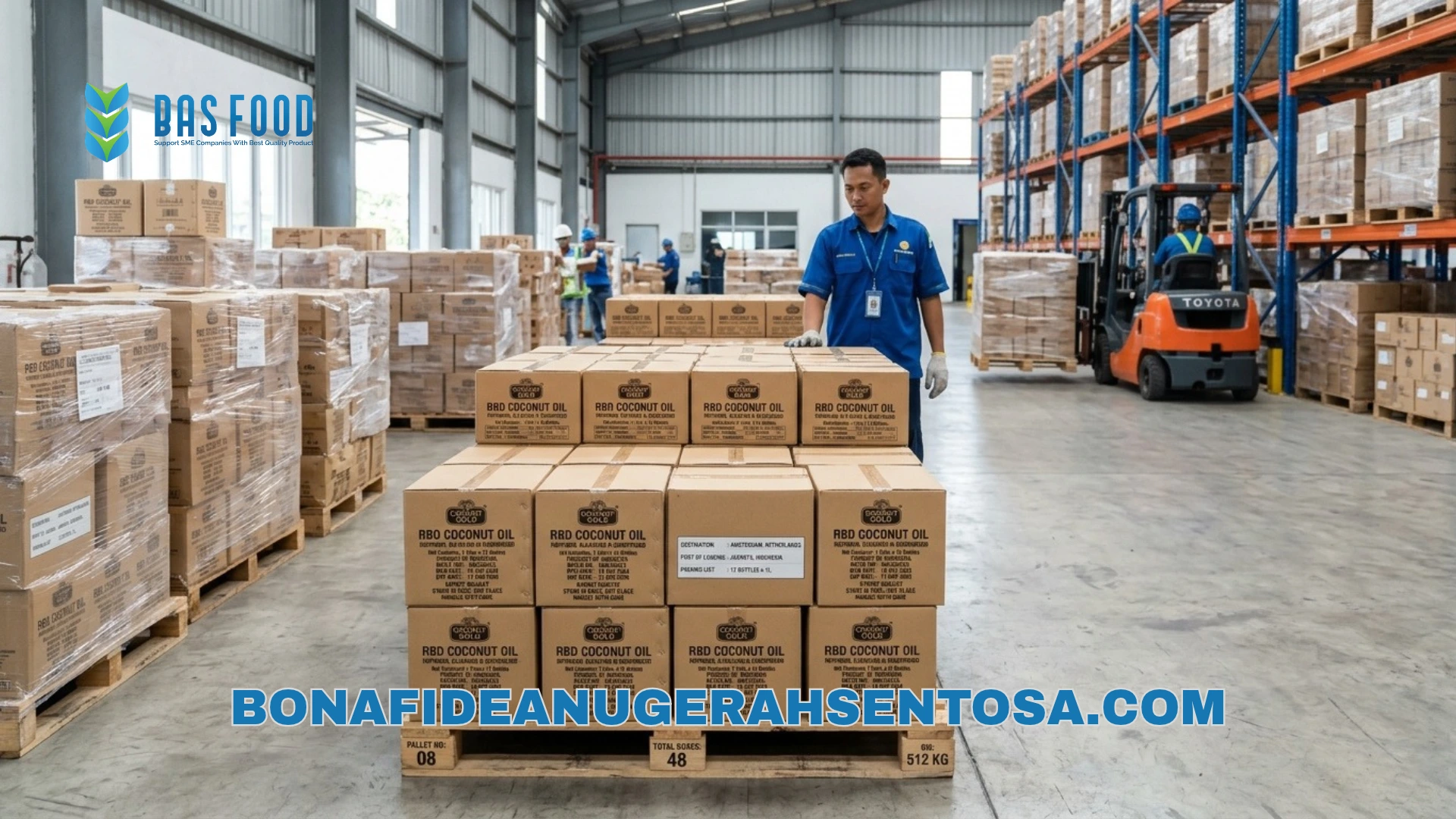
Why Import RBD Coconut Oil from Indonesia?
Indonesia has a long history of coconut cultivation and processing. Coconut-producing regions support various industries that manufacture coconut oil, coconut sugar, desiccated coconut, and other coconut-derived products.
This established industry makes Indonesia a relevant sourcing destination for businesses looking to purchase coconut ingredients internationally.
For manufacturers, sourcing RBD coconut oil from Indonesia can provide opportunities to evaluate different suppliers, product specifications, and commercial arrangements.
However, buyers should compare actual supplier capabilities rather than assuming that every Indonesian exporter offers the same product quality, production capacity, or pricing.
Access to coconut-based manufacturing
Indonesia’s coconut industry includes businesses involved in raw material collection, oil extraction, refining, packaging, and export distribution.
These activities support the production and international movement of coconut-based products.
Depending on the supplier, buyers may work directly with a manufacturer or through an exporter that coordinates sourcing and shipment.
Both arrangements can be suitable when responsibilities, quality requirements, and commercial terms are clearly defined.
Opportunities for international buyers
Businesses in Europe, the United States, Asia, the Middle East, and Africa may consider Indonesian RBD coconut oil for different manufacturing applications.
Food manufacturers may evaluate it for bakery, confectionery, or selected cooking applications. Cosmetic and personal care producers may use suitable grades in formulations, while soap manufacturers may consider its fatty acid characteristics.
Nevertheless, suitability depends on the product’s grade, specifications, and applicable regulatory requirements.
Importers should always confirm that the offered oil matches their intended use and destination market.
How to Choose a Reliable Indonesian Oil Exporter
Finding a suitable Indonesian oil exporter is one of the most important steps in international procurement.
A reliable supplier should communicate clearly, understand the product being offered, and provide appropriate documentation.
However, a professional website or attractive quotation does not automatically prove manufacturing capability or product quality.
Buyers should conduct supplier qualification before making a significant commercial commitment.
Verify the supplier’s business role
First, determine whether the company is a manufacturer, exporter, distributor, or sourcing intermediary.
A manufacturer may operate production facilities directly, while an exporter may coordinate purchases from an independent refinery.
Neither arrangement is automatically better.
What matters is whether the supplier can provide the agreed product, maintain appropriate traceability, and fulfill its contractual responsibilities.
Review product specifications
Ask for a product specification sheet describing the oil’s relevant characteristics.
Depending on the application, important parameters may include free fatty acid content, moisture, peroxide value, color, odor, and fatty acid composition.
Buyers should compare these parameters with their own purchasing requirements.
If the supplier cannot confirm essential specifications, additional evaluation may be necessary before proceeding.
Evaluate communication and transparency
Reliable communication is especially important in international trade.
Buyers should ask about production or sourcing arrangements, sample availability, packaging, lead times, and shipping responsibilities.
The supplier should also explain which documents can be provided.
Clear answers help reduce misunderstandings and support a more predictable purchasing process.
Understanding the Coconut Oil Export Process from Indonesia
The coconut oil export process involves several stages, beginning with product selection and ending with delivery to the overseas buyer.
Although the exact workflow depends on the transaction, most commercial shipments follow a similar sequence.
Understanding these stages helps importers plan purchasing schedules and coordinate with logistics providers.
Step 1: Submit a product inquiry
The buyer contacts the supplier and explains the required product.
A useful inquiry should include the intended application, quality specifications, estimated quantity, destination country, preferred packaging, and delivery requirements.
Providing complete information allows the exporter to prepare a more relevant quotation.
It also helps identify potential technical or regulatory issues early.
Step 2: Request samples and documentation
Before confirming a large order, buyers may request representative samples.
These samples can be used for laboratory analysis and practical production trials.
Buyers should also review the available product specification and Certificate of Analysis.
Sample approval provides useful information, but commercial shipments should still meet the agreed specifications and applicable quality assurance procedures.
Step 3: Confirm commercial terms
After evaluating the product, the buyer and exporter negotiate pricing, quantity, packaging, delivery schedule, and payment terms.
The agreement should clearly identify the product grade and relevant quality requirements.
It should also specify the applicable Incoterms rule and named place or port.
For example, FOB and CIF allocate certain transportation responsibilities differently.
Buyers should understand the agreed Incoterms 2020 rule rather than assuming that every quotation includes the same services.
Step 4: Arrange production and shipment
Once the order is confirmed, the supplier coordinates product preparation, packaging, inspection, and shipment according to the agreement.
The exporter may also work with freight forwarders, shipping lines, customs representatives, and other service providers.
Shipment timing depends on product readiness, documentation, vessel schedules, and logistics conditions.
Therefore, importers should confirm realistic lead times before planning downstream production.
Step 5: Complete customs procedures
Export customs formalities must be completed in Indonesia, while the importer or its representative handles the applicable procedures in the destination country.
These processes may involve customs declarations, supporting documents, duties, taxes, and product-specific requirements.
Because regulations vary by destination and can change, buyers should verify current requirements with the relevant customs authority or a qualified customs broker.
Essential Import Documentation for RBD Coconut Oil
Proper import documentation is essential for smooth international trade.
Missing or inconsistent documents can delay customs clearance, create additional costs, or cause problems with the receiving shipment.
However, the exact document requirements depend on the destination country, product classification, and commercial arrangement.
Commercial invoice
The commercial invoice identifies the transaction between the seller and buyer.
It typically includes the seller and buyer details, product description, quantity, price, currency, and agreed commercial terms.
Customs authorities may use invoice information when assessing the shipment.
Therefore, the description and quantities should match the relevant supporting documents.
Packing list
The packing list describes how the goods are packaged.
It may include package quantities, net and gross weights, packaging identification, and other shipment details.
For RBD coconut oil, the information should correspond to the agreed packaging format.
A clear packing list helps logistics providers and importers verify the shipment.
Bill of lading
The bill of lading is an important maritime transport document.
It provides information about the shipment and may serve additional legal functions depending on its form.
Importers should review the consignee details, product description, container information, and shipment references.
The parties should also agree on the appropriate document release arrangements.
Certificate of Analysis
A Certificate of Analysis, or CoA, summarizes specified quality test results.
For RBD coconut oil, it may include parameters such as free fatty acid content, moisture, peroxide value, and other relevant measurements.
The CoA should identify the product or batch to which the results apply.
However, a CoA does not automatically replace regulatory approvals or other documents required by the importing country.
Certificate of origin and other documents
A certificate of origin may be required or useful for certain customs procedures or preferential tariff claims.
Eligibility for preferential treatment depends on the applicable trade agreement and rules of origin.
Other documents may be necessary depending on the product and destination, including food-related certificates, inspection records, or additional regulatory paperwork.
Importers should confirm the requirements before shipment rather than assuming that every country uses the same documentation checklist.
HS Codes, Import Duties, and Customs Classification
Correct customs classification is an important part of importing RBD coconut oil.
The Harmonized System, commonly called the HS, provides an international framework for classifying traded goods.
Coconut oil and its fractions fall within heading 1513, while more detailed classification depends on the product and national tariff schedule.
For refined coconut oil, heading 1513.19 may be relevant, but buyers must verify the exact national tariff code and applicable classification.
Why the HS code matters
Customs classification can affect import duties, taxes, reporting requirements, and trade statistics.
An incorrect classification may lead to clearance delays or additional assessments.
Therefore, importers should confirm the appropriate code with a customs broker or the destination country’s customs authority.
Product descriptions and technical information may be needed to support the classification.
Understanding import duties and taxes
Import duties differ by country and may depend on trade agreements, product origin, and other factors.
Additional taxes, such as value-added tax or goods and services tax, may also apply.
For example, the requirements for importing into the European Union may differ from those in the United States, Taiwan, Saudi Arabia, or African markets.
Importers should calculate their estimated landed costs using the rules applicable to their actual destination.
Do not rely on a general global duty percentage, because there is no single rate that applies to every market.
Packaging Options for Bulk RBD Coconut Oil Exports
Packaging affects transportation efficiency, product protection, and handling costs.
RBD coconut oil may be shipped using different packaging systems, depending on the supplier’s capabilities and the buyer’s requirements.
Common options to evaluate include suitable drums, intermediate bulk containers, and bulk liquid transport systems.
However, availability must be confirmed with the exporter.
Food-grade drums
Drums can be practical for buyers who need manageable packaging units.
They may suit certain manufacturing facilities that do not have dedicated bulk liquid unloading equipment.
However, drum materials, linings, cleanliness, and closures must be appropriate for the intended product grade.
Buyers should also consider handling equipment and disposal requirements.
Intermediate bulk containers
Intermediate bulk containers, commonly called IBCs, may offer an alternative for buyers requiring larger individual packaging units.
They can support storage and controlled dispensing when compatible with the oil and handling conditions.
However, not every IBC is suitable for every product or transport arrangement.
Food-contact suitability and packaging integrity should be confirmed where relevant.
Flexitanks and bulk transport
Flexitanks may be considered for certain bulk liquid shipments when the product, container, transport route, and service provider are compatible.
Coconut oil’s temperature-dependent solidification behavior requires particular attention during loading and unloading.
The parties should confirm that the transport system can accommodate the oil’s physical properties.
Bulk shipping can reduce some packaging requirements, but it also creates specific handling and contamination-control considerations.
Shipping RBD Coconut Oil from Indonesia to International Markets
International shipping involves coordinating product readiness, inland transport, port handling, ocean freight, and destination clearance.
Indonesia has established commercial ports that support international cargo movements.
However, the most suitable export route depends on the supplier’s location, cargo requirements, and shipping arrangements.
Planning shipment schedules
Importers should discuss estimated lead times before confirming an order.
A shipment schedule may depend on product preparation, packaging availability, customs procedures, and vessel space.
Unexpected delays can occur.
Therefore, buyers should include reasonable scheduling flexibility in procurement planning, particularly when the oil is needed for continuous manufacturing.
Managing temperature during transport
Coconut oil can become cloudy or solidify at relatively cool temperatures.
This is a normal physical characteristic and does not automatically indicate poor quality.
However, solidification can affect pumping, unloading, and handling.
For this reason, importers should discuss temperature-related logistics with the supplier and transport provider.
Any warming procedure should be suitable for the product and avoid unnecessary overheating.
Inspecting the shipment upon arrival
When the shipment arrives, buyers should verify product identification, packaging condition, quantities, and supporting documentation.
Where required by the purchasing specification, incoming samples may be tested before the oil is released for production.
If a discrepancy appears, the buyer should document the issue and contact the supplier promptly.
A clear inspection procedure can help resolve problems more efficiently.
How to Calculate the Landed Cost of Imported RBD Coconut Oil
The supplier’s quoted product price is only one part of the total import cost.
Importers should also consider freight, insurance, customs charges, inland transport, handling fees, and other applicable expenses.
These costs can significantly influence the final purchasing decision.
Understanding the landed cost formula
A simplified landed cost calculation is:
Landed Cost = Product Cost + Freight + Insurance + Import Duties and Taxes + Clearance and Handling + Inland Delivery + Other Applicable Charges
The calculation should avoid counting expenses twice when they are already included in the agreed Incoterms price.
For example, a CIF quotation generally includes certain freight and insurance obligations up to the named destination port, but it does not automatically include all destination charges or import duties.
Therefore, buyers should review the complete quotation and confirm which expenses are included.
Compare suppliers using total value
A lower product price does not always produce the lowest total purchasing cost.
Differences in packaging, shipment size, freight arrangements, quality consistency, and payment terms can affect the final result.
For example, a supplier offering a slightly higher price may provide packaging that better suits the buyer’s equipment.
This could reduce handling costs or operational difficulties.
Importers should therefore compare total landed costs alongside quality and supplier reliability.
Working with CV Bonafide Anugerah Sentosa for Indonesian Coconut Products
For international businesses exploring Indonesian coconut ingredients, CV Bonafide Anugerah Sentosa is a supplier and exporter associated with coconut-derived products and other commodities.
The company can be contacted to discuss current product offerings, sourcing requirements, and export arrangements.
Buyers interested in RBD coconut oil should confirm the required grade, product availability, specifications, packaging options, minimum order quantities, and applicable commercial terms.
Why supplier communication matters
A successful import transaction begins with clear expectations.
Buyers should explain their intended application, required quality parameters, destination market, estimated quantity, and preferred delivery conditions.
This information helps the supplier assess whether it can meet the inquiry.
It also allows both parties to identify documentation and logistics requirements before committing to a shipment.
Coconut sugar and coconut oil sourcing
Businesses may also discover CV Bonafide Anugerah Sentosa while searching for a coconut sugar exporter supplier or coconut sugar supplier in Indonesia.
However, coconut sugar and RBD coconut oil are separate product categories.
Coconut sugar is generally produced from coconut palm sap, while RBD coconut oil is obtained through oil extraction and refining.
Their specifications, processing requirements, and documentation are different.
Therefore, buyers should request product-specific information rather than assuming that the same quality documents apply to both products.
For more information about the company’s coconut product offerings, visit CV Bonafide Anugerah Sentosa.
Conclusion: Import RBD Coconut Oil from Indonesia with Confidence
Choosing to import RBD coconut oil from Indonesia can provide international manufacturers with access to an established coconut-producing country and its coconut product supply chain.
However, successful importing requires careful planning.
Buyers should understand product specifications, supplier qualification, the coconut oil export process, import documentation, packaging, customs classification, and shipping arrangements.
A reliable Indonesian oil exporter should communicate clearly about its role, available products, technical documentation, and commercial responsibilities.
Meanwhile, importers should verify destination-country requirements, calculate landed costs accurately, and establish appropriate quality checks.
For businesses exploring Indonesian coconut-derived products, CV Bonafide Anugerah Sentosa can be contacted to discuss current sourcing opportunities and export arrangements.
Before placing a bulk order, confirm the product grade, technical specifications, documentation, packaging, and agreed delivery terms.
With the right preparation and supplier evaluation process, international buyers can reduce procurement risks and build more reliable coconut oil supply relationships.