
Manufacturers are constantly looking for food ingredients that can deliver consistent performance without making product development unnecessarily complicated. At the same time, consumers increasingly pay attention to ingredient labels, product origin, and the story behind the foods they buy. This combination creates an interesting opportunity for palm sugar for manufacturers.
Palm sugar can work as a sweetening ingredient in many food and beverage applications. Depending on the product, manufacturers can use palm sugar granules, powder, or molded formats. Its characteristic caramel-like taste and natural brown color can also contribute more than sweetness to a finished product.
However, choosing palm sugar for industrial production requires more than simply comparing prices. Manufacturers need to consider particle size, moisture, color, flavor, packaging, consistency, supply capacity, and production requirements.
This guide explains what manufacturers should know before sourcing palm sugar in commercial quantities. It also covers applications, product formats, supplier selection, quality considerations, and how to work with an Indonesian palm sugar supplier.
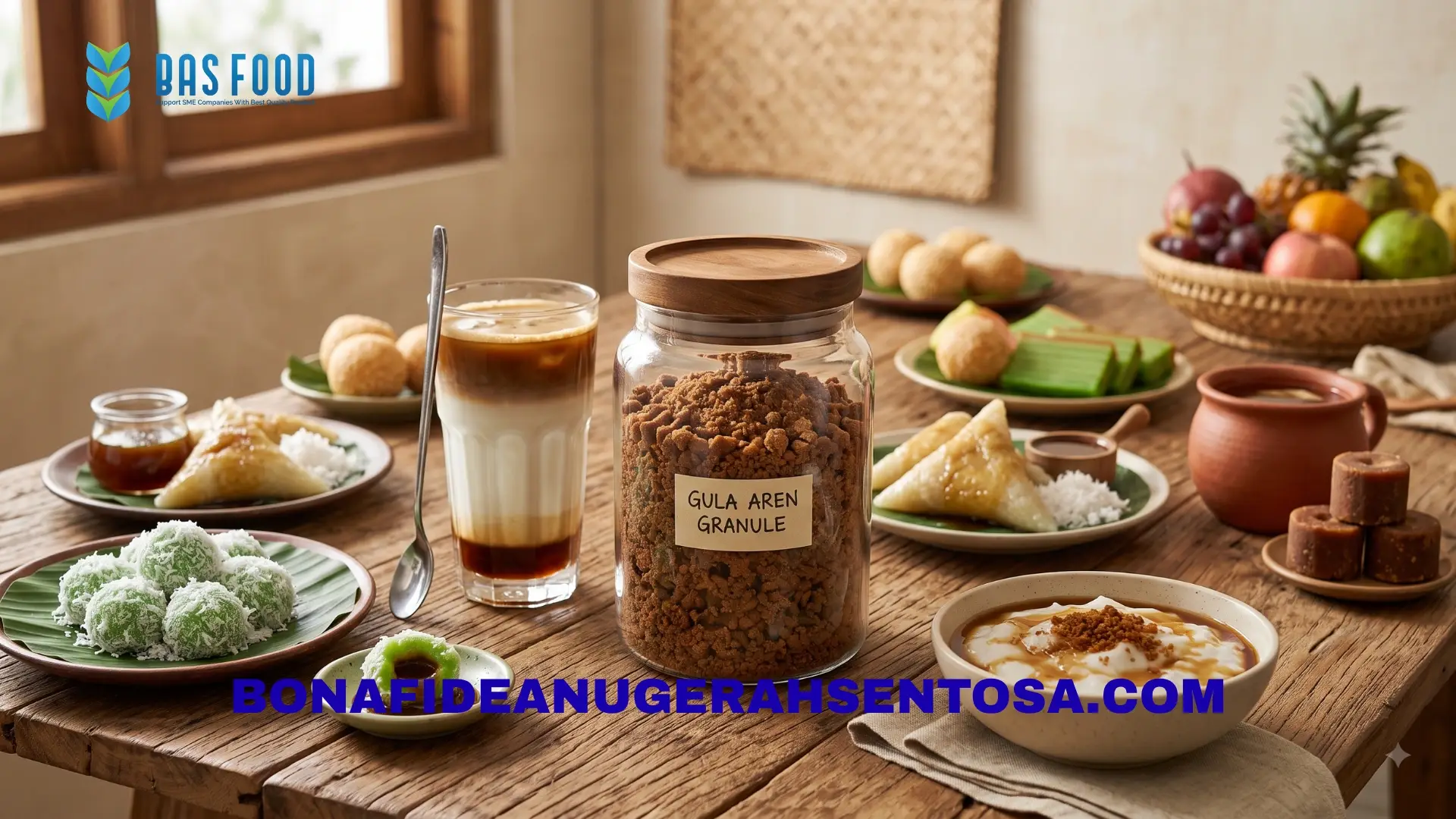
Why Palm Sugar Is Becoming Interesting for Food Manufacturers
Palm sugar has been used traditionally in Southeast Asian food culture for generations. Today, manufacturers can also use it as an ingredient in modern food and beverage products.
For industrial buyers, the attraction is not only the sweet taste. Palm sugar can provide a distinctive flavor profile that may help create a different sensory experience compared with conventional refined sugar.
Depending on the palm species, processing method, and production conditions, palm sugar may have notes that resemble caramel, molasses, or toasted sugar. These characteristics can be useful in products where flavor is an important part of the consumer experience.
At the same time, manufacturers need to remember that palm sugar is still a sugar ingredient. Marketing claims should accurately reflect the product and should not imply that it provides health benefits simply because it is less refined or naturally produced.
What Does Palm Sugar for Manufacturers Actually Mean?
Palm sugar for manufacturers refers to palm-derived sugar supplied in formats and specifications suitable for commercial food production.
Unlike retail consumers, manufacturers often purchase larger quantities and require more detailed product information.
A manufacturer may need to know:
- Product form
- Particle size
- Moisture level
- Color
- Flavor profile
- Packaging
- Net weight
- Shelf life
- Microbiological specifications
- Heavy metal requirements
- Allergen information
- Production process
- Country of origin
- Batch traceability
These details help the purchasing and R&D teams determine whether the ingredient is suitable for their formulation.
For this reason, an experienced supplier should be able to provide a technical specification or product data sheet when requested.
Palm Sugar as a Food Ingredient
Palm sugar can be used as one of many food ingredients in commercial formulations.
Manufacturers may use it in baked products, sauces, confectionery, beverages, snacks, desserts, and other processed foods.
The exact application determines the most suitable palm sugar format.
For example, a beverage manufacturer may prefer a fine powder that dissolves more easily. A bakery manufacturer may use granulated palm sugar. Meanwhile, a traditional food producer may prefer molded palm sugar.
This flexibility makes product format an important part of the sourcing discussion.
Palm Sugar Granule for Industrial Applications
Palm sugar granule is a practical format for manufacturers that need a dry, easy-to-handle sweetener.
Granules can be measured, blended, transported, and stored relatively easily.
Particle size can also affect how the ingredient performs during production.
A larger granule may dissolve more slowly than a fine particle. In contrast, a finer product may blend more quickly into some formulations.
Therefore, manufacturers should not simply request “palm sugar.” They should explain how the ingredient will be used.
A supplier can then recommend a suitable specification based on the application.
Palm Sugar Powder for Fast-Mixing Products
Some manufacturers need a finer palm sugar format for applications where rapid dispersion is important.
Powdered palm sugar can be useful in beverage mixes, instant products, bakery premixes, seasoning blends, and other dry formulations.
However, fine particles can also be more sensitive to humidity.
Therefore, packaging and storage become especially important.
Manufacturers purchasing powdered palm sugar should ask about moisture specifications, packaging, storage recommendations, and handling requirements before placing a large order.
Palm Sugar Mould for Traditional and Specialty Products
Palm sugar mould is another product format.
Instead of being supplied as loose granules or powder, palm sugar is formed into specific shapes.
This format can be useful for traditional foods, culinary applications, specialty products, and businesses that want to maintain a more traditional presentation.
However, molded palm sugar requires different handling from granulated products.
Manufacturers should consider mould size, weight, shape, packaging, stacking, and breakage during transportation.
For large-scale production, consistency in mould size can also make inventory management easier.
Natural Sugar With a Distinctive Flavor
Many manufacturers are interested in natural sugar ingredients because they want to develop products with a more recognizable ingredient story.
Palm sugar can support this positioning when the product formulation and labeling accurately describe the ingredient.
However, manufacturers should distinguish between “natural” and “healthy.”
Natural origin does not automatically mean that a product is suitable for every diet or that it has a specific nutritional advantage.
Instead, manufacturers can focus on the ingredient’s origin, processing characteristics, flavor, and role in the formulation.
This creates a more accurate and transparent product story.
Palm Sugar as an Industrial Sweetener
For manufacturers, palm sugar can function as an industrial sweetener in a wide range of formulations.
The main advantage is its ability to provide sweetness while also contributing its own flavor and color.
This can be particularly useful in products where a deeper sweet profile is desirable.
However, palm sugar does not necessarily behave exactly like white granulated sugar.
Its color, aroma, particle size, moisture, and solubility can influence the final product.
Therefore, manufacturers should conduct formulation trials before switching a production line from another sweetener to palm sugar.
Palm Sugar in Bakery Manufacturing
Bakery products are one of the most interesting applications for palm sugar.
Manufacturers can explore palm sugar in:
- Cookies
- Cakes
- Bread
- Muffins
- Pastries
- Granola
- Biscuits
- Bakery premixes
The ingredient can contribute sweetness and a deeper color.
It may also provide a caramel-like flavor that works well with ingredients such as chocolate, coconut, coffee, cinnamon, nuts, and spices.
However, the formulation may need adjustment because palm sugar has different physical characteristics from refined white sugar.
Palm Sugar in Beverage Manufacturing
Palm sugar can also be used in beverage applications.
Manufacturers may explore it in:
- Ready-to-drink beverages
- Coffee drinks
- Tea drinks
- Plant-based beverages
- Traditional beverages
- Beverage concentrates
- Instant drink mixes
The product format becomes particularly important here.
A beverage manufacturer may require fine granules or powder for better dispersion.
Solubility testing should be part of product development, especially when the beverage requires a smooth appearance.
Palm Sugar in Sauces and Seasonings
Palm sugar has an important role in many savory food applications.
It can balance salty, sour, spicy, and savory flavors in sauces and seasonings.
Manufacturers can use it in:
- Marinades
- Dipping sauces
- Cooking sauces
- Sambal
- Dressings
- Seasoning blends
- Asian-style sauces
In these products, palm sugar does not simply act as a sweetener.
It can help create a more rounded flavor profile.
Manufacturers should therefore evaluate both sweetness and flavor contribution when testing palm sugar in a formulation.
Palm Sugar for Confectionery and Snacks
Confectionery manufacturers may also explore palm sugar as an alternative sweetening ingredient.
Its characteristic flavor can complement products containing nuts, coconut, chocolate, coffee, and spices.
Snack manufacturers can also investigate its use in cereal bars, granola, roasted snacks, and other products.
However, product development teams should test how palm sugar behaves during heating.
Different processing conditions can affect color, flavor, texture, and final product appearance.
For this reason, small-scale trials should come before full-scale commercial production.
What Manufacturers Should Check Before Buying Palm Sugar
Price is important, but it should not be the only purchasing factor.
Manufacturers should first establish a clear technical specification.
This can include:
Product Form
Determine whether you need granules, powder, or molded palm sugar.
Particle Size
Specify the desired mesh or particle-size range where relevant.
Moisture
Ask for the supplier’s moisture specification and test method.
Color
Define an acceptable color range if appearance matters to the finished product.
Flavor
Consider whether you need a mild, medium, or stronger palm sugar profile.
Packaging
Choose packaging suitable for your production and storage system.
Shelf Life
Confirm the expected shelf life under recommended storage conditions.
Food Safety
Ask for relevant quality and food safety documentation.
A clear specification reduces misunderstandings between the buyer and supplier.
Consistency Matters More Than One Good Sample
One of the biggest differences between consumer purchasing and industrial sourcing is the importance of batch consistency.
A sample may perform perfectly in an R&D test.
But manufacturers need future shipments to perform within an agreed specification.
This is why supplier evaluation should consider production capability and quality control, not only sample quality.
A good palm sugar exporter should be able to explain how it manages product consistency between batches.
Manufacturers can also establish approval procedures before beginning regular purchasing.
Why a Reliable Palm Sugar Supplier Matters
A reliable palm sugar supplier becomes part of the manufacturer’s supply chain.
If the ingredient arrives late, fails quality testing, or changes significantly from one shipment to another, the manufacturer may face production problems.
Therefore, buyers should evaluate:
- Production capacity
- Quality control
- Packaging capability
- Export experience
- Lead time
- Communication
- Documentation
- Product consistency
For larger contracts, buyers may also want to discuss forecast volumes and expected purchasing schedules.
This helps the supplier plan production more effectively.
Choosing an Arenga Palm Sugar Supplier
Manufacturers specifically looking for arenga-derived palm sugar may search for an arenga palm sugar supplier with suitable technical and export capabilities.
The term “arenga palm sugar” generally refers to sugar made from the sap of the arenga palm.
However, buyers should always confirm the botanical source and product specification directly with the supplier.
This is particularly important when the destination market has specific requirements regarding ingredient descriptions or labeling.
Clear product documentation helps the manufacturer determine whether the ingredient matches its purchasing specification.
Sourcing Palm Sugar From Indonesia
Indonesia is an important origin for palm-based sweeteners and offers manufacturers access to a broad supplier base.
However, sourcing internationally requires more than finding a low quotation.
Manufacturers should evaluate the supplier’s ability to manage the complete export process.
This includes:
- Product sourcing
- Processing
- Quality control
- Packaging
- Warehousing
- Export documentation
- Container loading
- Shipping
An experienced Indonesian palm sugar exporter can help coordinate these stages.
For international buyers, this can simplify communication and reduce the number of parties involved in the sourcing process.
Palm Sugar Packaging for Manufacturers
Commercial buyers need packaging that protects the product and supports efficient handling.
Common bulk formats may include bags or sacks designed for industrial use.
The correct packaging depends on the product and buyer’s warehouse system.
For example, a manufacturer with automated production equipment may prefer standardized bags that are easy to open and transfer.
Another manufacturer may require inner liners for additional moisture protection.
Packaging should therefore be discussed as part of the product specification, not as an afterthought.
Working With CV Bonafide Anugerah Sentosa
For manufacturers considering CV Bonafide Anugerah Sentosa as a potential sourcing partner, the commercial discussion should begin with a clear product specification.
Buyers can provide details such as:
- Intended application
- Product form
- Required particle size
- Target quantity
- Packaging preference
- Destination country
- Quality requirements
- Labeling requirements
- Delivery terms
This information allows the supplier to understand the project more clearly.
Manufacturers that also purchase coconut-based sweeteners may additionally discuss their requirements with a coconut sugar supplier to compare product formats and applications.
Final Thoughts: Is Palm Sugar Right for Manufacturers?
Palm sugar for manufacturers can be an interesting ingredient option for companies developing bakery products, beverages, sauces, snacks, confectionery, and other processed foods.
Its appeal comes from more than sweetness. Palm sugar can contribute a distinctive flavor, natural brown color, and an ingredient story connected to traditional production.
However, industrial sourcing requires consistency.
Manufacturers should evaluate product specifications, particle size, moisture, packaging, food safety, supply capacity, documentation, and export experience before choosing a supplier.
A sample is a good starting point, but it should be followed by formulation testing and supplier evaluation.
For businesses sourcing from Indonesia, working with an experienced palm sugar supplier or palm sugar exporter can make international purchasing easier.
Companies considering CV Bonafide Anugerah Sentosa can discuss their specific application, packaging, quantity, and export requirements directly with the supplier.
Whether you need palm sugar granule, powdered palm sugar, or palm sugar mould, the most important step is to match the ingredient specification with your actual manufacturing process.
In the long run, the right supplier is not necessarily the one offering the lowest price. It is the one that can provide the right product, consistent quality, reliable supply, suitable packaging, and clear communication.
That is what turns palm sugar from a simple sweetener into a practical ingredient for modern food manufacturing.