
The bakery industry keeps evolving. Consumers want familiar baked foods, but they also enjoy new flavors, different sweeteners, and more interesting ingredient combinations. As a result, bakery manufacturers are continuously looking for ingredients that can support both product quality and new product development. One ingredient that deserves attention is coconut sugar syrup for bakery applications. Unlike dry sugar, coconut sugar syrup comes in a liquid format that can be incorporated into many bakery formulations. It can contribute sweetness, flavor, moisture, and color, depending on how manufacturers use it.
For small bakeries, commercial bakeries, and large-scale food manufacturers, however, choosing a syrup is not simply about finding a sweet ingredient. Product developers need to consider viscosity, sweetness, flavor, color, processing conditions, packaging, storage, and supply consistency.
This guide explains how coconut sugar syrup can be used in bakery products, what manufacturers should consider during formulation, and how international buyers can work with a reliable coconut sugar supplier or coconut sugar exporter supplier.
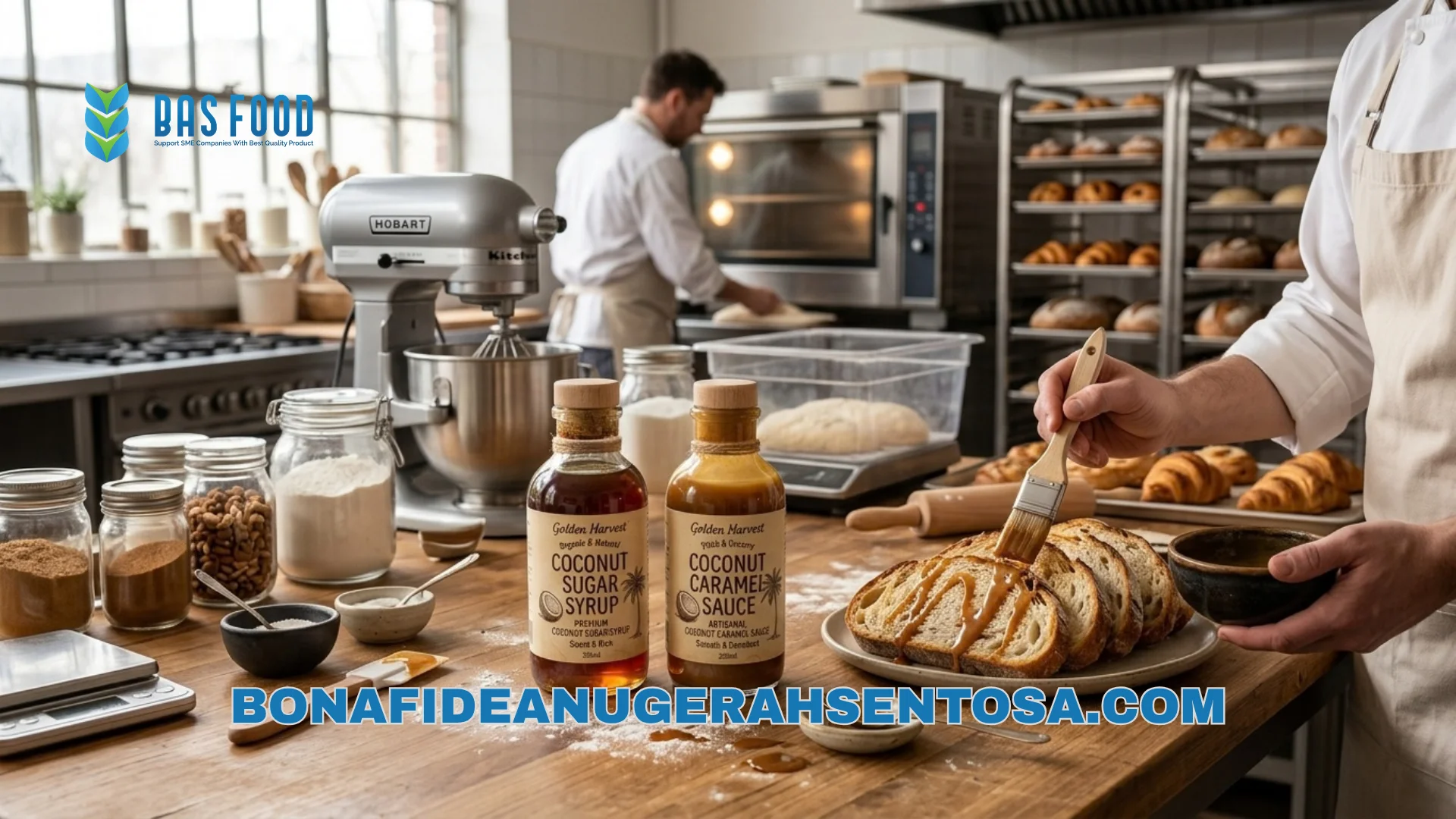
What Is Coconut Sugar Syrup for Bakery?
Coconut sugar syrup for bakery is a liquid sweetener made from coconut sugar that can be incorporated into bakery and dessert formulations. Its liquid form gives manufacturers another option besides granulated or powdered sweeteners.
In bakery production, ingredient format can affect the mixing process. Dry sugar needs to disperse throughout the formulation, while a liquid sweetener can be incorporated as part of the liquid ingredients. This can be useful for recipes that already contain water, milk, plant-based liquids, oils, eggs, or other liquid components.
Coconut sugar syrup can also contribute its own flavor and color. Depending on the formulation, these characteristics may complement products such as cakes, cookies, sauces, fillings, toppings, and other baked goods.
However, manufacturers should remember that every syrup has its own specifications. The actual performance depends on factors such as concentration, viscosity, processing conditions, and the rest of the recipe. Therefore, testing remains important before using the ingredient in commercial production.
Why Bakeries Are Exploring Liquid Sweeteners
Sweeteners do more than make bakery products taste sweet. They can influence texture, browning, moisture, flavor, and the overall eating experience.
That is why the choice of sweetener needs to match the product. A cookie, for example, may require different sweetener behavior from a cake or pastry filling. A bakery manufacturer must consider the complete formulation rather than looking at sweetness alone.
A liquid sweetener can be particularly useful when manufacturers want to introduce sweetness through a liquid component. This can make ingredient handling different from working with dry sugar and may support specific production processes.
Nevertheless, a liquid sweetener also introduces additional moisture into the formulation. Therefore, bakery developers need to balance it with the other liquid and dry ingredients. A recipe that works with granulated sugar may need adjustment when a syrup is introduced.
How Coconut Sugar Syrup Can Work as a Bakery Sweetener
As a bakery sweetener, coconut sugar syrup can provide sweetness while contributing characteristic coconut sugar notes. This can create opportunities for products where a deeper or more caramel-like flavor profile fits the recipe.
For example, manufacturers may explore coconut sugar syrup in cakes, muffins, cookies, brownies, fillings, toppings, glazes, and other bakery products. The suitability depends on the product’s target taste, texture, color, and production method.
The syrup format can also be convenient for certain mixing systems. Instead of handling another dry ingredient, manufacturers can incorporate the syrup into an appropriate stage of the liquid mixing process.
However, the amount used should be determined through formulation testing. Adding too much syrup may change the moisture balance, viscosity, sweetness, or structure of the finished product. Therefore, bakery developers should test several inclusion levels before finalizing the recipe.
Bakery Products That Can Use Coconut Sugar Syrup
The potential applications of coconut sugar syrup are broad. Nevertheless, each product category responds differently to sweeteners. Understanding the role of syrup in each application can help manufacturers create better test formulas.
Cakes and Muffins
Cakes and muffins commonly contain a combination of flour, sweetener, fat, eggs or egg alternatives, liquid ingredients, and leavening agents. Coconut sugar syrup can be explored as part of the sweetening system.
Its flavor may work particularly well in products where caramel-like or deeper sweet notes are desirable. It can also contribute color, which may be suitable for certain cake styles.
However, the added liquid needs to be considered carefully. If the syrup replaces a dry sugar completely, the formulation may require adjustments to maintain the desired batter consistency.
Cookies and Biscuits
Cookies and biscuits have different formulation requirements. Texture can range from soft and chewy to crisp and crunchy.
Coconut sugar syrup may be tested as part of the sweetening system, especially for cookies where a deeper flavor profile is desirable. However, manufacturers need to evaluate how the syrup affects dough handling, spread, moisture, and final texture.
Pilot testing is therefore essential. The same syrup may behave differently in different cookie formulas because flour, fat, water, and other ingredients interact differently.
Brownies and Chocolate Bakery Products
Chocolate products can provide another interesting application. The deeper flavor of coconut sugar may complement cocoa and chocolate notes.
Manufacturers can experiment with coconut sugar syrup in brownies, chocolate cakes, fillings, and related products. The final result will depend on the amount of syrup used and the balance of the complete formulation.
Because chocolate products often have strong flavors, developers should evaluate the syrup through sensory testing rather than relying only on theoretical ingredient compatibility.
Glazes, Fillings, and Toppings
Not every bakery application requires the syrup to be baked into the product. Coconut sugar syrup may also be considered for glazes, fillings, toppings, or dessert sauces.
These applications can be useful because the syrup remains part of a liquid or semi-liquid system. Manufacturers can focus on sweetness, viscosity, flavor, and appearance.
For example, a bakery may develop a sweet glaze for pastries or a topping for pancakes and baked desserts. In such applications, syrup consistency becomes particularly important.
Coconut Sugar Syrup as a Dessert Ingredient
Beyond traditional baked goods, coconut sugar syrup can be considered among various dessert ingredients. Modern food businesses increasingly combine bakery products with dessert concepts, creating products such as dessert cups, layered cakes, pancakes, waffles, ice cream toppings, and sweet sauces.
A liquid format can be useful for these applications because the ingredient can be drizzled, mixed, layered, or incorporated into another preparation.
For manufacturers, this creates an opportunity to use one ingredient across several product lines. A bakery business might use the same coconut sugar syrup in cake formulations, dessert toppings, and sweet sauces, depending on the product specifications.
Still, the formulation requirements can differ from one application to another. A syrup used as a topping may need different viscosity characteristics from one used inside a cake batter. Buyers should therefore communicate the intended applications when requesting product information from a supplier.
The Role of Viscosity in Bakery Formulation
Viscosity is one of the most important characteristics to consider when purchasing a liquid ingredient.
A syrup that is too thick may be difficult to pump, measure, or blend with other ingredients. On the other hand, a syrup with a lower viscosity may behave differently during dosing and mixing.
Temperature can also influence how a syrup flows. Therefore, bakery manufacturers should consider the conditions under which the product will be stored, transferred, measured, and mixed.
When sourcing coconut sugar syrup, buyers should ask the supplier for the relevant product specifications. Instead of assuming that all coconut sugar syrups have the same consistency, manufacturers should evaluate the specific product against their equipment and formulation.
Flavor and Color Considerations
Flavor plays a major role in bakery development. Sweeteners can influence the final taste profile, particularly when they have their own characteristic notes.
Coconut sugar syrup can provide a distinctive flavor that may complement products containing chocolate, spices, nuts, coffee, caramel-style flavors, or other rich ingredients. However, the final flavor depends on the entire recipe.
Color is another consideration. A coconut sugar-based syrup can influence the color of a batter, filling, topping, or finished product. This may be desirable in some products but less suitable in others.
Therefore, product developers should test the syrup in the actual recipe. A sample test allows the bakery team to evaluate flavor and appearance together rather than considering the ingredient in isolation.
Moisture Balance Is Critical
One of the biggest differences between dry sugar and syrup is the presence of liquid. This matters greatly in bakery production.
When a manufacturer introduces coconut sugar syrup into a recipe, the syrup contributes both sweetness and liquid. The additional liquid can affect batter or dough consistency and may influence the final texture.
For this reason, developers should not simply substitute syrup for dry sugar at the same weight without considering the formulation. Instead, they should calculate the contribution of the syrup and adjust other ingredients when necessary.
A controlled formulation process helps manufacturers achieve repeatable results. It also makes it easier to scale a recipe from laboratory trials to pilot production and eventually to commercial manufacturing.
Coconut Sugar Syrup and Industrial Bakery Production
Industrial bakeries need more than a good recipe. They also need ingredients that can work consistently at production scale.
Large-scale production involves automated mixers, dosing systems, pumps, storage tanks, conveyors, ovens, and packaging lines. An ingredient that works well in a small kitchen may behave differently in an industrial environment.
This is why manufacturers should conduct pilot-scale trials before making a major formulation change. The goal is to understand how the syrup behaves with actual equipment and production conditions.
The bakery team should monitor mixing, dosing, dough or batter consistency, processing time, finished-product texture, flavor, color, and other relevant quality characteristics.
Choosing a Coconut Sugar Exporter Supplier
For international bakery manufacturers, working with a coconut sugar exporter supplier involves additional considerations.
The supplier needs to understand international shipping, export packaging, documentation, product handling, and communication with overseas buyers. These factors can influence the overall supply process.
Buyers should also consider how the syrup will be transported from the production facility to the destination warehouse. International shipments may involve multiple handling stages, so packaging and sealing should be discussed carefully.
A good sourcing process starts with a detailed product inquiry. Buyers should provide their intended application, approximate order volume, packaging preference, destination country, and required specifications.
This information allows the supplier to respond with more relevant details instead of providing only a generic product quotation.
Why Samples Should Come Before Large Orders
Samples are an important part of B2B ingredient sourcing. A technical specification can provide valuable information, but bakery manufacturers still need to see how the ingredient behaves in their own formulation.
A product development team can use a sample to evaluate taste, color, viscosity, mixing behavior, and finished-product performance.
For example, a manufacturer developing a new muffin may test several syrup inclusion levels. Another bakery may use the sample in a glaze or filling. These tests can reveal whether the syrup fits the intended application.
Once the formulation has been validated, the buyer can establish the commercial specification with the supplier. This creates a clearer foundation for larger orders.
Sourcing Coconut Sugar Syrup From Indonesia
Indonesia has a well-established agricultural sector and is known as an origin for various coconut-based products. For international buyers, Indonesian suppliers can be considered when sourcing coconut-derived sweeteners for food manufacturing.
CV Bonafide Anugerah Sentosa is an Indonesian exporter involved in agricultural commodities and coconut-derived products. For bakery manufacturers exploring coconut sugar syrup, communication with the company can help buyers understand available product specifications, sampling, packaging, and export requirements.
As with any B2B ingredient purchase, buyers should communicate their requirements clearly. The intended application, desired product characteristics, packaging needs, order volume, and destination market can all affect the sourcing discussion.
Instead of asking only for a price, buyers can provide a complete product inquiry. This makes it easier to compare the supplier’s offering with the bakery’s technical and commercial requirements.
Creating Better Bakery Products With the Right Sweetener
Modern bakery development is about finding the right balance between taste, texture, production efficiency, and consumer expectations.
Coconut sugar syrup can offer an interesting option for manufacturers looking for a liquid sweetening ingredient with a distinctive flavor and color profile. It can be explored across cakes, muffins, cookies, brownies, glazes, fillings, toppings, and other dessert applications.
However, the key is proper formulation. Manufacturers should consider the syrup’s contribution to sweetness and liquid content while also evaluating viscosity, color, flavor, processing, and storage.
In other words, the ingredient should be selected because it fits the product, not simply because it is a different type of sweetener.
Final Thoughts on Coconut Sugar Syrup for Bakery
Coconut sugar syrup for bakery applications can give manufacturers another tool for developing modern baked goods and desserts. Its liquid format can make it useful in formulations where a syrup integrates naturally with other liquid ingredients.
It can potentially support cakes, muffins, cookies, brownies, glazes, fillings, toppings, and various dessert products. However, every recipe has its own requirements, so manufacturers should always test the ingredient under their actual production conditions.
For B2B buyers, the sourcing process should begin with a clear specification. Define the intended application, evaluate the syrup through samples, discuss packaging and storage, and confirm commercial requirements with a suitable coconut sugar supplier or coconut sugar exporter supplier.
With careful testing and clear communication, coconut sugar syrup can become a practical ingredient for bakeries and food manufacturers developing distinctive products for local and international markets.