
Coconut sugar has moved from a traditional sweetener into a widely used ingredient for food manufacturers, beverage brands, bakeries, retailers, and ingredient distributors. Among its different forms, granulated coconut sugar is especially practical for B2B applications because it is easy to measure, blend, pack, transport, and use in many recipes. Behind every bag of granulated coconut sugar, however, there is a process dedicated to coconut sugar granules production that starts much earlier than the finished product. It begins with coconut sap collected from flowering coconut palms. From there, producers must manage coconut sap processing, heating, concentration, drying, granulation, screening, quality control, and packaging.
Understanding coconut sugar granules production helps buyers make better sourcing decisions. It also helps food manufacturers understand why granule size, moisture, color, aroma, and texture can vary between suppliers.
This guide takes a closer look at how coconut sugar granules are produced, what happens at each stage, and what B2B buyers should consider when choosing a coconut sugar supplier.
What Is Granulated Coconut Sugar?
Granulated coconut sugar is a dry form of coconut sugar made from the sap of coconut palm flowers. Producers collect the sap, process it to reduce its water content, and convert the concentrated material into a dry sugar product.
The finished product usually has a light to medium brown color and a characteristic caramel-like aroma. Its flavor can vary depending on the raw material, processing conditions, and production method.
Unlike liquid coconut nectar, granulated coconut sugar can be stored, weighed, blended, and packed more easily for many industrial applications.
For that reason, it has become an interesting natural sweetener for businesses that need a dry ingredient.
Food manufacturers can use it in bakery products, cereals, snacks, confectionery, beverages, sauces, and other formulations. Meanwhile, distributors can offer it in bulk or retail packaging.
The Journey Begins With Fresh Coconut Sap
The first stage of coconut sugar granules production is collecting coconut sap.
Farmers tap the flower stalk of a coconut palm and collect the liquid sap in suitable containers. The sap contains naturally occurring sugars along with water and other components.
Fresh sap is highly perishable, so timing matters.
Once collected, it needs to move into processing as soon as practical. Delays can affect the characteristics of the raw material and may influence the final product.
This is why the supply chain between farmers and processors matters.
A reliable coconut sugar supplier needs an organized system for collecting raw material and moving it into production. The quality of the finished sugar depends partly on what happens before the sap reaches the processing area.
Coconut Sap Processing: Turning Liquid Into Concentrate
Coconut sap processing focuses on reducing the water content of the collected sap.
Producers heat the sap so that water gradually evaporates. As the water decreases, the natural sugars become more concentrated.
This stage requires attention because excessive or poorly controlled heating can affect color, aroma, flavor, and other product characteristics.
The producer therefore needs to manage processing conditions carefully.
Traditional producers may use cooking vessels and direct heating methods, while larger operations may use more controlled equipment.
The exact production setup can differ between suppliers.
However, the objective remains similar: transform fresh coconut sap into a concentrated material that can be converted into coconut sugar.
Why Heating Conditions Matter
Heating is one of the most important stages in coconut sugar production.
The producer needs to remove enough water to achieve the desired concentration while maintaining the intended product characteristics.
If processing conditions vary significantly, the resulting coconut sugar can also vary.
For B2B buyers, this explains why two coconut sugar products from different suppliers may not look or taste exactly the same.
Color is one visible difference.
Aroma and flavor can also differ.
Moisture is another important factor because it influences the product’s handling and storage characteristics.
Therefore, buyers should establish a product specification before beginning regular purchasing.
From Concentrated Sap to Coconut Sugar
After sufficient water has been removed, the concentrated coconut sap can be processed into coconut sugar.
At this point, the material needs to reach a suitable condition for drying and forming the desired product.
Depending on the production method, the concentrated material may be cooled, dried, agitated, or otherwise processed to create a dry sugar structure.
This stage is important because the producer is moving from a liquid or semi-liquid material toward a dry ingredient.
The final objective is a stable product that can be further processed into the required granule size.
For industrial buyers, the transition from concentrated sap to dry sugar is a key part of quality control.
What Is the Granulation Process?
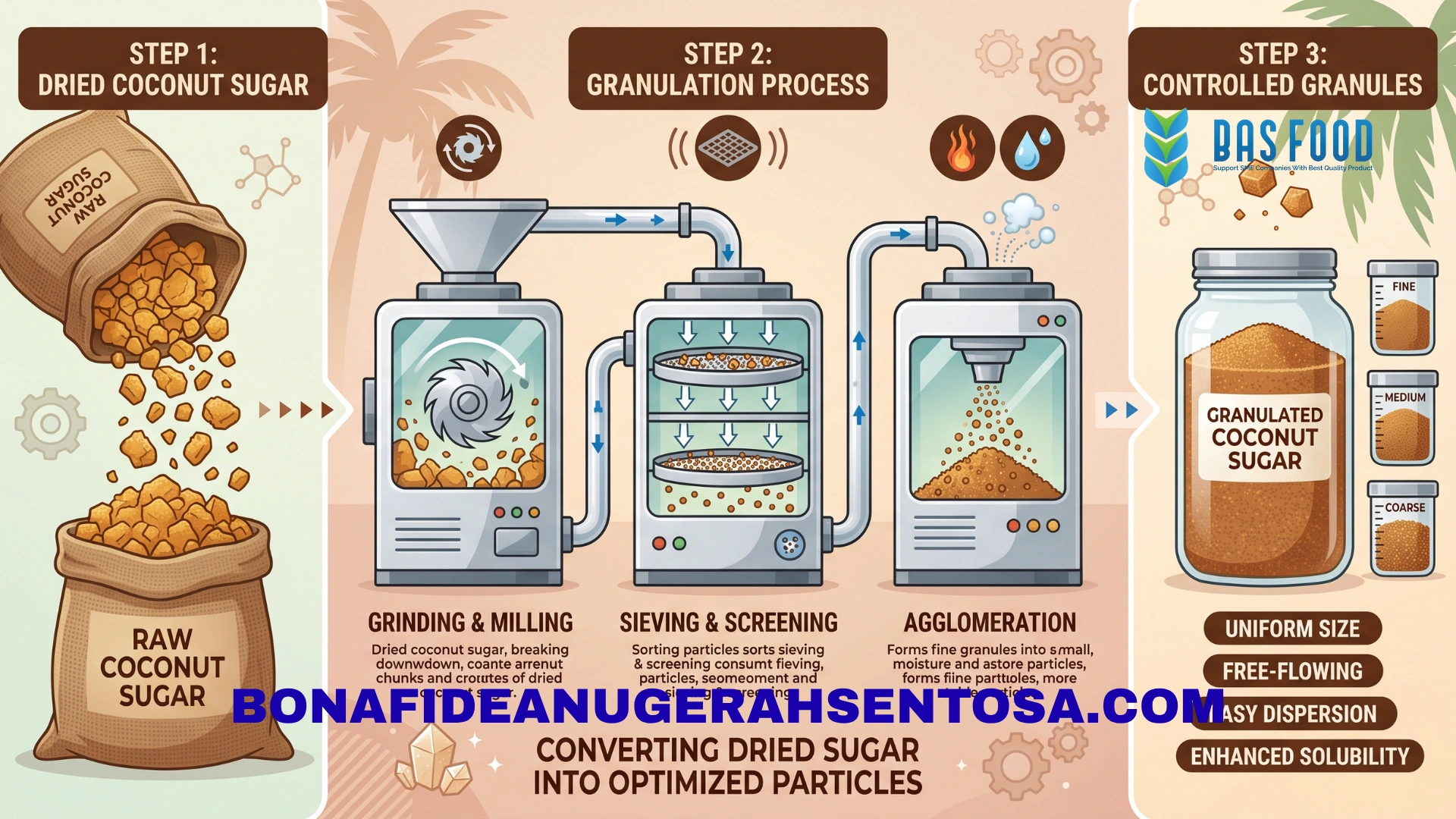
The granulation process converts dried coconut sugar into particles with a more controlled and useful size.
The exact method can differ between producers.
Some production systems create granulated material through controlled drying and mechanical processing. The product may then pass through screens or sieves to separate particles according to size.
The goal is not simply to make the sugar smaller.
The goal is to achieve a consistent particle distribution that matches the buyer’s specification.
This is particularly important for food manufacturers.
A manufacturer using coconut sugar in a dry blend may need a particular particle size so that the ingredient mixes evenly with other components.
Why Granule Size Matters
Granule size affects how coconut sugar behaves during handling and processing.
Fine granules generally have a greater surface area relative to their volume. They may blend quickly with other powdered ingredients.
Coarser granules, meanwhile, may provide a different texture and handling behavior.
Neither option is automatically better.
The right specification depends on the intended application.
A beverage manufacturer may want a different particle profile from a bakery manufacturer. A retail brand may also choose a particular granule appearance based on consumer expectations.
Therefore, B2B buyers should explain the intended application to their supplier.
Fine, Medium, and Coarse Coconut Sugar Granules
Coconut sugar can be supplied in different particle sizes.
Fine coconut sugar generally contains smaller particles and can be useful when rapid blending or a smoother dry texture is important.
Medium granules can offer a balance between handling and dissolution characteristics.
Coarse coconut sugar contains larger particles and may be preferred when a more visible granulated appearance is desired.
However, terminology can vary between suppliers.
One supplier’s definition of “fine” may not exactly match another supplier’s specification.
That is why buyers should not rely only on terms such as fine, medium, or coarse.
Instead, request a technical specification and, when possible, a physical sample.
Screening Helps Control Particle Size
Screening is an important part of producing consistent coconut sugar granules.
After drying and granulation, the product can be passed through screens or sieves that separate particles according to size.
This allows producers to remove particles that are too large or too small for the target specification.
The result can be a more consistent product.
For industrial customers, this consistency matters because the ingredient needs to perform predictably during manufacturing.
Screening also makes it easier for suppliers to offer different product specifications.
A buyer can request a particular granule range based on its manufacturing process.
Moisture Control During Coconut Sugar Production
Moisture is a major consideration in dry sugar products.
Too much moisture can affect the way granules behave during storage and handling. It can also contribute to clumping.
For that reason, producers need to control moisture during processing and packaging.
The exact target should be agreed between buyer and supplier according to the product specification and intended market.
A good coconut sugar supplier should be able to provide relevant product information and explain its quality-control process.
Buyers should also consider how the product will be stored after arrival.
Even a well-produced dry ingredient can be affected by poor storage conditions.
Preventing Clumping in Coconut Sugar Granules
Clumping can become a practical problem when handling granulated sugar.
Several factors can contribute to clumping, including moisture, storage conditions, particle characteristics, and packaging.
This is why the production process cannot be separated from packaging.
The producer should make sure the finished product reaches the packaging stage in an appropriate condition.
The packaging should also provide suitable protection from external moisture.
For importers, warehouse conditions matter too.
After receiving the shipment, the buyer should follow suitable storage practices and protect the product from excessive humidity.
Color, Aroma, and Flavor of Coconut Sugar
Consumers often recognize coconut sugar by its brown color and distinctive aroma.
However, the appearance can vary.
Differences may result from raw material characteristics and processing conditions.
A B2B buyer should therefore define acceptable product characteristics before placing regular orders.
For example, a food manufacturer may require a specific color range because the ingredient affects the appearance of its finished product.
A beverage company may be more concerned about flavor and aroma.
The right specification depends on the final application.
Quality Control Throughout the Production Process
Quality control should not happen only at the end of production.
It should begin with raw material handling.
The supplier should monitor the incoming coconut sap and maintain suitable processing practices.
Then, quality checks can continue through concentration, drying, granulation, screening, and packaging.
Finished product checks may include characteristics such as:
- Moisture
- Color
- Aroma
- Flavor
- Granule size
- Cleanliness
- Packaging condition
The exact testing program depends on the supplier, product specification, customer requirements, and destination market.
For B2B buyers, the key point is consistency.
Hygiene and Food Safety in Production
Because coconut sugar is used as a food ingredient, hygiene is an essential part of production.
The production environment, equipment, workers, raw materials, packaging materials, and storage areas should be managed according to appropriate food-safety practices.
The supplier should also understand the requirements of its target markets.
International buyers should discuss food-safety documentation and applicable requirements before ordering.
Do not assume that a supplier’s general export experience automatically means that every product meets every destination-market requirement.
The importer remains responsible for understanding the requirements that apply to its own market and product use.
Traditional Knowledge Meets Modern Production
Coconut sugar has a long history of traditional production in Indonesia and other coconut-growing regions.
Traditional knowledge remains valuable because producers understand the raw material and processing behavior through experience.
At the same time, B2B markets often require greater consistency than small-scale traditional production alone can provide.
This creates an opportunity to combine traditional knowledge with improved process control.
A supplier can preserve the characteristic qualities of coconut sugar while introducing better control over drying, granulation, screening, hygiene, packaging, and quality checks.
The right balance depends on the supplier’s production model.
The Role of Farmers in Coconut Sugar Granules Production
Farmers play an essential role in the coconut sugar supply chain.
The production process cannot begin without coconut sap.
Therefore, a supplier’s relationship with farmers can influence supply stability.
A well-managed sourcing network can help provide access to raw materials while supporting consistent collection practices.
For B2B buyers, it is useful to ask where the raw material comes from and how the supplier manages its sourcing network.
This provides a clearer picture of the supply chain.
It also helps buyers understand that coconut sugar is not simply a factory-made commodity. It starts with agricultural production.
Production Capacity and Granule Orders
Large-volume buyers need to consider production capacity.
A supplier may be able to produce standard coconut sugar but have limited capacity for a specific granule size.
For example, producing a particular particle specification may require additional screening or processing.
Therefore, buyers should ask about both total production capacity and capacity for their specific product specification.
This distinction can become important when an importer requires regular monthly shipments.
A capable supplier should be able to discuss realistic production lead times and available supply.
Packaging Coconut Sugar Granules for Export
Once the product meets the required specification, it needs to be packed for storage and transportation.
Export packaging should protect the product against moisture, contamination, handling damage, and other supply-chain risks.
B2B buyers may request different packaging formats depending on their operations.
Common considerations include:
- Bulk bag size
- Inner liner
- Outer packaging
- Net weight
- Labeling
- Palletization
- Container loading
Packaging should be agreed before production begins.
If the buyer needs private-label packaging, additional planning may be necessary.
Coconut Sugar Granules for Food Manufacturing
The versatility of granulated coconut sugar makes it useful in many areas of food manufacturing.
Bakeries can use it in cakes, cookies, pastries, and other baked products.
Food manufacturers can incorporate it into cereals, snacks, sauces, confectionery, and dry mixes.
Beverage companies can also use coconut sugar in selected formulations.
However, product suitability depends on the specific formulation.
Food developers should test the ingredient before commercial production.
The color, flavor, moisture, and particle size may influence the final product.
Coconut Sugar as a Natural Sweetener
Coconut sugar is commonly positioned as a natural sweetener because it comes from coconut palm sap rather than refined sugar cane.
However, “natural” does not mean that every coconut sugar product has identical characteristics.
Processing still matters.
Different suppliers can use different production methods, resulting in differences in color, texture, aroma, and particle size.
For this reason, B2B buyers should focus on measurable product specifications rather than marketing language alone.
A strong purchasing process combines product claims with technical information and sample testing.
How B2B Buyers Should Evaluate a Coconut Sugar Supplier
A good supplier evaluation should cover the entire production chain.
Start by requesting product specifications and samples.
Then ask about raw material sourcing, production capacity, processing methods, granulation, screening, quality control, packaging, and export experience.
It is also useful to ask about MOQ and lead time.
For larger orders, buyers should discuss projected demand rather than only the first shipment.
This allows the supplier to assess whether it can support future requirements.
A long-term supply relationship works better when both sides understand expectations from the beginning.
Choosing an Indonesian Coconut Sugar Supplier
Indonesia is an important sourcing origin for coconut-based products.
For international buyers, working with an Indonesian supplier can provide direct access to local production and agricultural supply networks.
However, buyers should still conduct proper due diligence.
- Review the supplier’s product specifications.
- Request samples.
- Discuss production capacity.
- Confirm packaging.
- Review export documentation.
- Ask about lead times.
Most importantly, make sure the supplier understands the exact specification you need.
A good coconut sugar supplier should be able to discuss these points clearly.
CV Bonafide Anugerah Sentosa as a Potential Sourcing Partner
Businesses looking for Indonesian agricultural products can consider CV Bonafide Anugerah Sentosa as a potential source for coconut sugar and other commodities.
For B2B buyers, the most useful approach is to provide detailed purchasing information.
For example, tell the supplier:
- Required product form
- Target quantity
- Monthly demand
- Desired granule size
- Packaging requirements
- Destination country
- Intended application
- Required documents
- Target delivery schedule
This allows the supplier to assess the request more accurately.
Before placing a commercial order, buyers should confirm current product availability, specifications, MOQ, production capacity, packaging, lead time, quality requirements, documentation, pricing, and shipping terms directly with the company.
Conclusion: Understanding Production Helps You Buy Better
Coconut sugar granules production is a multi-stage process that starts with coconut sap and ends with a dry, screened, packaged ingredient ready for commercial use.
The main stages include sap collection, coconut sap processing, concentration, drying, the granulation process, screening, quality control, and packaging.
Every stage can influence the final product.
That is why B2B buyers should not evaluate coconut sugar based only on appearance or price.
Instead, look at the complete production system.
Check the raw material supply. Understand the processing method. Confirm granule size. Review moisture specifications. Test samples. Evaluate production capacity. Check packaging. Discuss export requirements.
For businesses sourcing from Indonesia, CV Bonafide Anugerah Sentosa can be considered as one potential supplier for coconut sugar and other agricultural commodities. Buyers should confirm current specifications, availability, MOQ, capacity, packaging, lead time, documentation, and commercial terms directly before placing an order.
If you also need palm sugar, evaluate a suitable palm sugar supplier or palm sugar exporter separately.
Ultimately, understanding how coconut sugar is produced gives buyers a better basis for making purchasing decisions.
The better you understand the process, the easier it becomes to define the right specification, compare suppliers, and build a dependable long-term supply chain.