
Baking is all about balance. Flour, fat, liquid, eggs, salt, and sweeteners all need to work together to create the right texture, flavor, color, and aroma. That is why choosing the right sweetener matters, especially for commercial bakeries and food manufacturers. Coconut sugar granules for baking have become an interesting option for businesses looking for a distinctive sweetener for baked goods. Made from coconut palm sap, granulated coconut sugar offers a warm brown color and a characteristic caramel-like flavor that can complement many bakery formulations.
For consumers, the ingredient can be an alternative to conventional sweeteners. For B2B buyers, however, the decision involves more than taste. A bakery needs to consider granule size, moisture, consistency, supply capacity, packaging, storage, and price.
So, how does coconut sugar perform in baking? Which products can use it? What should manufacturers know before replacing another sweetener? And how should you evaluate a coconut sugar supplier?
This guide explores those questions in a simple, practical way.
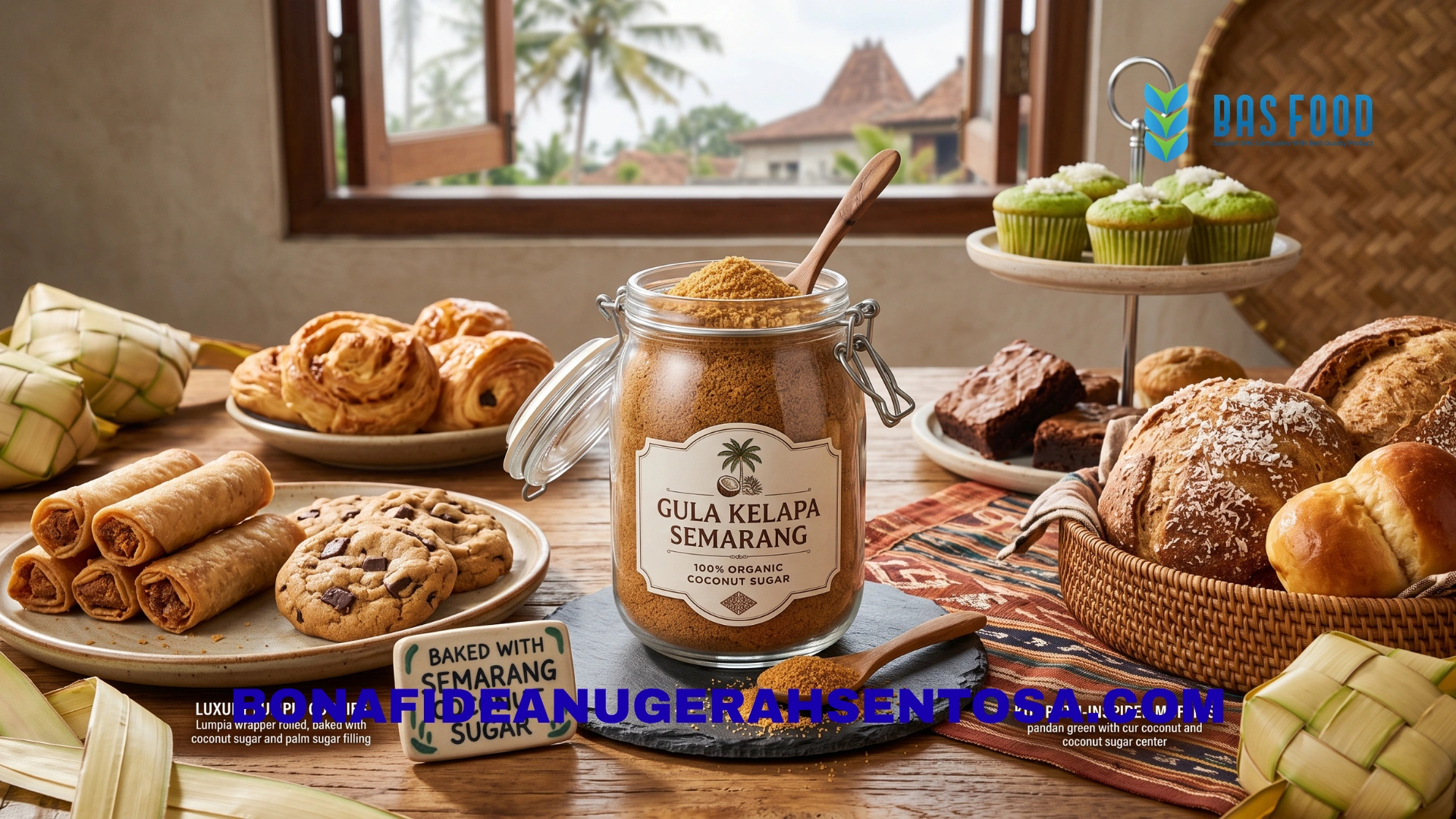
What Makes Coconut Sugar Interesting for Baking?
Coconut sugar comes from the sap of coconut palm flowers. Producers collect the sap and process it to reduce its water content before drying and preparing it into a granular form.
The finished sugar typically has a brown color and a characteristic flavor. Depending on the product and processing method, the flavor can range from mild caramel notes to a deeper, more toasted profile.
That flavor is one of the reasons coconut sugar granules for baking can be attractive.
Instead of simply adding sweetness, coconut sugar can contribute another layer of flavor to baked products. This can work particularly well in products where brown color and caramel notes are already welcome.
For example, cookies, cakes, muffins, granola bars, and some types of bread can all provide suitable applications.
Understanding Coconut Sugar Granules Before You Bake
Not all coconut sugar granules have exactly the same physical characteristics.
Granule size can vary from fine particles to larger granules. Moisture can also vary depending on production, storage, and packaging.
For commercial baking, these details matter.
A fine product may blend differently from a coarse product. Likewise, a product with higher moisture may behave differently during mixing and storage.
Therefore, bakeries should not choose a product based only on the name “coconut sugar.”
Instead, ask the coconut sugar granules supplier for a product specification.
Useful information can include granule size, moisture, color, flavor, packaging, shelf life, and other quality parameters relevant to your application.
Coconut Sugar Granules as a Bakery Ingredient
A sweetener does much more than make a product taste sweet.
In baking, sugar can affect browning, moisture retention, texture, spread, structure, and overall mouthfeel.
That means replacing one sweetener with another may require formulation adjustments.
Coconut sugar can be used as one of the bakery ingredients in a formulation, but the recipe should be tested rather than assuming a direct one-to-one substitution will always produce the same result.
The final result depends on the recipe.
Flour type, fat content, liquid, eggs, leavening agents, mixing method, baking temperature, and baking time all interact with the sweetener.
For that reason, professional product development should involve controlled trials.
Using Coconut Sugar Granules in Cookies
Cookies are one of the most straightforward applications for coconut sugar.
The brown color and caramel-like flavor can fit naturally into many cookie recipes. It can complement ingredients such as chocolate, oats, nuts, cinnamon, vanilla, and dried fruit.
The physical form also makes granulated coconut sugar convenient for dry mixing.
However, the final cookie characteristics depend on the formulation.
Changing the type of sugar can affect spread, color, crispness, softness, and moisture. Therefore, a bakery should test the ingredient before moving directly into full-scale production.
For commercial production, it is useful to compare a control batch with a coconut sugar formulation.
Measure important factors such as dough handling, cookie diameter, thickness, color, aroma, texture, and shelf stability.
This provides a much better basis for deciding whether the ingredient fits the product.
Coconut Sugar for Cakes and Muffins
Cakes require a different approach because their texture depends heavily on the balance between flour, fat, liquid, eggs, sugar, and leavening agents.
Coconut sugar can be incorporated into many cake and muffin formulations.
Its brown color may give the finished product a darker appearance than a formulation made with white sugar.
That can be an advantage for products designed around a rustic or naturally colored appearance.
The flavor can also work well with chocolate, banana, spices, nuts, coffee, and warm baking spices.
However, product developers should test the exact formulation.
If the bakery expects a very light-colored cake, coconut sugar may not be the best choice because its natural brown color can influence the finished appearance.
Can Coconut Sugar Be Used as a Bread Sweetener?
Yes, coconut sugar can be used as a bread sweetener in suitable formulations.
Some bread products use sugar to add sweetness, support browning, and contribute to the overall flavor profile.
Coconut sugar can bring its own flavor characteristics to the recipe.
It may be particularly suitable for sweet breads, buns, rolls, cinnamon-style products, and other bakery items where a deeper sweet flavor fits the concept.
However, bread formulation is sensitive to ingredient ratios.
Commercial bakeries should therefore conduct trials to determine the appropriate level of coconut sugar for the desired dough handling, fermentation, color, and final texture.
The ideal formulation depends on the specific bread product.
Why Granule Size Matters in Commercial Baking
Granule size may sound like a small technical detail, but it can influence how a sweetener behaves during production.
Fine granules can mix quickly with other dry ingredients.
Larger particles may behave differently during mixing and may take longer to dissolve when liquid is present.
This does not mean fine granules are always better.
A bakery should choose the particle size that matches its production process.
For example, a manufacturer producing a dry bakery mix may prioritize uniform particle distribution. A cookie manufacturer may have different requirements.
This is why a good supplier should be able to discuss available granule specifications.
Fine Coconut Sugar vs. Coarse Coconut Sugar for Baking
Fine coconut sugar can be useful when a bakery wants a smaller particle size that blends easily with other ingredients.
This may be helpful for certain cake mixes, powdered blends, and formulations where uniform distribution is important.
Coarser granules, meanwhile, may be suitable for applications where the sugar’s physical texture is less of a concern or where a more noticeable granulated appearance is desirable.
There is no universal winner.
The right option depends on the recipe and production equipment.
Before purchasing in bulk, ask the supplier for samples of the available particle sizes and test them in the actual manufacturing process.
Coconut Sugar and Cookie Texture
Cookie texture is influenced by many variables.
Sugar type is one of them.
The choice of sweetener can affect moisture, spread, crispness, chewiness, and browning.
Because coconut sugar has its own composition and physical characteristics, a recipe developed with another sugar may not behave exactly the same way when coconut sugar is introduced.
Therefore, product developers should avoid changing the sweetener without testing.
Run small batches first.
Compare the dough and finished cookies.
Then adjust the formula if necessary.
This approach allows the bakery to identify the best coconut sugar inclusion level for its product.
Coconut Sugar and Cake Color
One of the most visible effects of coconut sugar in baking is color.
The brown sugar granules can contribute to a darker batter and finished product.
For some products, this is exactly what the manufacturer wants.
It can create a warm, rustic appearance that works well with products positioned around whole-food or natural ingredient concepts.
For other products, especially very light cakes or pale pastries, the darker color may not fit the desired appearance.
Therefore, color should be considered during product development.
A sample bake will provide a much better indication than simply reading the ingredient specification.
Coconut Sugar and Caramel-Like Flavor
Flavor is another major reason bakeries consider coconut sugar.
Its characteristic taste can add warm, caramel-like notes to baked products.
This can complement chocolate, nuts, coffee, cinnamon, ginger, vanilla, coconut, and many other flavors.
However, flavor intensity can vary between products.
Processing methods and raw material characteristics can influence the final profile.
For this reason, sensory testing should be part of supplier evaluation.
Ask for a sample, bake with it, and compare the result with your current sweetener.
The goal is not simply to find a sweetener that tastes good on its own.
The goal is to find one that performs well in your finished product.
Coconut Sugar for Industrial Bakery Production
Small bakeries and large food manufacturers have different purchasing needs.
A small bakery may buy smaller quantities and focus heavily on flavor.
A large manufacturer may require consistent monthly supply, strict specifications, bulk packaging, and predictable lead times.
For industrial applications, consistency becomes particularly important.
The manufacturer needs confidence that the next shipment will perform similarly to the previous one.
This is why supplier selection matters.
A capable coconut sugar supplier should be able to discuss product specifications, production capacity, packaging, MOQ, lead time, and export requirements.
Why Sample Testing Should Come Before Bulk Purchasing
Bulk purchasing makes sense only after the product has been approved.
A bakery should first test the coconut sugar in its own formulation.
This is important because laboratory specifications alone cannot tell you everything about baking performance.
A product can meet a specification but still behave differently from the sweetener your recipe currently uses.
A practical test can evaluate:
- Mixing behavior
- Dough consistency
- Batter consistency
- Baking time
- Color
- Aroma
- Flavor
- Texture
- Finished-product appearance
- Shelf-life performance
After testing, the bakery can decide whether adjustments are needed.
Storage of Coconut Sugar for Bakery Operations
Good storage is essential after the product arrives.
Coconut sugar is a dry ingredient, but humidity can affect its physical condition.
Improper storage may contribute to clumping or changes in handling.
For this reason, warehouses should keep coconut sugar in suitable dry conditions and protect opened packaging from moisture.
Packaging also matters.
B2B buyers should discuss suitable bulk packaging with their supplier before placing the order.
The supplier should understand that the product may spend weeks or months in storage before it reaches the production line.
Export Packaging for International Bakery Buyers
International buyers have additional considerations because the product must travel through a longer supply chain.
Coconut sugar may move from the production area to a warehouse, port, container, destination port, customs clearance, and finally the buyer’s facility.
Packaging should therefore be suitable for transportation and storage.
Buyers should confirm:
- Bag weight
- Inner liner
- Outer packaging
- Sealing
- Labeling
- Pallet requirements
- Container loading
- Product identification
The packaging specification should be approved before production.
This helps prevent confusion when the first commercial shipment is prepared.
Buying Coconut Sugar in Bulk for Baking
When purchasing coconut sugar for commercial baking, price per kilogram is only one consideration.
Buyers should also calculate the total purchasing cost.
This can include product cost, packaging, freight, customs-related costs, local transport, storage, and other expenses.
A lower initial quotation may not represent the lowest total cost.
For example, inconsistent product quality can create waste or require formulation changes.
Likewise, delayed shipments can create production problems.
Therefore, buyers should evaluate total value rather than only the product price.
Coconut Sugar Supply Consistency
A bakery that uses coconut sugar as a regular ingredient needs dependable supply.
Imagine launching a successful cookie product and then discovering that your sweetener specification cannot be supplied consistently.
That can create unnecessary problems.
For this reason, buyers should discuss expected demand with their supplier.
If you need one container occasionally, your requirements are different from a manufacturer that needs regular monthly shipments.
Tell the supplier about your expected purchasing pattern.
This helps the supplier determine whether it can support your business over time.
CV Bonafide Anugerah Sentosa for B2B Coconut Sugar Sourcing
For businesses looking for Indonesian agricultural products, CV Bonafide Anugerah Sentosa can be considered as a potential source for coconut sugar and related products.
For bakery manufacturers, a detailed inquiry is more useful than simply asking for a price.
Provide information such as:
- Product form
- Required granule size
- Quantity
- Packaging
- Destination country
- Intended bakery application
- Monthly demand
- Required documents
- Target delivery schedule
This gives the supplier a clearer picture of the project.
Before placing a commercial order, buyers should confirm current product specifications, sample availability, MOQ, production capacity, packaging options, lead time, documentation, pricing, and shipping terms directly with the company.
Coconut Sugar Granules for Cookies, Cakes, and More
The versatility of coconut sugar makes it suitable for a wide range of bakery concepts.
Cookies
Coconut sugar can complement chocolate, oats, nuts, spices, and dried fruit.
Cakes
It can provide sweetness along with a brown color and characteristic flavor.
Muffins
It can work well with banana, chocolate, berries, spices, and nuts.
Sweet breads
It can serve as a bread sweetener in selected formulations.
Granola and snack bars
Its flavor can pair well with oats, nuts, seeds, dried fruit, and other ingredients.
Bakery mixes
Granulated coconut sugar can be incorporated into certain dry mixes, provided particle size and moisture are suitable.
The final suitability should always be confirmed through formulation testing.
Coconut Sugar as a Natural-Positioned Bakery Ingredient
Consumers increasingly pay attention to the ingredients used in food products.
This has created interest in ingredients that can support a natural or traditional product story.
Coconut sugar can fit into some of these product concepts because it is made from coconut palm sap.
However, food brands should communicate ingredient information accurately.
Avoid making health claims simply because a sweetener is described as natural.
Instead, focus on factual information about the ingredient, its origin, production, flavor, and intended application.
For B2B buyers, this also means asking suppliers for accurate technical information before developing product claims.
Conclusion: Make Coconut Sugar Part of Your Baking Strategy
Coconut sugar granules for baking offer an interesting combination of sweetness, brown color, and characteristic flavor for many bakery applications.
They can be used in cookies, cakes, muffins, sweet breads, snack bars, and selected bakery mixes. However, commercial buyers should remember that coconut sugar is not simply a drop-in replacement that will behave exactly like every other sugar.
Granule size, moisture, formulation, baking conditions, and product specifications all matter.
For this reason, the best approach is simple: test first, specify clearly, and choose your supplier carefully.
Start with a sample.
Test it in your actual recipe.
Evaluate flavor, color, texture, and processing performance.
Then review the supplier’s production capacity, packaging, lead time, documentation, and ability to provide consistent supply.
For businesses sourcing from Indonesia, CV Bonafide Anugerah Sentosa can be considered as a potential coconut sugar source. Buyers should confirm current specifications, availability, MOQ, capacity, packaging, quality requirements, and export terms directly before committing to a commercial order.
Whether you operate a small specialty bakery or a large food manufacturing business, the right ingredient and the right supplier can make a meaningful difference.
When product quality and supply are consistent, coconut sugar can become a practical and distinctive ingredient in your bakery portfolio.