
The confectionery industry is always looking for ways to create products that taste good, perform well, and stand out in a crowded market. While sugar remains a basic ingredient in many sweets, today’s product developers are paying more attention to the source, flavor, texture, and story behind the sweeteners they use. This is where coconut sugar granules for confectionery can offer an interesting option. Made from the sap of coconut palms, coconut sugar has a naturally brown appearance and a characteristic caramel-like flavor. In the right formulation, these qualities can add depth to chocolate, candy, caramel, bars, fillings, and other sweet products.
For B2B manufacturers, however, choosing coconut sugar is not simply about replacing one sugar with another. Confectionery production is sensitive to particle size, moisture, heat, texture, flavor, color, and process conditions. A sweetener that works well in one product may require adjustments in another.
Therefore, manufacturers need to evaluate both the ingredient and the supplier behind it.
This guide explains how coconut sugar granules can be used in confectionery, what product developers should consider during formulation, and how to select a reliable coconut sugar supplier for commercial production.
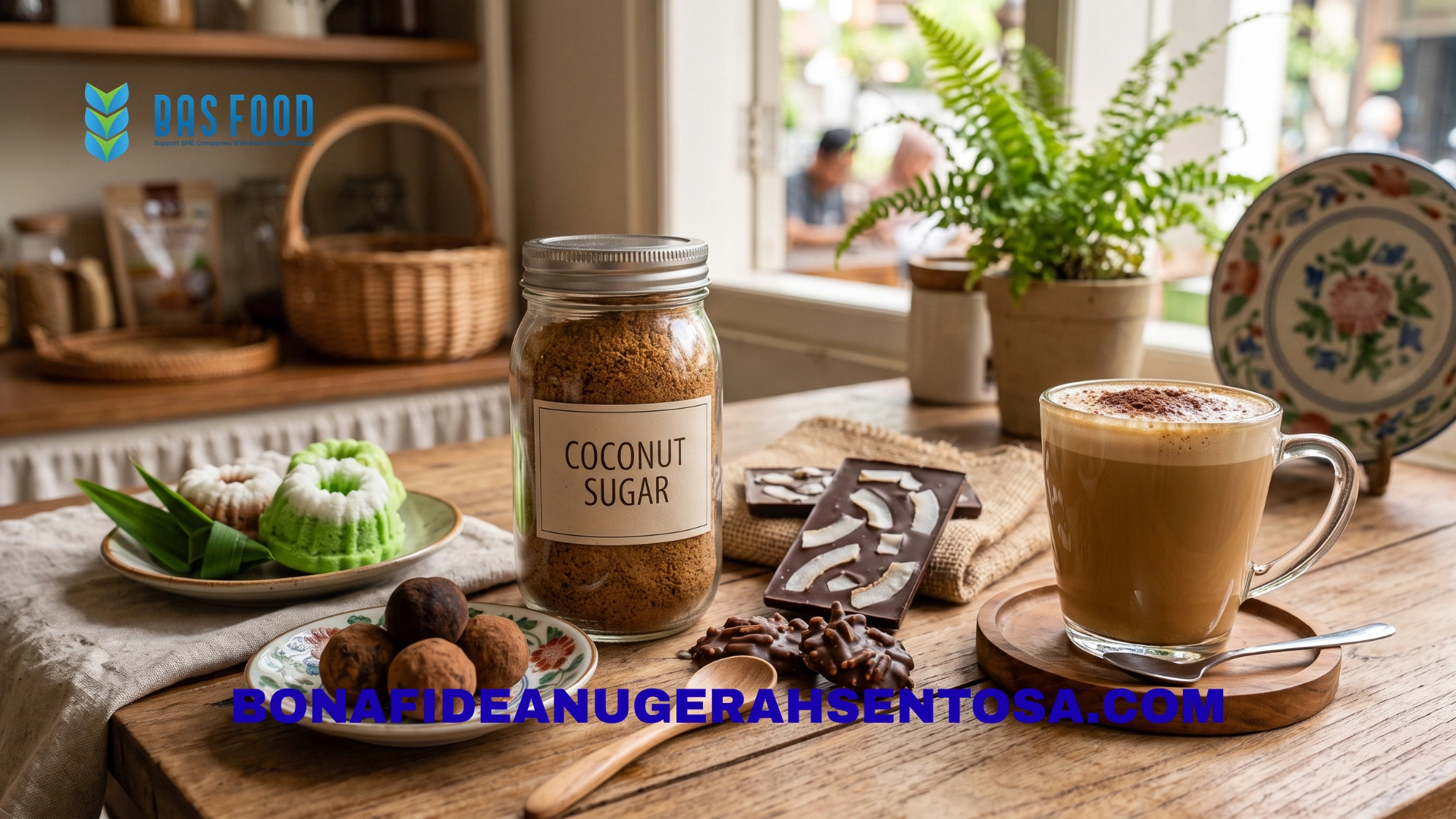
What Are Coconut Sugar Granules?
Coconut sugar granules are a dry form of coconut sugar made from coconut palm sap. Farmers collect sap from coconut flower stalks, and producers process the sap by reducing its water content until it develops into coconut sugar.
The finished sugar can be supplied in different physical forms. Depending on the manufacturing process and specification, it may be available as blocks, powder, or granules.
Granulated coconut sugar is particularly useful for food manufacturers because it can be weighed, blended, transported, and stored as a dry ingredient.
However, not all coconut sugar granules behave in exactly the same way.
Particle size, moisture, color, and processing conditions can affect how the ingredient performs in confectionery production. Consequently, buyers should request a detailed specification and sample before approving a commercial supply.
Why Coconut Sugar Is Interesting for Confectionery
Confectionery products depend heavily on sweetness, but sweetness is only one part of the eating experience.
Flavor also matters.
Coconut sugar has a characteristic warm, caramel-like profile that can complement ingredients such as cocoa, chocolate, nuts, spices, coconut, coffee, and vanilla.
This makes it interesting for brands that want to develop confectionery with a deeper flavor profile.
The brown color can also contribute to the visual identity of a product. In some applications, this can create an attractive natural-looking appearance.
However, the same color may not suit every confectionery product.
A manufacturer producing a bright white candy, for example, may have different requirements from a company making dark chocolate or caramel-based products.
Therefore, product developers should consider both the technical and sensory role of coconut sugar.
Coconut Sugar as a Natural Sweetener
Coconut sugar is often positioned as a natural sweetener, but manufacturers should be precise about how they describe it.
Its natural origin comes from coconut palm sap. However, the final ingredient still goes through processing before it reaches the food manufacturer.
For confectionery brands, the value of coconut sugar may come from its combination of sweetness, flavor, color, and ingredient origin.
That combination can support product concepts that focus on recognizable ingredients.
Nevertheless, manufacturers should avoid assuming that “natural” automatically means suitable for every formulation.
The ingredient still needs to meet the manufacturer’s technical specifications, food safety requirements, and target-market regulations.
Coconut Sugar Granules in Chocolate Products
Chocolate is one of the most interesting applications for coconut sugar.
Cocoa naturally has roasted, bitter, and complex flavor notes. Coconut sugar’s caramel-like character can complement these notes in certain formulations.
Manufacturers may explore coconut sugar in chocolate bars, chocolate-coated snacks, cocoa mixes, fillings, and other chocolate-based products.
However, chocolate production requires precise control.
Sugar particle size can affect texture, especially when the sugar is incorporated into chocolate and the product needs a smooth mouthfeel.
For this reason, chocolate manufacturers should not assume that any coconut sugar granule will work in a fine chocolate formulation.
The product should be tested under actual manufacturing conditions.
Particle Size Matters in Chocolate
Particle size is particularly important when coconut sugar becomes part of a chocolate formulation.
Large particles may create a noticeable texture if they are not sufficiently refined or processed.
Fine particles can provide a smoother result under suitable processing conditions.
However, particle size is only one factor.
Refining, mixing, fat content, moisture, formulation, and processing temperature can all influence the final texture.
Therefore, chocolate manufacturers should discuss their desired application with their coconut sugar granules supplier.
A supplier that understands the intended application can help the buyer identify an appropriate specification.
Coconut Sugar in Candy Manufacturing
Candy manufacturing covers many different products.
Hard candy, soft candy, caramel, toffee, gummies, chews, and filled sweets can all have different processing requirements.
Because of this, there is no single specification for coconut sugar that fits every candy product.
Manufacturers need to consider how the sugar behaves during heating, mixing, concentration, cooling, and forming.
The sugar’s color and flavor also need to match the intended product.
For caramel and toffee, the deeper color and flavor of coconut sugar may complement the formulation.
For light-colored candies, however, the natural brown tone may have a stronger visual impact.
Coconut Sugar for Caramel and Toffee
Caramel-based confectionery is a natural application to explore.
Caramel already has rich cooked-sugar notes, and coconut sugar can contribute additional depth to the flavor profile.
This may work well in caramel candies, toffee, dessert toppings, fillings, and snack coatings.
However, manufacturers should evaluate the complete cooking process.
Heating changes sugar chemistry and affects color, flavor, viscosity, and texture.
The formulation should therefore be developed through controlled trials rather than by making a simple one-for-one substitution.
Coconut Sugar in Chocolate Bars
Chocolate bars can use coconut sugar in several ways.
The sugar can be incorporated into the chocolate base, used in a filling, or included in a compound coating or other confectionery component depending on the product design.
The target texture should guide the choice of sugar specification.
If a smooth chocolate bar is required, manufacturers may need a finer particle size and suitable refining process.
For a product intentionally designed with a slightly more rustic texture, a different specification may be appropriate.
Again, the application determines the requirement.
Coconut Sugar for Snack Bars and Energy Bars
Coconut sugar can also be considered for confectionery-style snack bars.
These products often combine sweeteners with nuts, seeds, oats, chocolate, dried fruit, coconut, or other ingredients.
Coconut sugar can contribute sweetness while also adding its characteristic color and flavor.
The ingredient may work especially well in bars designed around chocolate, coconut, coffee, nuts, or caramel flavors.
Manufacturers should still consider water activity, texture, shelf stability, and the interaction between the sugar and other ingredients.
A product that tastes good immediately after production also needs to remain stable during storage.
Coconut Sugar and Confectionery Texture
Texture is one of the defining characteristics of confectionery.
Consumers notice whether a product is smooth, crunchy, chewy, soft, sticky, or creamy.
Sugar contributes to many of these properties.
Consequently, replacing conventional sugar with coconut sugar can change more than the flavor.
The difference may become noticeable during mixing, cooking, cooling, crystallization, or storage.
Product developers should therefore measure the effect on the finished product.
Sensory testing can provide useful information, while laboratory and production trials can help identify technical differences.
Moisture Control Is Essential
Moisture can affect the handling and performance of dry sugar.
If coconut sugar contains or absorbs excessive moisture, it may become more prone to clumping during storage.
That can create difficulties during weighing, automated feeding, and dry blending.
For confectionery manufacturers, moisture control is especially important because the finished product may have strict texture and shelf-life requirements.
Therefore, buyers should discuss moisture specifications with the supplier.
Packaging and warehouse conditions also matter.
Coconut sugar should be stored in a dry, suitable environment and protected from excessive humidity after opening.
Color Considerations for Confectionery
Coconut sugar generally has a brown to golden-brown appearance.
This characteristic can be useful for certain confectionery products.
Dark chocolate, caramel, toffee, nut bars, and coconut-based sweets may naturally complement the color.
On the other hand, manufacturers developing white or very light-colored products may need to consider whether the ingredient’s color is compatible with the desired appearance.
Color should therefore be part of the product development specification.
A sample can help the R&D team understand the visual impact before moving to commercial quantities.
Flavor Consistency Matters
Confectionery products often require consistent flavor from batch to batch.
If the sweetener changes significantly between shipments, the final product can also change.
This can create challenges for brands with established sensory standards.
A reliable supplier should therefore have appropriate quality controls for raw materials and finished products.
Buyers should ask how the supplier manages product specifications and production batches.
They can also retain an approved reference sample for comparison during future purchasing.
Coconut Sugar Granules and Formulation Adjustments
When introducing coconut sugar into an existing confectionery recipe, manufacturers should avoid assuming that a direct substitution will produce the same result.
Sugar affects sweetness, bulk, moisture balance, color, texture, and processing behavior.
Changing the sugar can therefore affect several parts of the formulation at once.
The R&D team may need to adjust other ingredients or processing parameters.
For example, cooking temperature, mixing time, refining conditions, or moisture targets may require review.
Small laboratory trials should come before full-scale production.
Testing Coconut Sugar Before Bulk Purchasing
Sample testing is one of the most important steps in B2B ingredient sourcing.
Start with the supplier’s technical specification.
Then examine the sample.
Check appearance, aroma, flavor, granule characteristics, and moisture according to your internal requirements.
Next, test the ingredient in the actual confectionery formulation.
For chocolate, evaluate mouthfeel and particle perception.
For candy, assess cooking behavior, color, flavor, and texture.
For bars, examine mixing, binding, texture, and shelf stability.
This application-based approach provides much more useful information than evaluating the ingredient alone.
Choosing a Coconut Sugar Granules Supplier
A professional coconut sugar granules supplier should be able to provide clear information about its product.
Ask for specifications that are relevant to your application.
These may include:
- Particle size
- Moisture
- Color
- Flavor
- Aroma
- Packaging
- Shelf life
- Batch identification
- Quality documentation
Then evaluate supply capability.
Can the supplier provide the required volume?
Can it maintain the specification?
Can it support repeat orders?
These questions become especially important when a confectionery product moves from development into commercial production.
Evaluating Production Capacity
A small product trial may require only a few kilograms.
Commercial confectionery production can require much more.
Therefore, buyers should discuss production capacity early in the sourcing process.
Ask about typical order volumes, MOQ, lead time, production planning, and shipment schedules.
A supplier that can support your initial order but cannot handle future growth may not be the right long-term partner.
For growing confectionery brands, supply planning is just as important as product quality.
Packaging for Confectionery Manufacturers
Packaging protects coconut sugar during storage and transportation.
Because coconut sugar is a dry food ingredient, protection against moisture is particularly important.
B2B packaging can vary depending on the customer’s production scale.
Smaller manufacturers may require smaller bags, while industrial confectionery producers may prefer larger bulk formats.
Buyers should discuss the packaging requirements before placing an order.
Important points can include bag size, inner liner, outer packaging, labeling, palletization, and container loading.
The right packaging should protect the ingredient while remaining practical for factory handling.
Export Documentation and International Purchasing
International confectionery manufacturers need to consider documentation as well as product specifications.
Depending on the destination market and transaction, buyers may need specific commercial and food-related documents.
Requirements can differ between countries.
Therefore, buyers should communicate their destination and import requirements to the supplier before shipment.
The supplier and buyer can then agree on the documentation needed for the transaction.
This step is particularly important when purchasing coconut sugar from Indonesia for international confectionery production.
Traceability in Coconut Sugar Supply
Traceability is another important consideration for B2B food manufacturers.
A traceable supply chain allows buyers to connect finished product batches with production information.
This can help with quality management and issue investigation.
Buyers should ask how the supplier identifies production lots.
They can also ask whether sourcing and production records are maintained.
Clear batch identification can make supplier management easier, particularly when a manufacturer receives multiple shipments over time.
Sustainable Sourcing of Coconut Sugar
Many confectionery companies are also interested in sustainability.
Coconut sugar comes from coconut palm sap, but the sustainability of a particular product depends on how the raw material is sourced and processed.
Therefore, buyers should ask suppliers about farmer relationships, sourcing practices, production systems, traceability, packaging, and relevant certifications.
Do not rely only on broad claims such as “eco-friendly” or “natural.”
Instead, ask for practical information.
This gives procurement teams a better basis for evaluating the ingredient supply chain.
Why Ethical Sourcing Matters
A coconut sugar supply chain begins with farmers.
They collect the sap that becomes the raw material for the finished sugar.
Responsible sourcing therefore needs to consider the relationship between farmers, collectors, processors, and buyers.
For B2B manufacturers, understanding this structure can support more responsible procurement decisions.
It can also help brands communicate more accurately about ingredient sourcing.
The best approach is to ask suppliers for clear information and supporting documentation where available.
Working With CV Bonafide Anugerah Sentosa
CV Bonafide Anugerah Sentosa can be considered as a potential Indonesian source for businesses looking for coconut sugar and related agricultural ingredients.
Confectionery manufacturers should provide detailed product requirements when discussing a potential order.
For example, communicate the desired granule specification, estimated volume, packaging preference, destination country, and intended application.
This gives the supplier a clearer picture of the project.
Before placing a commercial order, buyers should confirm current product specifications, sample availability, MOQ, production capacity, packaging, quality documentation, certifications where applicable, lead time, export documents, pricing, and shipping terms directly with the company.
Conclusion: The Right Granule Can Make a Big Difference
Coconut sugar granules for confectionery can provide more than sweetness. They can contribute color, flavor, and a distinctive ingredient profile to chocolate, candy, caramel, toffee, snack bars, and other sweet products.
However, successful commercial use depends on selecting the right specification.
Particle size matters.
Moisture matters.
Color matters.
Flavor consistency matters.
Packaging matters.
And supplier capacity matters.
For confectionery manufacturers, the best approach is to start with samples and application testing. Evaluate how the coconut sugar performs in the actual product rather than relying only on a product description.
Then assess the supplier from a broader B2B perspective.
Look at quality controls, production capacity, traceability, packaging, documentation, MOQ, lead time, and export experience.
For companies sourcing from Indonesia, CV Bonafide Anugerah Sentosa can be considered as a potential coconut sugar source. Buyers should verify current specifications, availability, capacity, certifications where applicable, packaging, documentation, and commercial terms directly with the company.
Ultimately, a successful coconut sugar ingredient program is not just about finding sugar at the right price.
It is about finding a product that performs consistently and a supplier that can support your business as it grows.
For confectionery manufacturers ready to explore new formulations, coconut sugar granules may be worth a place in the next product development trial.