
For food manufacturers, importers, distributors, and ingredient buyers, buying good coconut sugar is only half the job. The other half is keeping it in good condition after it arrives at the warehouse. This is why coconut sugar granules storage deserves more attention than it often gets. Coconut sugar is a dry food ingredient, but it can still be affected by humidity, temperature, packaging damage, poor warehouse conditions, and incorrect handling. When these factors are not controlled, the product may clump, become difficult to handle, or lose the physical quality expected by the buyer.
For businesses purchasing coconut sugar in commercial quantities, proper storage can also protect inventory value. A well-managed warehouse helps maintain product quality from arrival until the ingredient enters the production line.
This guide explains how to store coconut sugar granules properly, how moisture control affects product quality, how to manage bulk storage, and what buyers should discuss with a coconut sugar supplier before receiving a shipment.
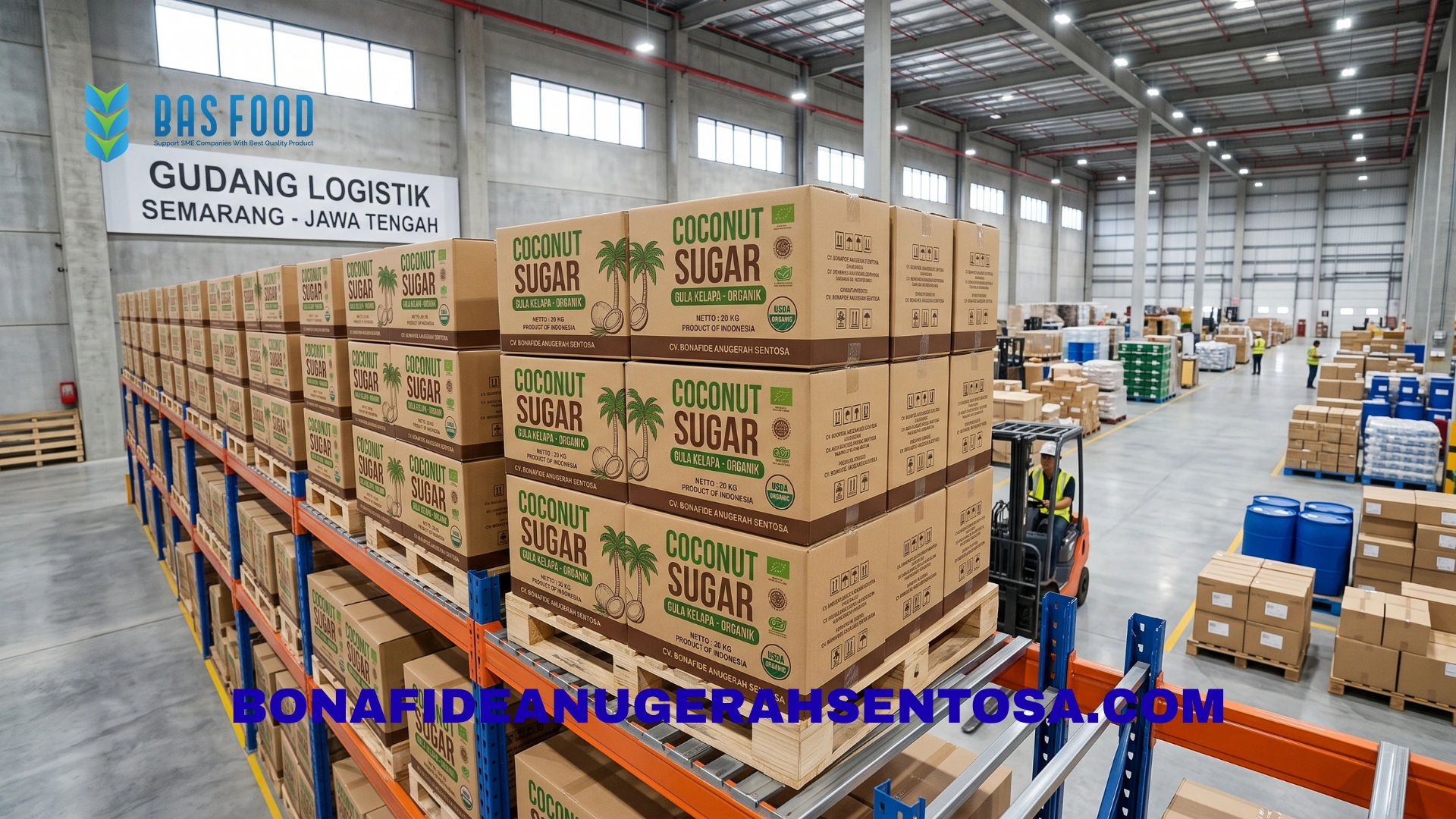
Why Coconut Sugar Granules Storage Matters
Coconut sugar granules are a dry ingredient, which makes them relatively convenient to transport and store. However, “dry” does not mean the product is completely unaffected by its surroundings.
Humidity is one of the main concerns. Coconut sugar can interact with moisture in the surrounding environment, particularly when packaging is opened or damaged. Increased moisture can contribute to clumping and changes in handling characteristics.
For industrial buyers, this can become more than a small warehouse inconvenience. Clumped sugar may be harder to transfer into hoppers, weighing systems, mixers, or other production equipment.
Therefore, proper storage should be part of the purchasing and quality management process from the beginning.
A buyer should consider not only the product specification but also the warehouse, packaging, handling procedures, and expected storage period.
Understanding Coconut Sugar Shelf Life
Shelf life describes the period during which a product is expected to maintain its specified quality under stated storage conditions.
For coconut sugar granules, shelf life depends on the product specification, processing method, packaging, and storage environment.
This means buyers should not assume that every coconut sugar product has exactly the same shelf life.
The manufacturer’s specification and packaging label should always take priority.
Storage conditions also matter. A product kept in a dry, clean, temperature-controlled environment can behave differently from one stored in a hot, humid warehouse with frequent exposure to outside air.
For B2B buyers, the best practice is to request the supplier’s stated shelf life and recommended storage conditions before placing a large order.
Moisture Is the Main Storage Challenge
When discussing coconut sugar granules storage, moisture control should be near the top of the list.
Coconut sugar granules can absorb moisture from humid surroundings. Once moisture enters the product, granules may start sticking together.
The result can range from minor clumping to a more significant handling problem.
This is especially important in tropical regions or warehouses located in areas with high relative humidity.
Even warehouses with good ventilation can experience moisture problems if doors remain open for long periods or if products are exposed to humid outside air.
Therefore, warehouse teams should treat humidity as a quality-control factor rather than simply an environmental condition.
What Happens When Coconut Sugar Absorbs Moisture?
The first visible sign can be clumping.
Instead of flowing freely, individual granules may stick together and form larger lumps.
This can affect weighing and material handling.
In automated factories, consistent flow is especially important. Ingredients often need to move through conveyors, feeders, hoppers, or dosing systems.
A product with excessive clumping may require additional handling before production.
Moisture can also affect the sensory and physical characteristics of a dry ingredient over time.
For this reason, preventing moisture exposure is generally easier than trying to correct the problem after it occurs.
Choosing the Right Warehouse
A good warehouse provides a clean, dry, and controlled environment.
Coconut sugar should ideally be stored away from direct sources of heat, water, and excessive humidity.
The storage area should also be protected from pests and contamination.
Do not place bags directly on a wet floor.
Use suitable pallets or other appropriate warehouse systems to keep packaging elevated and allow practical inspection around stored goods.
The warehouse should also have enough space for workers to inspect, move, and rotate stock safely.
Good organization matters just as much as the physical environment.
Temperature and Humidity Control
Temperature and humidity are closely related in warehouse management.
High temperatures can make warehouse conditions more challenging, especially when combined with high humidity.
For this reason, businesses should follow the supplier’s recommended storage conditions and monitor the warehouse environment where appropriate.
The goal is not necessarily to create an expensive cold-storage facility.
Instead, the priority is to maintain stable, suitable conditions for a dry food ingredient.
A clean and dry warehouse with controlled exposure to humidity can provide a much better environment than a space where temperature and moisture fluctuate significantly.
Packaging Protects the Product
Packaging is the first physical barrier between coconut sugar and the warehouse environment.
A suitable package helps protect the granules from moisture, contamination, physical damage, and handling problems.
For bulk buyers, packaging may include different bag sizes or bulk formats depending on the supplier and application.
The exact packaging specification should be agreed before shipment.
Buyers should ask about the inner liner, outer bag, sealing method, palletization, and container loading where relevant.
These details may appear minor, but they can have a major effect on the condition of the product when it reaches the warehouse.
Inspect Packaging When the Shipment Arrives
Warehouse teams should inspect incoming coconut sugar as soon as practical after delivery.
Look for damaged bags, broken seals, water exposure, unusual staining, or other visible problems.
If packaging has been damaged during transportation, record the condition and follow the company’s receiving procedure.
Do not simply place damaged bags into normal inventory without inspection.
A damaged package can expose the product to humidity and contamination.
Early inspection helps the buyer identify potential issues before the product moves into long-term storage.
Keep Coconut Sugar Away From Water
This sounds obvious, but it is one of the most important rules.
Do not store coconut sugar near leaking pipes, open water containers, wet cleaning areas, or locations that can become flooded.
Warehouse cleaning procedures should also take the product into account.
If floors are washed, make sure stored goods remain protected from water.
Likewise, products should not be placed against walls where condensation or leaks may occur.
Simple physical controls can prevent significant product losses.
Bulk Storage Requires Better Organization
Bulk storage becomes more important when a company purchases coconut sugar in large commercial quantities.
A few bags are relatively easy to manage.
Several pallets or multiple containers require a proper inventory system.
The warehouse should identify each batch clearly.
Use lot numbers, receiving dates, supplier information, and expiry or best-before information where applicable.
This makes stock rotation easier and helps the quality team trace products if an issue occurs.
Use FIFO or FEFO Inventory Rotation
Food manufacturers often use inventory rotation systems such as FIFO or FEFO.
FIFO means “first in, first out.”
FEFO means “first expired, first out.”
The appropriate system depends on the company’s inventory policy and product labeling.
The important point is to avoid leaving older stock forgotten at the back of the warehouse.
When coconut sugar arrives in several shipments, warehouse teams should organize inventory so that older or earlier-dated stock is used according to the company’s approved rotation method.
Good stock rotation can reduce unnecessary losses.
Do Not Open Bulk Packaging Too Early
Coconut sugar generally remains better protected while its original packaging remains properly sealed.
Therefore, warehouse teams should avoid opening bags before the ingredient is needed.
Once a package is opened, the product has greater exposure to the surrounding environment.
In humid locations, even normal warehouse air can introduce moisture over time.
For this reason, only open the amount needed for production or approved repacking activities.
If a package must be opened, reseal it appropriately after use according to the manufacturer’s or company’s food-handling procedure.
Handling Opened Coconut Sugar
Opened coconut sugar requires extra attention.
The remaining product should not simply be left exposed on a production floor.
Keep it in a clean, suitable container or properly resealed original packaging where appropriate.
Make sure the container is food-safe and clearly identified.
The label should preserve important information such as the product name and batch or lot identification.
This is useful for both inventory management and traceability.
The less unnecessary exposure the ingredient has to humid air, the easier it is to maintain its original handling characteristics.
Avoid Extreme Warehouse Conditions
A warehouse does not need to be perfect, but it should be suitable for food ingredients.
Avoid areas with excessive heat, humidity, direct sunlight, water exposure, and poor ventilation.
Also avoid placing coconut sugar close to strong-smelling materials.
Dry food ingredients can sometimes pick up unwanted odors if stored near unsuitable products.
A dedicated or properly segregated ingredient area is often a better choice.
The warehouse should also follow applicable food safety and hygiene procedures.
Prevent Cross-Contamination
Coconut sugar should be protected from contamination by other materials.
This includes chemicals, cleaning products, waste, pests, and unsuitable food ingredients.
Storage areas should remain clean and organized.
Products should be clearly identified.
If a company stores several powdered ingredients, each product should have an appropriate location and labeling system.
This makes warehouse handling safer and reduces the chance of mixing or misidentification.
For food manufacturers, storage is part of the wider food safety system.
Pest Control Matters
Pest control is another basic requirement for food ingredient storage.
Coconut sugar should be stored in a warehouse with an appropriate pest management program.
Regular inspections can help identify problems early.
Keep doors, storage areas, and waste zones properly managed.
Damaged packaging should also be addressed quickly.
Pest prevention works best as a complete system rather than a single treatment.
Cleanliness, packaging integrity, warehouse organization, monitoring, and corrective action should all work together.
Managing Coconut Sugar During International Shipping
Storage does not begin only when the product reaches the buyer’s warehouse.
For international B2B orders, the supply chain may include factory storage, container loading, ocean transport, port handling, customs clearance, and final warehouse storage.
Each stage can expose the product to different conditions.
Packaging therefore needs to be suitable for the intended logistics process.
Buyers should discuss export packaging with their coconut sugar granules supplier, especially when shipping large quantities internationally.
Container loading should also be handled carefully to reduce the risk of water exposure and physical damage.
Why Container Conditions Matter
Shipping containers can experience temperature and humidity changes during international transport.
These changes can create challenging conditions for dry food ingredients.
The exact risk depends on route, season, container condition, packaging, transit time, and other logistics factors.
For this reason, export packaging should be selected based on the actual supply chain.
Buyers can discuss packaging specifications and loading practices with their supplier and logistics provider.
It is also useful to inspect the container before loading to make sure it is clean, dry, odor-free, and suitable for food cargo.
Palletizing Coconut Sugar for B2B Storage
Pallets can make bulk inventory easier to handle.
They allow warehouse teams to move multiple bags using forklifts or pallet jacks rather than handling every bag individually.
However, palletization should not block airflow or create unsafe stacking conditions.
The supplier and buyer should agree on pallet requirements where applicable.
Consider pallet dimensions, bag arrangement, maximum stack height, wrapping, labeling, and container loading.
The exact configuration depends on the product, packaging, warehouse equipment, and shipping requirements.
How Humidity Affects Different Forms of Coconut Sugar
Coconut sugar can be supplied in several physical forms, including granules and powder.
Fine powders generally have different handling characteristics from larger granules because their surface area and flow behavior can differ.
This does not mean one form is automatically better.
Instead, the storage strategy should match the actual product.
A buyer purchasing fine coconut sugar powder may need to pay particularly close attention to packaging and humidity exposure.
A granulated product may have different flow characteristics, but it still requires moisture protection.
Always follow the supplier’s specific product specification.
Storage Requirements for Food Manufacturers
Food manufacturers should connect warehouse storage with their production schedule.
If coconut sugar is going into production within a short period, inventory may not need to remain in storage for an extended time.
However, seasonal purchasing or large-volume procurement can create longer storage periods.
In that case, warehouse planning becomes more important.
Procurement teams should consider expected consumption, lead time, safety stock, shelf life, warehouse capacity, and production schedules.
This can help prevent both stock shortages and excessive inventory.
How to Monitor Stored Coconut Sugar
Regular inventory checks can help detect problems early.
Warehouse teams can inspect packaging, labels, physical condition, and storage surroundings.
If the business has an environmental monitoring system, humidity and temperature records can also provide useful information.
The frequency of checks should follow the company’s food safety and quality procedures.
The goal is simple: identify changes before they become major problems.
If bags start showing moisture damage or granules begin clumping, investigate the cause rather than simply moving the stock.
Working With CV Bonafide Anugerah Sentosa
CV Bonafide Anugerah Sentosa can be considered as a potential Indonesian source for coconut sugar and related products.
For buyers planning commercial purchases, it is useful to discuss storage requirements before finalizing the order.
Ask the company to confirm the current product specification, stated shelf life, packaging format, recommended storage conditions, MOQ, production capacity, batch identification, export packaging, and shipping requirements.
Buyers should also confirm whether the selected product is available as coconut sugar granules and whether the proposed packaging suits their warehouse and production system.
Because product specifications can change, buyers should use the latest information provided directly by the supplier for commercial purchasing decisions.
Conclusion: Protect the Sugar After It Reaches Your Warehouse
Proper coconut sugar granules storage is an important part of B2B ingredient management.
Coconut sugar may be a dry ingredient, but it still needs protection from moisture, water, contamination, pests, heat, packaging damage, and poor inventory practices.
For most buyers, moisture control deserves special attention.
Humidity can contribute to clumping and make the ingredient more difficult to handle. Therefore, businesses should maintain suitable warehouse conditions, keep packaging intact, avoid unnecessary exposure, and follow the supplier’s storage recommendations.
Shelf life should also be treated as a specification rather than a universal number. The correct shelf life depends on the product and packaging, so buyers should confirm the current information with their supplier.
For businesses purchasing large quantities, bulk storage requires additional planning. Batch identification, palletization, inventory rotation, receiving inspection, and warehouse organization can all contribute to better stock management.
Choosing the right supplier also helps.
A reliable coconut sugar supplier should be able to explain its product specifications, packaging, shelf life, storage recommendations, and batch information.
For buyers considering CV Bonafide Anugerah Sentosa, the company can be evaluated as a potential Indonesian coconut sugar source. Buyers should confirm current specifications, packaging, availability, storage recommendations, production capacity, MOQ, and export requirements directly with the company before purchasing.
In the end, good coconut sugar management does not stop when the container reaches your warehouse.
It continues until the last bag enters production.
When product quality, suitable packaging, dry storage, careful handling, and proper inventory control work together, businesses can protect their coconut sugar investment and maintain a more reliable ingredient supply.