
The Middle East offers opportunities for international food ingredient suppliers. Food manufacturers, distributors, bakeries, confectionery producers, and foodservice businesses need dependable ingredients that meet their quality standards and production requirements. For importers exploring vegetable oils, coconut oil can be an option worth evaluating. RBD coconut oil for Middle East markets is particularly relevant for buyers seeking refined coconut oil for selected food manufacturing applications. RBD stands for Refined, Bleached, and Deodorized. These processing stages help reduce unwanted impurities, color, and strong odors, producing an oil with a relatively mild flavor.
Depending on its specifications, RBD coconut oil may be suitable for bakery products, confectionery fillings, coatings, and other processed foods. Its distinctive melting behavior and fatty acid composition also make it different from many other vegetable oils.
However, importing edible oil into the Middle East involves more than finding a competitive price. Buyers must consider local food regulations, product specifications, packaging, shipping conditions, customs procedures, and supplier reliability.
This guide explains how importers can evaluate RBD coconut oil, plan purchases, understand market requirements, and explore Indonesian sourcing opportunities.
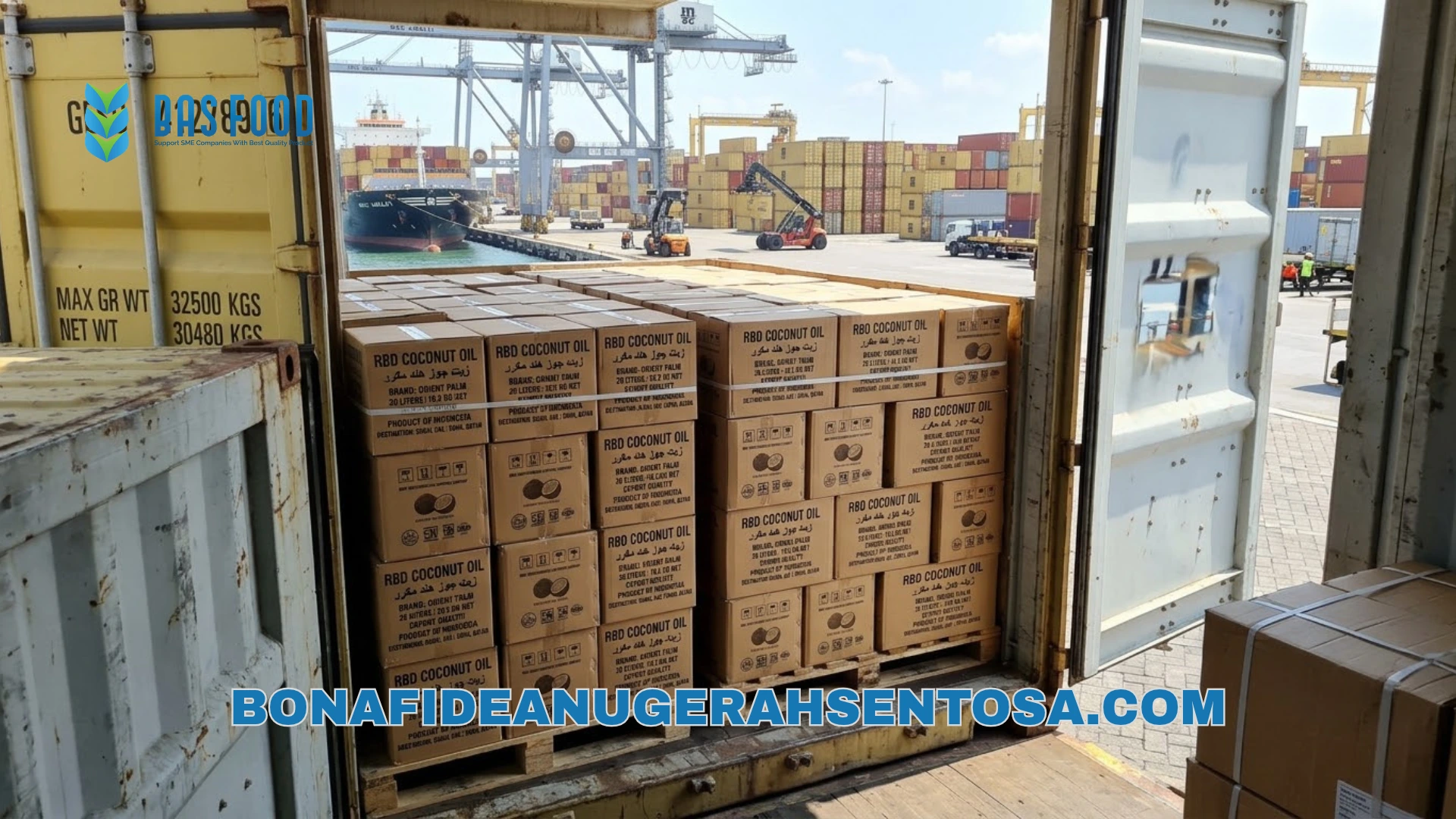
Understanding the Middle East Edible Oil Market
The Middle East is not one uniform market. Countries differ in their food manufacturing sectors, import procedures, distribution networks, labeling rules, and consumer preferences.
Saudi Arabia and the United Arab Emirates, for example, serve as important commercial destinations for many food products and ingredients. Other regional markets may offer opportunities depending on the buyer’s product category, business network, and distribution strategy.
For businesses evaluating the Saudi Arabia edible oil market, the first step is to identify the intended customer segment.
A food manufacturer may require bulk oil with precise technical specifications. A distributor may prioritize packaging, shelf-life documentation, and reliable replenishment. Meanwhile, a foodservice supplier may need formats suited to commercial kitchens.
Identify the right application before purchasing
RBD coconut oil should be evaluated according to the product a buyer plans to manufacture.
Bakery businesses may focus on texture and handling. Confectionery producers may prioritize melting characteristics and fat compatibility. Processed food manufacturers may assess flavor neutrality and performance under specific operating conditions.
Not every business needs the same oil specifications.
Therefore, buyers should define the application, estimated volume, packaging format, and required quality parameters before requesting quotations.
This approach helps prevent mismatches between the supplier’s product and the buyer’s production requirements.
Why Consider Indonesia as a Sourcing Origin?
Indonesia has an established coconut industry and supplies coconut-derived products to international markets. Its agricultural supply chain includes products such as coconut oil, coconut sugar, and other coconut-based ingredients.
For importers, Indonesia may provide opportunities to diversify sourcing and build relationships with suppliers closer to the raw material’s origin.
However, sourcing from a major coconut-producing country does not automatically guarantee that every exporter offers the same product quality, certifications, or production capacity.
Each supplier must be evaluated individually.
Assess the supplier, not just the country
When comparing Indonesian suppliers, importers should examine product specifications, available laboratory results, packaging options, communication, and export experience.
They should also confirm whether the supplier can meet the destination market’s requirements.
For example, a buyer importing food-grade oil into Saudi Arabia may need documentation and product information suitable for the applicable Saudi regulatory process.
Another buyer importing into the UAE may need to confirm requirements with the relevant local authorities and importer.
By checking these details early, businesses can reduce avoidable delays and make more informed purchasing decisions.
RBD Coconut Oil Applications in Middle Eastern Food Manufacturing
RBD coconut oil can be considered for several food manufacturing applications, although suitability depends on the formulation and product specifications.
Its relatively neutral flavor makes it useful in selected products where manufacturers do not want a pronounced coconut aroma.
Bakery products
Bakeries and industrial bakery manufacturers use fats to influence texture, tenderness, mouthfeel, and processing performance.
RBD coconut oil may be evaluated for selected biscuits, cookies, cake formulations, fillings, and other baked products.
However, coconut oil does not behave exactly like butter or every type of shortening. Its melting characteristics may require adjustments to mixing, cooling, and storage conditions.
Manufacturers should test the oil in their actual recipes before introducing it into regular production.
Confectionery and dessert products
Confectionery manufacturers may evaluate RBD coconut oil for selected fillings, coatings, and fat-based dessert applications.
Its melting behavior can influence firmness and mouthfeel. However, standard RBD coconut oil is not automatically interchangeable with cocoa butter or specialized confectionery fats.
Compatibility testing is essential, particularly when the finished product needs a specific texture or resistance to heat.
Processed foods
Some processed food manufacturers may consider RBD coconut oil for selected cooking, frying, or coating applications.
Its suitability depends on operating temperature, product design, oil management, and the expected storage period.
Manufacturers should validate its performance under real production conditions instead of assuming that it suits every industrial process.
Quality Specifications Middle Eastern Importers Should Check
Before purchasing RBD coconut oil, importers should establish clear product specifications.
A product’s appearance alone cannot confirm its identity, quality, or suitability for food production. Technical testing and documentation provide a more reliable basis for supplier evaluation.
Common quality parameters include:
| Parameter | Why it matters |
|---|---|
| Free fatty acid (FFA) content | Helps evaluate refining quality and hydrolytic deterioration |
| Peroxide value | Indicates certain early-stage oxidation products |
| Moisture and volatile matter | Helps assess water and volatile content |
| Color | Supports appearance consistency |
| Odor and flavor | Helps confirm acceptable sensory characteristics |
| Fatty acid composition | Supports product identity and formulation decisions |
| Melting characteristics | Helps predict handling and processing behavior |
| Contaminant testing | Supports food safety and regulatory compliance |
The acceptable limits should be agreed upon in the purchase specification and comply with the applicable destination-market requirements.
Request supporting documentation
Importers should request a product specification sheet and, where available, a batch-specific certificate of analysis.
Additional information may include ingredient declarations, origin details, relevant food safety documentation, and available test results for contaminants associated with oil refining.
Certifications can support supplier assessment, but buyers should verify the issuing body, validity, and product or facility scope.
No certificate should be assumed to cover every regulatory requirement in the destination market.
Import Planning: From Supplier Inquiry to Shipment Arrival
Successful import planning starts before the purchase order is issued.
Importers should define their target volume, delivery schedule, destination port, packaging requirements, and acceptable product specifications.
They should then compare supplier quotations using consistent assumptions. A low unit price may not result in the lowest total cost once freight, insurance, customs charges, and inland transportation are included.
Calculate the full landed cost
The landed cost may include:
- Product price.
- Export packing and handling.
- International freight.
- Cargo insurance, where applicable.
- Customs duties.
- Import VAT or other applicable taxes.
- Customs clearance and port charges.
- Inland transportation and warehouse handling.
The exact costs depend on the importing country, product classification, shipment terms, and transaction details.
Buyers should confirm the correct customs classification and applicable duty rate before finalizing their budget.
Choose suitable Incoterms
International contracts often use Incoterms such as FOB or CIF, depending on the commercial arrangement.
These terms help define the responsibilities of the buyer and seller for transportation, costs, and transfer of risk.
Importers should confirm which party arranges freight, which party obtains insurance where applicable, and who handles export and import clearance.
Clear written terms help avoid misunderstandings when the shipment is ready to move.
Food Safety and Import Regulations in the Middle East
Food safety requirements differ between Middle Eastern countries. Importers should identify the rules that apply to their destination rather than treating the region as a single regulatory area.
For Saudi Arabia, buyers should check the current requirements of the Saudi Food and Drug Authority (SFDA) and relevant customs authorities.
For the UAE, importers should confirm applicable federal and local food control procedures, including registration or documentation requirements that apply to their product and shipment.
Other destinations may have their own competent authorities, import permits, and product registration systems.
What should importers verify?
Before shipping, buyers should confirm whether the product needs registration, specific declarations, laboratory testing, or other supporting documents.
They should also check applicable rules for product labeling, packaging, shelf life, and country-of-origin information.
Depending on the transaction and destination, relevant documents may include a commercial invoice, packing list, bill of lading, certificate of origin, certificate of analysis, and other required declarations.
Not every shipment requires the same set of documents. The final checklist should come from the importer and relevant authorities or customs broker.
Plan for halal-related requirements when relevant
For food manufacturers serving halal-certified markets or customers, halal-related requirements may also form part of supplier approval.
Importers should verify whether certification is required for their particular product, manufacturing process, or customer contract.
They should not assume that a supplier holds a halal certificate without checking the actual documentation and scope.
Early verification can prevent costly delays and reduce compliance risks.
Packaging, Temperature, and Shipping Considerations
Packaging protects RBD coconut oil from contamination and damage during transportation. The most suitable format depends on order size, logistics arrangements, and the buyer’s storage facilities.
Depending on supplier capabilities, options may include drums, intermediate bulk containers, flexitanks, or other suitable food-grade packaging systems.
Importers should confirm packaging availability, material suitability, closure integrity, and compatibility with the intended transport method.
Prepare for temperature changes
Although the Middle East is associated with hot weather, shipments can encounter different temperatures during ocean transit, port handling, air-conditioned storage, and inland delivery.
Coconut oil may solidify or become semi-solid when temperatures fall below its melting range. This is a physical characteristic and does not automatically mean the oil has spoiled.
However, solidification may affect pumping, unloading, and transfer into production equipment.
Importers should ask the supplier for suitable handling instructions and determine whether controlled warming is needed before use.
Avoid unnecessary overheating
Heating may help return solidified coconut oil to a liquid state, but it should be controlled.
Excessive heat or prolonged exposure to elevated temperatures can contribute to quality deterioration.
Warehouses and manufacturers should follow suitable temperature management procedures and avoid uncontrolled heating.
Before dispatch, the buyer and supplier should agree on packaging, loading conditions, storage instructions, and any special handling requirements.
Choosing a Reliable Coconut Oil Supplier
Selecting a dependable coconut oil supplier is essential for long-term procurement.
Importers should evaluate more than price. Product consistency, documentation, communication, production availability, and delivery reliability all influence the success of an international supply relationship.
Questions to ask before ordering
Before approving a supplier, buyers should ask:
- Is food-grade RBD coconut oil currently available?
- What specifications and laboratory results can be provided?
- Which packaging formats are available?
- What minimum order quantity applies?
- What shelf-life and storage information is provided?
- Which export documents can the supplier supply?
- What are the estimated production and shipping lead times?
- How does the supplier handle quality complaints?
- Can samples be provided for product testing?
- Which certifications, if any, are valid for the product and facility?
These questions help importers compare suppliers using practical evidence.
For important or recurring purchases, buyers may also consider independent testing, supplier audits, and written quality agreements.
Exploring Indonesian Coconut Products with CV Bonafide Anugerah Sentosa
CV Bonafide Anugerah Sentosa operates in Indonesia’s agricultural commodity supply and export sector, including coconut-derived products.
Businesses interested in sourcing RBD coconut oil can contact the company to confirm current product availability, technical specifications, packaging options, and export arrangements.
Importers should provide their destination country, intended application, expected order volume, and required documentation. This information helps establish whether the proposed product and commercial terms match their needs.
The company may also be relevant to businesses searching for a coconut sugar exporter supplier or coconut sugar supplier.
However, coconut sugar and RBD coconut oil serve different purposes. Coconut sugar is a sweetening ingredient, while coconut oil provides fat and influences texture and melting behavior.
Buyers should request separate specifications and verify availability for each product rather than assuming that all coconut-derived products are offered under identical terms.
Make your supplier inquiry more effective
A detailed inquiry can speed up the sourcing process.
Include the required product, destination port, target volume, packaging preference, desired specifications, and estimated purchase schedule.
If your business has a technical specification sheet, share it with the supplier. You can also ask about samples and the documents available for import clearance.
Finally, confirm pricing validity, payment terms, production lead time, and shipment responsibilities in writing before placing the order.
Conclusion: A Smarter Route to RBD Coconut Oil Imports
Sourcing RBD coconut oil for Middle East markets requires careful attention to product specifications, food safety, import regulations, shipping conditions, and supplier reliability.
Indonesia offers potential sourcing opportunities because of its established coconut industry. Nevertheless, importers must assess individual suppliers and confirm that each product meets their intended application and destination-market requirements.
For businesses evaluating the Saudi Arabia edible oil market or other regional opportunities, effective import planning should begin with clear specifications, verified documentation, and a realistic landed-cost calculation.
Temperature management and appropriate packaging are also important because coconut oil can solidify during transportation or storage.
For international buyers exploring Indonesian coconut-derived ingredients, CV Bonafide Anugerah Sentosa can be contacted to discuss current product availability and export requirements.
With thorough preparation and clear supplier communication, businesses can make better sourcing decisions and build more reliable international supply relationships.