
Sourcing palm sugar sounds simple. Find a supplier, request a price, order the product, and arrange shipping. In practice, international palm sugar sourcing is more complex. Buyers need to consider raw material supply, processing, product specifications, quality consistency, packaging, documentation, logistics, and long-term availability.
For food manufacturers, distributors, retailers, and importers, choosing the right supplier can directly affect production costs and product quality. A low initial price may look attractive, but it does not always mean lower total purchasing costs. Delayed shipments, inconsistent granulation, high moisture, unsuitable packaging, or incomplete documents can create much bigger problems later.
Indonesia is an important origin for palm-based sweeteners. The country has a long tradition of processing palm sap into sugar and has developed an export supply chain serving international food businesses. As a result, companies looking for a palm sugar supplier can find several sourcing options in Indonesia.
This guide explains how to approach palm sugar sourcing more professionally. It covers supplier selection, procurement planning, quality control, common supplier mistakes, product formats, import strategy, and long-term supply management.
Why Palm Sugar Sourcing Requires a Clear Strategy
The first mistake buyers make is treating palm sugar like a simple commodity. While price is certainly important, the product has several characteristics that can affect its suitability for manufacturing and distribution.
Palm sugar can vary in color, aroma, flavor, moisture, texture, particle size, and processing method. These differences may be acceptable for one application but unsuitable for another. For example, a food manufacturer using palm sugar in a dry beverage mix may have different requirements from a bakery or sauce producer.
Therefore, effective palm sugar sourcing begins with a product specification. Before contacting suppliers, buyers should define what they actually need. The specification can include product form, granule size, moisture target, color, flavor profile, packaging, shelf life, quantity, and destination market.
This approach makes supplier comparison much easier. Instead of asking several companies for their “best palm sugar price,” buyers can ask each supplier to quote against the same requirements.
A clear specification also reduces misunderstandings. If the buyer needs a particular palm sugar granule size, for example, the supplier should know this before preparing a sample or quotation.
Understand the Indonesian Palm Sugar Supply Chain
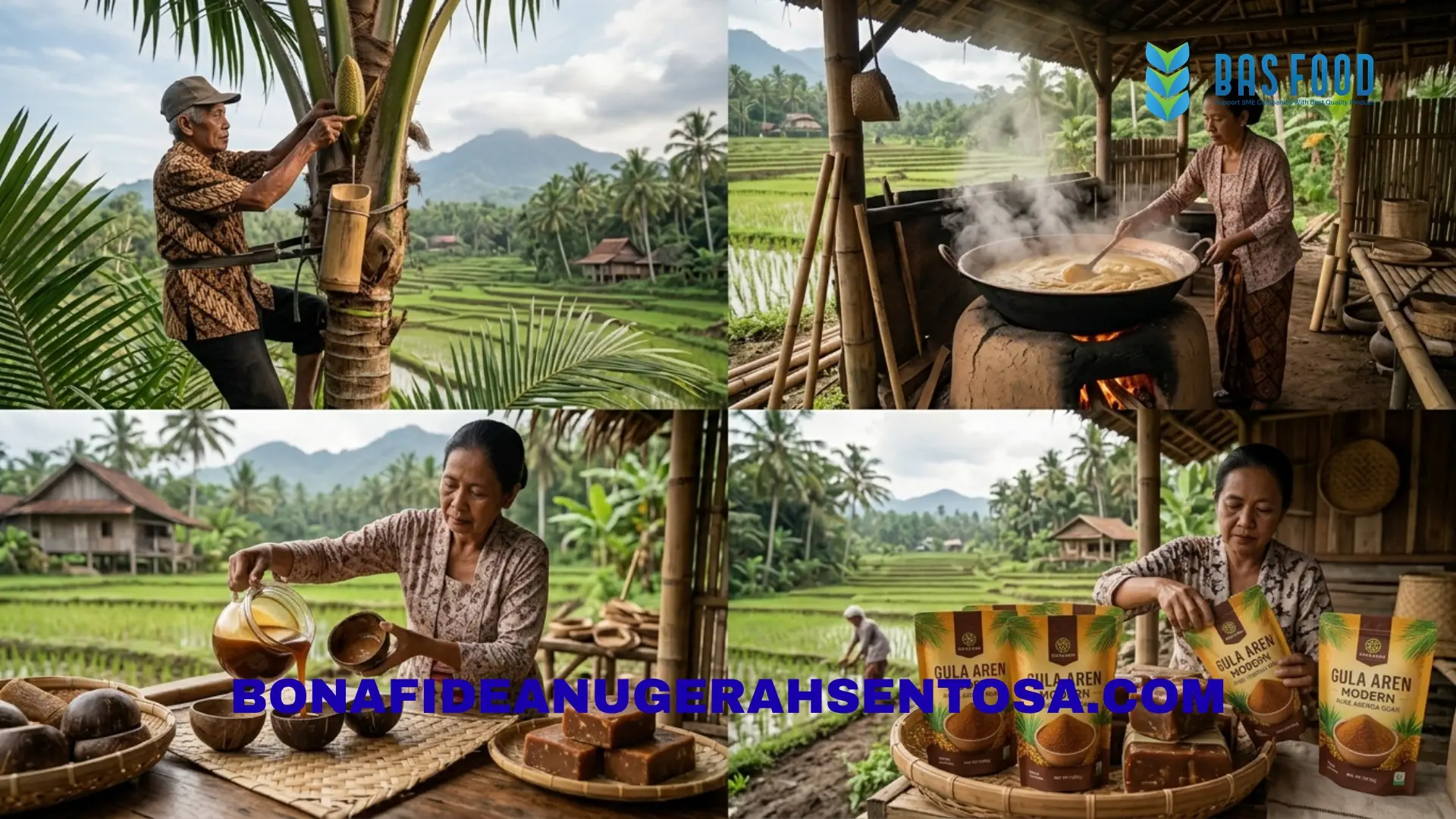
Indonesia’s palm sugar supply chain often begins with smallholder farmers. Farmers collect sap from palm trees and process it into a concentrated sweetener. Depending on the production system, the product may pass through several stages before reaching an exporter.
This structure gives Indonesian palm sugar its traditional character, but it can also create challenges for consistency. Agricultural products naturally experience variation. Weather, harvesting conditions, raw material quality, processing temperature, storage, and handling can influence the final product.
For international buyers, understanding this supply chain is useful because it helps explain why supplier management matters. A professional palm sugar exporter needs a reliable sourcing network and quality control process.
Buyers should therefore ask suppliers how they manage raw materials. They can ask whether the supplier works directly with farmers, uses collection networks, operates its own processing facility, or combines several sourcing channels.
None of these models is automatically better. What matters is whether the supplier can maintain the agreed specification and supply volume.
Factory Direct or Trading Company?
One of the common questions in palm sugar sourcing is whether buyers should purchase factory direct or through a trading company.
A factory-direct arrangement can provide greater visibility into production. Buyers may communicate directly with the processor, discuss product specifications, request customized packaging, and better understand production capacity.
However, factory direct is not automatically the best option. A factory may produce good palm sugar but have limited export experience. Another supplier may work with several production facilities and have stronger international logistics and documentation capabilities.
Therefore, buyers should evaluate the complete service rather than focusing only on the phrase “factory direct.”
A strong palm sugar supplier should be able to explain where the product comes from, how quality is controlled, what formats are available, and how the supplier handles international shipments.
For larger buyers, the best supplier may be the company that combines reliable production with strong export management. This can reduce the amount of coordination required between the buyer and multiple parties.
Choosing the Right Palm Sugar Format
Palm sugar is not available in only one form. The best format depends on how the buyer intends to use the product.
Molded palm sugar may be suitable for traditional food applications, foodservice, or retail products. Powder can work well in some dry formulations. Granulated palm sugar is often convenient for manufacturers because it can be weighed, blended, and dosed relatively easily.
Palm sugar granule specifications deserve particular attention. Particle size can affect mixing, dissolution, packaging, and production efficiency.
For example, a beverage manufacturer may want a smaller particle size to improve dissolution. A bakery manufacturer may prefer another size because the sugar will be blended with dry ingredients.
Buyers should not assume that “granulated” means the same thing across suppliers. Always request the actual specification and sample.
The same principle applies to coconut sugar granule. Buyers sourcing both palm sugar and coconut sugar should keep separate product specifications because the two ingredients come from different raw materials and can have different characteristics.
Quality Control: What Buyers Should Check
Quality control is one of the most important parts of international sourcing. A product can look good in a photograph but still fail to meet a manufacturer’s requirements.
Start with a physical sample. Evaluate color, aroma, taste, texture, moisture, cleanliness, and particle size. If the product will be used in a specific formulation, testing it in the actual application can provide even better information.
For industrial buyers, laboratory data may also be important. Depending on the destination market and application, buyers may request microbiological analysis, nutritional information, product specifications, or other technical documents.
Moisture deserves particular attention. High moisture can affect flowability and storage characteristics, while inconsistent moisture between batches can create problems in production.
The buyer and supplier should agree on acceptable specifications before commercial production. Ideally, the approved sample and written specification become references for future shipments.
This creates a more objective quality-control system. Instead of debating whether one shipment “looks different,” both sides can compare the shipment against an agreed standard.
How to Avoid Supplier Mistakes Before Ordering
Supplier verification should happen before the purchase order, not after the shipment arrives.
Start by checking the supplier’s business profile and export experience. Ask how long the company has supplied palm sugar and which markets it serves. You can also request product samples and supporting documents.
For larger orders, buyers can consider a supplier audit or third-party inspection. The level of verification should match the size and risk of the purchase.
Communication is another useful indicator. If a supplier cannot clearly answer basic technical questions before receiving an order, the relationship may become even more difficult after the purchase.
Buyers should also ask how the supplier handles problems. A strong supplier should have a clear process for addressing quality deviations, damaged packaging, shortages, or shipment delays.
In other words, supplier evaluation should look at both the product and the business relationship.
Creating an Effective Import Strategy
A good import strategy starts with understanding the entire cost of bringing palm sugar into the destination market.
The purchase price is only one component. Buyers should also consider packaging, inland transportation, export documentation, freight, insurance where applicable, customs charges, duties or taxes where applicable, port fees, inspection costs, warehousing, and local distribution.
This is why comparing suppliers only by FOB or EXW price can be misleading. The lowest quoted product price may not result in the lowest landed cost.
Buyers should ask suppliers for clear shipping terms and confirm the destination port. Then, they can compare the estimated landed cost between suppliers.
Lead time should also be included in the import strategy. If the buyer’s factory requires continuous production, a delayed shipment can cause production problems that are more expensive than a small difference in purchase price.
For regular buyers, maintaining a safety stock can also reduce supply risk. The right inventory level depends on demand, shipping time, storage capacity, and product shelf life.
Packaging Matters More Than Many Buyers Expect
Packaging protects the product throughout transportation and storage. It also affects warehouse handling and the final cost of distribution.
Industrial buyers should discuss packaging materials, bag sizes, inner liners, carton requirements, palletization, and container loading with their supplier.
For palm sugar granules, moisture protection is especially important. Packaging should help prevent unwanted moisture exposure during transportation and storage.
Buyers should also consider how the product will be handled after arrival. If the product goes directly into a factory, large food-grade bags may be practical. If it will be distributed to smaller customers, smaller packages may be more suitable.
Retail and private-label buyers have additional considerations. Packaging may need consumer information, lot numbers, product weight, storage instructions, barcode requirements, and destination-market labeling.
Therefore, packaging should be included in the purchasing specification from the beginning.
Documentation and Compliance for International Buyers
International food ingredient purchases require more than a commercial invoice. The exact documentation depends on the destination country, product classification, customer requirements, and applicable regulations.
Common export documents can include commercial invoices, packing lists, bills of lading or other transport documents, certificates of origin, and relevant food safety or inspection documents.
Some buyers may also request certificates or laboratory reports based on their internal quality systems or destination-market requirements.
The key point is to discuss documentation before shipment. Buyers should provide the supplier with a list of required documents at the quotation or purchase-order stage.
This prevents a common problem where the product is ready to ship but a required document has not been prepared.
A professional palm sugar exporter should be comfortable discussing export documentation and coordinating with the buyer’s logistics team.
Palm Sugar Sourcing for European, American, and Asian Markets
Different international markets can have different purchasing priorities. A buyer in Europe may focus heavily on traceability, labeling, certifications, and sustainability information.
An American importer may have different requirements related to food labeling, importer responsibilities, product documentation, and supply-chain reliability.
Asian markets can also vary considerably. Some buyers may prioritize traditional flavor and product authenticity, while industrial food manufacturers may focus more on consistency, granulation, and price.
Therefore, suppliers should not use a one-size-fits-all approach. Buyers should explain the final application and destination market before requesting a quotation.
This allows the supplier to provide more relevant information and reduces the chance of receiving an unsuitable product.
For companies that source multiple ingredients, the same principle applies to a coconut sugar supplier. A supplier should understand the buyer’s target market and intended application rather than simply offering a standard catalogue product.
Building a Long-Term Relationship With a Palm Sugar Supplier
A successful first shipment is only the beginning. For manufacturers and distributors, the real value comes from building a stable supply relationship.
Once a supplier has passed the initial evaluation, buyers can establish an annual or rolling purchasing forecast. This gives the supplier better visibility and can help with production planning.
Buyers should also maintain a consistent specification. Changing product requirements from one order to another can make it harder for suppliers to maintain consistency.
Regular communication is useful as well. Buyers can share demand forecasts, expected order dates, packaging changes, and new product requirements.
In return, suppliers should communicate important changes in production, raw material availability, lead times, or logistics.
This creates a more predictable supply chain. Both sides understand what is expected and can prepare for changes before they become urgent problems.
CV Bonafide Anugerah Sentosa as an Indonesian Supply Option
For buyers exploring Indonesian palm sugar sourcing, CV Bonafide Anugerah Sentosa is an Indonesian exporter associated with coconut sugar, palm sugar, and other agricultural commodities. Its wider business context also includes spices, fishery products, and coffee.
For B2B buyers, the best way to evaluate a potential supplier is to provide detailed purchasing requirements. Instead of requesting only a price, buyers can provide the desired palm sugar format, quantity, packaging, destination country, application, and documentation requirements.
This gives the supplier a clearer understanding of the project and allows both sides to discuss the right specification.
Buyers should confirm current product availability, MOQ, packaging, lead time, certifications, specifications, and shipping terms directly before placing a commercial order.
For companies sourcing both palm sugar and coconut sugar, discussing both requirements with one experienced Indonesian exporter may also simplify supplier evaluation and communication.
Conclusion: Make Palm Sugar Sourcing a Process, Not a Guess
Successful palm sugar sourcing starts with a clear understanding of what you need. Instead of choosing a supplier based only on price, buyers should evaluate product quality, consistency, packaging, documentation, production capacity, logistics, and communication.
A strong procurement process can prevent many common supplier mistakes. Start with a specification, request samples, compare suppliers fairly, calculate landed costs, confirm documentation, and establish quality standards before placing a large order.
For international buyers, the right palm sugar supplier should function as more than a seller. A dependable palm sugar exporter should help create a supply chain that works from the Indonesian production source to the buyer’s warehouse or factory.
Whether you need palm sugar for bakery products, beverages, sauces, confectionery, foodservice, or retail, careful supplier selection can reduce purchasing risk and support consistent production.
For companies also sourcing coconut-based sweeteners, an experienced coconut sugar supplier can provide another option for building a broader ingredient portfolio.
Ultimately, the best palm sugar sourcing strategy is simple: define your requirements, verify your suppliers, test the product, understand the total cost, and build relationships with suppliers that can support your business for the long term.