
The global food ingredient market continues to create opportunities for buyers looking for alternative sweetening ingredients with a distinctive flavor and practical applications. Among the products gaining attention is coconut sugar syrup, a liquid sweetener made from coconut-derived raw materials and used across beverages, bakery products, sauces, desserts, and other food applications. For importers, however, buying coconut sugar syrup involves more than finding a product and agreeing on a price. Buyers also need to understand product specifications, supplier capabilities, packaging, documentation, shipping, quality control, and the import procedure in their destination country.
Indonesia is an important sourcing country to consider because coconut production is closely connected to rural farming communities and a well-established coconut processing sector. Therefore, buyers searching for Indonesian coconut syrup can work directly with exporters and suppliers that understand international trade requirements.
This guide explains how to import coconut sugar syrup, what to check before placing an order, and how to evaluate an export supplier for long-term B2B sourcing.
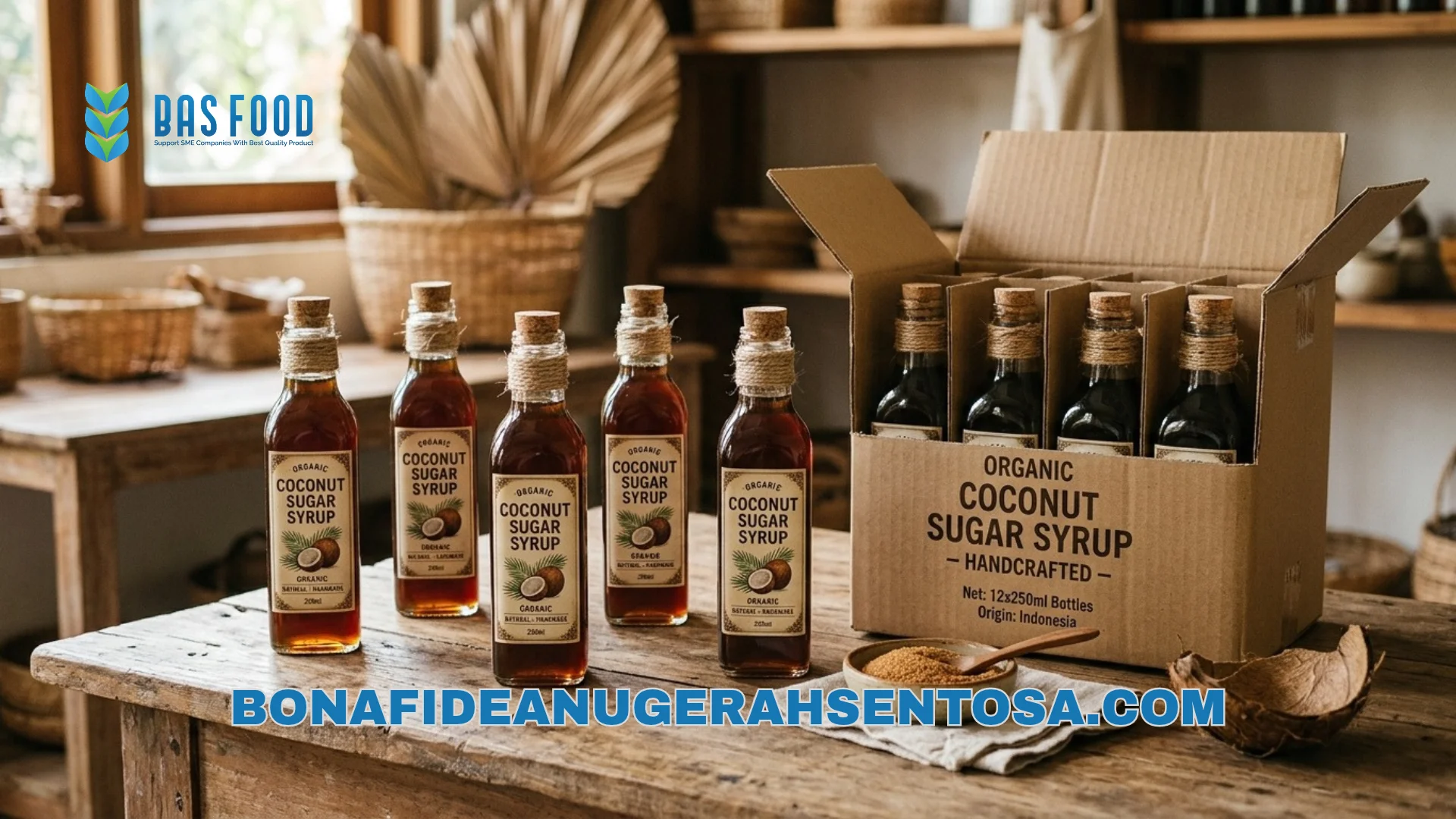
What Is Coconut Sugar Syrup?
Coconut sugar syrup is a liquid sweetener produced from coconut-derived sugar materials. Depending on the producer and processing method, the product may have a brown to dark amber appearance, a characteristic caramel-like flavor, and a smooth liquid texture.
The exact characteristics can vary between suppliers. For that reason, buyers should not rely only on the product name. A professional purchasing process should use a technical specification sheet to define important characteristics such as appearance, flavor, viscosity, moisture or soluble solids, packaging format, shelf life, and applicable food safety requirements.
Coconut sugar syrup can be used in many food and beverage applications. Beverage manufacturers may use it in coffee, tea, smoothies, flavored drinks, and other formulations. Meanwhile, food manufacturers can incorporate it into sauces, dressings, bakery products, desserts, and specialty food products.
For international buyers, this versatility makes coconut sugar syrup more than a retail sweetener. It can function as a food ingredient that becomes part of a larger formulation.
Why Import Coconut Sugar Syrup From Indonesia?
Indonesia has a strong connection with coconut production, making it an interesting sourcing market for international buyers. Coconut-related products are produced across several regions, while local processing knowledge has developed around products made from coconut sap and other coconut materials.
When buyers search for Indonesian coconut syrup, they should look beyond the country of origin. The real objective is to find a supplier that can provide consistent specifications, communicate clearly, prepare export documentation, and support repeat orders.
Indonesia can also be relevant for buyers looking for different packaging and product formats. Depending on the supplier, coconut sugar syrup may be available for foodservice, wholesale distribution, ingredient manufacturing, or private-label projects.
However, country of origin alone does not guarantee product suitability. Buyers should still evaluate the individual supplier, production process, quality controls, specifications, packaging, and export experience before making a purchasing decision.
Understanding the Coconut Sugar Syrup Supply Chain
Before you import coconut sugar syrup, it helps to understand how the product moves from its source to the final buyer.
The process generally starts with raw material sourcing. Coconut-derived raw materials are collected and processed before being converted into a syrup product. The syrup then goes through processing and quality control before being packed for domestic or international distribution.
For export orders, the supply chain continues with packaging, labeling, documentation, transportation to the port, customs procedures, international shipping, destination clearance, and final delivery.
Because several stages are involved, a problem at one stage can affect the entire order. For example, unsuitable packaging may create leakage risks during transportation. Incomplete documents can delay customs clearance. Differences between the approved sample and production batch can also create problems for food manufacturers.
Therefore, importers should evaluate the complete supply chain rather than focusing only on the product price.
What Should Buyers Check Before Importing?
One of the most important steps when you import coconut sugar syrup is defining your product requirements before requesting quotations.
Start with the intended application. A syrup intended for beverages may have different technical requirements from a syrup used in bakery products or sauce production. Your supplier needs to understand how you plan to use the ingredient so both sides can discuss the appropriate specifications.
Next, create a clear product specification. Depending on the application, buyers may need information about appearance, color, flavor, aroma, viscosity, soluble solids or Brix, moisture, microbiological parameters, packaging, shelf life, and storage conditions.
Do not assume that every supplier uses the same specifications. Terms such as “natural,” “premium,” “organic,” or “high quality” can have different meanings in commercial discussions. A written specification is much more useful because it gives both buyer and supplier a measurable reference.
Key Product Information to Request
Before approving a supplier, buyers can request:
- Product specification sheet
- Ingredient information
- Appearance and color description
- Flavor and aroma profile
- Viscosity specification, where applicable
- Soluble solids or Brix specification, where applicable
- Microbiological requirements
- Shelf-life information
- Storage recommendations
- Packaging details
- Product sample
- Certificate of Analysis, where applicable
- Food safety documentation, where applicable
- Export documentation information
These documents help purchasing teams compare suppliers using the same criteria.
How to Find a Reliable Coconut Sugar Supplier
Finding a coconut sugar supplier is relatively easy. Finding one that fits your long-term procurement requirements requires more work.
Start by examining the supplier’s product information. A professional supplier should be able to explain the product clearly and answer technical questions without relying entirely on generic marketing descriptions.
Communication is another important factor. International sourcing involves different time zones, shipping schedules, documentation requirements, payment procedures, and production planning. Clear communication can reduce misunderstandings throughout the transaction.
Buyers should also ask about production capacity and lead time. You do not necessarily need the largest supplier. Instead, look for a supplier whose production capability matches your expected order volume and delivery schedule.
For larger projects, ask how the supplier manages batch consistency. A sample may look suitable, but the real test is whether future production can remain within the agreed specification.
The Importance of Product Samples
A product sample should be part of the sourcing process before a significant commercial order.
Samples allow buyers to evaluate the syrup under real application conditions. For example, a beverage manufacturer can test the syrup in its actual beverage formulation. A bakery manufacturer can test its performance in a recipe. A sauce producer can examine flavor, texture, and processing behavior.
This approach is more useful than evaluating the syrup only by appearance.
During testing, record the results carefully. Compare the sample with your required specification and document any differences. If the product will be used in industrial production, conduct application testing under the same conditions used for the final product whenever practical.
Once the sample is approved, make sure the commercial specification reflects the approved product. This creates a clearer reference for future orders.
Export Packaging Matters More Than You Think
Packaging plays an important role when you import coconut sugar syrup because the product may travel thousands of kilometers before reaching the buyer.
The packaging should protect the syrup during handling, storage, and transportation. Buyers should discuss the container type, capacity, sealing method, outer packaging, labeling, palletization, and other requirements with the export supplier.
Packaging should also match the buyer’s warehouse and production system. For example, a food manufacturer may have different handling requirements from a distributor supplying smaller customers.
Before confirming an order, ask the supplier to provide packaging details and, where relevant, packaging photographs or specifications. This can help identify potential handling issues before the shipment leaves the origin country.
Understanding the Import Procedure
The import procedure can differ depending on the destination country, product classification, intended use, importer status, and applicable food regulations.
For this reason, buyers should not assume that the import procedure is identical in every market.
Generally, an international shipment involves commercial documentation, customs information, transportation documents, and product-related documents. Depending on the destination, additional food safety or regulatory documentation may also be required.
The importer remains responsible for understanding the regulations that apply in the destination country. At the same time, an experienced export supplier can help prepare the origin-side documentation and coordinate shipping requirements.
Before ordering, buyers should check:
- Import requirements in the destination country.
- Product classification and customs requirements.
- Food ingredient regulations.
- Labeling requirements.
- Required certificates or declarations.
- Packaging requirements.
- Documentation needed for customs clearance.
- Shipping and delivery terms.
- Import taxes, duties, and local charges.
- Any requirements from the destination food authority.
This preparation can prevent avoidable delays after the shipment arrives.
Choosing the Right Export Supplier
An export supplier should be evaluated based on more than quotation price.
First, look at product knowledge. Can the supplier explain the product specification clearly? Are they provide samples? Can they discuss packaging and shipping requirements?
Second, evaluate communication. A supplier that responds clearly and consistently can make international procurement easier.
Third, examine quality control. Ask how the supplier manages raw materials, processing, production batches, packaging, and final product checks.
Fourth, consider export readiness. International shipments require coordination between the supplier, freight forwarder, shipping line, customs parties, and buyer. An experienced supplier should understand the basic flow of export transactions.
Finally, consider whether the supplier can support repeat orders. A supplier may be suitable for a one-time purchase but unsuitable for a long-term supply program.
Working With a Coconut Sugar Exporter Supplier
A coconut sugar exporter supplier can provide an important link between Indonesian production and international buyers.
For importers, the advantage of working with an exporter is that the supplier can coordinate several aspects of the transaction. These may include product preparation, packaging, documentation, logistics coordination, and communication with the overseas buyer.
However, buyers should still conduct their own supplier evaluation. Ask for samples, specifications, documentation, company information, and commercial terms before committing to a major purchase.
A good sourcing relationship develops through transparency. Both parties should understand the product requirements, expected volume, delivery schedule, packaging, payment terms, and quality expectations.
This is particularly important when the buyer plans to import repeatedly. Long-term supply works better when both sides establish clear expectations from the beginning.
Why Product Specifications Should Come Before Price
Price is naturally important in B2B purchasing. However, comparing suppliers only by price can produce misleading results.
Suppose Supplier A offers a lower price but uses packaging that does not match your warehouse system. Supplier B offers a slightly different price but provides packaging and specifications that fit your production process. The real purchasing cost cannot be understood from the product price alone.
The same applies to quality consistency. If a lower-priced syrup varies significantly between batches, your production team may need to make adjustments. This can increase operational costs.
Therefore, buyers should compare suppliers based on total sourcing requirements, including:
- Product specification
- Sample performance
- Batch consistency
- Packaging
- Minimum order requirements
- Production lead time
- Shipping terms
- Documentation
- Communication
- Quality control
- Delivery reliability
A structured comparison gives procurement teams a better foundation for commercial decisions.
Import Coconut Sugar Syrup for Different Food Applications
Coconut sugar syrup can fit a wide range of food applications, which is one reason importers may consider it as a commercial ingredient.
Beverages
The syrup can be incorporated into coffee, tea, smoothies, flavored beverages, and other liquid formulations. Its liquid format can be convenient when a manufacturer needs a sweetener that mixes into a formulation without first dissolving solid sugar.
Bakery and Desserts
Bakery and dessert manufacturers may use coconut sugar syrup in recipes where a liquid sweetener is suitable. The syrup can contribute sweetness as well as its characteristic flavor and color.
Sauces and Dressings
Food manufacturers may also explore coconut sugar syrup for sauces, dressings, marinades, and specialty formulations. However, the suitability depends on the recipe and technical requirements.
Food Manufacturing
Industrial food manufacturers should conduct application testing before approving the product for large-scale production. Factors such as viscosity, sweetness, flavor, color, and processing conditions can affect the final product.
The key point is simple: application testing should come before large-scale purchasing.
How CV Bonafide Anugerah Sentosa Can Fit Your Sourcing Process
For buyers looking for an Indonesian source, CV Bonafide Anugerah Sentosa can be considered as part of the supplier evaluation process for coconut-derived products.
When discussing an import project, buyers should provide clear information about their requirements. This includes the intended application, estimated order volume, preferred packaging, destination market, product specifications, and expected delivery schedule.
This information helps create a more productive commercial discussion. Instead of simply asking for a price, buyers can request a product specification, sample, packaging details, and export information based on their actual needs.
For international buyers searching for a coconut sugar supplier, the goal should be to establish a clear connection between product requirements and supplier capabilities.
The same approach applies when working with a coconut sugar exporter supplier. The best starting point is not simply “How much does it cost?” but rather “Can this product and supply process meet our requirements?”
Building a Long-Term Coconut Sugar Syrup Supply Strategy
Importing once is different from building a reliable supply chain.
If your company expects recurring demand, establish a supplier relationship based on documented specifications, realistic forecasts, quality expectations, and regular communication.
You can also create an internal supplier scorecard covering product quality, delivery performance, communication, documentation, packaging, and commercial performance. This makes it easier to monitor the relationship over time without relying on memory or informal impressions.
Furthermore, communicate expected demand early. Suppliers can plan production more effectively when they understand approximate future requirements. Buyers can also reduce supply risk by discussing lead times and seasonal factors before placing repeat orders.
The result is a more predictable procurement process.
Final Thoughts: Import With Information, Not Guesswork
To import coconut sugar syrup successfully, buyers need more than a supplier name and a competitive quotation. They need a clear understanding of the product, application, specification, packaging, quality requirements, import procedure, documentation, and logistics.
Indonesia can be a useful sourcing market for buyers exploring coconut-derived sweeteners. However, the supplier still matters. A professional sourcing process should begin with samples and specifications, followed by supplier evaluation and a clear commercial agreement.
Whether you are a food manufacturer, distributor, importer, private-label brand, or ingredient buyer, taking time to define your requirements can make international sourcing much easier.
If you are looking for an Indonesian coconut syrup source, start by discussing your application, product specification, packaging requirements, and target order volume with a qualified supplier. With the right preparation, importing coconut sugar syrup can become a structured procurement process rather than a complicated guessing game.