
Virgin Coconut Oil has become one of the most sought-after coconut products in the global market. Over the last decade, demand has increased significantly across industries such as food and beverages, cosmetics, pharmaceuticals, wellness products, and personal care. Consumers increasingly prefer natural ingredients, minimally processed products, and plant-based alternatives. As a result, Virgin Coconut Oil, commonly known as VCO, has gained strong international attention. However, many buyers focus only on the finished product and rarely understand the detailed journey behind its production. For importers, distributors, and manufacturers, understanding the complete virgin coconut oil production process is important. Production methods directly influence product quality, shelf life, aroma, purity, and market value. Unlike heavily processed oils, VCO requires careful handling from the beginning. Every step matters, from selecting mature coconuts to final packaging for export. Furthermore, understanding the VCO manufacturing process helps buyers identify reliable suppliers and evaluate production quality standards.
This article explains how fresh coconuts transform into export-grade Virgin Coconut Oil and why proper coconut processing practices create premium products for international markets.
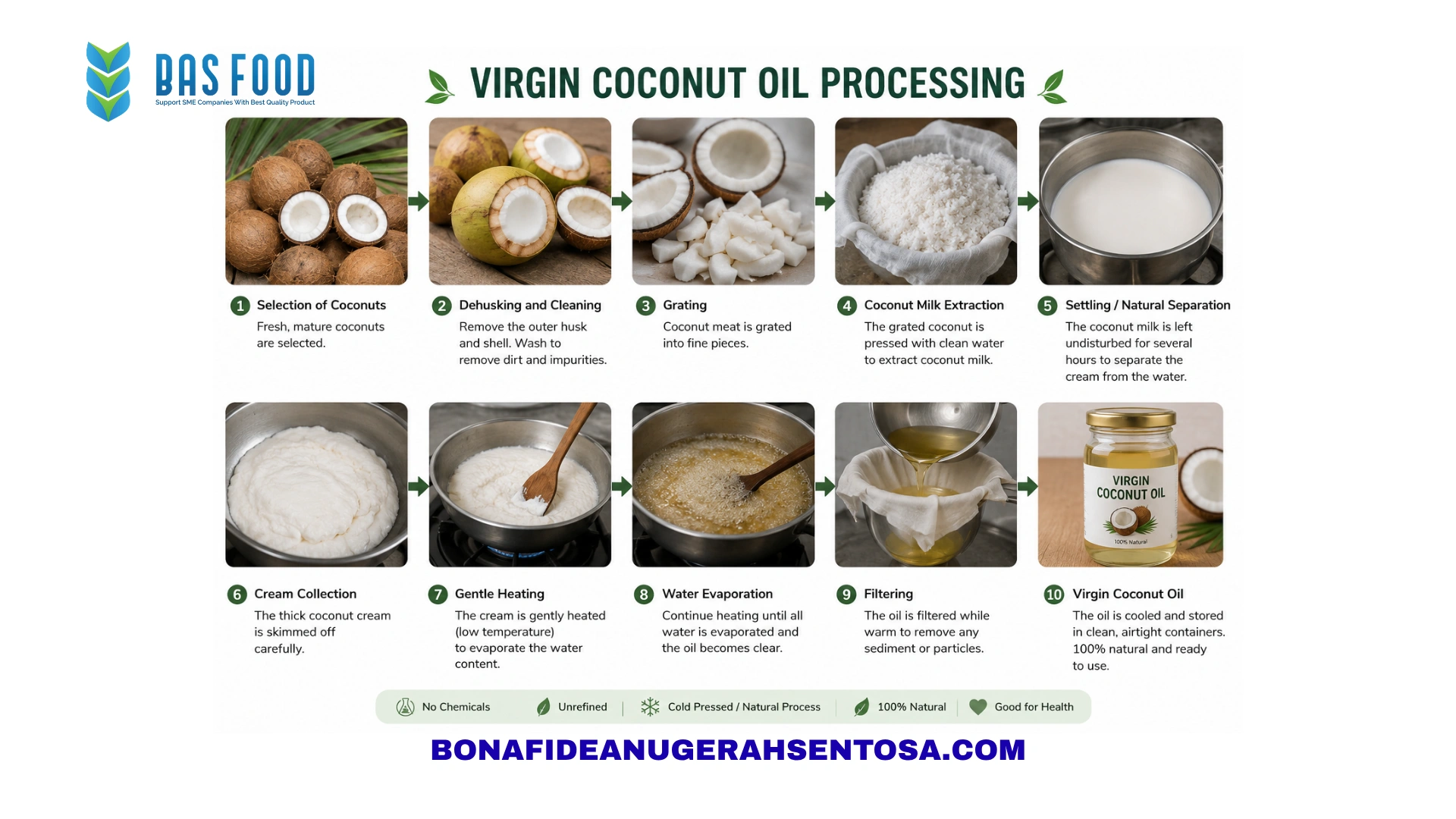
The Beginning of the Journey: Selecting Fresh Coconuts
Quality Starts at the Farm
Every premium coconut product begins with raw material quality. In the virgin coconut oil production process, selecting fresh and mature coconuts is one of the most critical stages.
Farmers typically harvest coconuts that are approximately 10 to 12 months old. At this stage, coconuts contain fully developed meat with high oil content. Mature coconuts produce better extraction yields and create more stable oil quality.
Indonesia offers excellent conditions for coconut cultivation. Its tropical climate supports year-round harvesting, allowing exporters to maintain stable supply chains.
Reliable suppliers carefully select coconuts to avoid defects, spoilage, or contamination. Poor raw material quality can negatively affect the final oil product.
Sorting and Initial Inspection
After harvesting, coconuts undergo sorting and inspection.
Workers evaluate:
- Freshness
- Size consistency
- Shell condition
- Maturity level
- Internal quality
Damaged coconuts are removed immediately.
This inspection process ensures that only premium coconuts continue into the VCO manufacturing process.
<p style=”text-align: justify;”>Proper selection also helps maintain aroma, flavor, and purity throughout production.
Breaking Down the Coconut: Preparing Raw Materials
Dehusking and Shell Removal
Once selected, coconuts move into the preparation stage.
The outer husk is removed first. Then, workers crack the hard shell to access the coconut meat inside.
<p style=”text-align: justify;”>This stage requires careful handling because contamination risks increase once the coconut opens.
Factories follow strict hygiene procedures throughout coconut processing to maintain food safety.
Separating White Coconut Meat
After shell removal, workers separate the white meat from the shell.
<p style=”text-align: justify;”>The brown skin may also be peeled away depending on production specifications.<p style=”text-align: justify;”>Clean white meat creates better oil appearance and improves overall product quality.<p style=”text-align: justify;”>At this stage, coconut meat undergoes washing and sanitation procedures before extraction begins.
Proper cleaning helps reduce microbial contamination and prepares the material for the next stage of the virgin coconut oil production process.
Extracting Coconut Milk: The Foundation of Virgin Coconut Oil
Grating Fresh Coconut Meat
Once cleaned, coconut meat enters industrial grating systems.
Grating breaks the coconut meat into smaller particles and increases surface area for extraction.
<p style=”text-align: justify;”>This stage plays an important role because it improves coconut milk yield.
Factories use stainless steel equipment to maintain hygiene and avoid contamination.
Pressing Coconut Milk
After grating, workers press the coconut meat to extract fresh coconut milk.
This milk contains:
- Water
- Coconut fats
- Proteins
- Natural compounds
The extracted milk serves as the base material for Virgin Coconut Oil production.
At this stage, maintaining freshness becomes extremely important.
<p style=”text-align: justify;”>Delays may affect quality and reduce oil stability later in the VCO manufacturing process.
The Core of Production: Separating Oil Naturally
Understanding Oil Separation Methods
One of the biggest differences between VCO and refined oils lies in extraction techniques.
Virgin Coconut Oil avoids extensive refining and chemical treatments.
<p style=”text-align: justify;”>Instead, producers use methods such as:
- Fermentation
- Centrifugation
- Cold pressing
- Enzymatic separation
These techniques help preserve natural compounds.
<p style=”text-align: justify;”>The goal is simple: separate oil while maintaining product integrity.
Cold Pressed Coconut Oil Method
Among all techniques, cold pressed coconut oil remains one of the most popular.
<p style=”text-align: justify;”>Cold pressing minimizes heat exposure during extraction.
This method helps preserve:
- Natural aroma
- Flavor compounds
- Antioxidants
- Product purity
<p style=”text-align: justify;”>Because heat remains limited, many premium markets prefer cold pressed coconut oil products.
Health-conscious consumers often associate cold pressing with cleaner and less processed ingredients.
This method plays a major role in modern virgin coconut oil production process systems.
Filtration and Purification: Creating Export-Grade Quality
Removing Impurities
<p style=”text-align: justify;”>After oil separation, crude VCO still contains small particles and moisture residues.<p style=”text-align: justify;”>Therefore, filtration becomes necessary.
Factories use multiple filtration systems to remove:
- Fine solids
- Water residues
- Sediments
- Remaining impurities
Proper filtration improves clarity and appearance.
High-quality VCO should appear transparent and clean.
Maintaining Product Stability
<p style=”text-align: justify;”>Purification also improves shelf life.<p style=”text-align: justify;”>Moisture reduction is especially important because excess water may accelerate spoilage.
Professional suppliers conduct quality testing throughout this stage.
Testing often includes:
- Moisture content
- Free fatty acid levels
- Peroxide value
- Appearance
- Aroma evaluation
This careful quality control supports international market requirements.
Reliable coconut processing systems always prioritize product consistency.
Quality Control in Virgin Coconut Oil Production
Food Safety Systems Matter
Global buyers increasingly demand strict quality assurance systems.
<p style=”text-align: justify;”>Modern facilities implement standards such as:
- HACCP
- ISO
- GMP
- Organic certification
- Halal certification
These systems reduce risks and improve product consistency.
The virgin coconut oil production process requires hygienic handling at every stage.
Without proper controls, contamination may affect product quality.
Laboratory Testing for Export Standards
<p style=”text-align: justify;”>Professional suppliers conduct laboratory analysis before export.
Tests may include:
- Microbial analysis
- Fat composition
- Moisture analysis
- Chemical stability
- Sensory evaluation
Testing ensures compliance with destination market regulations.
<p style=”text-align: justify;”>Importers often require certificates and quality reports before purchasing products.<p style=”text-align: justify;”>Therefore, laboratory verification remains essential throughout the VCO manufacturing process.
Packaging and Preparing Virgin Coconut Oil for Export
Selecting Suitable Packaging Materials
<p style=”text-align: justify;”>Packaging protects VCO during storage and transportation.
Exporters use food-grade containers designed to maintain product stability.
Packaging options may include:
- PET bottles
- Glass bottles
- Jerry cans
- Bulk drums
- Flexi tanks
Different customers require different formats.
Industrial buyers often request larger packaging volumes.
Documentation and International Logistics
Export preparation extends beyond packaging.
<p style=”text-align: justify;”>Suppliers also prepare:
- Commercial invoices
- Packing lists
- Certificates of origin
- Health certificates
- Shipping documents
These requirements help products move smoothly across international borders.
Professional exporters understand global compliance standards and coordinate logistics carefully.
Reliable handling supports successful international coconut processing businesses.
Why Indonesia Leads Global Virgin Coconut Oil Production
Natural Advantages in Coconut Cultivation
Indonesia remains one of the world’s largest coconut producers.
Its tropical climate supports continuous harvesting throughout the year.
Large coconut-growing regions create strong raw material availability.
This abundance helps exporters maintain stable supply capacity.
Growing Processing Capabilities
Indonesian manufacturers increasingly invest in:
- Modern extraction technology
- Food safety certifications
- Automated equipment
- Export systems
These improvements strengthen international competitiveness.
As demand increases, Indonesian companies continue improving the virgin coconut oil production process for global buyers.
Why CV Bonafide Anugerah Sentosa Is a Trusted Export Partner
Commitment to Quality and Consistency
CV Bonafide Anugerah Sentosa specializes in exporting coconut products, spices, coffee, and fishery products from Indonesia.
The company prioritizes quality throughout sourcing, processing, and export preparation.
Their strong supplier network helps maintain stable product consistency.
Complete Export Support Services
The company provides:
- Product customization
- Export documentation
- Packaging solutions
- Quality assurance
- Logistics coordination
This complete support system simplifies procurement for international buyers.
Businesses seeking premium VCO products benefit from experienced suppliers that understand every stage of the VCO manufacturing process.
Future Trends in Virgin Coconut Oil Industry
Growing Demand for Natural Products
Consumers increasingly prefer minimally processed ingredients.
Health-focused lifestyles continue driving global VCO demand.
<p style=”text-align: justify;”>Industries such as:
- Functional food
- Wellness products
- Natural cosmetics
- Plant-based products
continue expanding rapidly.
This trend supports future growth in cold pressed coconut oil markets.
Sustainability and Ethical Sourcing
Global buyers increasingly value sustainability.
Companies now seek suppliers committed to:
- Ethical sourcing
- Environmental responsibility
- Transparent supply chains
- Community partnerships
These practices strengthen long-term competitiveness.
Conclusion: From Fresh Coconut to Global Opportunity
The journey from fresh coconuts to export-grade Virgin Coconut Oil involves much more than simple extraction.
Each stage in the virgin coconut oil production process affects product quality, purity, and market value.
From careful coconut selection and milk extraction to filtration and export packaging, every step contributes to premium VCO production.
Understanding the complete VCO manufacturing process helps buyers evaluate suppliers and make informed sourcing decisions.
Indonesia continues leading the industry through abundant resources and expanding production expertise.
By partnering with experienced exporters such as CV Bonafide Anugerah Sentosa, businesses can secure reliable access to premium cold pressed coconut oil products and build sustainable supply chains for global markets.