
Coconut sugar treacle is a useful liquid sweetener for food manufacturers, beverage companies, bakeries, dessert producers, and other commercial applications. However, one property often determines how easy it is to handle and process: viscosity. Understanding coconut sugar treacle viscosity is essential for optimising its use in various recipes and industrial processes.
Understanding coconut sugar treacle viscosity helps buyers choose a product that fits their production process. Viscosity affects how easily the treacle flows, pours, pumps, mixes, fills, and spreads. It can also influence packaging, storage, transportation, and the final texture of food and beverages.
For B2B buyers, viscosity should therefore be more than a number on a specification sheet. It should be connected to the actual application. A beverage manufacturer may need a treacle that flows easily through dosing equipment, while a bakery producer may prefer a thicker product that contributes body and sweetness to a recipe.
For buyers sourcing from Indonesia, working with an experienced coconut sugar supplier can make this process easier. Clear specifications, samples, and communication about the intended application help ensure that the selected treacle performs as expected.
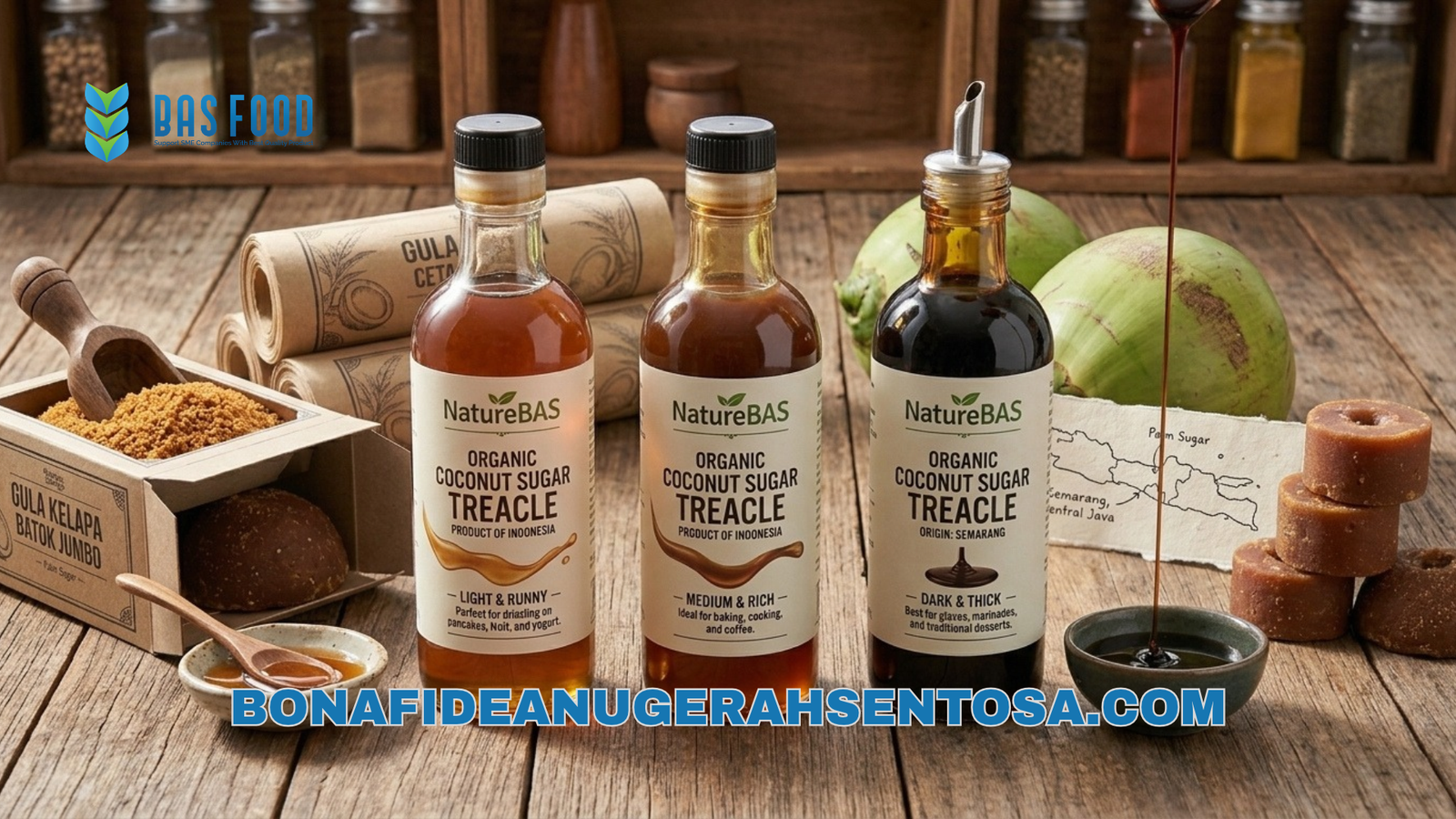
What Is Coconut Sugar Treacle Viscosity?
Viscosity describes how strongly a liquid resists flowing. In simple terms, it tells us whether a liquid is thin and easy to pour or thick and slow to move.
Water has very low viscosity, so it flows quickly. Honey has much higher viscosity, so it moves more slowly. Coconut sugar treacle sits somewhere within the broader range of liquid sweeteners, although its actual viscosity can vary depending on its formulation and production conditions.
Therefore, coconut sugar treacle viscosity is an important characteristic for commercial buyers. It gives an indication of how the product may behave during processing and handling.
However, viscosity should not be viewed in isolation. Two treacle products can have different viscosity values while both being suitable for their intended applications.
The important question is not simply, “Which treacle is thicker?” Instead, buyers should ask, “What viscosity works best for my process?”
That distinction is particularly important for industrial food production. A treacle that works well in one factory may not be ideal for another because pumps, filling machines, storage temperatures, and formulations can differ.
Why Viscosity Matters for Commercial Food Production
Viscosity affects almost every stage of handling a liquid sweetener.
First, it influences how the product moves from one container to another. A low-viscosity product generally flows more easily, while a higher-viscosity product may require more time or greater pumping force.
Second, viscosity can affect dosing and filling. Food manufacturers often need to add a specific amount of sweetener to each batch or package. If the product flows inconsistently, accurate dosing can become more difficult.
This is why manufacturers should consider syrup viscosity when selecting coconut sugar treacle.
The right viscosity can help improve process consistency. It may make it easier to transfer the sweetener through pipes, fill containers, mix it with other ingredients, or control the amount added to a recipe.
On the other hand, a treacle that is too thick for a particular system may slow production. It may require additional heating, stronger pumping equipment, or different handling procedures.
A product that is too thin can create a different problem. It may not provide the desired coating, body, or texture in applications where a thicker sweetener is preferred.
Consequently, viscosity should always be considered alongside the equipment and final product requirements.
Understanding Treacle Consistency
Treacle consistency refers to the overall feel and flow behavior of the product. It is closely related to viscosity, although buyers may use the term more generally when discussing whether the product is thin, medium, or thick.
A consistent treacle should behave predictably from batch to batch when produced under the same agreed specification.
This matters because food manufacturers build recipes and processes around expected ingredient performance.
For example, imagine a sauce manufacturer using coconut sugar treacle as a sweetening ingredient. If one batch flows easily while another batch is significantly thicker, the manufacturer may need to adjust the production process.
Likewise, beverage manufacturers may experience problems if the sweetener does not mix as expected.
Good treacle consistency therefore supports predictable production.
However, natural ingredients can show some variation. Coconut sugar is derived from coconut blossom sap, and its characteristics can be influenced by raw materials and processing conditions.
For this reason, professional B2B buyers should agree on product specifications and acceptable variation with their supplier.
Rather than relying on a general description such as “thick coconut syrup,” buyers should request measurable specifications where necessary.
Factors That Affect Coconut Sugar Treacle Viscosity
Several factors can influence the viscosity of coconut sugar treacle.
Soluble Solids
One major factor is the concentration of soluble solids. Generally, a more concentrated syrup can become thicker.
This is why buyers should consider viscosity together with other specifications, such as total soluble solids or Brix, when applicable to their purchasing requirements.
Temperature
Temperature can have a major effect on liquid viscosity.
Many viscous liquids become easier to flow when warmed. Conversely, they can become thicker when cooled.
This means that viscosity measurements should be interpreted together with the temperature at which the measurement was taken.
For international buyers, this point is especially important. A treacle measured under controlled factory conditions may behave differently in a colder warehouse or during transportation.
Moisture
Moisture content can also influence the physical behavior of a liquid sweetener.
Changes in the balance between water and dissolved solids can affect flow characteristics. Therefore, moisture-related specifications should be considered as part of the broader product quality profile.
Processing Conditions
Heating, concentration, filtration, and other processing steps can affect the final characteristics of coconut sugar treacle.
For that reason, suppliers should maintain controlled production practices and consistent specifications.
Storage Conditions
Storage temperature and time can also influence how a treacle behaves.
A buyer should therefore follow the supplier’s recommended storage conditions and packaging instructions.
Coconut Sugar Treacle Viscosity and Liquid Sweetener Texture
When people discuss liquid sweetener texture, they often describe how a syrup feels when poured, stirred, spread, or mixed.
Although texture is not exactly the same as viscosity, the two properties are closely connected.
A thick treacle may feel rich and dense. It can coat a surface more easily and may remain visible on foods such as pancakes, desserts, or bakery products.
A thinner treacle may spread more quickly and mix more easily into beverages or liquid formulations.
Therefore, the preferred liquid sweetener texture depends on the application.
For beverage producers, a product that mixes efficiently may be more practical.
For dessert manufacturers, a thicker texture may be desirable because the sweetener can contribute both sweetness and body.
Meanwhile, sauce manufacturers may need a viscosity that provides the right balance between flow and coating.
This is why a good B2B specification should describe the intended use before the final viscosity target is selected.
How Viscosity Affects Food and Beverage Applications
Coconut sugar treacle can be used in a wide range of applications.
Beverages
In beverages, the sweetener needs to distribute effectively throughout the formulation.
A suitable viscosity can help manufacturers control dosing and mixing. Depending on the production system, a highly viscous product may require additional processing considerations.
For coffee, tea, specialty drinks, and beverage concentrates, the manufacturer should test the treacle directly in the intended formulation.
Bakery Products
Bakeries can use coconut sugar treacle in cakes, cookies, sauces, fillings, glazes, and other products.
Here, viscosity may influence mixing and the final moisture balance of the recipe.
A thicker treacle may also provide a useful texture in fillings and toppings.
Sauces
Coconut sugar treacle can contribute sweetness and color to sauces and dressings.
The correct viscosity can help determine how easily the finished sauce spreads or pours.
Desserts
Dessert producers may use treacle in toppings, fillings, syrups, and sweet sauces.
In these applications, texture becomes particularly important because consumers can directly see and feel the finished product.
Therefore, viscosity testing should ideally be connected to a real product trial.
How Buyers Should Specify Syrup Viscosity
International buyers should avoid specifying viscosity using vague terms alone.
Words such as “thick,” “medium,” or “light” can mean different things to different people.
Instead, buyers can request a technical specification that includes the measurement method, test temperature, and viscosity unit where applicable.
The exact test method should be agreed between the buyer and supplier because viscosity values can vary depending on the instrument and testing conditions.
For example, a viscosity result without a test temperature may be difficult to interpret correctly.
Therefore, a strong specification can include:
- Product name
- Appearance
- Color
- Flavor and aroma
- Brix or soluble solids specification, where applicable
- Moisture specification
- Viscosity specification
- Viscosity test temperature
- Packaging format
- Net weight
- Shelf life
- Storage conditions
- Microbiological requirements, where applicable
This gives both parties a clearer reference point.
It also helps the buyer’s quality assurance team evaluate incoming shipments.
Why Samples Are Important Before a Large Order
A sample is one of the most useful tools for evaluating coconut sugar treacle.
A specification sheet provides important technical information, but a sample allows buyers to see how the product behaves in the real world.
For example, a buyer can test how quickly the treacle pours from its container.
They can also check whether it works with their pump, filling machine, mixer, or dosing equipment.
A food manufacturer can add the sample to its existing recipe and compare the results with its current sweetener.
This practical test can reveal whether the viscosity is suitable.
It is especially useful for buyers who have never used coconut sugar treacle before.
Instead of placing a large order based only on a written description, the buyer can first conduct a small application test.
If adjustments are required, the buyer and supplier can then discuss the target specification before commercial production.
This approach can reduce the risk of receiving a product that technically meets a description but does not perform well in the buyer’s specific process.
Packaging Considerations for Different Viscosity Levels
Viscosity can also affect packaging decisions.
A highly viscous treacle may require packaging with an opening large enough to allow practical dispensing.
The packaging must also be strong enough for transportation and suitable for the product’s characteristics.
For industrial buyers, larger containers may be preferred because they reduce the number of units that need to be handled.
Retail brands may choose smaller bottles, jars, pouches, or other consumer-friendly formats.
However, the packaging should always be evaluated together with the product’s flow characteristics.
If the opening is too small for a thick product, dispensing can become inconvenient.
On the other hand, packaging designed for a thin syrup may not provide the best experience for a more viscous product.
Therefore, packaging trials can be useful during product development.
This is particularly relevant for private-label and OEM projects, where the buyer controls the final retail presentation.
Temperature and Viscosity During International Shipping
International shipping introduces another consideration: temperature changes.
Coconut sugar treacle can experience different temperatures during storage, container loading, sea transportation, unloading, and warehouse storage.
Because temperature can influence viscosity, buyers should understand the recommended storage conditions.
A product that flows easily at one temperature may become noticeably thicker at a lower temperature.
This does not necessarily mean that the product has a quality problem. It may simply reflect the natural relationship between temperature and liquid flow.
Therefore, buyers should evaluate the product under realistic conditions whenever possible.
For example, if a product will be stored in a cool warehouse, the buyer can test the sample under a similar temperature before finalizing the specification.
This approach provides a more realistic understanding of the product’s behavior.
Choosing a Reliable Coconut Sugar Supplier
The supplier plays an important role in maintaining consistent viscosity.
An experienced coconut sugar supplier should understand that B2B buyers need reliable product specifications rather than general descriptions.
The supplier should be able to discuss the buyer’s intended application, packaging needs, target market, and technical requirements.
For international sourcing, communication is especially important.
A buyer may have different requirements from a local customer because the product could be shipped over long distances and handled through several logistics stages.
This makes clear documentation valuable.
A supplier should provide relevant product information and communicate clearly about samples, specifications, packaging, lead times, and shipment requirements.
For companies comparing a coconut sugar exporter supplier, buyers should look at the complete sourcing relationship rather than focusing only on the initial product price.
Quality consistency, communication, packaging, documentation, and production capability can all affect the total value of the supplier relationship.
Working With CV Bonafide Anugerah Sentosa
CV Bonafide Anugerah Sentosa is an Indonesian supplier and exporter of coconut sugar and other coconut-derived products.
For B2B buyers interested in coconut sugar treacle, discussing the intended application can help establish the appropriate product specification.
For example, a buyer can explain whether the treacle will be used for beverages, bakery products, sauces, desserts, food manufacturing, or another application.
The buyer can then discuss requirements such as viscosity, packaging, quantity, and other product specifications.
This application-based approach is useful because there is no single viscosity that is automatically ideal for every business.
A beverage manufacturer and a bakery producer may have completely different requirements.
Similarly, a retail brand may prioritize dispensing and consumer convenience, while an industrial manufacturer may prioritize pumping and automated dosing.
Therefore, the goal should not simply be to find the thickest or thinnest coconut sugar treacle.
The goal is to find a product whose characteristics fit the buyer’s process.
Final Thoughts on Coconut Sugar Treacle Viscosity
Understanding coconut sugar treacle viscosity is important for any business purchasing coconut sugar treacle for commercial use.
Viscosity affects how the product flows, pours, pumps, mixes, fills, spreads, and behaves in different applications. It can also influence packaging and handling throughout the supply chain.
However, there is no universal viscosity that is perfect for every buyer.
The right specification depends on the intended application and production system. Beverage manufacturers may prioritize easy flow and dosing, while bakeries, dessert companies, and sauce manufacturers may require different characteristics.
For this reason, buyers should look beyond a simple viscosity number. They should consider treacle consistency, syrup viscosity, liquid sweetener texture, temperature, Brix, packaging, storage, and the final application.
Working with an experienced coconut sugar supplier can make this process easier. Buyers can discuss their requirements, request samples, test the product, and establish a clear specification before placing a larger order.
For international businesses looking for a reliable coconut sugar exporter supplier, this practical approach can help reduce sourcing risks while creating a more consistent supply chain.
When buyers and suppliers communicate clearly about technical requirements from the beginning, coconut sugar treacle becomes much easier to source, evaluate, and integrate into commercial food production.