
When buying coconut sugar treacle for commercial use, appearance and taste are only part of the story. For food manufacturers, beverage companies, bakeries, sauce producers, and importers, technical specifications also matter. One of the most useful measurements to understand is Brix.
Coconut sugar treacle Brix tells buyers about the concentration of dissolved solids in the liquid sweetener. In simple terms, it helps indicate how concentrated the treacle is. A higher Brix value generally means that the liquid contains more dissolved solids and less water, although Brix should not be treated as a direct measurement of sugar alone.
For B2B buyers, understanding Brix can make product sourcing much easier. It helps with formulation, production planning, quality control, packaging, storage, and communication with a coconut sugar supplier.
However, Brix is only one part of a complete product specification. Buyers should also consider viscosity, moisture, flavor, color, pH where relevant, packaging, shelf life, and the intended application.
For companies sourcing Indonesian coconut sugar treacle, working with an experienced coconut sugar exporter supplier can help turn these technical requirements into a practical purchasing specification.
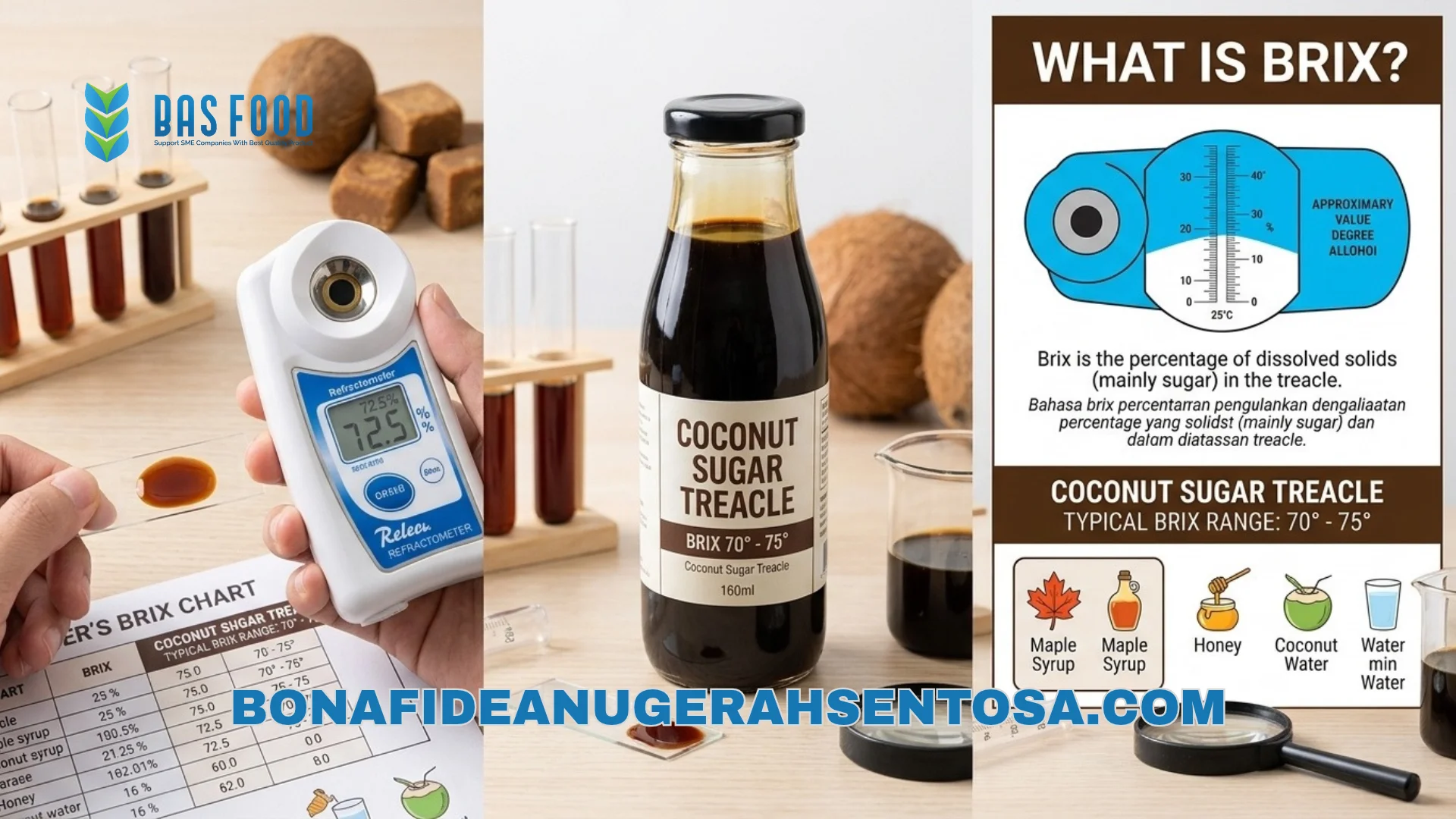
What Does Coconut Sugar Treacle Brix Mean?
Brix is commonly used in the food and beverage industry to describe the concentration of dissolved solids in a liquid. It is often written as °Bx.
For a simple sucrose-water solution, 10°Bx roughly means 10 grams of sucrose per 100 grams of solution. However, coconut sugar treacle is not simply a mixture of pure sucrose and water. It contains different dissolved components, so its Brix reading represents total soluble solids rather than pure sugar content.
That distinction is important.
When discussing coconut sugar treacle Brix, buyers should understand that the Brix value gives an indication of concentration, but it does not tell the complete story about the product.
For example, two treacles with similar Brix levels may still have different flavor profiles, colors, viscosity, or processing characteristics.
This is why Brix works best as one part of a broader quality specification.
For commercial buyers, the value of Brix comes from its ability to provide a measurable reference. Instead of describing a treacle as simply “concentrated,” a buyer can discuss a defined Brix level with the supplier.
That makes communication more precise and helps both parties work toward a consistent product.
Why Brix Level Matters to B2B Buyers
The Brix level can affect how a liquid sweetener performs during production.
A more concentrated treacle generally contains a higher proportion of dissolved solids. As a result, it may behave differently during pumping, mixing, filling, heating, and storage compared with a more diluted product.
For food manufacturers, this difference can be significant.
Suppose a manufacturer uses coconut sugar treacle as an ingredient in a sauce. If the treacle concentration changes significantly from one batch to another, the manufacturer may need to adjust the recipe to maintain the same finished product.
The same principle applies to beverages.
If a beverage manufacturer adds a fixed amount of treacle to every production batch, changes in concentration can affect the amount of sweetening solids entering the formulation.
Therefore, consistent soluble solids can contribute to better production control.
Brix can also help purchasing teams compare products from different production batches. When the agreed specification is clear, the buyer can use Brix as one of the parameters for incoming quality checks.
However, buyers should always confirm the acceptable Brix range with their supplier rather than assuming that a higher number is automatically better.
The ideal Brix level depends on the product’s intended use.
Understanding Soluble Solids in Coconut Sugar Treacle
The term soluble solids refers to materials dissolved in the liquid.
In a sugar-based syrup, these can include sugars and other dissolved components. A Brix measurement provides an estimate of the total dissolved solids based on the measurement principle and instrument used.
This is why Brix is widely used in food processing.
For coconut sugar treacle, soluble solids are an important part of understanding the product’s concentration.
A higher concentration can influence several physical properties, including flow behavior and perceived thickness. As concentration increases, the liquid may become more resistant to flow.
However, Brix and viscosity are not the same thing.
Two products can have similar Brix readings but different viscosities because viscosity can also depend on temperature and the composition of the liquid.
Therefore, buyers should not use Brix as a replacement for a viscosity specification.
Instead, Brix and viscosity should be considered together when both properties are important for the application.
This approach gives manufacturers a more complete understanding of how the product is likely to behave.
Brix and Treacle Concentration: What Is the Difference?
Treacle concentration is a general way of describing how concentrated the product is. Brix provides a measurable way to describe soluble solids concentration.
In everyday purchasing conversations, these terms may sometimes be used interchangeably. However, technically, they are not exactly the same concept.
Brix is a measurement expressed as °Bx, while concentration can be discussed in several different ways depending on the product and industry.
For B2B purchasing, it is therefore useful to ask the supplier exactly what a stated concentration means.
For example, if a specification says that a product has a certain Brix level, the buyer should understand how that value was measured.
This is particularly important when comparing different suppliers.
A buyer may receive two technical sheets with similar-looking specifications but different test methods or measurement conditions.
The safest approach is to establish a clear specification before commercial production.
That specification can include the target Brix range, measurement method, temperature, viscosity, packaging, and other relevant parameters.
This gives both parties a common reference.
How Brix Affects Coconut Sugar Treacle Applications
The ideal coconut sugar treacle Brix depends on how the product will be used.
Beverage Production
Beverage manufacturers often need predictable ingredients because their recipes depend on accurate dosing.
If coconut sugar treacle is used as a sweetener, the Brix level can help the manufacturer estimate the concentration of dissolved solids being added to the formulation.
The manufacturer may also consider how easily the treacle mixes with water or other liquid ingredients.
Therefore, a beverage producer should test the actual treacle in its production process before finalizing a large commercial order.
Bakery Products
Bakeries may use coconut sugar treacle in cakes, cookies, fillings, glazes, sauces, and other products.
Here, concentration can influence the amount of liquid introduced into the recipe.
If the treacle is more concentrated than expected, it may add less water while contributing more dissolved solids.
Conversely, a more diluted product may introduce additional moisture.
This is why recipe developers should consider Brix when replacing one syrup with another.
Sauces and Dressings
Sauce manufacturers may use coconut sugar treacle for sweetness, color, and flavor.
The Brix level can contribute to the overall concentration of the formulation.
However, the finished sauce still depends on many other ingredients and processing steps.
Therefore, Brix should be used as a guide rather than as the sole indicator of final sauce quality.
Dessert Products
Dessert manufacturers can use coconut sugar treacle in toppings, fillings, caramel-style preparations, and sweet sauces.
In these applications, concentration can influence texture and handling.
Again, the buyer should test the product under actual production conditions.
Brix and Syrup Specifications for Export Buyers
For international sourcing, clear syrup specifications are essential.
A good technical specification should explain the product in a way that can be understood by purchasing, quality control, production, and logistics teams.
A coconut sugar treacle specification may include:
- Product name
- Ingredients
- Appearance
- Color
- Flavor
- Aroma
- Brix level
- Moisture
- Viscosity
- pH where applicable
- Packaging
- Net weight
- Shelf life
- Storage conditions
- Microbiological requirements
- Country of origin
Not every buyer needs every parameter. The exact specification should match the application and market requirements.
For example, a beverage manufacturer may place greater emphasis on Brix and viscosity, while a retail importer may focus more on packaging, labeling, shelf life, and consumer requirements.
The important point is that the specification should be agreed before production.
This reduces confusion and provides a reference for quality control when the shipment arrives.
How Temperature Can Affect Brix Measurements
Temperature is an important consideration when measuring Brix.
Many refractometers are temperature-sensitive, which means the reading can change if the sample temperature changes.
Modern digital instruments may include automatic temperature compensation, but buyers should still follow the instrument manufacturer’s instructions and use a consistent testing procedure.
This matters because a Brix number without measurement conditions may be difficult to compare accurately.
For example, a supplier might report a Brix value based on a controlled laboratory procedure, while a buyer checks the product using a different instrument under different conditions.
The two readings may not be directly comparable.
Therefore, international buyers should ask how the Brix value was determined.
They can also establish a standard testing method for future shipments.
This creates a more reliable quality-control process.
Brix and Viscosity Are Connected, But Not the Same
One of the most common misunderstandings is assuming that Brix and viscosity are identical measurements.
They are not.
Brix describes soluble solids concentration, while viscosity describes resistance to flow.
Even though the two properties can be related, other factors also affect viscosity.
Temperature is one example.
Composition is another.
Therefore, a buyer who needs a specific flow behavior should not simply specify Brix and assume that the viscosity will automatically be correct.
Instead, the buyer should include both measurements when both are important.
For example, a beverage manufacturer may specify a target Brix range and a viscosity range.
This provides a much clearer technical target than using one number alone.
For a coconut sugar supplier, understanding this distinction also makes it easier to communicate product capabilities with international buyers.
How Buyers Can Test Coconut Sugar Treacle Brix
Buyers can measure Brix using a refractometer.
A refractometer measures how light behaves as it passes through a sample and uses that information to estimate soluble solids concentration.
For routine quality control, digital refractometers are commonly used because they are relatively quick and practical.
However, proper sample preparation is important.
The sample should be representative of the product being tested. The instrument should also be clean, calibrated, and used according to its instructions.
Temperature should be controlled or compensated for according to the instrument’s specifications.
For commercial purchasing, buyers may want to compare their own test results with supplier documentation.
If the results differ significantly, the two parties should first review the testing methods before assuming that the product itself is inconsistent.
This is especially important for international supply relationships.
A shared testing method can help prevent unnecessary disputes.
Why Samples Matter Before Placing a Large Order
Technical specifications are useful, but a sample provides something equally important: real-world experience.
Before purchasing a large volume of coconut sugar treacle, buyers can test the sample in their own production environment.
They can measure Brix, evaluate viscosity, test mixing behavior, and check the product’s flavor and color.
A beverage producer can test how the treacle dissolves and integrates into the formulation.
A bakery can test how it affects dough, batter, filling, or glaze.
A sauce manufacturer can evaluate how the treacle affects sweetness, body, color, and flow.
These tests help determine whether the product is suitable for the intended application.
They can also reveal whether the requested Brix level needs to be adjusted.
For this reason, sample approval is a valuable step before moving to a large export order.
Choosing the Right Coconut Sugar Supplier
Finding a reliable coconut sugar supplier is about more than finding a competitive price.
For B2B buyers, consistency and communication are equally important.
A good supplier should be able to discuss the buyer’s technical requirements and explain which specifications are practical for the intended application.
The supplier should also provide clear information about samples, packaging, production, and export procedures.
For liquid products such as coconut sugar treacle, technical communication becomes particularly important because buyers may have specific requirements for Brix, viscosity, packaging, and storage.
When comparing a coconut sugar exporter supplier, buyers should therefore consider the supplier’s ability to maintain consistent product specifications from batch to batch.
A long-term supply relationship works best when both sides understand the same quality standards.
Coconut Sugar Treacle for International Markets
Coconut sugar treacle has potential applications across different international food markets.
Importers may purchase it for retail products, foodservice, ingredient distribution, or further processing.
However, each market can have different requirements.
A buyer may need specific labeling, packaging, documentation, or food safety standards depending on the destination country.
Technical specifications should therefore be prepared with the target market in mind.
Brix can be one useful part of this documentation because it gives a measurable indication of product concentration.
Still, it should sit within a larger specification rather than being presented as the only quality parameter.
This is especially useful for importers that need to share technical information with their own customers.
Clear documentation makes it easier for distributors and food manufacturers to understand how the product should be stored, handled, and used.
Working With CV Bonafide Anugerah Sentosa
CV Bonafide Anugerah Sentosa is an Indonesian supplier and exporter of coconut sugar and other coconut-derived products.
For buyers interested in coconut sugar treacle, discussing the intended application can help establish suitable syrup specifications.
For example, a buyer can explain whether the product is intended for beverages, bakery products, sauces, desserts, food manufacturing, or retail.
The buyer can then discuss relevant requirements such as Brix, viscosity, packaging, quantity, and storage.
This approach is more practical than selecting a specification based on a single number.
A B2B buyer may need a particular Brix range because of an existing recipe or manufacturing process.
Another buyer may have more flexibility but require specific packaging for retail distribution.
By communicating these needs early, the buyer and supplier can work toward a more suitable product specification.
Final Thoughts: Making Brix Work for Your Business
Understanding coconut sugar treacle Brix gives B2B buyers a clearer way to evaluate liquid coconut sugar products.
Brix provides useful information about soluble solids and overall treacle concentration. It can help manufacturers manage formulations, compare batches, and establish consistent purchasing specifications.
However, Brix should never be viewed as the only measure of quality.
Viscosity, temperature, flavor, color, moisture, packaging, shelf life, and application requirements can all influence how well coconut sugar treacle performs.
The best approach is to define the intended application first, then establish the appropriate Brix level and supporting syrup specifications.
Samples can then be tested before a larger order is confirmed.
For international buyers, working with a reliable coconut sugar supplier or coconut sugar exporter supplier can make the process much easier. Clear communication allows both parties to agree on measurable specifications and realistic expectations.
For buyers sourcing Indonesian coconut sugar treacle, CV Bonafide Anugerah Sentosa can be part of that sourcing conversation by helping businesses discuss product requirements, samples, packaging, and export supply needs.
Ultimately, the right Brix level is not simply about choosing the highest concentration. It is about finding the concentration that works best for the buyer’s product, equipment, recipe, packaging, and market.
That is what makes Brix a valuable tool for smarter coconut sugar treacle sourcing.