
Coconut sugar is available in several forms, but two of the most useful for commercial buyers are solid blocks and granulated products. Understanding coconut sugar blocks vs granules can help importers, distributors, food manufacturers, retailers, restaurants, and private-label brands choose the right format for their business.
At first, the difference looks simple. Blocks are solid pieces of coconut sugar, while granules are small particles. However, the difference affects much more than appearance. Product form can influence handling, portioning, mixing, packaging, storage, production efficiency, and consumer convenience.
For this reason, B2B buyers should select coconut sugar based on its intended application. A traditional food business may prefer moulded blocks, while a beverage manufacturer or bakery may find coconut sugar granules easier to use.
This guide compares both formats in practical terms. We will look at production, applications, packaging, storage, logistics, customization, and supplier selection so you can make a more informed sourcing decision.
What Is the Difference Between Coconut Sugar Blocks and Granules?
The simplest way to understand coconut sugar blocks vs granules is to look at their physical form.
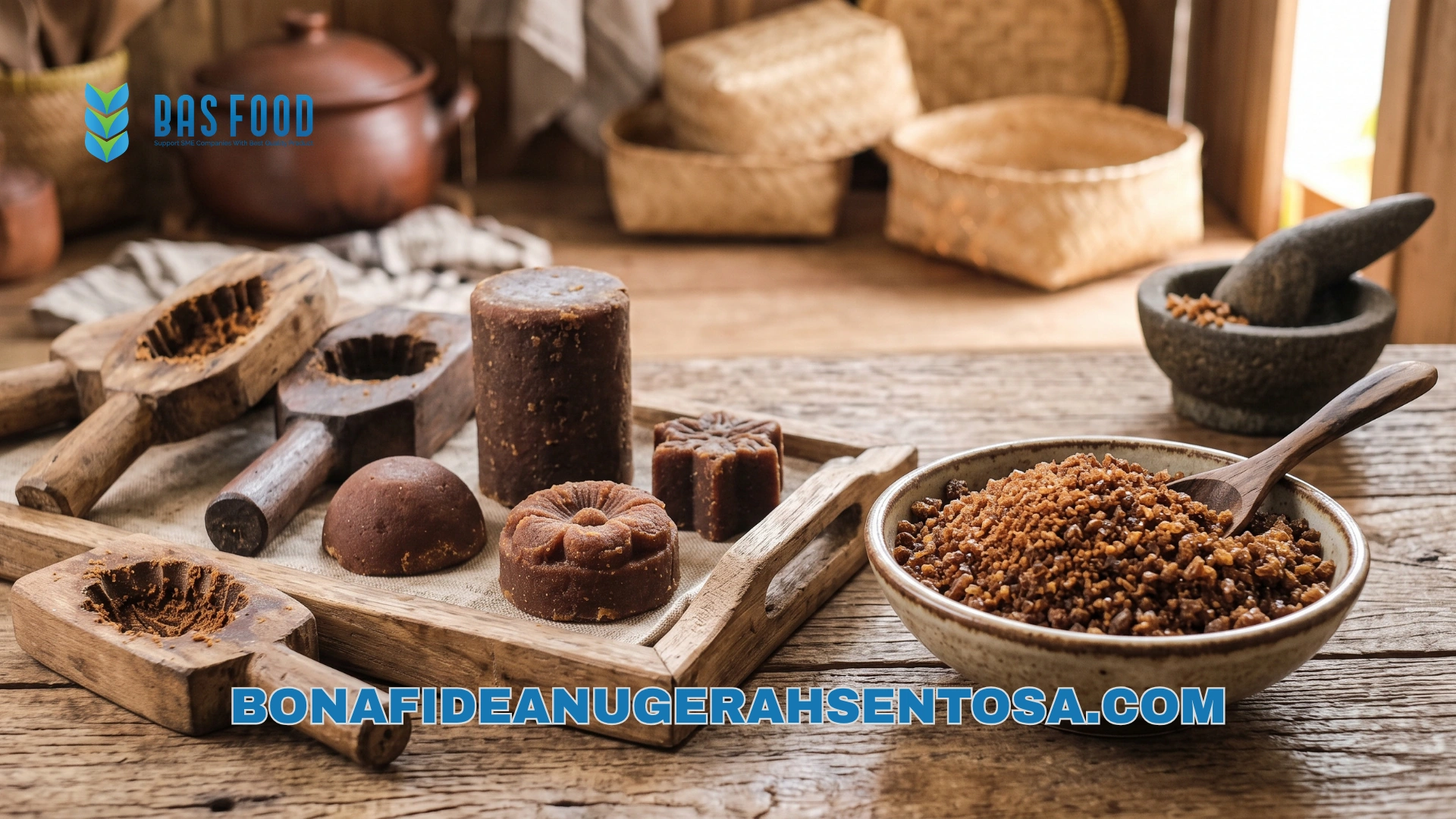
Coconut sugar blocks are solid pieces formed using a coconut sugar mould. The concentrated sugar is shaped into a defined size and allowed to set. Depending on the production method, blocks can be round, square, rectangular, or other shapes.
Granulated coconut sugar, meanwhile, is processed into smaller particles. The finished product can be screened to achieve a particular particle-size range. This makes it easier to measure, mix, and distribute throughout many food formulations.
Both products come from coconut sap, but their final processing and physical characteristics are different. Therefore, one format is not automatically better than the other.
The right choice depends on what the buyer wants to do with the product.
Coconut Sugar Blocks: Traditional, Solid, and Practical
Coconut sugar blocks are closely associated with traditional coconut sugar production. The solid format has been used for many years in cooking and food preparation.
A block can be broken, chopped, shaved, grated, or dissolved depending on the recipe. This makes it useful for traditional foods and culinary applications where the cook wants to work with solid coconut sugar.
For B2B buyers, blocks can also provide a strong traditional product identity. A brand selling authentic Indonesian ingredients may prefer moulded sugar because the physical appearance supports its traditional positioning.
How Coconut Sugar Blocks Are Made
The production process starts with coconut sap collected from coconut flower blossoms. The sap is processed and concentrated before being formed into moulds.
The coconut sugar mould determines the basic shape and dimensions of the finished product. A supplier may use standard moulds or, depending on its capabilities, develop customized designs for commercial customers.
After the product sets, the blocks can be removed from the mould and prepared for packaging.
For commercial orders, consistency matters. Buyers may specify the approximate weight, dimensions, shape, and packaging requirements for every piece.
Coconut Sugar Granules: Flexible for Modern Food Production
Coconut sugar granules offer a different type of convenience. Instead of a solid block, the product consists of smaller particles that can be measured and blended more easily.
This makes granulated coconut sugar attractive to food manufacturers, bakeries, beverage producers, foodservice businesses, and ingredient distributors.
Because the particles are smaller, manufacturers can incorporate them directly into many dry or wet formulations without first breaking down a large block.
This can save preparation time and make ingredient handling easier.
What Is Granulated Coconut Sugar?
Granulated coconut sugar is coconut sugar processed into a granular form. Depending on the specification, the product can have different particle sizes.
A buyer may request a particular grade based on the intended application. For example, a manufacturer may want relatively fine granules for quick mixing, while another application may work better with a larger particle size.
Therefore, buyers should not simply ask for “granulated coconut sugar.” They should also discuss particle size and distribution.
Coconut Sugar Blocks vs Granules for Food Manufacturing
For food manufacturers, product format can have a direct effect on production efficiency.
Blocks may need to be broken or processed before they can be added to a formulation. This additional preparation can be acceptable for traditional recipes, but it may not be ideal for a large-scale automated production line.
Granules are often easier to weigh and incorporate directly into formulations. They can be added to mixers, dry blends, bakery formulations, and other processes without first breaking a solid block.
However, the final choice still depends on the manufacturing system. Some traditional or specialty products may specifically require block-form coconut sugar.
Coconut Sugar Blocks vs Granules for Baking
Baking is one area where granulated coconut sugar can offer practical advantages.
Bakers typically need to measure and distribute ingredients accurately. Smaller particles can be easier to mix with flour and other dry ingredients.
Granulated coconut sugar can therefore be useful in cookies, cakes, bread, pastry products, and other bakery formulations where the manufacturer wants a dry granular ingredient.
Blocks can still work for baking, particularly in recipes where the sugar is melted or dissolved first. However, the additional preparation step may be less convenient in commercial production.
For large-scale bakeries, the choice often comes down to production workflow, equipment, formulation, and desired ingredient handling.
Coconut Sugar Blocks vs Granules for Beverages
Beverage production presents another important difference.
Granulated coconut sugar can be easier to measure and incorporate into beverage formulations. Depending on particle size and processing conditions, it can be mixed into liquid systems as part of the formulation process.
Blocks may require additional processing before they can be used. The solid pieces may need to be crushed, shaved, or dissolved first.
For this reason, beverage manufacturers often have a practical reason to consider granulated formats.
However, buyers should test the actual product in their formulation. Dissolving behavior can depend on particle size, liquid temperature, mixing method, and other ingredients.
Coconut Sugar Blocks vs Granules for Foodservice
Restaurants, hotels, catering businesses, and foodservice distributors may use either format.
Blocks can be useful for traditional kitchens because chefs can break off the amount they need. The solid format also gives the product a traditional appearance.
Granules, on the other hand, can be convenient for fast-paced commercial kitchens. Staff can measure the product directly without needing to break or chop a block.
The better choice depends on kitchen workflow and the type of food being prepared.
For foodservice distributors, offering both formats may also make sense because different customers can have different preferences.
Comparing Packaging Requirements
Packaging is an important part of the decision between blocks and granules.
Blocks have a defined shape, so packaging needs to protect the pieces from breakage while keeping them organized. Individual wrapping, pouches, cartons, or bulk packaging may be used depending on the market.
Granules require packaging that protects the product from moisture and contamination. Because the product consists of smaller particles, packaging should also help prevent unwanted exposure to humidity.
For export shipments, buyers should discuss packaging specifications with the supplier before placing an order.
Packaging for Retail
Retail packaging can make moulded blocks visually attractive. A consistent shape can create a recognizable product appearance.
Granules, however, can be convenient for consumers because they are easy to scoop and measure. Pouches, jars, and other formats can work well depending on the target market.
The best retail format depends on consumer habits, brand positioning, packaging cost, and intended use.
Storage and Moisture Considerations
Both blocks and granules require proper storage, but their physical form can influence how they are handled.
Coconut sugar can absorb moisture from the surrounding environment. Therefore, packaging and storage conditions are important for maintaining product quality.
Granules may become more difficult to handle if moisture causes particles to stick together. Blocks can also be affected by moisture, depending on packaging and storage conditions.
For both formats, buyers should use suitable packaging and store the product in a clean, dry environment.
Why Moisture Protection Matters
Moisture can affect texture and handling. In a commercial environment, clumping or changes in physical condition can create problems during production and packaging.
Therefore, buyers should discuss moisture specifications, packaging materials, sealing, and storage recommendations with their coconut sugar supplier.
For international shipments, these factors become even more important because the product may travel through different climates before reaching the final warehouse.
Which Form Is Easier to Handle?
In general, granules can offer greater convenience for applications that require frequent weighing, mixing, or dosing.
A production worker can measure a quantity of granulated coconut sugar directly. This can simplify ingredient preparation.
Blocks require more physical handling when the recipe calls for a quantity smaller than the full block. The user may need to break or cut the product before weighing it.
However, this does not make blocks unsuitable. Their solid form can actually be an advantage in traditional culinary applications.
Therefore, “easy to handle” depends on the context.
Which Form Is Better for Retail Products?
Retail brands should think about their target customer.
A traditional food brand may want moulded coconut sugar because blocks communicate authenticity and traditional production. The shape itself can become part of the product story.
A modern ingredient brand may prefer granules because they are familiar, easy to use, and convenient for everyday cooking and baking.
Packaging also matters. Granules can be packaged in resealable pouches or containers, while blocks can be individually wrapped or placed in protective packaging.
The product format should therefore support the brand’s positioning rather than simply follow what another supplier offers.
Customization and the Role of a Coconut Sugar Mould
One major advantage of blocks is the possibility of customized shapes.
A coconut sugar mould can be designed to create specific dimensions, weights, or shapes. This can help private-label brands create a distinctive product.
For example, a company may want a small round piece for portion control or a unique shape for premium retail packaging.
However, customization requires more planning. Buyers should discuss tooling, dimensions, target weight, minimum order quantity, production lead time, and packaging before approving a custom mould.
When Should You Choose a Custom Mould?
A custom mould can make sense when:
- The product requires a specific portion size.
- The brand wants a unique appearance.
- Existing moulds do not fit the packaging.
- The buyer has sufficient commercial volume.
- The shape is important for product positioning.
- The buyer plans long-term production.
For smaller orders, a standard mould may be more practical.
Coconut Sugar Mould Supplier vs Coconut Sugar Supplier
The terms can sometimes be confusing.
A coconut sugar supplier provides the finished coconut sugar product. Depending on the supplier, this may include blocks, granules, powder, or other formats.
A coconut sugar mould supplier may focus specifically on moulding equipment or mould-related production requirements. In some supply chains, the producer and mould supplier are separate businesses. In other cases, a coconut sugar producer may manage its own moulding process.
For buyers, the important point is to understand who controls the final product specification.
If you need custom blocks, ask the coconut sugar supplier whether it can support custom moulding directly or works with a specialized mould supplier.
Coconut Sugar Blocks vs Granules for Export
For international B2B buyers, both formats can be suitable for export. The decision should be based on market demand, packaging, logistics, and final use.
Granulated coconut sugar can be attractive for ingredient buyers because it fits many manufacturing applications. Blocks may be more attractive for traditional food products, specialty retailers, and brands focused on authentic presentation.
Export buyers should also consider how the product will be packed inside cartons or larger shipping units.
A well-designed packaging system can protect the product and make better use of shipping space.
Quality Factors Buyers Should Compare
When comparing coconut sugar blocks vs granules, buyers should evaluate more than shape.
Important factors include:
- Color
- Aroma
- Moisture
- Purity
- Texture
- Particle size for granules
- Piece weight for blocks
- Shape consistency
- Packaging
- Storage conditions
- Batch consistency
For granules, particle distribution is particularly important. For blocks, dimensions and piece weight become more important.
In both cases, buyers should establish a product specification before ordering at commercial scale.
Working With CV Bonafide Anugerah Sentosa
CV Bonafide Anugerah Sentosa is an Indonesian exporter that can be considered by international buyers looking for coconut sugar products.
For B2B sourcing, buyers should clearly explain whether they need blocks or granules. If they need blocks, they should provide the desired shape, dimensions, and target weight. If they need granules, they should discuss particle size and distribution.
It is also useful to provide packaging requirements, order volume, destination country, and intended application.
A clear specification makes it easier for the supplier to prepare an appropriate quotation and sample.
A B2B Comparison: Blocks vs Granules
| Factor | Coconut Sugar Blocks | Coconut Sugar Granules |
|---|---|---|
| Physical form | Solid pieces | Small particles |
| Traditional appearance | Strong | Moderate |
| Easy measuring | Moderate | High |
| Easy mixing | Lower | Higher |
| Custom shapes | Possible | Not applicable in the same way |
| Portion control | High with defined weights | Flexible |
| Bakery applications | Suitable with preparation | Highly practical |
| Beverage applications | May require processing | Convenient for formulation |
| Foodservice | Suitable | Suitable |
| Retail presentation | Traditional | Modern and convenient |
| Particle-size control | Not the main factor | Important |
| Mould requirement | Yes | No moulded shape required |
| Packaging focus | Shape and breakage protection | Moisture and flowability |
This comparison shows why neither format is universally better. Each one solves a different set of commercial needs.
Final Verdict: Coconut Sugar Blocks or Granules?
The answer depends on your business.
Coconut sugar blocks are a strong choice when traditional appearance, solid portions, and moulded presentation matter. They can work particularly well for traditional foods, specialty retail, foodservice, and brands that want a more authentic product format.
Coconut sugar granules are often more convenient when the product needs to be weighed, blended, dosed, or incorporated into commercial food formulations. They can be especially practical for bakeries, beverage producers, dry mixes, and industrial food manufacturers.
So, when comparing coconut sugar blocks vs granules, do not ask which product is universally better. Instead, ask which format fits your production process, target market, packaging, and customer needs.
The right coconut sugar supplier should be able to discuss both product formats and help you define the appropriate specification. If you need moulded products, also ask about the supplier’s experience with a coconut sugar mould and custom shapes.
For international buyers, a clear specification, sample approval, and reliable supplier relationship are the foundations of successful coconut sugar sourcing.