
For food manufacturers, importers, distributors, retailers, and foodservice businesses, buying coconut sugar in bulk is about more than finding a competitive price. The product needs to fit the buyer’s application, packaging system, storage conditions, and supply schedule. Bulk moulded coconut sugar is one format that can meet the needs of businesses looking for solid coconut sugar pieces rather than loose granules or powder. The moulded format can be produced in different shapes and sizes, depending on the product specification and production capability of the supplier.
For international buyers, the moulded format also brings several practical questions. What is the minimum order quantity? How should the sugar be packed for export? How long will production take? Can the supplier provide consistent shapes and weights? These questions should be answered before a commercial order is confirmed.
A successful B2B purchase starts with clear specifications. Buyers should know what they need and communicate those requirements to the supplier. In return, the supplier should provide clear information about the available product, packaging, production schedule, and commercial terms.
This guide explains what bulk moulded coconut sugar is, where businesses can use it, what to consider when sourcing it, and how to prepare for a reliable long-term supply relationship.
What Is Bulk Moulded Coconut Sugar?
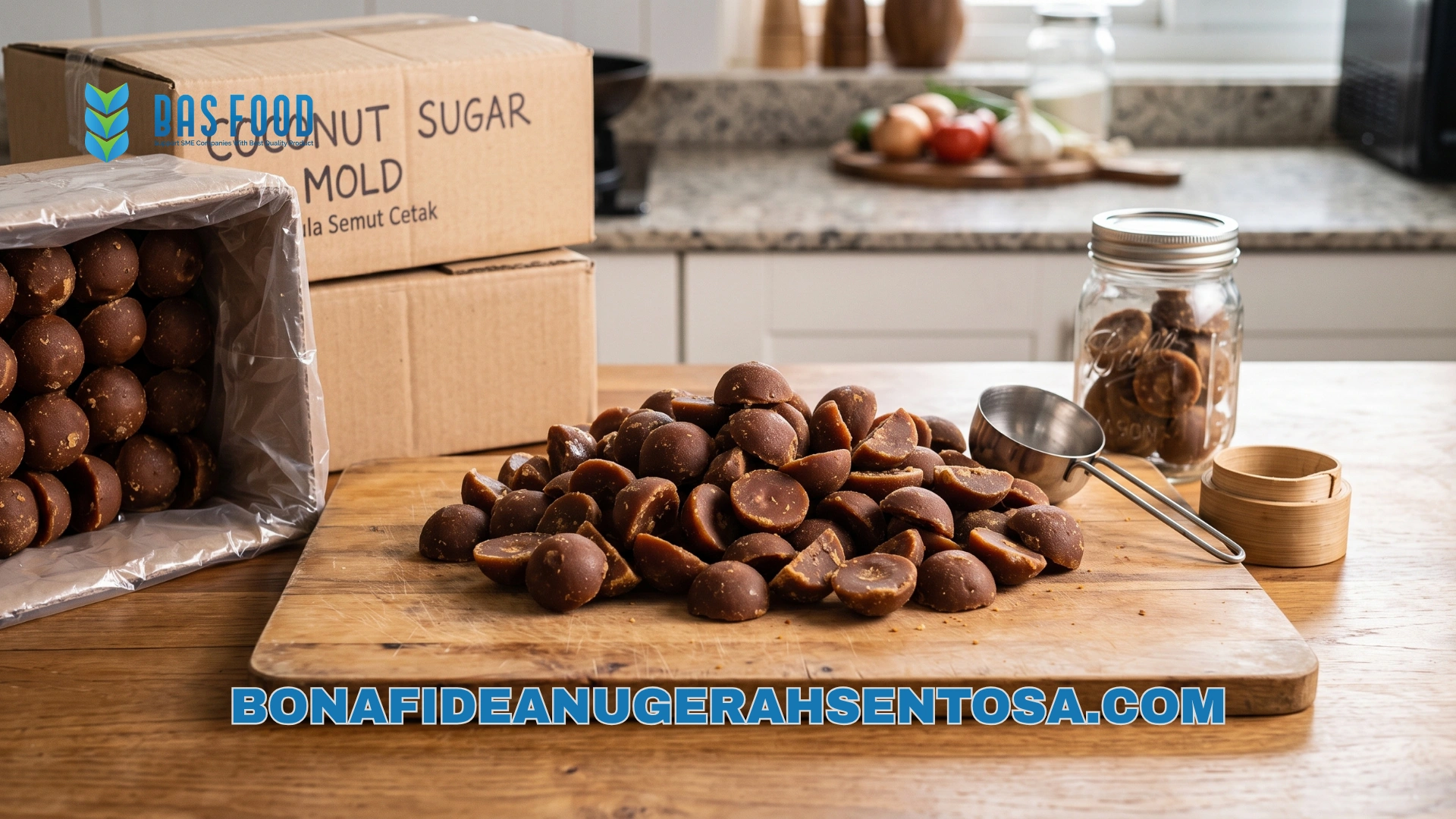
Bulk moulded coconut sugar is coconut sugar produced in solid pieces and prepared for larger-volume commercial orders. Instead of being supplied as loose granules or powder, the sugar is shaped using moulds and then packed according to the buyer’s requirements.
The shape can vary. Depending on the production process, buyers may request blocks, discs, rounds, cubes, or other practical forms. The exact shape, dimensions, and piece weight should be agreed between the buyer and supplier before production.
The moulded format has an important advantage for certain applications: the sugar is already portioned into physical pieces. This can make it suitable for traditional cooking, foodservice, specialty retail, and businesses that want a more distinctive product presentation.
However, moulded coconut sugar is not automatically the best choice for every business. Food manufacturers that require fast mixing or automated dosing may prefer granules or powder. Therefore, the first step is always to consider the final application.
Why Businesses Choose the Moulded Format
Businesses may choose moulded coconut sugar because they want:
- Solid sugar pieces
- Consistent piece sizes
- Traditional product presentation
- Easy portioning by piece
- Specialty retail products
- Foodservice applications
- Custom shapes
- Bulk supply for commercial use
The right format depends on how the product will be used and sold.
Why Buy Coconut Sugar in Bulk?
Bulk purchasing can make sense for businesses with regular demand.
Importers and distributors may need larger quantities to supply multiple customers. Food manufacturers may use coconut sugar as a regular ingredient in their production. Retail brands may also purchase larger quantities for repacking under their own labels.
However, bulk purchasing requires better planning than buying a small quantity.
The buyer needs to consider storage capacity, cash flow, packaging, production schedules, shipping arrangements, and expected sales volume.
Bulk Does Not Always Mean “As Much As Possible”
One common mistake is assuming that a larger order is always better.
A buyer should first estimate actual demand.
For example, ordering several tons may provide a better unit cost, but it also requires sufficient warehouse space and working capital. If the product remains in storage for too long, the business may face unnecessary inventory costs.
Therefore, buyers should find a practical order size that balances price and inventory requirements.
Understanding Coconut Sugar MOQ
Coconut sugar MOQ, or minimum order quantity, is an important consideration when discussing bulk supply.
The MOQ represents the smallest quantity a supplier is willing to produce or sell under the agreed commercial conditions. The exact MOQ can vary based on product format, packaging, production capacity, and customization requirements.
Moulded coconut sugar can have different production requirements compared with loose granules or powder. Custom shapes, special packaging, or specific piece weights may also influence the minimum order quantity.
Ask About MOQ Before Finalizing the Product
Buyers should ask the supplier about MOQ early in the sourcing process.
Useful questions include:
- What is the standard MOQ?
- Does the MOQ change for custom moulds?
- Is there a different MOQ for private-label packaging?
- Does the MOQ apply per product or per shipment?
- Can different products be combined in one order?
- Does packaging affect the MOQ?
These questions help buyers plan their purchase more accurately.
For new businesses, a supplier with a practical MOQ can make it easier to test the market before committing to very large volumes.
Choosing the Right Moulded Coconut Sugar Shape
Shape is one of the defining features of moulded coconut sugar.
A standard block may be suitable for traditional applications and bulk foodservice. Smaller pieces may be easier to portion. Custom shapes can help a retail brand create a more distinctive product.
However, shape should not be selected based only on appearance.
The dimensions need to work with packaging, storage, transportation, and the customer’s intended use.
Standard vs Custom Shapes
A standard mould is often a practical starting point for businesses that want to control costs and simplify production.
Custom moulding can be useful when a buyer has a specific product concept. For example, a brand may want a particular shape that fits its retail packaging.
Before ordering a custom format, discuss:
- Shape
- Dimensions
- Piece weight
- Mould design
- Production quantity
- Packaging
- Storage
- Transportation
A reliable coconut sugar mould supplier should be able to discuss these factors with the buyer before production begins.
The Role of a Coconut Sugar Mould Supplier
A coconut sugar mould supplier needs to understand more than just the shape of the product.
The mould affects how the sugar is formed and how the finished pieces fit into packaging. A poorly matched shape can create problems during packing, stacking, or shipping.
For this reason, buyers should provide clear dimensional requirements whenever possible.
A supplier may also recommend a standard mould if it is more practical for the desired order volume.
Customization Requires Planning
Custom moulds can require additional preparation.
The buyer may need to approve a design before production starts. Depending on the supplier and project, there may also be additional costs associated with developing or preparing the mould.
For larger B2B orders, these details should be confirmed before the purchase order is issued.
A good sourcing process avoids surprises by agreeing on specifications, costs, quantities, and production timing in advance.
Quality Factors to Check Before Ordering
A moulded shape alone does not determine coconut sugar quality.
B2B buyers should also evaluate the product’s appearance, aroma, flavor, texture, moisture characteristics, cleanliness, and consistency.
The physical pieces should match the agreed specifications.
If the buyer requires a specific piece weight, for example, consistency between pieces becomes important.
Request Samples Before a Bulk Order
Product samples can help buyers evaluate the actual product before committing to a large shipment.
A sample can be checked for:
- Color
- Aroma
- Taste
- Texture
- Shape
- Piece weight
- Size
- Packaging
- General condition
If the sample meets expectations, the buyer can use it as a reference when discussing commercial production.
This approach is especially useful for international buyers who may not be able to visit the production facility before placing an order.
Export Packaging for Bulk Moulded Coconut Sugar
Packaging becomes particularly important when coconut sugar travels internationally.
Export packaging needs to protect the product during handling, transportation, storage, and delivery.
Moulded coconut sugar can experience physical pressure when cartons are stacked. At the same time, coconut sugar needs protection from excessive moisture.
Therefore, the packaging should address both physical protection and environmental conditions.
What Should Buyers Discuss?
Before confirming a shipment, buyers should discuss:
- Inner packaging
- Outer cartons
- Bag materials
- Carton strength
- Net weight
- Gross weight
- Piece arrangement
- Pallet configuration
- Moisture protection
- Labeling requirements
The final packaging configuration should be suitable for the shipping method and destination.
For retail products, the requirements may be different from bulk foodservice packaging.
Bulk Packaging vs Retail Packaging
A B2B buyer may purchase the same coconut sugar product for very different purposes.
A food manufacturer may want large food-grade bags or cartons that can be moved directly into production.
A retailer may need individually packed pieces or smaller consumer-ready packages.
This means the buyer should define whether the product will be sold as bulk ingredients or repacked for consumers.
Packaging Should Match the Sales Model
For wholesale distribution, larger packaging can reduce handling and packaging costs.
For retail, smaller packages can improve convenience and presentation.
Some businesses may also purchase bulk moulded coconut sugar and then repack it locally.
If this is the business model, the importer should confirm the packaging format and labeling requirements before ordering.
Production Lead Time: Plan Before You Order
Production lead time is another important factor in bulk sourcing.
Production lead time refers to the time required to prepare the product before it is ready for shipment. The actual schedule can depend on product availability, order quantity, packaging, custom moulds, and production planning.
A standard product that is already available may have a different lead time from a custom moulded product.
Custom Orders May Need More Planning
If a buyer requests a new shape, special packaging, or other customization, the supplier may need additional preparation.
Therefore, buyers should not wait until the last minute to place an order.
A better approach is to provide a purchasing forecast where possible.
For example, if a distributor expects to need regular shipments every quarter, sharing that information with the supplier can support better production planning.
Storage Requirements for Bulk Moulded Coconut Sugar
Once the shipment arrives, proper storage becomes the buyer’s responsibility.
Coconut sugar should generally be kept in a clean, dry storage area and protected from excessive humidity.
Moulded pieces can be easier to stack than loose powder, but the packaging still needs to remain intact.
Warehouse Planning
Before ordering bulk quantities, buyers should consider:
- Available warehouse space
- Temperature conditions
- Humidity
- Pallet storage
- Carton stacking
- Pest control
- Product rotation
- Packaging integrity
A first-in, first-out approach can help businesses manage inventory effectively.
Buyers should also follow the supplier’s recommended storage conditions and applicable food-safety requirements.
Applications for Bulk Moulded Coconut Sugar
Moulded coconut sugar can serve a wide range of commercial applications.
Foodservice businesses may use it in traditional recipes, sauces, desserts, and beverages.
Specialty food brands may sell the pieces as a traditional coconut sugar product.
Food manufacturers can also break or process the blocks before using them in production, depending on their equipment and recipe.
Foodservice and Hospitality
Restaurants and hotels may appreciate the convenience of solid portions.
A moulded piece can be added to a recipe or served as a sweetener alongside beverages.
This format can also create a more traditional presentation than loose powder.
However, foodservice businesses should select piece sizes that match their typical serving and cooking requirements.
Bulk Moulded Coconut Sugar for Retail Brands
Retail brands can use moulded coconut sugar to create a product with a strong visual identity.
A solid piece can communicate a traditional ingredient format, particularly when the packaging highlights its origin and intended culinary use.
Brands may choose standard shapes or explore custom moulding.
Building a Retail Product
Retail businesses should consider:
- Piece size
- Package size
- Product appearance
- Consumer instructions
- Packaging design
- Label information
- Storage instructions
- Shelf presentation
The physical product and packaging should work together.
A beautifully shaped sugar piece will have limited value if the package does not protect it during transportation and storage.
Bulk Moulded Coconut Sugar for Food Manufacturers
Manufacturers often approach coconut sugar differently from retailers.
The ingredient needs to fit into a production system.
For example, a manufacturer may break moulded sugar into smaller pieces before adding it to a cooking process.
In other situations, moulded sugar may not be the most efficient format.
Compare Moulded Sugar With Granules and Powder
Before purchasing, manufacturers should compare:
Moulded: solid pieces, useful for traditional and portion-based applications.
Granules: loose particles, suitable for many food and beverage formulations.
Powder: fine particles, often useful for dry blends and applications that require easy incorporation.
The best option depends on the production equipment and final product.
How to Calculate the Right Bulk Order
Ordering the right quantity requires some basic planning.
A buyer can estimate expected monthly consumption and multiply it by the desired inventory period.
For example:
Monthly demand × inventory coverage period = estimated purchase quantity
The buyer should then consider production lead time and shipping time.
Avoid Both Overstocking and Stockouts
Ordering too little can create supply gaps.
Ordering too much can tie up cash and warehouse space.
For this reason, businesses should consider safety stock when planning recurring imports.
A supplier with predictable production and communication can help buyers maintain a more reliable purchasing schedule.
Evaluating an Indonesian Coconut Sugar Supplier
For international buyers, Indonesia can be an important sourcing market for coconut-based products.
However, buyers should evaluate suppliers based on more than country of origin.
Consider the supplier’s communication, product specifications, packaging capabilities, production capacity, export experience, and ability to maintain agreed requirements.
CV Bonafide Anugerah Sentosa
CV Bonafide Anugerah Sentosa is an Indonesian exporter and supplier of coconut sugar and other coconut-derived products.
For B2B buyers interested in bulk moulded coconut sugar, the sourcing discussion should begin with the intended product application and required specifications.
Buyers can explain their desired shape, piece weight, packaging format, order quantity, and target delivery schedule.
This gives the supplier a clearer understanding of the project.
Final Thoughts: Buying Bulk Moulded Coconut Sugar With Confidence
Bulk moulded coconut sugar can be a practical option for importers, distributors, foodservice businesses, specialty retailers, and manufacturers that need solid coconut sugar pieces.
The format offers opportunities for traditional food applications, portion-based use, specialty retail, and customized product concepts.
However, successful bulk sourcing requires more than choosing a shape.
Buyers should consider coconut sugar MOQ, export packaging, production lead time, piece dimensions, product specifications, storage conditions, and supplier reliability before confirming an order.
Sampling is also an important step. It allows buyers to evaluate the actual product and confirm whether it meets their expectations.
For international buyers, working with a supplier that understands both product requirements and export processes can make the purchasing process easier.
CV Bonafide Anugerah Sentosa can be considered as a potential Indonesian coconut sugar supplier for B2B buyers looking for coconut sugar products and related export requirements.
Ultimately, the best bulk purchasing strategy is simple: define the product clearly, test the sample, confirm the commercial specifications, plan the production schedule, and choose packaging that protects the product throughout its journey.
With careful planning, moulded coconut sugar can become a dependable ingredient or retail product for businesses serving customers in international markets.