
Europe’s food industry depends on a wide range of imported ingredients. From bakery manufacturers and confectionery producers to food distributors and private-label brands, companies need reliable supplies of edible oils that meet their technical, commercial, and regulatory requirements. One ingredient worth exploring is RBD coconut oil for European importers. This refined vegetable oil offers a relatively neutral aroma, useful melting characteristics, and applications across several food manufacturing sectors.
RBD stands for Refined, Bleached, and Deodorized. These processing stages help produce coconut oil with reduced color, odor, and certain impurities. As a result, manufacturers can use it in selected food formulations without introducing a strong coconut flavor.
However, importing edible oil into Europe requires more than finding an attractive price. Buyers must evaluate product specifications, food safety, traceability, regulatory compliance, packaging, and logistics.
This guide explains what European importers should know about sourcing RBD coconut oil from Indonesia, including quality parameters, supplier documentation, shipping considerations, and practical purchasing strategies.
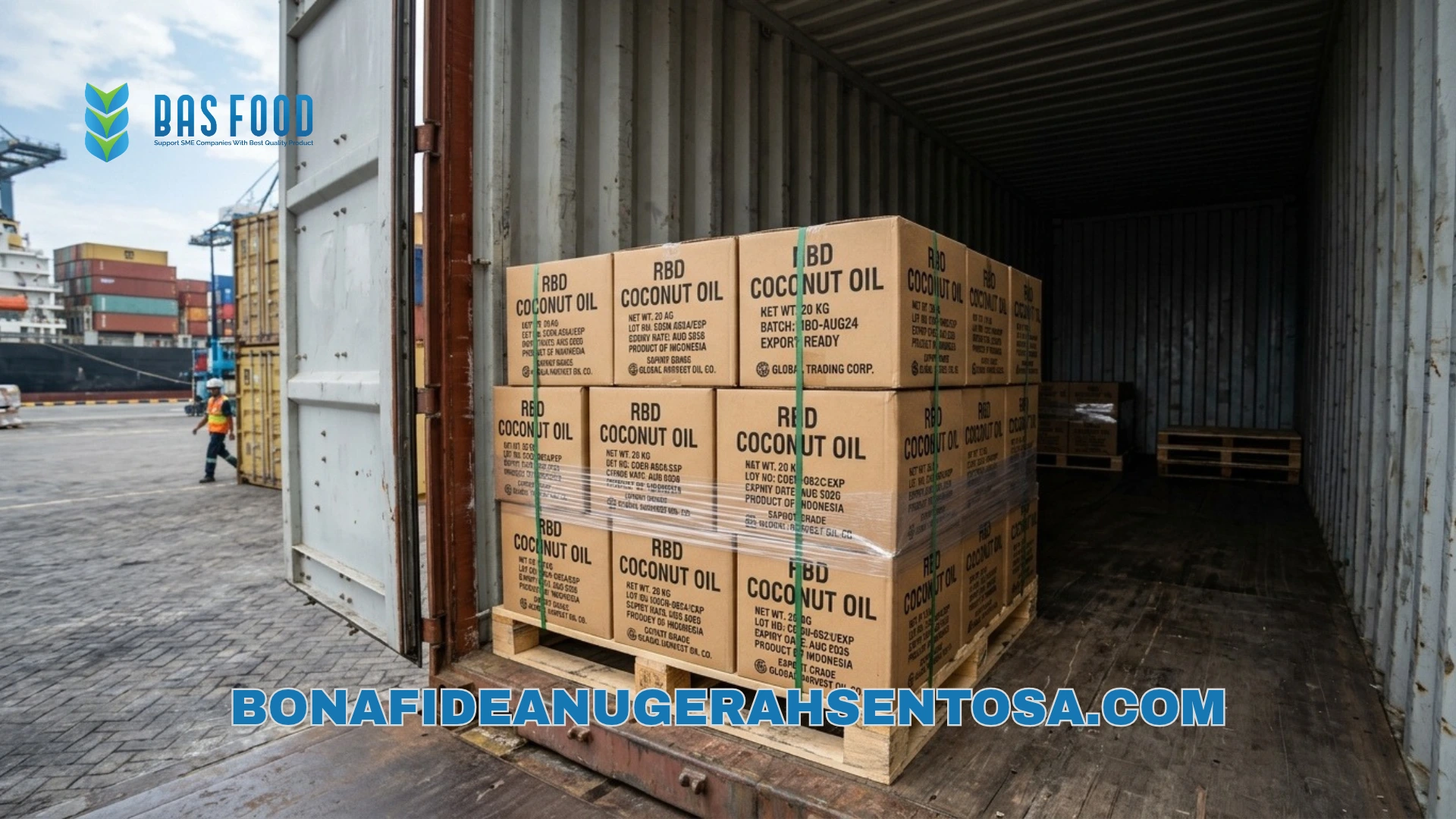
Why Indonesia Is Relevant to European Coconut Oil Sourcing
Indonesia is one of the world’s major coconut-producing countries and has an established industry supplying coconut-based products to international markets.
Its coconut sector supports the production and trade of several commodities, including coconut oil, coconut sugar, coconut-derived ingredients, and other agricultural products.
For European buyers, Indonesia represents a potential sourcing origin when exploring alternatives or additional suppliers for coconut-based ingredients.
However, country of origin alone does not guarantee product quality. Individual manufacturers and exporters may differ in their processing capabilities, quality systems, documentation, and commercial arrangements.
Therefore, importers should evaluate each supplier independently.
Understanding the sourcing opportunity
Businesses involved in European food ingredient sourcing often prioritize consistency, competitive pricing, traceability, and reliable communication.
Indonesian suppliers may offer opportunities to diversify sourcing networks, but buyers must confirm whether individual exporters can meet their specific requirements.
For example, a European bakery ingredient distributor may need bulk shipments with consistent fatty acid composition. Meanwhile, a smaller food manufacturer may prefer a different packaging format or purchasing volume.
By communicating these needs early, buyers can identify suppliers whose capabilities match their purchasing strategy.
Important RBD Coconut Oil Specifications for European Buyers
Product quality is one of the most important factors when importing edible oils.
European manufacturers often require detailed edible oil specifications before approving a new ingredient. These specifications help ensure that the oil meets processing requirements and supports consistent finished-product quality.
Although individual purchasing standards vary, buyers commonly evaluate several technical parameters.
| Quality parameter | Why European importers check it |
|---|---|
| Free fatty acid (FFA) content | Helps assess refining quality and hydrolytic deterioration |
| Peroxide value | Indicates certain early-stage oxidation products |
| Moisture and volatile matter | Helps evaluate water and volatile content |
| Color | Supports appearance consistency |
| Odor and taste | Helps confirm acceptable sensory characteristics |
| Fatty acid composition | Supports identity verification and formulation |
| Melting characteristics | Helps predict handling and product performance |
| Contaminant levels | Supports food safety and regulatory compliance |
Importers should request a product specification sheet and, where appropriate, batch-specific laboratory results.
Importantly, the acceptable values depend on the intended use, applicable regulations, and agreed commercial specifications.
Why specifications matter in manufacturing
Imagine a European confectionery manufacturer developing a fat-based coating.
If the incoming oil has different melting characteristics from the approved sample, the finished coating may behave differently during cooling, storage, or consumption.
Similarly, changes in odor or oxidation indicators may affect the sensory quality of a bakery product.
For this reason, technical specifications should be established before large-scale purchasing.
Buyers should also agree on sampling procedures, testing methods, and how quality deviations will be handled.
European Union Food Safety Requirements for RBD Coconut Oil
Food safety compliance is a central part of importing RBD coconut oil into the European Union.
Importers must ensure that products placed on the EU market meet applicable food law requirements. These include general food safety obligations, traceability, and relevant contaminant limits.
EU Regulation (EC) No 178/2002 establishes general food law principles, including responsibilities related to food safety and traceability.
Additionally, Regulation (EC) No 852/2004 addresses food hygiene requirements. The obligations applying to a particular operator depend on its activities and position in the supply chain.
For contaminants, Commission Regulation (EU) 2023/915 establishes maximum levels for specified contaminants in food, where relevant to the product category.
Understanding refining-related contaminants
Refined edible oils may require attention to contaminants associated with processing, including glycidyl fatty acid esters and certain 3-MCPD-related substances.
These compounds can be associated with high-temperature refining processes, although their levels depend on the raw material and production conditions.
European buyers should therefore review the applicable legal limits and request appropriate testing information.
Other potential concerns may include pesticide residues, certain environmental contaminants, and contamination during handling or transportation, depending on the product and supply chain.
Importers should verify current requirements rather than relying on an outdated or generic checklist.
Food safety documentation
European importers may request a supplier’s food safety management information, relevant certificates, traceability procedures, and laboratory test reports.
Certifications such as FSSC 22000, ISO 22000, or other recognized schemes may support supplier assessment when applicable.
However, these certifications should never be assumed. Buyers must verify which certifications a particular supplier actually holds and whether their scope covers the relevant product and facility.
Supplier Documentation: What Importers Should Request
Reliable supplier documentation helps European buyers evaluate product quality, manage regulatory obligations, and prepare international shipments.
Before placing an order, importers should request documents appropriate to the product and destination market.
Common documents may include:
- Product technical data sheet.
- Product specification sheet.
- Certificate of analysis, where available.
- Ingredient and allergen information.
- Relevant food safety certifications, if held.
- Traceability or origin information.
- Commercial invoice.
- Packing list.
- Bill of lading or other transport document.
- Certificate of origin, when required or commercially relevant.
Additional documents may be necessary depending on the importing country, product classification, buyer requirements, and shipment circumstances.
Why documentation should be checked early
A frequent purchasing mistake is waiting until the shipment is ready before confirming documentation requirements.
This approach can create delays if the buyer discovers that a required test report, declaration, or customs document is missing.
Instead, importers should prepare a document checklist during supplier qualification.
They should also confirm the correct product description, customs classification, shipment details, and responsibilities of each trading party.
Clear communication reduces the risk of misunderstandings during customs clearance and product acceptance.
Understanding EU Import Duties and Customs Classification
Import duties are another important consideration when purchasing RBD coconut oil for European importers.
Coconut oil is generally classified within heading 1513 of the Harmonized System. However, the precise EU Combined Nomenclature or TARIC classification depends on the product’s characteristics and applicable classification rules.
For example, refined coconut oil may fall under a different subheading from crude coconut oil.
European buyers should confirm the correct classification before calculating landed costs.
Are preferential tariffs available?
Import duties may depend on the product classification, origin, applicable trade arrangements, and the date of importation.
Therefore, buyers should check the current EU TARIC database and relevant customs guidance rather than assuming that a particular duty rate always applies.
Any preferential treatment must meet the applicable origin rules and documentation requirements.
Importers should also consider customs clearance charges, import VAT where applicable, freight, insurance, port handling, and inland transportation.
These costs can significantly influence the final purchasing decision.
Packaging and Shipping RBD Coconut Oil to Europe
Packaging plays an important role in protecting edible oil during international transportation.
Depending on supplier capabilities and buyer requirements, RBD coconut oil may be shipped in drums, intermediate bulk containers, flexitanks, or other suitable bulk systems.
However, not every supplier offers every packaging format. Buyers should confirm availability before finalizing commercial terms.
The chosen packaging should be suitable for food contact and the intended transport conditions.
Managing temperature during shipment
RBD coconut oil can solidify when temperatures fall below its melting range.
This characteristic is particularly relevant for shipments traveling from tropical Indonesia to cooler European destinations.
Solidification is not necessarily evidence of product damage. Nevertheless, it can affect unloading, pumping, and storage operations.
For this reason, importers should plan appropriate handling procedures and confirm whether controlled warming is necessary.
Excessive heating should be avoided because it can contribute to product deterioration.
Choosing the right shipping terms
International buyers should agree on suitable Incoterms, such as FOB, CIF, or other terms that match the transaction.
These terms help define responsibilities for transportation, insurance where applicable, costs, and the transfer of risk.
Buyers should also confirm loading ports, destination ports, estimated transit arrangements, and required shipping documents.
A clearly written purchase contract helps prevent disputes and supports more predictable delivery planning.
RBD Coconut Oil Applications in European Food Manufacturing
European food manufacturers use vegetable oils in many applications, and RBD coconut oil can be considered for selected formulations.
Its relatively neutral flavor and melting behavior may make it useful in bakery products, confectionery, processed foods, and certain specialty applications.
Bakery products
In cookies, biscuits, cakes, and selected fillings, fat selection influences texture, tenderness, and processing performance.
RBD coconut oil may be evaluated as part of a bakery fat system. However, manufacturers should test its behavior because it does not have the same plasticity or melting profile as every conventional shortening.
Confectionery and coatings
Confectionery manufacturers may consider RBD coconut oil for selected fillings and fat-based coatings.
Nevertheless, standard RBD coconut oil is not automatically interchangeable with cocoa butter or specialized confectionery fats.
Fat compatibility, crystallization, and storage stability must be evaluated before commercial production.
Snacks and processed foods
RBD coconut oil may also be considered for selected frying, coating, or processed food applications.
Its suitability depends on operating temperatures, product requirements, and the manufacturer’s oil management procedures.
Manufacturers should validate performance under actual production conditions rather than assuming that coconut oil is appropriate for every frying process.
Exploring Indonesian Coconut Products with CV Bonafide Anugerah Sentosa
CV Bonafide Anugerah Sentosa operates in Indonesia’s agricultural commodity supply and export sector, including coconut-derived products.
European businesses exploring Indonesian sourcing opportunities can contact the company to discuss current product availability, technical requirements, packaging options, and export arrangements.
For RBD coconut oil inquiries, buyers should specifically confirm whether the required food-grade product, specifications, and documentation are available.
The company is also relevant to businesses searching for a coconut sugar exporter supplier or coconut sugar supplier.
Coconut sugar and RBD coconut oil are different ingredients, however, and should be evaluated according to their respective functions.
Coconut sugar serves primarily as a sweetener, while RBD coconut oil provides fat and influences physical properties such as melting behavior and texture.
Building an effective B2B inquiry
A detailed inquiry can make sourcing discussions more efficient.
European importers should provide the intended application, destination country, estimated purchasing volume, preferred packaging, and required quality parameters.
If possible, include the relevant technical specification or an approved reference sample.
Buyers should also identify any required certifications, laboratory tests, or documentation before negotiating final commercial terms.
This information helps determine whether the proposed supply arrangement meets the buyer’s expectations.
Building a Long-Term Coconut Oil Supply Strategy
Long-term sourcing requires more than completing one successful shipment.
European importers should monitor supplier performance, product consistency, delivery reliability, and changes in regulatory requirements.
Regular communication can help both parties anticipate production schedules, packaging needs, and shipment planning.
It is also useful to maintain clear records of approved specifications, laboratory results, purchase orders, and quality concerns.
Preparing for changing market requirements
Food regulations and customer expectations can evolve.
Consequently, importers should periodically review applicable EU rules, product documentation, and supplier quality procedures.
Businesses should also consider traceability, responsible sourcing expectations, and supply chain risks when developing procurement strategies.
A well-managed sourcing program combines technical evaluation, regulatory awareness, and commercial planning.
For companies purchasing RBD coconut oil regularly, these practices can support more predictable operations and stronger supplier relationships.
Conclusion: Smarter RBD Coconut Oil Sourcing for European Importers
Sourcing RBD coconut oil for European importers requires careful attention to quality, regulatory compliance, documentation, logistics, and supplier reliability.
Indonesia offers potential sourcing opportunities for businesses interested in coconut-derived ingredients. However, successful purchasing depends on evaluating individual suppliers and confirming that the product meets the intended application’s requirements.
European buyers should prioritize clear edible oil specifications, appropriate laboratory testing, reliable supplier documentation, and accurate customs planning.
They should also consider the practical effects of temperature during shipping and storage.
For businesses exploring Indonesian coconut products, CV Bonafide Anugerah Sentosa can be contacted to discuss current availability and export requirements.
With a structured procurement process, European importers can make more informed sourcing decisions and build stronger international supply relationships.