
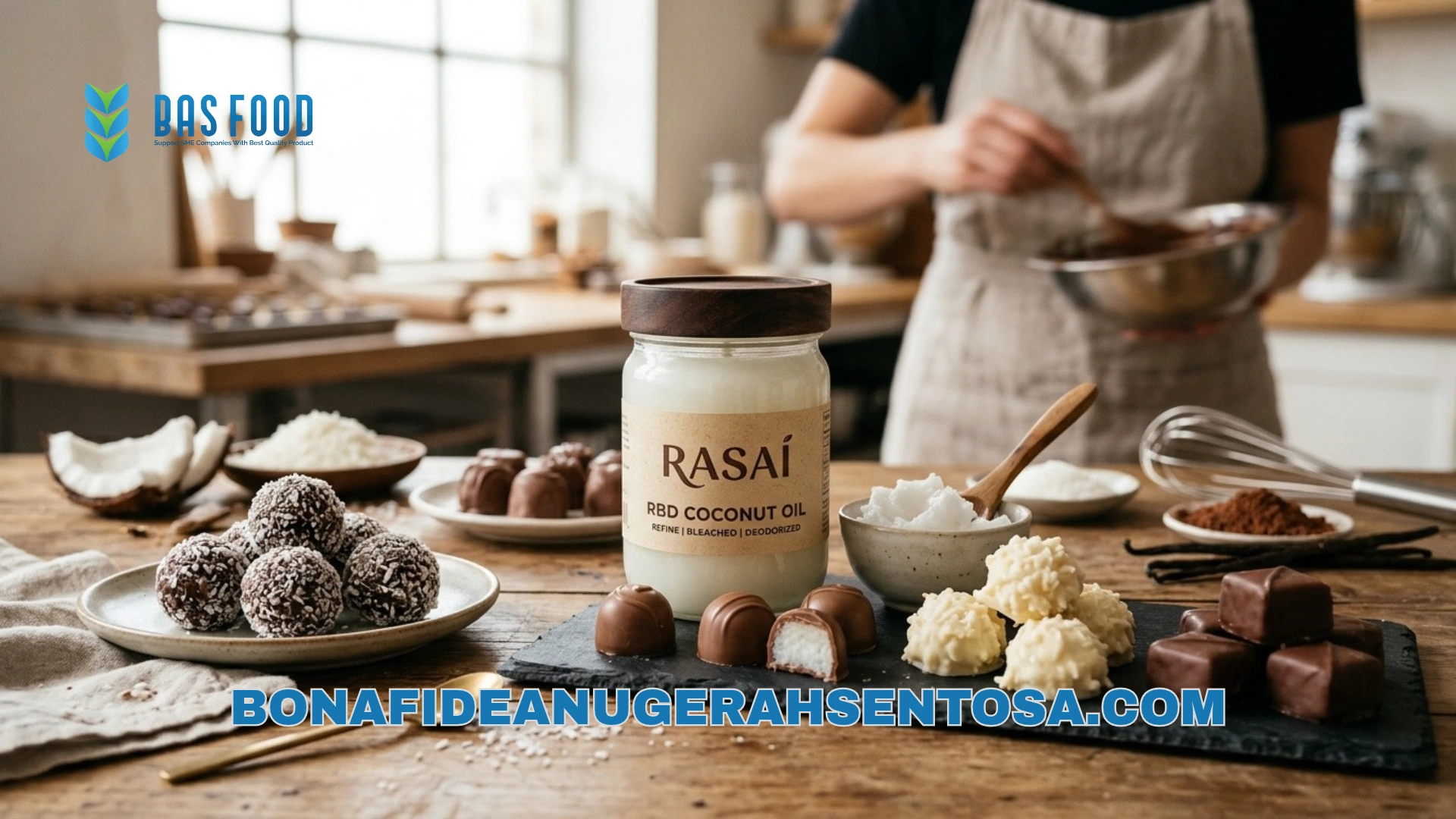
The confectionery industry depends on ingredients that deliver the right texture, flavour, appearance, and performance. From chocolate coatings to creamy fillings and chewy sweets, manufacturers need fats that work well during processing and help create a consistent final product. One ingredient worth considering is RBD coconut oil for confectionery, a refined vegetable oil that can serve as a fat ingredient in selected confectionery formulations.
RBD stands for refined, bleached, and deodorized. These steps help reduce unwanted impurities, colour compounds, and odours in coconut oil. The result is an oil with a milder sensory profile than unrefined coconut oil. Its functional properties can make it useful in applications where manufacturers want a relatively neutral coconut oil ingredient rather than a strong coconut aroma.
Coconut oil has a high proportion of saturated fatty acids, which influences its melting behaviour. It can be solid or semi-solid in cooler conditions and liquid at warmer temperatures, depending on the surrounding temperature and the oil’s composition. This behaviour matters in confectionery because fat selection affects mouthfeel, product firmness, coating performance, and storage stability.
However, RBD coconut oil is not automatically suitable for every chocolate or candy recipe. Its melting profile differs from cocoa butter and from some specialised confectionery fats. Manufacturers should therefore evaluate the intended application, formulation, processing conditions, and final product requirements before choosing it.
For confectionery businesses, the main question is not simply whether coconut oil can be used. It is whether the oil performs well in the specific recipe, production process, and distribution environment.
Why Confectionery Manufacturers Use Vegetable Fats
Fats play several important roles in confectionery. They influence how a product feels in the mouth, how quickly it softens, how ingredients combine, and how the finished product behaves during storage. In some recipes, fat also helps carry flavour and creates a smooth, creamy texture.
Different confectionery products require different fat properties. A soft filling needs a different structure from a firm coating. A chewy caramel may need fat that supports its texture and processing behaviour, while a chocolate product may depend on carefully controlled melting and crystallisation characteristics.
This is why manufacturers use a range of confectionery fats, including cocoa butter, dairy fat, coconut oil, palm-based fats, and specialised vegetable fats. Each ingredient offers a different balance of melting behaviour, firmness, flavour, and cost.
RBD coconut oil can be useful where its melting profile fits the product. For example, a formulation may use coconut oil to adjust the softness of a filling or to provide a fat component in a coating. Nevertheless, its performance depends on the other ingredients and the temperatures encountered during manufacturing, transport, and storage.
Potential advantages of RBD coconut oil
One advantage is its relatively mild flavour and aroma after refining. This can be useful when the manufacturer wants other ingredients, such as cocoa, vanilla, caramel, fruit, or dairy flavours, to remain prominent.
Another advantage is its ability to melt readily under suitable conditions. This can support certain coatings and fillings, although the exact processing temperature must be determined through product testing rather than assumed from the ingredient name alone.
RBD coconut oil may also provide a useful alternative for manufacturers exploring different fat systems. However, it should not be treated as a direct replacement for every confectionery fat. Formulation trials remain essential because even small changes in fat composition can affect firmness, texture, and shelf performance.
RBD Coconut Oil in Chocolate Products: What Buyers Should Know
Chocolate products require particular attention when selecting a fat ingredient. Traditional chocolate relies on cocoa butter, which has a distinctive fat composition and crystallisation behaviour. These properties contribute to chocolate’s snap, gloss, texture, and melting characteristics.
RBD coconut oil behaves differently from cocoa butter. Because its fatty acid composition and melting profile are not identical, replacing cocoa butter with coconut oil can change how a chocolate formulation sets and melts. It may also affect firmness, resistance to warm temperatures, and the finished product’s eating quality.
For that reason, RBD coconut oil for confectionery should be evaluated according to the specific chocolate application. It may be considered in selected compound coatings, fillings, or other chocolate-flavoured products, depending on the formulation. However, it is not automatically suitable for use in products legally defined as chocolate in every market.
Compound coatings and chocolate-flavoured products
Compound coatings are designed using a fat system that differs from traditional cocoa-butter-based chocolate. Some formulations use vegetable fats to achieve particular processing or cost characteristics. Coconut oil may be considered as one component of a suitable formulation, but the manufacturer must confirm that its melting behaviour and compatibility meet the required specifications.
For example, a confectionery producer may want a coating that flows smoothly during application and produces an acceptable texture after cooling. The manufacturer must test how the selected fat interacts with cocoa powder, sugar, milk ingredients, emulsifiers, and other components.
The correct fat choice depends on the product’s intended use and storage conditions. A coating designed for a cool retail environment may perform differently from one intended for distribution in a warm climate.
Tempering and crystallisation
Traditional chocolate production often requires tempering to encourage the desired cocoa butter crystal structure. RBD coconut oil does not behave like cocoa butter, so a standard chocolate tempering process should not automatically be applied to an oil-based coating containing coconut oil.
Instead, manufacturers should establish a suitable heating, mixing, cooling, and setting process for the complete formulation. Pilot trials can help identify the correct process conditions and reveal issues such as poor setting, excessive softness, surface changes, or unsuitable mouthfeel.
If a product must comply with a particular chocolate identity standard, consult the applicable food regulations before selecting the fat system. The permitted ingredients and labelling rules may vary by destination market.
Candy Manufacturing: Fillings, Caramels, and Soft Confectionery
Beyond chocolate-style coatings, RBD coconut oil may be useful in selected soft confectionery applications. Candy manufacturing covers a wide range of products, including caramels, toffees, creamy centres, fudge-style sweets, layered bars, and filled confectionery. Each product has its own requirements for texture, moisture, fat content, and processing stability.
In caramel and toffee formulations, fat can help influence softness, smoothness, and the way the product feels during chewing. Depending on the recipe, coconut oil may contribute to the fat phase. However, the finished texture also depends on sugar concentration, dairy ingredients, moisture, cooking temperature, and cooling conditions.
Creamy fillings and centres
Some confectionery products contain a creamy filling inside a shell or coating. The filling needs to remain stable during manufacture and storage while delivering the intended texture. RBD coconut oil may be considered in certain fillings when its melting profile fits the desired result.
For instance, a manufacturer developing a coconut-flavoured centre may test coconut oil as part of the fat system. In a different recipe, the oil may be combined with cocoa, milk powder, sugar, or flavour ingredients. The final result depends on the full formulation, not on coconut oil alone.
Manufacturers should test the filling at the temperatures it is likely to encounter throughout distribution. A filling that performs well in a cool production room may become too soft during transport in warmer conditions.
Chewy and soft candies
In soft candies, fat selection can influence lubrication, chewiness, and the way the product releases flavour. However, coconut oil will not create the same effect in every recipe. Its performance depends on the amount used, the other fats present, the sugar system, and the production method.
A practical development process begins with a small trial. Adjust the fat level gradually, document the mixing and cooking conditions, and evaluate the product after cooling. Then test the candy after storage to see whether the texture, appearance, and flavour remain acceptable.
This process helps manufacturers avoid relying on assumptions. It also creates useful data for scaling the recipe from laboratory or pilot production to commercial manufacturing.
How to Select the Right RBD Coconut Oil Specification
Not all purchasing decisions should begin with price. For food manufacturers, the oil’s specification must match the intended use. A suitable supplier should be able to explain the available product grade and provide relevant technical information for evaluation.
Start by requesting a product specification sheet. Depending on the supplier and intended application, relevant details may include appearance, odour, free fatty acid level, moisture and impurities, melting characteristics, and other quality parameters. The exact limits should be agreed upon with the supplier and assessed against the manufacturer’s needs.
Melting profile and texture
Melting behaviour is one of the most important factors in confectionery formulation. It affects whether a product remains firm, softens quickly, or melts pleasantly in the mouth. It can also influence coating performance and the product’s ability to withstand different storage temperatures.
Ask for relevant technical data and confirm the test method used. If your recipe needs a particular melting range or solid-fat profile, communicate that requirement before purchasing. Do not assume that every RBD coconut oil has exactly the same behaviour.
Sensory properties and product quality
RBD coconut oil is generally processed to reduce colour and odour, but buyers should still assess the actual product. Check the appearance, smell, and handling characteristics of a sample. If the oil will be used in a sensitive recipe, conduct a trial under the same conditions as commercial production.
A supplier’s documentation should support the agreed specification. Depending on the market and buyer requirements, you may also need batch-specific certificates of analysis, food safety documentation, or independent test results. Confirm availability and validity rather than assuming that every document is automatically included.
Consistency between batches
Confectionery manufacturers need predictable ingredients because changes in fat properties can affect production. Ask how the supplier monitors product quality and identifies individual batches. Lot identification and clear specifications help the buyer investigate any unexpected variation.
For ongoing supply, agree on the parameters that must remain consistent and the process for communicating changes. This is particularly important when the oil forms a major part of the recipe.
Formulation Tips: Getting the Best Results from RBD Coconut Oil
Successful confectionery development requires testing. Even when RBD coconut oil appears suitable on paper, manufacturers should verify its performance in the actual recipe. A change in fat can influence mixing, viscosity, cooling, firmness, flavour release, and storage behaviour.
First, define the result you want to achieve. Are you developing a softer filling, a coating that sets at a particular temperature, or a candy with a specific mouthfeel? Clear goals make it easier to select the right tests and assess the results.
Next, establish a baseline formulation. Record the ingredients, their quantities, mixing conditions, processing temperatures, cooling time, and final product characteristics. Change one major variable at a time where practical, so you can understand which adjustment causes each result.
Test compatibility with other fats
If the recipe contains cocoa butter, dairy fat, or specialised confectionery fats, do not assume that blending them with coconut oil will produce the desired structure. Different fats can interact in ways that influence crystallisation, firmness, and melting behaviour.
Test the blend at the intended ratio and follow a controlled cooling process. Evaluate the product immediately after setting and again after storage. Depending on the formulation, checks may include hardness, flow, coating appearance, mouthfeel, and signs of fat migration or surface changes.
Consider the production environment
Production temperature, room humidity, cooling equipment, and packaging can all influence confectionery performance. A recipe that works on a small scale may behave differently on a commercial line because mixing, cooling, and product thickness can change.
Therefore, conduct pilot production before approving a full-scale recipe. Record the results and adjust the process where needed. This reduces the risk of discovering a major issue after ingredients and packaging have already been purchased in large quantities.
Evaluate shelf performance
Shelf life depends on the complete product, not just the fat ingredient. Factors such as moisture, oxidation, packaging, processing hygiene, and storage temperature can affect the final confectionery item.
Use appropriate shelf-life studies and quality checks for the product and market. Assess changes in flavour, aroma, texture, and appearance over time. Follow the applicable food safety and labelling rules when setting the product’s shelf-life declaration.
Storage, Packaging, and Handling for Food Manufacturers
Proper storage helps protect RBD coconut oil before it enters the production line. Follow the supplier’s handling recommendations and keep the oil in clean, suitable containers that protect it from contamination, moisture, and strong odours.
Temperature matters because coconut oil can change between liquid and solid states as the environment changes. Solidification in cooler conditions does not automatically mean the oil has spoiled. However, the buyer should follow the supplier’s guidance for liquefying or warming the oil, including any recommended temperature limits and handling procedures.
Avoid excessive heating or repeated uncontrolled heating and cooling. These practices may affect quality and complicate production planning. If the oil needs to be warmed before use, follow a controlled procedure appropriate to the product and equipment.
Packaging selection should reflect the shipment size, storage conditions, and handling process. Industrial buyers may require drums, pails, or other food-grade bulk formats, depending on what the supplier offers. Confirm the available packaging, net weight, container material, sealing method, and transport arrangements before ordering.
Once the oil arrives, inspect the packaging and check the shipment documents. Record the batch information and store the oil according to the supplier’s instructions. A clear inventory system helps your team track stock, rotate inventory, and investigate quality issues if they arise.
For international shipments, also consider transit time, temperature exposure, container cleanliness, and the destination warehouse environment. These details are particularly important when the product travels through regions with different climates.
RBD Coconut Oil vs Other Confectionery Fats
Choosing a fat depends on the product’s technical needs, cost targets, label requirements, and intended market. RBD coconut oil is one option among several, and each alternative offers different characteristics.
Cocoa butter is central to traditional chocolate because of its characteristic melting and crystallisation properties. A manufacturer developing premium chocolate usually needs to account for cocoa butter’s specific behaviour. Coconut oil cannot be assumed to provide an identical result.
Palm-based fats and specialised confectionery fats may be developed for particular firmness, melting, and processing characteristics. Depending on their composition, they may offer advantages for certain coatings or fillings. Buyers should evaluate the precise grade instead of comparing oils only by their general source.
Dairy fat and butter contribute flavour and texture to many confectionery products. However, they also introduce different composition, handling, and labelling considerations. Whether coconut oil is suitable as a replacement depends on the recipe and the intended product characteristics.
Other vegetable oils may offer different levels of liquid fat and different functional behaviour. A liquid oil may be appropriate for some fillings but unsuitable for a coating that needs to set firmly at room temperature.
The most effective comparison uses actual product specifications and controlled formulation trials. Consider the total cost per finished product, not just the price per kilogram of fat. A lower-cost ingredient may require additional stabilisers, processing adjustments, or packaging changes that affect the final economics.
Sourcing RBD Coconut Oil for Confectionery from Indonesia
For food manufacturers, importers, and ingredient distributors, sourcing from a reliable supplier is an important part of production planning. A good sourcing process starts with a clear technical brief that describes the intended confectionery application and the specifications needed from the oil.
CV Bonafide Anugerah Sentosa is a contact point for businesses exploring Indonesian coconut-derived ingredients and export opportunities. Buyers should discuss their intended application, required product grade, order quantity, packaging preference, destination country, and expected delivery schedule before making a purchasing decision.
When contacting a supplier, explain whether the oil will be used in chocolate-style coatings, fillings, caramels, or another confectionery product. This helps identify the technical information your team needs to evaluate the ingredient. Ask for the current product specification and confirm whether the available grade matches your processing requirements.
Businesses searching for a coconut sugar exporter supplier or coconut sugar supplier should distinguish between coconut sugar and coconut oil. These are different products with different specifications and uses. A supplier’s ability to provide one product does not automatically confirm availability of the other, so verify the exact product and grade directly.
The Spanish phrase exportador de azúcar de coco means “coconut sugar exporter.” It may be useful when researching suppliers for Spanish-speaking markets, but buyers sourcing RBD coconut oil should use clear product-specific enquiries to avoid confusion between coconut sugar and coconut oil.
Before placing an order, confirm the product’s availability, minimum order quantity, packaging, quotation validity, lead time, export documentation, and shipping terms. Ask for samples or technical documents where appropriate, and make sure both parties agree on the specification before production or shipment.
Conclusion: Choose the Right Fat for Better Confectionery Results
RBD coconut oil for confectionery can offer useful formulation possibilities for selected coatings, fillings, and soft sweets. Its refined sensory profile and melting behaviour may fit certain applications, but manufacturers need to evaluate its performance against the requirements of each product.
The best results come from combining clear specifications with practical testing. Review the oil’s technical data, assess its compatibility with other fats, test the formulation at production scale, and evaluate the finished product under realistic storage conditions. At the same time, consider packaging, supply reliability, and the regulations of your target market.
For B2B buyers, a dependable ingredient sourcing process supports consistent production and helps reduce avoidable risk. Contact CV Bonafide Anugerah Sentosa to discuss current product availability and confirm whether the required coconut oil grade, specifications, packaging, and export arrangements suit your business.