
Coconut oil is widely used in food manufacturing, personal care products, cosmetics, and other industrial applications. However, not every application requires coconut oil in its raw or unrefined form. Many manufacturers prefer refined coconut oil because of its lighter color, neutral smell, and consistent quality. This is where the RBD coconut oil manufacturing process becomes important.
RBD stands for Refined, Bleached, and Deodorized. These three words describe the main treatment stages used to improve the quality and usability of coconut oil. Through controlled processing, manufacturers can reduce unwanted impurities, improve color, and remove odors that may affect the final product.
For importers, distributors, food manufacturers, and other B2B buyers, understanding how RBD coconut oil is produced can make sourcing decisions easier. It helps buyers understand product specifications, ask better questions, and compare suppliers based on processing methods and quality-control practices.
In this guide, we will explore each stage of the RBD coconut oil manufacturing process, from raw material preparation to final packaging. We will also explain the role of coconut oil refining, the bleaching process, the deodorization process, and the factors that buyers should consider when sourcing refined coconut oil from Indonesia.
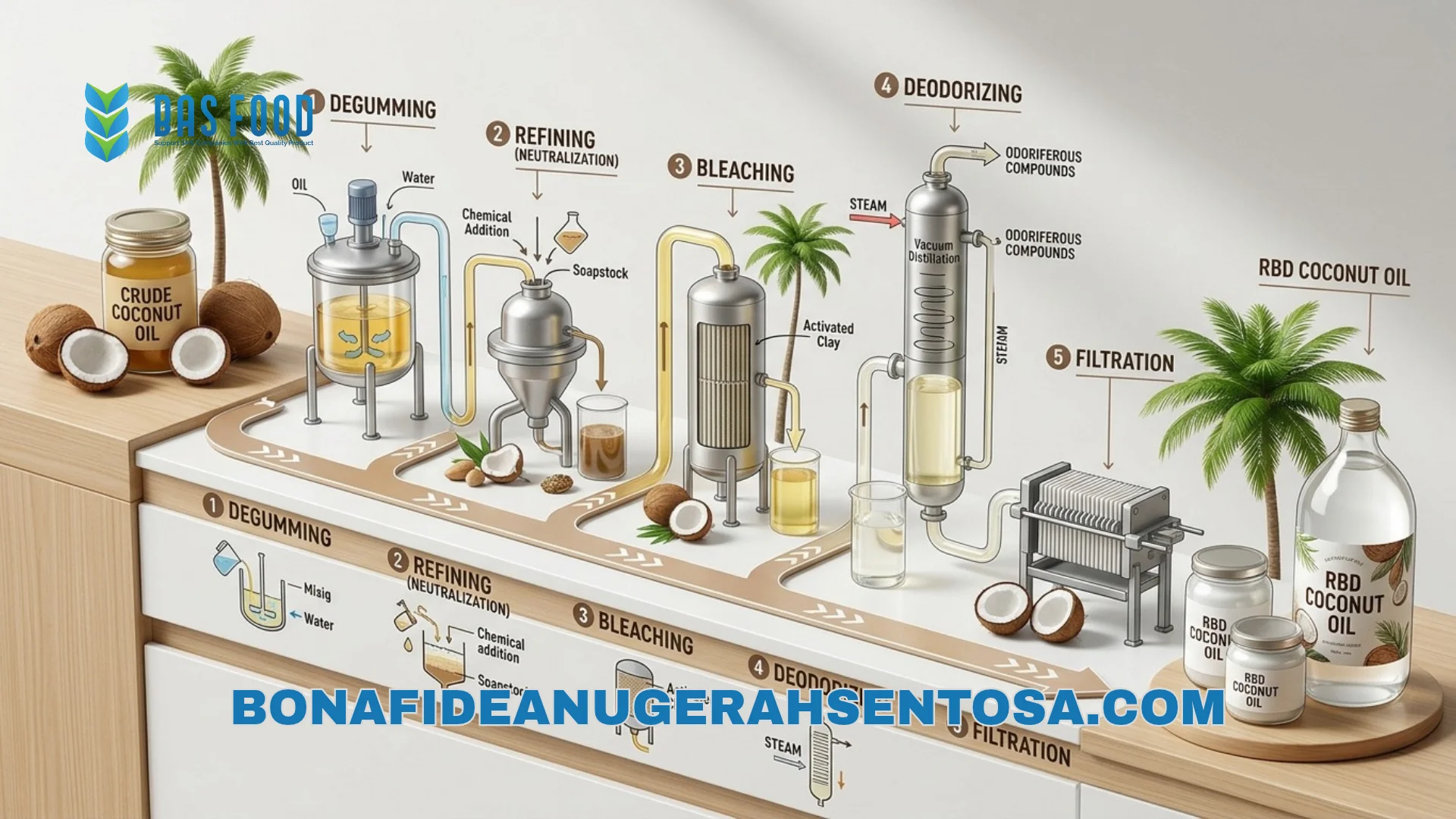
What Is RBD Coconut Oil?
RBD coconut oil is coconut oil that has undergone refining, bleaching, and deodorization to improve its physical and sensory characteristics. The process aims to remove unwanted materials, reduce color, and minimize odor while maintaining the oil’s intended functional properties.
The refining stage helps reduce free fatty acids and other undesirable components, depending on the technology used. Bleaching helps remove color compounds and certain impurities. Finally, deodorization uses controlled conditions, commonly involving steam under a vacuum, to remove volatile substances that contribute to unwanted odors and flavors.
These stages make RBD coconut oil suitable for applications where a neutral smell, consistent appearance, and predictable performance are important. For example, food manufacturers may use it in bakery products, confectionery, processed foods, and other formulations, depending on the product grade and applicable regulations.
Why Is the RBD Coconut Oil Manufacturing Process Important?
The RBD coconut oil manufacturing process plays a major role in determining the finished oil’s color, odor, purity, and consistency. Raw coconut oil can contain free fatty acids, moisture, suspended particles, and other substances that affect its quality or suitability for particular uses.
Without appropriate processing, these components may cause unwanted changes in appearance, odor, stability, or performance. Refining helps manufacturers manage these characteristics and produce oil that meets an agreed specification.
Consistency is particularly important in B2B supply chains. A food manufacturer, for example, may need coconut oil that behaves consistently from one production batch to another. Significant changes in color, odor, or composition can affect the finished product and create additional work for the quality-control team.
In addition, refining can help suppliers meet the requirements of different markets and customer applications. Buyers may request specific parameters, such as free fatty acid content, moisture, color, odor, and other chemical or physical properties.
Nevertheless, the final quality depends on more than the refining stages alone. Raw material condition, equipment, process control, storage, and packaging also affect the result. Therefore, buyers should evaluate the complete manufacturing and quality-control system rather than focusing only on the process name.
Step One: Preparing the Raw Coconut Oil
Before refining begins, manufacturers need a suitable source of coconut oil. Depending on the facility and production model, the starting material may be crude coconut oil produced through an oil extraction process or another appropriate intermediate oil.
The quality of this starting material affects the work required during subsequent processing. For example, oil containing higher levels of free fatty acids, moisture, impurities, or unwanted color compounds may require different process conditions from oil with a cleaner initial profile.
Raw material inspection is therefore an important first step. Manufacturers may check the appearance, odor, moisture content, free fatty acid level, and other relevant parameters before accepting the oil for processing.
Once the oil passes the required checks, the plant prepares it for refining. This preparation may involve filtration, settling, heating, or other steps depending on the oil’s condition and the facility’s process design.
Heating can help improve oil flow and prepare it for further treatment. However, the temperature must remain controlled to avoid unnecessary damage to the oil.
Proper handling at this stage helps reduce contamination risks and supports more consistent results during the rest of the manufacturing process.
Step Two: Coconut Oil Refining
Coconut oil refining is the broader treatment stage that reduces unwanted components in the oil. Its exact design depends on the starting material, the refinery’s equipment, the required product specification, and whether the plant uses chemical refining, physical refining, or a combination of suitable treatment methods.
In a typical chemical refining system, an alkali treatment may be used to neutralize free fatty acids. The resulting soapstock is then separated from the oil. Washing and drying may follow, depending on the plant’s process design.
Physical refining follows a different approach. Rather than using an alkali neutralization step, it relies on suitable pretreatment and subsequent steam stripping under controlled conditions to remove free fatty acids. This approach requires the oil to be prepared appropriately before the deodorization stage.
Both methods aim to produce oil that meets the intended quality requirements, but their operating conditions and waste streams differ. Therefore, buyers who need detailed manufacturing information should ask the supplier which refining method the facility uses.
Refining can also involve the removal of gums, phospholipids, trace metals, and other unwanted components when these are present and relevant to the raw material. The treatment steps depend on the oil’s composition and the desired finished product.
The key objective is to improve quality while maintaining the oil’s intended properties. A properly controlled refining system balances impurity removal, product yield, energy use, and quality requirements.
For B2B buyers, this stage is important because it provides the foundation for a consistent finished product. However, the term “refined” alone does not guarantee that every supplier’s oil has identical specifications.
Step Three: The Bleaching Process
The bleaching process is designed to reduce unwanted color and help remove certain impurities from coconut oil. Despite its name, bleaching does not usually mean adding a household bleaching chemical to the oil.
Instead, many refineries use adsorbent materials, such as bleaching earth or activated carbon, under controlled conditions. These materials can attract and retain selected color compounds and other substances present in the oil.
During a typical bleaching operation, the oil is brought to a suitable temperature and mixed with the selected adsorbent. The mixture is held under controlled conditions so that the adsorbent can interact with the compounds targeted for removal.
The oil then passes through filtration to separate the adsorbent and the materials it has captured. The result is oil with reduced color and fewer selected impurities, depending on the initial oil condition and the effectiveness of the treatment.
Why does bleaching matter?
Color is an important characteristic in many commercial applications. Food manufacturers may prefer coconut oil with a consistent, light appearance because it can be easier to incorporate into formulations where the oil should not noticeably affect the final color.
Bleaching can also help reduce certain oxidation products, trace contaminants, and other unwanted compounds, depending on the adsorbent and process conditions. However, it does not remove every possible contaminant, so other quality-control measures remain necessary.
The effectiveness of the bleaching process depends on several factors, including the type and quantity of adsorbent, temperature, contact time, filtration efficiency, and oil quality before treatment.
Using too much adsorbent can increase production costs and oil losses. On the other hand, inadequate treatment may leave the oil outside the target color specification. Manufacturers must therefore establish suitable conditions through process control.
For buyers, it is useful to review the finished oil’s color specification instead of assuming that all RBD coconut oil has exactly the same appearance.
Step Four: The Deodorization Process
The deodorization process is another essential stage in RBD coconut oil production. Its main purpose is to remove volatile substances that contribute to unwanted odors and flavors.
Coconut oil may contain volatile compounds from the raw material or earlier processing stages. Depending on the source and handling conditions, these compounds can affect the oil’s aroma and sensory characteristics.
Deodorization commonly uses steam under vacuum at an elevated temperature. The vacuum lowers the pressure in the system, while steam helps carry volatile compounds away from the oil.
The oil must be exposed to carefully controlled conditions. Temperature, vacuum level, steam flow, and treatment time all influence the effectiveness of deodorization.
Once the treatment is complete, the oil is cooled under suitable conditions. The facility may then carry out additional steps, such as final filtration or transfer to a clean storage tank, according to its process design.
Why is temperature control important?
Deodorization requires enough heat and appropriate operating conditions to remove unwanted volatile compounds. However, excessive heat exposure can increase the risk of undesirable changes in the oil.
For that reason, manufacturers must balance odor removal with the preservation of the oil’s quality. Equipment design and process control help determine how effectively the plant achieves this balance.
A properly deodorized product generally has a more neutral odor than oil that has not undergone this treatment. This characteristic makes RBD coconut oil useful in formulations where the distinctive smell of coconut oil is not desired.
However, neutral odor should be verified against the buyer’s agreed specification. The final sensory profile may vary with raw material quality, processing conditions, and the requirements of the application.
Step Five: Cooling, Filtration, and Final Handling
After deodorization, manufacturers need to handle the oil carefully before packaging. Cooling brings the oil to a suitable temperature for storage or transfer, while final filtration may help remove remaining particles if required by the process.
Temperature management matters because coconut oil can change from a liquid to a semi-solid or solid state as it cools. Its physical state depends on temperature and composition, so the oil’s appearance in a warehouse may differ from its appearance in a warm processing area.
This natural behavior does not necessarily indicate a quality problem. Buyers should understand the expected physical state of the product at the storage and transport temperatures relevant to their market.
The storage system should also protect the oil from contamination, excessive exposure to air, moisture, and unsuitable materials. Clean tanks, appropriate handling procedures, and controlled transfer systems can help preserve the product after refining.
Before release, the manufacturer may collect representative samples for laboratory testing. The specific tests depend on the product grade, customer requirements, and applicable standards.
These final handling steps are important because even well-refined oil can experience quality problems if it is contaminated or stored incorrectly after processing.
Quality Control: How Manufacturers Check RBD Coconut Oil
Quality control is a central part of the RBD coconut oil manufacturing process. It helps confirm that the finished oil meets the required specifications before the supplier releases it for sale.
Common quality parameters may include:
- Free fatty acid (FFA) content: Helps indicate the level of free fatty acids remaining in the oil.
- Moisture and volatile matter: Helps assess the amount of water and other volatile substances present.
- Color: Indicates the oil’s visual appearance and consistency with the agreed specification.
- Odor and flavor: Helps confirm that the oil has the expected sensory profile.
- Peroxide value: Provides information about primary oxidation products.
- Insoluble impurities: Helps assess the amount of material that does not dissolve in the oil.
- Fatty acid profile: Helps verify the oil’s composition where required.
- Other customer-specific parameters: May include additional chemical, physical, or food safety tests.
Not every customer requires every test. For example, a buyer purchasing oil for a particular industrial application may have different priorities from a food manufacturer. The supplier and buyer should therefore agree on the applicable specification before production or shipment.
A certificate of analysis (COA) can help buyers review the test results for a specific batch. However, the COA should correspond to the supplied product and identify the parameters actually tested.
Buyers should also confirm whether the supplier’s testing is performed internally, by an external laboratory, or through a combination of methods. The appropriate approach depends on the customer’s risk assessment and purchasing requirements.
Applications of RBD Coconut Oil in Different Industries
RBD coconut oil has several commercial applications because of its relatively neutral odor and its functional characteristics. However, suitability depends on the grade, specification, and requirements of the final product.
Food manufacturing
Food manufacturers may use RBD coconut oil in bakery products, confectionery, fillings, coatings, and other formulations where coconut oil’s properties suit the recipe. Its neutral sensory profile can be useful when the manufacturer wants to avoid a pronounced coconut aroma.
Formulators should consider melting behavior, texture, oxidation stability, and compatibility with other ingredients. They should also confirm that the supplied oil meets applicable food-grade and regulatory requirements.
Personal care and cosmetics
Certain cosmetic and personal care formulations use refined coconut oil as an ingredient. Depending on the formulation, it may contribute emollient properties or function as part of the product’s oil phase.
However, cosmetic manufacturers need to confirm the material’s suitability for their specific formulation. Requirements for documentation, impurity limits, packaging, and quality testing may differ from those for food applications.
Soap and selected industrial uses
Coconut oil can also be used in soap production and other applications that require its fatty acid composition. The required specification depends on the manufacturing process and the performance expected from the final product.
Industrial buyers should communicate the intended use before ordering. This allows the supplier to identify which product specification and supporting documentation are relevant.
Packaging and Storage After Refining
Once RBD coconut oil passes the required quality checks, the manufacturer prepares it for storage and shipment. Packaging depends on the order size, customer requirements, destination market, and distribution method.
Smaller commercial orders may use suitable drums or other approved containers. Larger shipments may use intermediate bulk containers or bulk transport systems where appropriate. Food-contact materials should be suitable for the intended use and comply with applicable requirements.
Packaging must protect the oil from contamination and help maintain its quality during storage and transport. Buyers should confirm container compatibility, sealing arrangements, net weight, labeling, and any special handling requirements before shipment.
Storage temperature also deserves attention. Coconut oil may become cloudy, semi-solid, or solid at cooler temperatures and return to a liquid state when warmed. This behavior is related to the oil’s physical properties and does not automatically mean that the product has deteriorated.
Nevertheless, buyers should follow the supplier’s storage and handling instructions. Unnecessary exposure to contamination, moisture, or unsuitable storage conditions can affect quality.
For international shipments, importers should also check destination-country requirements for product labeling, documentation, and food or industrial ingredient compliance where applicable.
Sourcing Coconut-Based Products From Indonesia
Indonesia is an important origin for coconut-based agricultural products, including coconut oil and coconut sugar. For international buyers, sourcing from Indonesia may provide access to suppliers serving different markets and applications.
However, buyers should evaluate each supplier individually. The origin of a product does not automatically guarantee a particular quality level, certification, production capacity, or export capability.
When evaluating a supplier, review its product range, technical documentation, communication, quality-control practices, and ability to meet your purchasing requirements. If certification is important for your business, ask for current and relevant documentation rather than assuming that every supplier holds the same certifications.
CV Bonafide Anugerah Sentosa is relevant to buyers exploring Indonesian coconut-based products and related agricultural commodities. Buyers interested in RBD coconut oil should confirm the company’s current product availability, technical specifications, processing arrangements, and applicable documentation directly before making a purchasing decision.
The phrase coconut sugar exporter supplier relates to coconut sugar sourcing rather than the technical classification of RBD coconut oil. Similarly, a coconut sugar supplier may not necessarily manufacture or supply refined coconut oil. Buyers should therefore verify that a company’s actual product range matches their requirements.
This distinction is important when researching exporters with multiple coconut-derived products. It helps prevent confusion between different commodities and ensures that purchasing discussions focus on the correct material.
Conclusion: Understanding Every Stage From Refining to Deodorization
The RBD coconut oil manufacturing process transforms suitable raw coconut oil into a refined product with controlled color, odor, and other quality characteristics. Each stage plays a different role, from initial preparation and refining to the bleaching process, deodorization process, final handling, and quality testing.
For buyers, understanding these stages makes it easier to evaluate technical specifications and ask suppliers the right questions. It also helps explain why the refining method, raw material condition, process control, and storage practices can affect the finished product.
Most importantly, buyers should not rely on the term “RBD” alone. They should review the product’s specification, confirm its suitability for the intended application, and request relevant batch documentation.
Whether you are a food manufacturer, distributor, importer, or industrial buyer, a well-defined purchasing specification is one of the best tools for securing consistent supply.
By combining technical knowledge with careful supplier evaluation, businesses can source RBD coconut oil more confidently and build a supply chain that supports their product quality and commercial goals.