
Have you ever opened a container of coconut oil and found a clear liquid, only to discover that the same oil had turned cloudy or solid a few hours later? This is a normal characteristic of coconut oil. Its physical state changes with temperature, and understanding this behavior is important when buying, storing, transporting, or using refined coconut oil. The RBD coconut oil melting point is an important technical property for food manufacturers, importers, distributors, and industrial buyers. RBD stands for Refined, Bleached, and Deodorized. This processing method improves the oil’s color, odor, and overall quality characteristics, while its fatty acid composition continues to influence how it melts and solidifies.
For businesses that use coconut oil in food production, confectionery, bakery products, cosmetics, or other formulations, melting behavior can affect storage, handling, processing temperatures, and the texture of the finished product. Therefore, knowing the melting point is not just a matter of technical interest. It can help buyers select the right ingredient for their production needs.
In this guide, we will explain the melting point of RBD coconut oil, why the oil becomes solid, how temperature affects its physical state, and what B2B buyers should consider when sourcing coconut oil from suppliers.
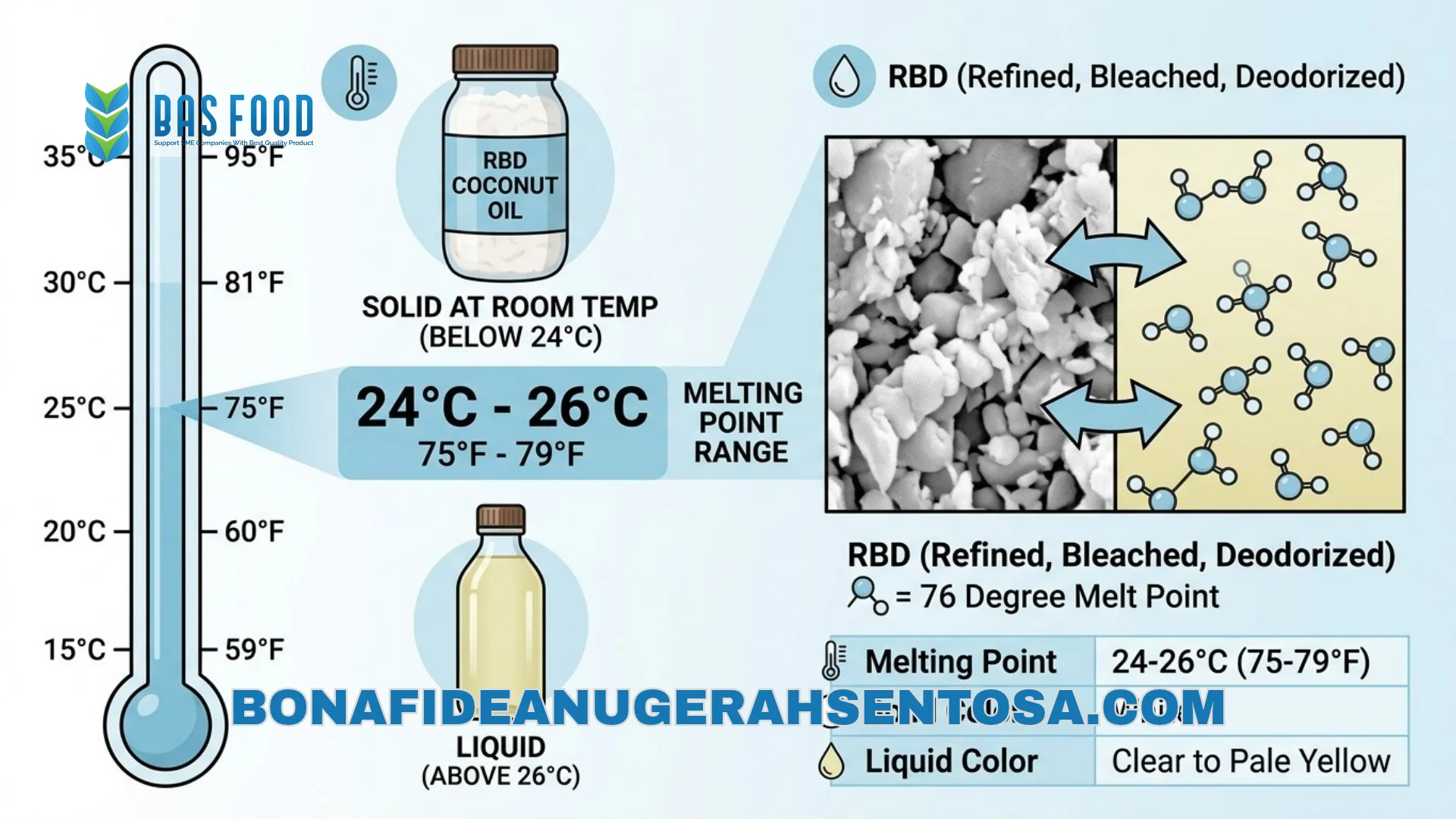
Why Does RBD Coconut Oil Become Solid?
Coconut oil becomes solid when its temperature falls enough for some of its fat components to crystallize. This process is a normal physical change, not necessarily a sign of poor quality or contamination.
Coconut oil contains a high proportion of saturated fatty acids, including lauric acid. These fatty acids form part of triglycerides that influence the oil’s melting behavior. As the temperature decreases, some of these components begin to form crystals, making the oil cloudy, thick, or solid.
The process of coconut oil solidification depends on temperature, composition, cooling history, and time. For example, oil stored in a cool warehouse may become firm or solid, while the same oil may turn clear and liquid after being moved to a warmer room.
The transition can also happen unevenly. A container may develop solid material near its cooler walls while the center remains liquid. This can occur because different parts of the container cool at different rates.
These changes are especially important for importers who receive coconut oil in drums, intermediate bulk containers, or other large packages. The oil’s appearance when it arrives may differ from its appearance during loading.
Therefore, buyers should understand the expected physical behavior of coconut oil before deciding that a solid or cloudy shipment indicates a quality problem.
Melting Point vs. Solidification Point: What Is the Difference?
The melting point and solidification point are related, but they do not always represent the same measured temperature. The melting point describes the transition from solid to liquid, while the solidification point describes the transition from liquid to solid.
For a pure substance under defined conditions, these temperatures can be very close. However, fats such as coconut oil contain mixtures of triglycerides that crystallize and melt over a range of temperatures.
Cooling history also matters. When oil cools, crystals may not form immediately at the temperature where melting begins during heating. The liquid may need to cool further before enough crystals form for solidification to become visible. This behavior is known as supercooling.
The rate of cooling, the presence of crystal nuclei, and the oil’s composition can all affect the observed transition. As a result, the temperature at which a sample starts to solidify may differ from the temperature at which it becomes fully liquid again.
For this reason, a supplier’s melting-point specification should not automatically be used as a precise solidification temperature. Buyers should ask which property the supplier measures and how the test is performed.
Understanding this distinction helps prevent confusion during storage, transport, and production. It also makes communication between suppliers, laboratories, and manufacturing teams more accurate.
How Fatty Acid Composition Influences Melting Temperature
The melting temperature of RBD coconut oil depends largely on its fatty acid composition and the triglycerides formed from those fatty acids.
Coconut oil contains several saturated fatty acids, with lauric acid being a major component. It also contains smaller proportions of other fatty acids, including caprylic, capric, myristic, palmitic, stearic, and oleic acids. Their proportions can vary with the source material and processing conditions.
However, fatty acids do not exist only as separate molecules in the finished oil. Most are bound into triglycerides, which are molecules containing three fatty acids attached to a glycerol backbone. The types and arrangements of fatty acids in these triglycerides influence the oil’s melting profile.
This explains why the melting behavior of a natural fat cannot always be predicted by looking at the melting point of one individual fatty acid. The complete composition and structure of the fat must be considered.
Refining, bleaching, and deodorization primarily aim to remove unwanted impurities, color compounds, free fatty acids, and odor-producing substances, depending on the process. These treatments do not normally aim to transform coconut oil into a fundamentally different fat composition.
Therefore, ordinary RBD coconut oil generally retains the melting characteristics associated with coconut oil. Nevertheless, the finished product’s measured value can vary according to composition, processing history, and the testing method.
For manufacturers with narrow technical requirements, a supplier’s actual specification is more useful than relying on a general melting-point range alone.
How Temperature Changes the Appearance and Texture of RBD Coconut Oil
Temperature can change the appearance of RBD coconut oil even when the oil remains suitable for its intended application. Buyers may observe clear liquid oil, cloudy oil, a partly crystallized mixture, or a firm solid depending on the conditions.
At warmer temperatures, more of the fat remains liquid. The oil may appear clear and flow easily through pipes, pumps, and filling equipment. As the temperature falls, some fat components crystallize, causing the oil to become cloudy or thicker.
At lower temperatures, the oil may become mostly or completely solid. This can affect how easily workers can pour it, pump it, or transfer it from one container to another.
However, a change in physical state does not automatically mean that the oil has deteriorated. Quality assessment should also consider odor, color, packaging integrity, storage history, and relevant chemical specifications.
If the oil becomes solid during transport, the buyer should first compare the storage temperature with the product’s expected melting behavior. Any warming should follow the supplier’s instructions and avoid excessive heat or localized overheating.
For large shipments, it is especially important to plan temperature management before delivery. This can reduce delays and help receiving teams prepare suitable equipment for unloading and handling.
Why the Melting Point Matters in Food Manufacturing
The melting behavior of coconut oil can influence several stages of food production. Manufacturers need to know when the oil will remain liquid, when it may begin to crystallize, and how it will behave when combined with other ingredients.
In bakery production, coconut oil may be used in doughs, fillings, coatings, or other formulations. Its physical state can affect mixing, distribution, texture, and processing. A solid oil may need controlled warming before it can be incorporated evenly.
Confectionery manufacturers may also pay attention to melting behavior because fats help influence texture, mouthfeel, and the physical stability of certain products. However, the performance of a finished formulation depends on the complete ingredient system, not only on the melting point of coconut oil.
For example, combining coconut oil with other fats can change the melting profile of the blend. The result may behave differently from pure coconut oil, even if the same processing temperatures are used.
Manufacturers should therefore test the oil within the actual recipe or process rather than relying entirely on a standalone melting-point value. Bench trials can help identify suitable mixing temperatures, cooling conditions, and storage requirements.
This is particularly important when a business changes suppliers or replaces one fat with another. Even oils described by the same general product name may differ in properties that matter to a specific formulation.
The Role of Melting Point in Fat Formulation
Fat formulation involves selecting and combining fats to achieve the desired texture, stability, melting behavior, and processing performance in a finished product.
Coconut oil can be one part of a fat blend, but its suitability depends on the target product. A manufacturer may need a fat that flows at a certain processing temperature, sets under controlled cooling, or contributes a particular texture.
For example, a product that needs a firm structure at room temperature may require a different fat system from a product that should remain pourable. The required performance also depends on the product’s storage conditions and the temperatures it experiences during distribution.
When formulating a blend, manufacturers should consider more than the melting point. Other relevant properties may include solid fat content at different temperatures, crystallization behavior, oxidation stability, compatibility with other fats, and the texture of the final product.
The melting profile is especially useful when the product moves through several temperature stages. A fat may need to be liquid during mixing but develop the right structure after cooling.
However, adding coconut oil to another fat does not always produce a predictable average melting point. The components can interact in ways that change crystallization and melting behavior. Testing the actual blend is therefore essential.
For B2B buyers, the key question is not simply whether coconut oil has a suitable melting point. It is whether the oil performs reliably within the complete formulation and manufacturing process.
RBD Coconut Oil Melting Point and Industrial Applications
Although food manufacturing is an important application, RBD coconut oil can also be used in selected personal care, cosmetic, and industrial products. In these applications, melting behavior can affect processing and the consistency of the finished material.
In cosmetic formulations, for instance, coconut oil may contribute to the oil phase of a cream, balm, or other product. Whether it is suitable depends on the formula, the desired texture, the storage temperature, and the technical requirements for the finished product.
If the formulation is designed to remain soft at room temperature, the manufacturer must consider whether coconut oil could crystallize under expected storage conditions. If the product needs to remain firm, the same characteristic may be useful rather than problematic.
For industrial applications, the buyer may be more concerned with the oil’s flow properties, pumping temperature, and compatibility with the production equipment. These factors can affect process efficiency and operating costs.
Nevertheless, not every grade of RBD coconut oil is suitable for every industry. Buyers should confirm the product’s grade, intended-use documentation, and relevant quality requirements before using it in a formulation.
In all cases, the melting point should be treated as one part of a broader technical profile.
How to Measure the Melting Point of RBD Coconut Oil
Melting point measurement helps manufacturers and buyers determine whether the oil meets the required specification. However, fats can melt over a range of temperatures, so the result depends on the test method.
Common approaches include capillary methods and other standardized procedures designed for fats and oils. Some tests identify a clear endpoint under defined conditions, while other methods assess different aspects of melting behavior.
Because methods differ, a reported melting point should always be considered alongside the test standard or method used. Two results from different methods may not be directly comparable.
Sample preparation is also important. The sample’s previous temperature history, cooling rate, and crystal structure can affect the observed transition. A properly controlled test helps reduce these sources of variation.
For routine purchasing, buyers may not need to perform the test themselves. Instead, they can request a technical data sheet or certificate of analysis from the supplier and confirm that the reported parameter matches their requirement.
If the melting point is critical to a manufacturing process, it may be useful to verify the supplier’s result through an independent laboratory. The appropriate approach depends on the product’s risk, the customer’s quality system, and the commercial agreement.
Storage and Transportation: Preventing Temperature-Related Problems
Storage and transportation deserve special attention when purchasing RBD coconut oil in bulk. Since coconut oil can solidify at temperatures near typical room temperature in cooler environments, the supply chain should account for this behavior.
First, buyers should confirm the supplier’s recommended storage conditions. These instructions should cover the suitable temperature range, container handling, and any recommended steps before transferring or using the oil.
Second, receiving facilities should be prepared for the possibility of solid oil. Depending on the packaging and production setup, the business may need suitable warming equipment or a controlled area where the product can return to a workable state.
Any warming procedure should follow the supplier’s guidance. Excessive heat, uneven heating, or direct exposure to a very hot surface can create avoidable quality and safety risks.
Third, transport planning should consider the destination climate, expected transit duration, warehouse conditions, and the product’s physical state at the anticipated temperature. A container that remains liquid in a warm region may arrive partly solid after traveling through a cooler environment.
Finally, buyers should distinguish normal solidification from signs of a genuine quality issue. If the oil has an unusual odor, unexpected discoloration, damaged packaging, or results outside the agreed specification, the supplier should be contacted for further evaluation.
A practical storage plan helps reduce unnecessary delays and ensures that the oil can be handled efficiently upon arrival.
How to Choose a Reliable Coconut Oil Supplier
Selecting a supplier involves more than comparing the price per kilogram or metric ton. Buyers should check whether the supplier can deliver the required product, provide relevant documentation, and maintain consistent quality over time.
Start by requesting a technical data sheet. It should describe the product and its key parameters, including the melting point where relevant. If the value is important to your manufacturing process, specify the required test method or ask the supplier to clarify the method used.
Next, review the supplier’s quality documentation. Depending on the application, this may include a batch-specific certificate of analysis, product specifications, safety information, and applicable certification documents. Buyers should verify that any claimed certification is current and relevant to the product and facility involved.
It is also helpful to discuss packaging, storage, order quantities, lead times, and shipping arrangements before confirming an order. These details can influence the total cost and ease of handling after delivery.
For long-term supply relationships, buyers should agree on how changes in specifications will be managed. A documented process for samples, batch testing, complaints, and corrective actions can help both parties handle issues more efficiently.
A reliable supplier should communicate clearly about what it can provide and avoid making unsupported claims about product specifications or certifications.
Sourcing Coconut-Based Products From Indonesia
Indonesia is a significant origin for coconut-based agricultural products, including coconut oil and coconut sugar. International buyers may explore Indonesian suppliers when building supply chains for food ingredients and other coconut-derived materials.
However, buyers should evaluate the actual product range and capabilities of each business. A company that supplies coconut sugar does not necessarily manufacture RBD coconut oil, and a supplier of crude coconut oil may not operate its own refining facility.
CV Bonafide Anugerah Sentosa is a business name relevant to sourcing Indonesian coconut-based commodities. Buyers interested in RBD coconut oil should confirm current availability, product specifications, sourcing arrangements, and supporting documentation directly with the company before placing an order.
It is also important to separate the technical requirements for coconut oil from those for coconut sugar. The keyword coconut sugar exporter supplier relates to coconut sugar sourcing, while a coconut sugar supplier may specialize in a different product category from refined coconut oil.
When sourcing multiple coconut-derived products from one business, buyers should confirm each product separately. This ensures that the correct grade, packaging, documentation, and quality requirements are addressed for every commodity.
For international trade, clear communication and product-specific specifications are essential. They help importers make sound purchasing decisions and reduce the risk of confusion between products.
Final Thoughts: Use Melting Point to Make Better Buying Decisions
The RBD coconut oil melting point is an important technical property for businesses that purchase, store, transport, or process refined coconut oil. It helps explain why the oil may be liquid in a warm environment but cloudy or solid in a cooler one.
The commonly reported melting range of around 24°C to 26°C provides a useful starting point, but buyers should not treat it as a universal specification. The actual result depends on the oil’s composition and the method used to measure it.
For manufacturers, melting behavior can affect production temperatures, fat formulation, handling, and the texture of finished products. For importers and distributors, it can influence storage plans, transport conditions, and unloading procedures.
Therefore, the best approach is to evaluate melting point together with the complete technical specification. Ask for relevant documentation, confirm the test method, and ensure that the oil suits the intended application.
By understanding coconut oil solidification and its temperature-related behavior, B2B buyers can plan more effectively, avoid common misunderstandings, and build stronger supplier relationships.