
Walk through the world of natural sweeteners and you will find plenty of familiar formats. There are granules, powder, blocks, syrup, and liquid sweeteners. Yet one format that deserves more attention from food businesses is coconut sugar treacle. With its rich color, sweet taste, and liquid form, coconut sugar treacle can be an interesting ingredient for manufacturers, beverage producers, bakeries, sauce makers, retailers, and food service businesses. It offers the familiar character of coconut sugar in a form that can be easier to mix into many recipes and formulations.
However, buyers should not judge a liquid sweetener by its name alone. Terms such as coconut treacle, coconut sugar syrup, and coconut sugar liquid can be used differently by different suppliers. The actual product specification is therefore essential when purchasing for commercial use.
For importers and B2B buyers, the important questions are practical. What is coconut sugar treacle? How is it produced? What makes it different from other coconut sugar products? How should buyers evaluate quality, packaging, and suppliers?
This guide answers those questions and explains what businesses should consider before sourcing coconut sugar treacle in bulk.
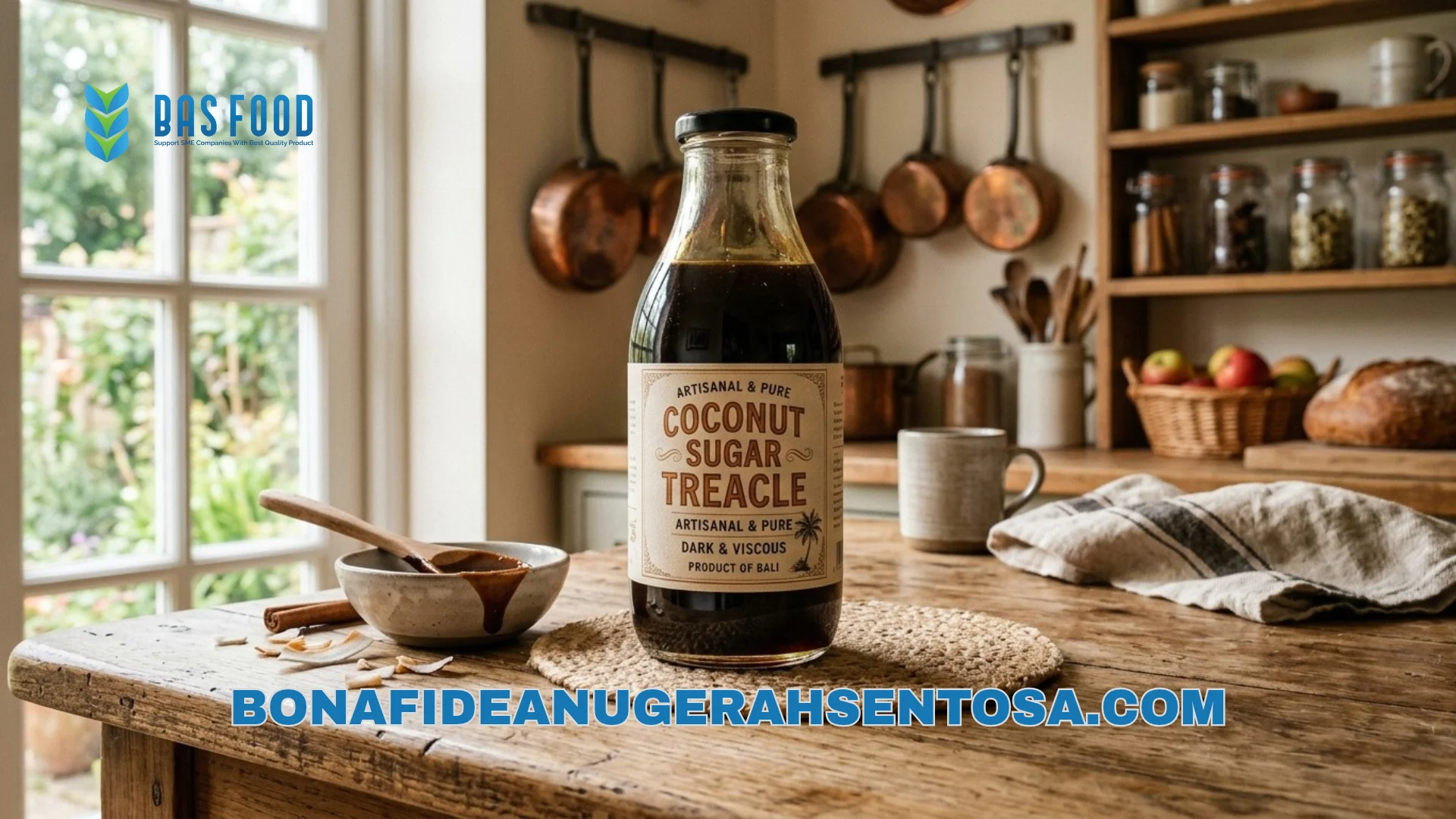
What Is Coconut Sugar Treacle?
Coconut sugar treacle is a thick liquid sweetener associated with coconut sugar production. It has a concentrated sweet taste and typically features a brown to dark brown appearance, although the exact color can vary depending on the raw material and processing method.
The term “treacle” can have different meanings in different markets. Therefore, international buyers should avoid assuming that every product sold as coconut sugar treacle has exactly the same composition, viscosity, or processing method.
Instead, buyers should request a product specification from the supplier. This specification can describe important characteristics such as ingredients, appearance, flavor, viscosity, solids content, moisture, packaging, shelf life, and storage conditions.
In simple terms, coconut sugar treacle is best understood as a liquid coconut sugar-based sweetener that can be used as an ingredient. Its liquid form makes it particularly interesting for applications where manufacturers want to incorporate sweetness without first dissolving a dry sugar ingredient.
Coconut Treacle, Coconut Sugar Liquid, or Syrup?
You may encounter several terms while searching for this type of ingredient, including coconut treacle, coconut sugar liquid, coconut sugar syrup, and liquid coconut sugar.
These terms may overlap in commercial discussions, but they should not automatically be treated as identical products. Different manufacturers can use different names based on their formulation, production process, market, or product positioning.
That is why professional buyers should focus on specifications rather than terminology. If a manufacturer requires a particular viscosity, solids level, flavor profile, or packaging format, those requirements should be written into the purchasing specification.
How Coconut Sugar Treacle Is Produced
The production process starts with the raw material used by the manufacturer. For coconut sugar-based products, coconut sap can play an important role in the traditional production chain.
Coconut sap is collected from coconut flower blossoms and then processed to concentrate its natural sugars. The producer controls the heating and concentration process to develop the desired characteristics of the sweetener.
Depending on the production method, the concentrated material can then be processed into a liquid product with a specific consistency. The final characteristics depend on factors such as raw material quality, processing conditions, concentration, formulation, and handling.
From Coconut Sap to Liquid Sweetener
The transformation from coconut sap to a commercial liquid sweetener requires careful process control. The producer needs to manage the product throughout processing to achieve consistent characteristics.
For B2B buyers, this consistency matters because food manufacturers often need ingredients that behave similarly from one production batch to another.
For example, a beverage manufacturer may need a sweetener that mixes consistently. A sauce manufacturer may need a predictable texture. A bakery may need a liquid ingredient that performs consistently during mixing and baking.
Therefore, the production process should be discussed together with the final product specification.
What Makes Coconut Sugar Treacle Different?
The biggest difference between coconut sugar treacle and dry coconut sugar is its physical form. Granules and powder are dry ingredients, while treacle is a liquid or semi-liquid ingredient.
This difference can influence how the ingredient is stored, transported, measured, and incorporated into recipes. A manufacturer may find a liquid format convenient when its production system already handles liquid ingredients.
The flavor profile can also be important. Coconut sugar products are often associated with a rich, caramel-like sweetness, although the exact sensory profile depends on the product and processing method.
Liquid vs Dry Coconut Sugar
Dry coconut sugar can be useful when manufacturers need a dry ingredient for mixes, bakery products, snacks, cereals, or powdered formulations.
A liquid format can make more sense when the formulation already contains liquid ingredients. Instead of dissolving dry sugar separately, the manufacturer can add the liquid sweetener directly according to its production process.
Neither format is universally better. The right choice depends on the application.
For this reason, buyers should consider the complete production process before selecting between coconut sugar granules, powder, moulded products, or coconut sugar liquid.
Why Food Manufacturers Use Liquid Sweeteners
Liquid sweeteners can be practical in many food production environments. They can be incorporated into sauces, beverages, desserts, bakery products, toppings, and other formulations.
The main advantage is handling. A liquid ingredient can be pumped, measured, or blended depending on the production system. This can simplify certain formulations, although the exact handling method depends on the product’s viscosity and the manufacturer’s equipment.
For smaller food businesses, liquid sweeteners can also be useful for recipes where the sweetener needs to combine with other liquids.
Applications for Coconut Sugar Treacle
Potential applications include:
- Beverage formulations
- Coffee and tea drinks
- Bakery products
- Desserts
- Sauces
- Dressings
- Marinades
- Toppings
- Confectionery
- Food processing
- Specialty food products
However, buyers should test the ingredient in their actual formulation before moving to large-scale procurement.
A sweetener that works well in one recipe may behave differently in another because of differences in acidity, temperature, water content, fat content, processing time, or other ingredients.
Coconut Sugar Treacle as a Natural Liquid Sweetener
Many buyers search for natural liquid sweetener ingredients because they want alternatives to conventional refined sugar in certain product concepts.
Coconut sugar treacle can fit this category when its ingredients and processing meet the buyer’s definition of a natural sweetener. However, businesses should avoid making broad “natural” claims without checking the actual formulation and the labeling rules of the destination market.
The term natural can have different regulatory or marketing implications depending on the country. Therefore, buyers should confirm what can legally be stated on packaging and marketing materials.
Focus on the Product Specification
Rather than relying on marketing language, B2B buyers should request clear technical information.
A useful specification may cover:
- Product name
- Ingredients
- Appearance
- Color
- Flavor
- Aroma
- Viscosity
- Solids content
- Moisture
- pH where relevant
- Microbiological requirements
- Packaging
- Shelf life
- Storage conditions
Not every specification will contain the same parameters. The relevant information depends on the product and intended application.
The key is to make sure the buyer and supplier agree on the characteristics that actually matter to the final product.
Key Quality Factors Buyers Should Check
Quality evaluation should begin with the intended use. A beverage manufacturer may focus heavily on flavor, solubility, and viscosity, while a sauce manufacturer may have different requirements.
Appearance provides a useful first check. Buyers can examine color, consistency, and visible uniformity. However, appearance alone cannot confirm the full quality of a liquid sweetener.
Sensory evaluation is also useful. A sample can help buyers assess sweetness, aroma, flavor, aftertaste, and overall compatibility with their formulation.
Viscosity and Consistency
Viscosity is especially important for liquid sweeteners. If the product is too thick or too thin for the intended production system, handling can become difficult.
However, buyers should not assume that there is one universal viscosity requirement for coconut sugar treacle. The correct target depends on the product and application.
Instead, buyers should discuss the desired consistency with the supplier and, when necessary, include a measurable specification in the product agreement.
Color, Flavor, and Aroma
Coconut sugar liquid products can have a distinctive brown appearance and sweet aroma. The exact sensory characteristics can vary between products.
For commercial sourcing, buyers should approve a representative sample before committing to a large order. This gives the manufacturer an opportunity to test the ingredient under actual production conditions.
Sample approval can also provide a useful reference for future batches.
Packaging Coconut Sugar Treacle
Packaging is one of the most important considerations when purchasing liquid sweeteners internationally.
Unlike dry coconut sugar, coconut sugar treacle needs packaging that can safely contain a liquid product during storage, handling, and transportation. The package should also be suitable for food use and compatible with the product.
The appropriate packaging depends on order volume, destination, buyer requirements, storage facilities, and logistics arrangements.
Bulk Packaging for B2B Buyers
Industrial buyers may require larger containers because they use the product as a regular ingredient. Smaller buyers may prefer smaller packaging that is easier to handle in their facility.
Potential packaging formats can include suitable food-grade liquid containers, drums, jerry cans, or other formats agreed between buyer and supplier.
The packaging decision should consider:
- Product volume
- Container strength
- Closure and sealing
- Leakage protection
- Handling requirements
- Storage conditions
- Shipping method
- Warehouse equipment
- Buyer production system
Before production, buyers should request detailed packaging information and, when appropriate, photographs of the final packing configuration.
Shelf Life and Storage Considerations
Shelf life is another important part of B2B purchasing. A buyer needs enough remaining shelf life to transport, clear, store, and use the product.
The actual shelf life depends on the formulation, processing method, packaging, storage conditions, and supplier specification. Therefore, buyers should not assume a universal shelf-life period.
Instead, request the supplier’s stated shelf life and recommended storage conditions.
Protecting Product Quality
Storage conditions should be followed from the supplier’s warehouse through international transportation and finally into the buyer’s facility.
Exposure to unsuitable conditions can affect product quality or packaging performance. Therefore, the logistics team should understand the storage instructions before the shipment leaves the supplier.
For importers, this also means planning warehouse space before the cargo arrives. The receiving team should know where and how the product should be stored.
Choosing a Coconut Sugar Supplier
Selecting the right coconut sugar supplier is one of the most important decisions in the sourcing process.
Price is important, but it should not be the only consideration. A reliable supplier should be able to explain the product, provide samples, discuss specifications, confirm packaging, and communicate clearly about production and shipping.
International buyers should also evaluate whether the supplier understands export procedures and can provide the documentation required for the shipment.
What Should Buyers Ask?
Before placing an order, consider asking:
- What exactly does the supplier mean by coconut sugar treacle?
- What are the ingredients?
- How is the product processed?
- What are the viscosity characteristics?
- What packaging formats are available?
- What is the shelf life?
- What storage conditions are recommended?
- Can the supplier provide samples?
- Can the product specification be shared?
- What quality tests are performed?
- What export documents are available?
- What is the production lead time?
- What are the available shipping options?
- Can the supplier support bulk orders?
These questions help buyers compare suppliers using useful information rather than relying only on product descriptions.
Sourcing Coconut Sugar Treacle From Indonesia
Indonesia is well known for its coconut-producing regions and coconut-based products. This makes Indonesian suppliers relevant to international buyers searching for coconut sugar and related ingredients.
However, successful international sourcing requires more than identifying the country of origin. Buyers need to evaluate the actual supplier, product specification, packaging, production process, and export capability.
A clear sourcing process usually begins with a product inquiry. The buyer provides the intended application, estimated volume, packaging preference, destination, and technical requirements.
The supplier can then respond with product information and sample options.
The Role of CV Bonafide Anugerah Sentosa
CV Bonafide Anugerah Sentosa is an Indonesian supplier and exporter of coconut sugar and coconut-derived products. For international businesses exploring liquid coconut sugar products, the company can be considered during the supplier evaluation stage.
As with any B2B sourcing process, buyers should confirm the exact product specification before placing an order. This is particularly important when terms such as coconut treacle, coconut sugar liquid, and syrup are used interchangeably in informal discussions.
A clear product specification removes uncertainty and gives both sides the same reference.
How to Test Coconut Sugar Treacle Before Bulk Purchasing
Sampling is one of the smartest steps a B2B buyer can take before placing a large order.
A sample lets the buyer evaluate the product in real conditions rather than relying only on a supplier description. This is especially useful when the ingredient will become part of a manufactured food or beverage.
Start by checking the appearance, aroma, texture, and flavor. Then test the product in the intended application.
Test the Product in Your Own Formula
Suppose you manufacture beverages. Test the sweetener in your actual beverage formula.
If you manufacture sauces, evaluate how it affects flavor, color, texture, and processing.
If you manufacture bakery products, test it under your normal mixing and baking conditions.
This practical testing can reveal issues that are not obvious from a product specification alone.
It also gives the buyer a better basis for defining the required specification for future orders.
Building a Long-Term Coconut Sugar Supply
For businesses that use liquid sweeteners regularly, the goal should not be a successful first shipment alone. The real objective is a stable supply relationship.
That requires consistent communication and clear expectations. Buyers should maintain records of approved samples, specifications, packaging, and previous shipments.
These records become useful when comparing future batches.
From One Purchase to a Reliable Partnership
A long-term supplier relationship can become more efficient when both sides understand the buyer’s regular requirements.
The buyer can provide forecasts or expected purchasing patterns where possible. The supplier can then plan production and packaging more effectively.
At the same time, the buyer can monitor product quality, delivery performance, documentation, and communication over time.
This creates a more organized sourcing process and reduces unnecessary surprises.
Conclusion: Finding the Right Liquid Coconut Sugar for Your Business
Coconut sugar treacle offers B2B food businesses another way to use coconut-based sweetness in liquid formulations. Its format can be useful for beverages, sauces, bakery products, desserts, and other food applications.
However, successful sourcing depends on more than finding a product with the right name. Buyers need to understand the actual formulation, processing method, viscosity, flavor, packaging, shelf life, storage conditions, and export requirements.
For international buyers, working with a capable coconut sugar exporter supplier can simplify the sourcing process. Clear communication, sample testing, agreed specifications, and suitable packaging can help reduce problems before the shipment begins.
For businesses exploring Indonesian suppliers, CV Bonafide Anugerah Sentosa can be considered as part of the supplier evaluation process. Buyers should communicate their intended application and technical requirements clearly so the supplier can provide the most relevant product information.
Ultimately, the best coconut sugar supplier is not simply the one offering the lowest price. It is the supplier that can provide a product that fits your application, communicate clearly, support the required documentation, and maintain a dependable supply relationship.