
Coconut sugar is often associated with granules, powder, or traditional blocks. However, the same raw material can also be processed into a rich liquid sweetener commonly described as coconut sugar treacle. This format gives food manufacturers, beverage companies, bakeries, sauce producers, and other B2B buyers another way to use the characteristic flavor of coconut sugar. Understanding coconut sugar treacle production is especially useful for buyers who want to source liquid coconut sugar from Indonesia. The final product does not simply appear after boiling coconut sap. Several stages influence its color, flavor, consistency, stability, packaging, and suitability for different applications.
For international buyers, knowing the basic production process can also make supplier discussions easier. Instead of asking only about price, buyers can discuss raw material handling, processing, quality control, specifications, packaging, and storage requirements.
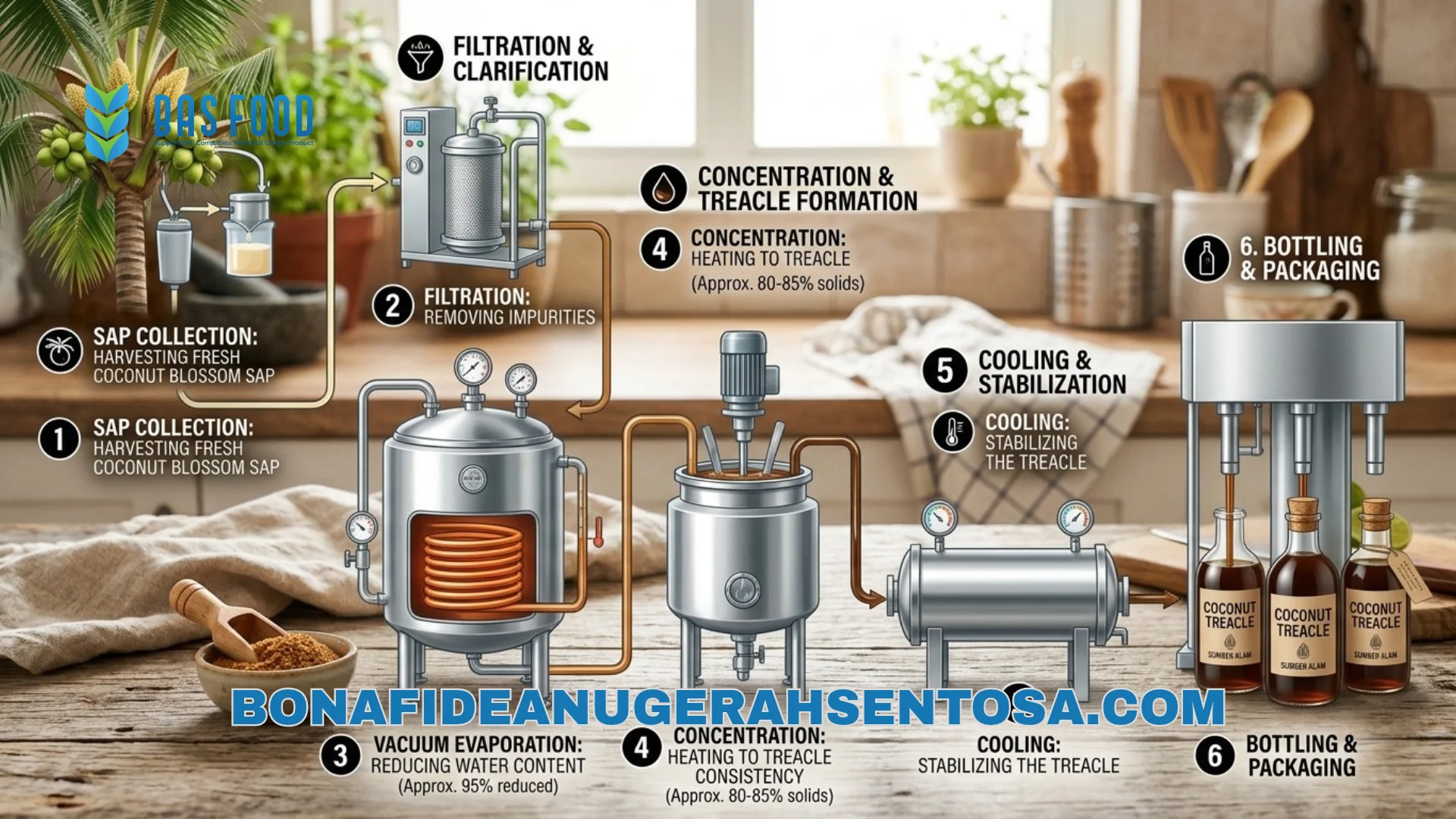
This article explains how coconut sugar treacle is produced, from coconut sap collection to processing, concentration, quality control, packaging, and export preparation. It also explains what B2B buyers should consider when choosing a coconut sugar supplier.
What Is Coconut Sugar Treacle?
Coconut sugar treacle generally refers to a thick liquid sweetener made from coconut sap or coconut sugar through a controlled concentration process. The exact meaning of “treacle” can vary between markets and suppliers, so buyers should always refer to the agreed product specification when purchasing commercially.
In practical terms, the product has a liquid or semi-liquid consistency and carries the characteristic sweet, caramel-like profile associated with coconut sugar. Depending on processing conditions and the supplier’s specification, the color, viscosity, sweetness, and flavor intensity can vary.
Unlike moulded or granulated coconut sugar, treacle is designed to remain in a pourable or spoonable form. This makes it convenient for applications where a liquid sweetener is easier to blend, measure, or distribute throughout a formulation.
For B2B buyers, this distinction matters. A beverage manufacturer may want a liquid sweetener that mixes easily, while a bakery or sauce producer may need a thicker product with a specific viscosity. Therefore, the buyer should define the intended application before selecting the product.
Coconut Sap: The Starting Point of Production
The story of coconut sugar treacle production begins with coconut sap. Coconut palms produce sap from their flower stalks, and farmers collect this liquid as part of the traditional coconut sugar supply chain.
Fresh coconut sap contains water and naturally occurring sugars. It is therefore quite different from the concentrated sweetener that eventually becomes coconut sugar treacle.
Proper handling at this stage is important. The condition of the sap can influence later processing and the characteristics of the final product. Producers need suitable harvesting and handling practices so that the raw material reaches the processing stage in an appropriate condition.
This is one reason why sourcing matters. A producer’s ability to maintain consistent raw material handling can support better consistency in the finished product.
For international buyers, it is useful to understand that product quality starts before the factory or processing area. The agricultural supply chain and processing system work together.
Collecting and Handling Coconut Sap
Farmers collect coconut sap from coconut flower stalks using established harvesting practices. The sap then moves into the next stage of the production chain.
At this point, handling conditions become important because fresh sap is a perishable agricultural material. Producers need to manage the time between collection and processing appropriately.
The objective is to preserve the raw material in a condition suitable for further processing. Delays or unsuitable handling can affect the raw material’s characteristics and may influence the final product.
For this reason, an experienced producer pays attention to the complete process rather than focusing only on the final cooking stage.
B2B buyers should keep this in mind when evaluating a supplier. Asking where the raw material comes from, how it is collected, and how it moves into processing can provide useful insight into the supplier’s overall production system.
The First Stage of Coconut Sugar Processing
Once the sap reaches the processing area, producers begin coconut sugar processing by heating the liquid. The primary purpose is to reduce its water content and concentrate the naturally occurring sugars.
As heating continues, the liquid gradually becomes more concentrated. Its consistency changes from a thin liquid into a thicker sweetener.
The producer needs to monitor this transformation carefully. Too little concentration can leave the product too thin for the intended specification. Excessive heating or concentration, on the other hand, can change the color, flavor, or texture.
Therefore, production is not simply a matter of boiling the sap for a fixed amount of time. The raw material itself can vary, and processing conditions may need to be controlled according to the desired product characteristics.
For B2B production, repeatability is important. A buyer who orders one batch and then orders again later generally expects the second batch to remain reasonably consistent with the agreed specification.
Concentrating the Sap Into a Rich Sweetener
The concentration stage is one of the most important parts of treacle production. As water is removed, the sugar becomes more concentrated and the liquid develops a thicker texture.
The producer monitors the product as it changes. Depending on the target specification, the final product may need to reach a particular level of concentration, viscosity, or other quality characteristics.
However, there is no single universal processing condition that applies to every coconut sugar treacle product. Different producers may use different equipment, recipes, processing controls, and specifications.
That is why B2B buyers should avoid purchasing based on a generic description alone. The buyer and supplier should agree on the actual product specification.
This is particularly important when the treacle will be used as an ingredient in industrial food production. A small difference in viscosity can affect pumping, dosing, mixing, filling, or the final texture of a product.
How Heating Influences Color and Flavor
Heating does more than remove water. It also contributes to the sensory characteristics of the final product.
Coconut sugar treacle can develop a deeper color and richer flavor as processing continues. Buyers may associate these characteristics with the familiar profile of coconut sugar, although the exact result depends on the raw material and processing conditions.
The producer needs to balance concentration with the desired sensory profile. Excessive heating may create a product that differs from the buyer’s expected color or flavor.
For this reason, color and flavor should be included in the product evaluation process. A buyer should ideally review a sample before approving a larger order.
An approved sample provides a practical reference. Instead of relying on descriptions such as “dark” or “rich,” the buyer and supplier can compare the actual product against the agreed reference.
Controlling Viscosity During Production
Viscosity is an important characteristic for liquid sweeteners. It describes how easily a liquid flows.
A thin treacle may flow easily through production equipment, while a thicker product may provide a different texture and mouthfeel. The appropriate consistency depends on how the buyer plans to use the product.
For example, a beverage producer may have different requirements from a bakery or sauce manufacturer. Equipment design also matters. Pumping and dosing systems need to work with the physical properties of the ingredient.
Therefore, buyers should communicate the intended application before finalizing the product specification.
A capable coconut sugar supplier should be able to discuss viscosity or consistency requirements with the buyer and determine how they relate to the production process.
Filtering and Handling the Finished Liquid
After concentration, the product may undergo additional handling steps according to the producer’s process and specification. These steps can help prepare the liquid sweetener for filling and packaging.
The exact method depends on the production system. Buyers should ask suppliers to explain their process if filtration, clarification, or other handling requirements are important to the final application.
The objective is to produce a consistent liquid sweetener that meets the agreed specification.
At this stage, producers also need to consider hygienic handling. The product should be transferred and stored using suitable food-handling practices.
For B2B buyers, these details matter because the product is often incorporated into another food or beverage. Good handling throughout the supply chain helps protect the quality of the ingredient.
Quality Control in Coconut Sugar Treacle Production
Quality control should take place throughout coconut sugar treacle production, not only when the product is ready for shipment.
Raw material checks, processing controls, appearance, flavor, viscosity, packaging condition, and other relevant parameters can all form part of a supplier’s quality approach.
The exact tests depend on the product specification and buyer requirements. Some customers may need specific technical data for their production process, while others may focus more on sensory and physical characteristics.
A product specification sheet can help organize this information. It gives buyers a clear reference for the characteristics that have been agreed between both parties.
Where relevant, buyers can also request appropriate quality documentation or test results. The exact documentation will depend on the product, destination market, and commercial agreement.
Packaging Coconut Sugar Treacle for B2B Orders
Because treacle is a liquid or semi-liquid product, packaging requires different considerations compared with granulated coconut sugar.
The container must be suitable for food use and appropriate for the product’s physical characteristics. It should also protect the sweetener during storage, handling, and transportation.
B2B buyers may have different packaging needs. A food manufacturer may prefer bulk containers, while a retail brand may require smaller consumer-ready packaging.
The buyer should communicate the required pack size and packaging format before production begins. This allows the supplier to plan filling, labeling, carton configuration, and shipment preparation.
For international orders, packaging also needs to work with the expected shipping conditions. The objective is to ensure that the product reaches the destination in suitable condition.
Storage and Shelf Stability
Proper storage is important after production. Coconut sugar treacle should be stored according to the supplier’s recommended conditions and agreed product specification.
Environmental conditions can influence liquid sweeteners over time. Temperature, container integrity, exposure to air, and storage practices can all affect product quality.
For this reason, buyers should ask the supplier for storage recommendations and shelf-life information relevant to the actual product.
It is also important to distinguish between general expectations and a supplier’s validated specification. Shelf life should not be assumed simply because two products are both called coconut sugar treacle.
For commercial procurement, the buyer should rely on the product specification, supplier documentation, and applicable requirements for the destination market.
Applications of Coconut Sugar Treacle
One advantage of liquid coconut sugar is its versatility. Because it is already in liquid form, it can be easier to incorporate into certain food and beverage formulations.
Beverage companies can explore it as a sweetening ingredient. It may also be used in sauces, dressings, bakery products, desserts, marinades, and other food formulations.
For bakeries, a liquid sweetener can contribute both sweetness and a characteristic flavor profile. Food manufacturers may also evaluate it when developing products that require a liquid sugar ingredient.
However, suitability depends on the formulation. The product’s sweetness, viscosity, color, and flavor should be evaluated against the specific application.
Therefore, B2B buyers should test samples in their own production environment before making a large purchasing decision.
Why Samples Matter Before Bulk Purchasing
A sample is one of the most useful tools during B2B sourcing. It allows the buyer to evaluate the product before committing to a larger quantity.
For coconut sugar treacle, buyers can inspect color, aroma, flavor, consistency, packaging, and handling characteristics.
More importantly, the buyer can conduct an application test. A beverage manufacturer can test mixing behavior. A sauce producer can evaluate texture and flavor. A bakery can test the ingredient in an actual recipe.
The results provide much more useful information than a product description alone.
Once the buyer approves a sample, the approved reference can also support future discussions about batch consistency.
Choosing a Coconut Sugar Exporter Supplier
Selecting a coconut sugar exporter supplier should involve more than comparing quotations.
First, buyers should evaluate whether the supplier can produce the required product consistently. The supplier should understand the buyer’s desired specifications and be able to explain its production process.
Second, communication matters. Export transactions involve product specifications, packaging, documentation, shipping schedules, and other commercial details.
A supplier that communicates clearly can make the sourcing process easier. Buyers should be comfortable asking questions about raw materials, processing, quality control, samples, packaging, and storage.
Finally, buyers should evaluate whether the supplier can support their long-term requirements. A successful B2B relationship is usually built around consistent quality and reliable communication rather than a single low-price transaction.
Sourcing Coconut Sugar Treacle From Indonesia
Indonesia is a major origin for coconut-based agricultural products, supported by extensive coconut-growing areas and established farmer communities.
For buyers interested in Indonesian liquid coconut sugar, the sourcing process should begin with a clear product specification. Buyers should explain the intended application, packaging needs, desired consistency, and target market requirements.
This information helps suppliers determine whether their existing product matches the buyer’s needs or whether adjustments need to be discussed.
CV Bonafide Anugerah Sentosa can be considered by businesses looking for an Indonesian coconut sugar supplier and exporter. Buyers interested in coconut sugar treacle can discuss product specifications, samples, packaging, and export requirements directly with the company.
As with any B2B purchase, buyers should evaluate the actual product and agreed specification before moving into larger-scale procurement.
Common Mistakes When Buying Coconut Sugar Treacle
One common mistake is treating all coconut sugar treacle products as identical. The term can cover products with different processing methods and physical characteristics.
Another mistake is focusing only on price. A lower-priced product may not match the required viscosity, flavor, color, packaging, or technical specification.
Buyers should also avoid skipping product testing. A sample allows the buyer to determine whether the sweetener works in the intended application.
Packaging is another area that deserves attention. Liquid products require appropriate containers, closures, labeling, and transportation preparation.
Finally, buyers should not assume that a supplier can automatically meet every specification. Requirements should be discussed and confirmed before production.
Final Thoughts: Understanding the Process Behind the Product
Coconut sugar treacle production starts with a simple agricultural ingredient, coconut sap, but turning that raw material into a consistent liquid sweetener requires careful processing and quality control.
The journey includes sap collection, raw material handling, heating, concentration, product handling, quality checks, and packaging. Each stage can influence the final product.
For B2B buyers, understanding these stages provides a better foundation for supplier evaluation. Instead of asking only for a price, buyers can discuss the characteristics that actually matter to their business.
A clear specification, product sample, suitable packaging, and reliable communication can make the sourcing process much easier.
For businesses sourcing from Indonesia, CV Bonafide Anugerah Sentosa can be considered as a potential partner for coconut sugar products. Buyers should communicate their requirements clearly and evaluate the product against their intended application.
Ultimately, successful sourcing is about matching the right product with the right application and the right supplier. By understanding the production process, buyers can make better decisions and build more reliable B2B supply relationships.