
Buying coconut sugar syrup internationally can be an exciting opportunity, especially for food manufacturers, beverage companies, distributors, and private-label brands. However, a successful export shipment involves more than finding the right product and agreeing on a price. Documentation is one of the most important parts of international trade. Even when the product itself meets the buyer’s requirements, incomplete or inconsistent paperwork can create delays during customs clearance, transportation, or destination-country inspection.
That is why buyers and sellers should understand coconut sugar syrup export documents before the shipment is arranged. Knowing what each document does makes communication easier and helps both parties prepare the transaction correctly.
For importers sourcing from Indonesia, the process may involve commercial documents, shipping documents, origin documents, and product-related documentation. The exact requirements can differ depending on the destination country, product classification, trade terms, and applicable regulations.
This guide explains the main export documents buyers should know when sourcing coconut sugar syrup and how to work with a supplier to prepare an international shipment.
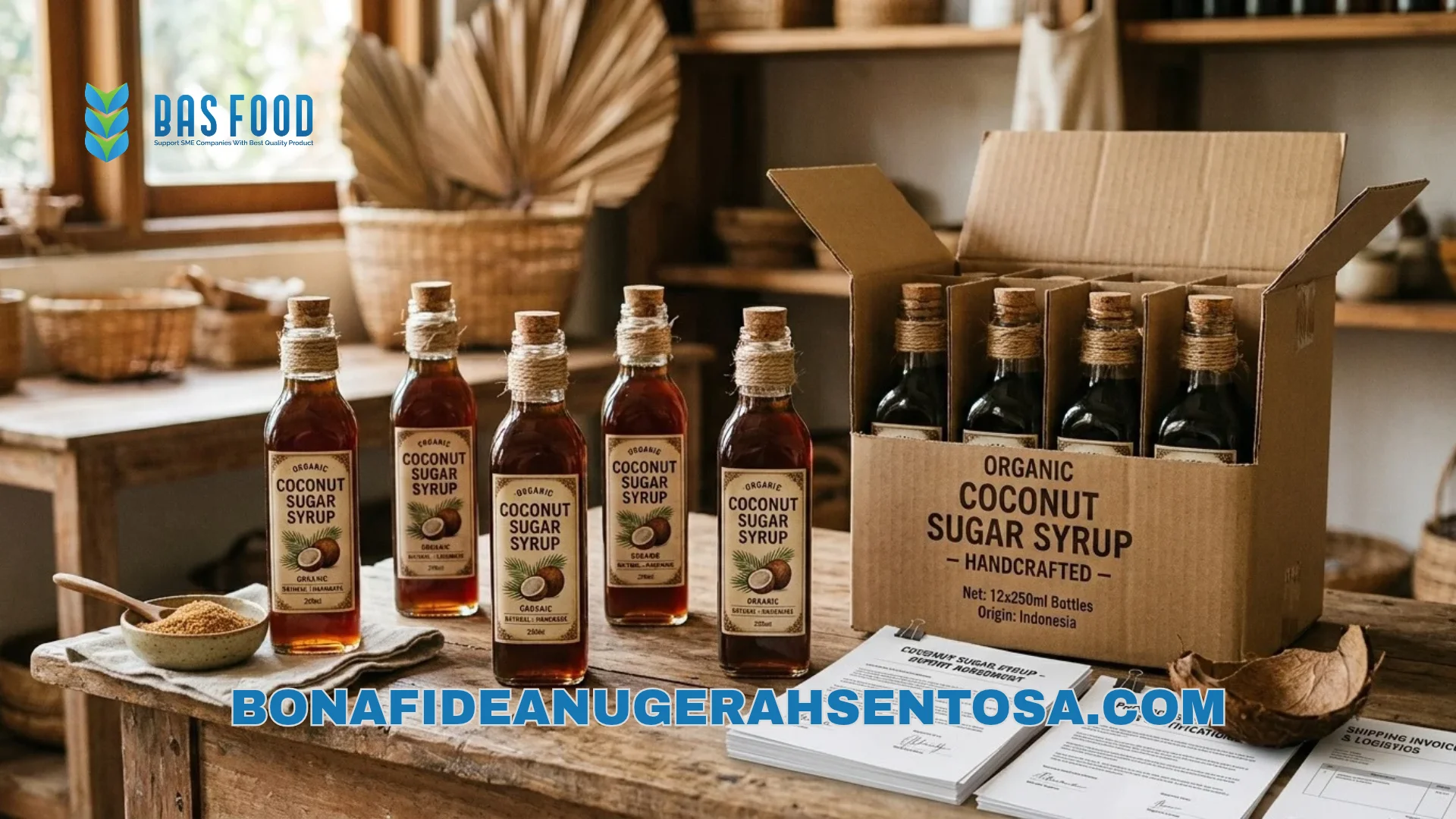
Why Export Documents Matter for Coconut Sugar Syrup
Export documents provide the information needed to identify, value, transport, and clear a shipment. They create a paper trail between the exporter, importer, freight forwarder, customs authorities, banks, and other parties involved in the transaction.
For example, customs authorities may need information about the seller, buyer, product description, quantity, value, origin, and transportation. Meanwhile, the importer may need product information to meet internal purchasing and regulatory requirements.
Therefore, documentation is not simply administrative paperwork. It supports the entire export process.
When you purchase coconut sugar syrup in bulk, the documentation should also match the actual shipment. Product descriptions, quantities, weights, packaging details, invoice values, and shipping information should be consistent wherever applicable.
Even a small discrepancy can lead to questions from a customs broker or logistics provider. Consequently, exporters and importers should review documents carefully before shipment.
The Main Coconut Sugar Syrup Export Documents
The exact documentation package can vary from one shipment to another. However, several documents commonly appear in international trade transactions.
The main documents buyers may encounter include:
- Commercial invoice
- Packing list
- Bill of lading or other transport document
- Certificate of origin
- Export customs documentation
- Product specification sheet
- Certificate of Analysis, where applicable
- Health, food safety, or other certificates, where required
- Insurance documentation, depending on the trade arrangement
- Other documents required by the destination country
Not every shipment requires every document on this list. Regulatory requirements depend on the destination market and the nature of the product.
For this reason, buyers should check the import requirements of their own country before confirming an order. At the same time, the exporter should explain which documents it can prepare or provide.
Commercial Invoice: The Core Commercial Document
The commercial invoice is one of the most important documents in an international shipment. It provides key commercial information about the transaction between the exporter and importer.
A commercial invoice commonly identifies the seller and buyer and describes the goods being sold. It can also include quantity, unit price, total value, currency, payment information, and applicable trade terms.
For a coconut sugar syrup shipment, the product description should be clear enough to identify what is being shipped. The invoice should also correspond with the purchase agreement and other shipping documents.
Accuracy is especially important because customs authorities use commercial information when assessing imported goods. The invoice may also be used by banks, freight forwarders, customs brokers, and accounting teams.
What Buyers Should Check
Before approving the commercial invoice, buyers should review:
- Exporter name and address
- Importer name and address
- Invoice number and date
- Product description
- Quantity
- Unit price
- Total value
- Currency
- Packaging information, where relevant
- Applicable Incoterms
- Payment terms
- Other required commercial details
If something does not match the purchase order, ask the supplier to correct it before shipment.
Packing List: Understanding the Physical Shipment
While the commercial invoice focuses mainly on the commercial transaction, the packing list provides information about how the goods are physically packed.
A packing list can include the number of packages, package type, net weight, gross weight, dimensions, and product details. This information helps logistics providers and customs authorities understand the physical characteristics of the shipment.
For coconut sugar syrup, packaging information can be particularly useful because liquid products may be packed in different types and sizes of food-grade containers depending on the buyer’s requirements.
The packing list should correspond with the actual shipment. If the number of packages or weights changes during final packing, the document should reflect the final information.
For importers, checking the packing list before shipment can also make warehouse planning easier. Your receiving team can prepare the appropriate space and handling process before the goods arrive.
Certificate of Origin: Proving Where the Product Comes From
A certificate of origin is a document used to identify the country of origin of goods. It can be relevant when an importer or customs authority needs evidence of origin.
For buyers sourcing coconut sugar syrup from Indonesia, the certificate of origin may be important depending on the destination country’s customs rules and any applicable trade arrangements.
However, buyers should understand that the specific type, format, and issuing requirements can vary. Not every destination market uses exactly the same origin documentation.
The certificate of origin should therefore be discussed before shipment rather than requested at the last minute.
Why Origin Matters
Country of origin can affect customs treatment, trade preferences, import procedures, and regulatory requirements.
For that reason, buyers should tell their supplier the destination country and intended import arrangement as early as possible. The exporter can then determine which origin documents may be relevant to the transaction.
A professional coconut sugar supplier should be prepared to discuss origin documentation as part of the export process.
Bill of Lading and Transport Documents
Once the shipment is transported internationally, the logistics process requires a transport document.
For ocean freight, this is commonly a bill of lading. Other transportation methods may use different documents.
The transport document contains information about the shipment and its movement from the origin point to the destination. Depending on the shipping arrangement, it may contain details about the shipper, consignee, port of loading, port of discharge, cargo description, package information, and freight terms.
Importers should carefully review the shipping information before the final document is issued. Names, addresses, ports, and other details should match the agreed transaction.
If the buyer uses a freight forwarder or customs broker, it is useful to coordinate document review with them as well.
Export Customs Documentation
Export customs procedures require documentation that allows the shipment to be declared and processed through the exporting country’s customs system.
The exact process depends on the exporting country and applicable customs regulations. In Indonesia, exporters generally need to work through the relevant customs and logistics procedures for outbound shipments.
The exporter or its appointed logistics partner usually handles the export-side process. However, the importer should still understand what is being prepared because the export documents form part of the overall shipment record.
The information submitted to customs should be consistent with the commercial invoice, packing list, and other relevant documents.
This is another reason why accurate product descriptions and shipment information matter.
Product Specification Sheet: Important for Food Buyers
Not all important documents are customs documents.
For food ingredient buyers, the product specification sheet can be equally valuable because it explains the characteristics of the product being purchased.
A coconut sugar syrup specification may include information about appearance, color, flavor, aroma, viscosity, soluble solids or Brix where applicable, moisture or other relevant parameters, microbiological requirements, packaging, storage, and shelf life.
The exact specification depends on the product and supplier.
Before placing a bulk order, buyers should review the specification and confirm that it fits their intended application. A beverage manufacturer may have different requirements from a bakery or sauce manufacturer.
The specification should also serve as a reference when evaluating product samples and future production batches.
Certificate of Analysis and Quality Documents
A Certificate of Analysis, commonly known as a COA, may be provided when applicable to demonstrate the results of certain product tests.
The exact tests included on a COA depend on the product, buyer requirements, supplier quality system, and applicable regulations.
For coconut sugar syrup, a buyer may want information related to selected physical, chemical, or microbiological parameters. However, the required testing should be agreed in advance rather than assumed.
A COA should be connected to the relevant production batch whenever applicable. This allows the buyer to understand which batch the test results represent.
Buyers should also distinguish between a product specification and a COA. The specification describes the agreed product requirements, while the COA generally reports test results for a particular batch or sample.
Food Safety and Regulatory Documents
Coconut sugar syrup is a food ingredient, so regulatory requirements can be important.
Depending on the destination country, buyers may need specific food safety documents, declarations, certificates, or supporting information. Requirements can differ considerably between markets.
For example, one destination may have specific food labeling or import requirements, while another market may request different supporting documents.
Therefore, buyers should not assume that a document required in one country is automatically required in another.
The importer should verify destination-country requirements with the relevant authority, customs broker, or regulatory specialist. The exporter can then provide the documents that fall within its responsibilities.
How Export Documentation Supports Customs Clearance
Customs clearance is one of the most important stages of international shipping. Authorities need sufficient information to identify and process imported goods.
Export documentation helps create a consistent record of the shipment.
The commercial invoice provides commercial information. The packing list explains the physical shipment. The transport document provides shipping information. The certificate of origin identifies the origin where required. Product documents provide additional information about the goods.
When these documents are consistent, the clearance process can be easier to manage.
However, documentation alone does not guarantee clearance. The importer remains responsible for complying with the destination country’s regulations and import requirements.
Common Documentation Mistakes Buyers Should Avoid
One common mistake is waiting until the cargo is already on the way before reviewing documents.
By that stage, correcting certain information can be more difficult and may create delays.
Another mistake is assuming that every shipment uses exactly the same documents. International requirements can change depending on the destination, product classification, buyer requirements, and shipping arrangement.
Buyers should also avoid using vague product descriptions. The commercial description should clearly identify the goods while remaining consistent with the applicable customs and trade documentation.
Finally, buyers should avoid ignoring small differences between documents. Differences in quantity, package count, weight, consignee details, or shipment references can create unnecessary questions.
What Buyers Should Ask a Coconut Sugar Supplier
When selecting a coconut sugar supplier, do not ask only for a price.
Ask the supplier about the product specification, available packaging, sample availability, production lead time, quality control, and export experience.
You should also ask which export documents the supplier can provide and which documents must be arranged by the importer or a third party.
This distinction is important because the exporter cannot always provide every document required by the destination country.
A good supplier should communicate clearly about what it can prepare and what information it needs from the buyer.
Working With a Coconut Sugar Exporter Supplier
A coconut sugar exporter supplier can help coordinate the commercial and logistics side of international sourcing.
For example, the exporter may coordinate product preparation, packaging, export customs processes, shipping arrangements, and commercial documentation.
However, the buyer should remain involved in the process. The importer knows the requirements of its destination market and should communicate those requirements clearly to the exporter.
For larger or recurring orders, buyers can create a standard document checklist. This helps both sides use the same process for every shipment.
Over time, this can reduce communication problems and make repeat orders easier to manage.
Working With CV Bonafide Anugerah Sentosa
For buyers sourcing coconut-derived ingredients from Indonesia, CV Bonafide Anugerah Sentosa can be approached as an Indonesian supplier and export partner for discussion about product requirements and international orders.
When contacting the company, buyers can provide important information upfront, such as the destination country, intended application, estimated quantity, preferred packaging, and required product specification.
This information makes the initial discussion more productive. Instead of discussing a generic coconut sugar syrup product, both parties can focus on the requirements of the actual import project.
Buyers should also request the relevant product specification and sample before finalizing a large order. This allows the purchasing team to evaluate the product while the commercial and documentation requirements are being discussed.
How Buyers Can Make Documentation Easier
The best time to discuss documentation is before placing the purchase order.
During the quotation stage, tell the supplier which documents you expect. This gives both parties time to determine whether the documents are available and whether additional arrangements are necessary.
It is also useful to appoint one person on the buyer’s side to coordinate documentation. This person can communicate with the supplier, freight forwarder, customs broker, warehouse team, and purchasing department.
Furthermore, keep copies of previous successful shipments. If you import the same product repeatedly, the previous document package can serve as a useful reference for future orders.
However, do not automatically copy old requirements forever. Regulations and commercial requirements can change, so the current destination requirements should always be checked.
Final Thoughts: Good Documentation Supports a Better Import Process
Understanding coconut sugar syrup export documents can make international sourcing much easier.
The commercial invoice, packing list, certificate of origin, transport documents, customs documents, product specifications, and applicable quality certificates each serve different purposes. Together, they create the documentation framework for an international shipment.
For buyers, the most important lesson is to prepare early. Confirm the destination requirements, agree on the product specification, discuss the required documents with your supplier, and review the paperwork before shipment.
If you are sourcing from Indonesia, work closely with your export supplier and clearly communicate your destination-country requirements. Whether you are working with a new coconut sugar supplier or an established coconut sugar exporter supplier, good communication can prevent many avoidable problems.
For B2B buyers, documentation should not be treated as an afterthought. It should be part of the sourcing process from the beginning.