
Coconut oil is widely used in the food industry, cosmetics, personal care products, and many other applications. However, not all coconut oils are made in the same way. Two popular types are refined, bleached, and deodorized coconut oil, commonly known as RBD coconut oil, and virgin coconut oil, or VCO. Understanding RBD coconut oil vs VCO is important for importers, food manufacturers, distributors, and other B2B buyers. Although both products come from coconuts, their processing methods, aroma, flavor, appearance, and typical applications can differ significantly.
For example, a food manufacturer may need a neutral oil that will not change the flavor of a finished product. Meanwhile, a premium food brand may prefer an oil with a natural coconut aroma. These different needs can influence which type of coconut oil is the better choice.
In this guide, we will explain how RBD coconut oil and virgin coconut oil differ, how manufacturers produce them, where businesses commonly use each type, and what buyers should consider before placing a bulk order. We will also discuss practical quality checks and supplier questions that can help international buyers make informed purchasing decisions.
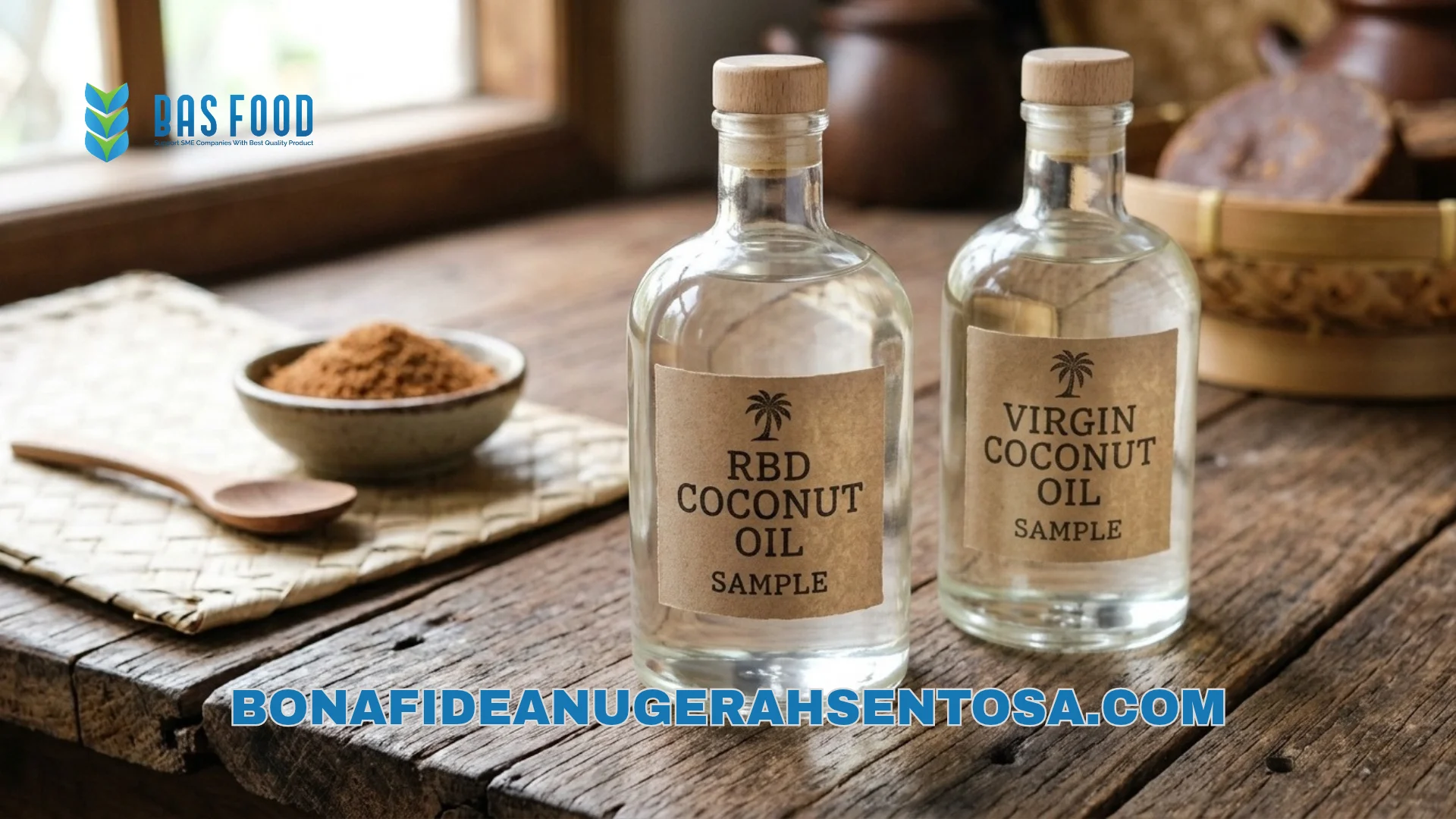
What Is RBD Coconut Oil?
RBD coconut oil is coconut oil that undergoes refining, bleaching, and deodorizing. Manufacturers process the oil to reduce impurities, remove unwanted odors and flavors, and achieve the product characteristics required for its intended use.
Despite the term “bleached,” the process does not necessarily mean that manufacturers add household bleach to the oil. Instead, industrial refining commonly uses suitable adsorbent materials to help remove pigments and certain impurities. The exact process depends on the manufacturer, the equipment, and the product specification.
RBD coconut oil typically has a neutral aroma and a mild or neutral taste compared with less-refined coconut oil. Its appearance is often clear and colorless when the oil is fully melted, although the exact characteristics depend on processing and quality standards.
These properties make RBD coconut oil useful when manufacturers want the functional qualities of coconut oil without a strong coconut flavor dominating the final product.
Why Do Businesses Choose RBD Coconut Oil?
The main attraction of RBD coconut oil is its neutral sensory profile. Food manufacturers often need ingredients that perform consistently without adding a strong flavor to their recipes.
For example, a business producing baked goods, confectionery, processed foods, or other formulated products may want coconut oil to serve a functional purpose while allowing other ingredients to define the taste.
RBD coconut oil can also be suitable for buyers who require defined technical specifications for industrial production. However, businesses should not assume that every RBD product has the same melting behavior, shelf life, or suitability for a particular process. They should confirm those details with the supplier.
What Is Virgin Coconut Oil (VCO)?
Virgin coconut oil, or VCO, is coconut oil produced from fresh coconut material without the conventional refining, bleaching, and deodorizing process used to make RBD coconut oil.
Manufacturers commonly use mechanical extraction and other suitable processing methods to obtain oil from fresh coconut meat or coconut milk. Depending on the production method, the process may involve pressing, separation, centrifugation, controlled heating, or fermentation.
The objective is to produce coconut oil while preserving its characteristic natural qualities. Good-quality VCO often has a recognizable coconut aroma and a mild coconut flavor. Its appearance is generally clear when fully melted, although appearance can vary with production methods and storage conditions.
Importantly, the term “virgin” does not mean that the oil is automatically organic, certified, or suitable for every health-related application. Those claims require appropriate evidence and, where relevant, independent certification.
Why Do Businesses Choose VCO?
VCO is often selected when the natural coconut aroma and flavor are important selling points. For instance, a premium food brand may use it in selected recipes where coconut notes complement the other ingredients.
VCO also appears in personal care and cosmetic formulations. However, buyers should evaluate the intended application carefully because food-grade, cosmetic-grade, and other product requirements may differ.
For B2B buyers, the main question is not whether VCO is universally better than RBD coconut oil. Instead, it is whether the product’s characteristics fit the intended use, target market, formulation, and price point.
RBD Coconut Oil vs VCO: Key Differences at a Glance
The most useful way to compare these products is to consider how manufacturers process them and what buyers expect from the finished oil.
| Comparison point | RBD coconut oil | Virgin coconut oil (VCO) |
|---|---|---|
| Main processing approach | Refined, bleached, and deodorized | Extracted from fresh coconut material without conventional RBD refining |
| Starting material | May use copra or other suitable coconut oil feedstock | Typically fresh coconut meat or coconut milk |
| Aroma | Usually neutral or very mild | Often has a natural coconut aroma |
| Flavor | Generally neutral | Often has a mild coconut taste |
| Appearance | Usually clear and colorless when fully melted | Usually clear when fully melted, depending on processing |
| Common buying priority | Neutral flavor and defined industrial specifications | Natural coconut aroma and product positioning |
| Potential applications | Food manufacturing, baking, confectionery, and other suitable formulations | Selected food products, premium formulations, and personal care applications |
| Processing requirements | Requires refining, bleaching, and deodorizing stages | Requires careful fresh-material handling and oil separation |
| Quality evaluation | Includes refining quality, oxidation indicators, and other agreed specifications | Includes freshness, aroma, moisture, oxidation indicators, and other agreed specifications |
| Best purchasing approach | Match the specification to the production process | Match the sensory profile and specification to the intended product |
This comparison is a general guide rather than a universal product specification. Different manufacturers may use different processes, and products can vary in quality. Therefore, buyers should compare actual technical data sheets instead of relying on product names alone.
Differences in Aroma, Flavor, and Appearance
Aroma and flavor are often the first differences that buyers notice. These characteristics can also determine whether an oil works well in a specific recipe.
RBD coconut oil generally has a neutral sensory profile because deodorization removes many volatile compounds responsible for strong odors. This makes it useful when a manufacturer wants to avoid introducing a distinct coconut flavor into a finished product.
VCO often retains a natural coconut aroma because it does not undergo conventional deodorization. This can be an advantage for products that deliberately highlight coconut as part of their identity. However, the strength and quality of the aroma depend on the raw material, extraction method, processing conditions, and storage.
Does Color Tell You Which Oil Is Better?
Not necessarily. Both RBD coconut oil and VCO can appear clear when fully melted. Color alone cannot establish purity, freshness, or overall quality.
Coconut oil can become cloudy or solid as its temperature drops. This behavior is normal because coconut oil contains a substantial proportion of saturated fatty acids that crystallize at relatively warm room temperatures compared with many liquid vegetable oils.
Consequently, a solid or cloudy appearance does not automatically indicate that the oil has spoiled. Buyers should consider the temperature history, packaging condition, smell, and relevant quality test results before making a judgment.
How Should Buyers Evaluate Aroma and Flavor?
A sensory evaluation should follow an agreed procedure. Buyers can compare representative samples under similar conditions, using clean equipment and avoiding cross-contamination.
For RBD coconut oil, they may look for an acceptably neutral smell and the absence of unwanted rancid or burnt notes. For VCO, they may evaluate whether the natural coconut aroma is pleasant, consistent, and appropriate for the intended product.
Aroma is useful, but it cannot replace laboratory testing. A product may smell acceptable while still failing a moisture, oxidation, contaminant, or other technical requirement. For bulk procurement, sensory checks and documented specifications should work together.
RBD Coconut Oil vs VCO: Which Is Better for Food Manufacturing?
Neither oil is automatically the best choice for every food product. The correct option depends on the recipe, the required sensory profile, processing conditions, cost target, and customer expectations.
For example, a manufacturer producing a recipe with delicate flavors may prefer RBD coconut oil because its neutral profile allows other ingredients to stand out. In contrast, a brand developing a coconut-forward product may prefer VCO because its natural aroma supports the intended flavor experience.
RBD Coconut Oil for Industrial Food Applications
RBD coconut oil may suit applications where manufacturers want a relatively neutral oil. Depending on the product specification, possible uses include:
- Bakery products and selected baked goods
- Confectionery and chocolate-related formulations
- Processed foods that require a suitable fat ingredient
- Food formulations in which a strong coconut aroma is undesirable
- Other manufacturing processes that specify refined coconut oil
These are potential applications, not a guarantee that every RBD coconut oil will meet every formulation requirement. Manufacturers should confirm the oil’s melting profile, fatty acid composition, moisture limits, free fatty acid limits, and other relevant parameters before using it in production.
RBD coconut oil should also not be treated as interchangeable with every other refined vegetable oil. Its fatty acid composition and melting behavior influence the texture and performance of finished products.
VCO for Products That Highlight Coconut
VCO may suit selected food products where the natural coconut character is desirable. Depending on the formulation and local regulatory requirements, potential applications may include certain sauces, specialty foods, or premium products designed to feature coconut ingredients.
However, VCO may not be the right choice when a manufacturer wants a completely neutral flavor. Its aroma can influence the finished product, so product developers should test the oil in the actual recipe before approving a supplier.
In addition, businesses should consider how the oil behaves during heating, mixing, cooling, and storage. Small-scale formulation trials can reveal differences that are difficult to predict from a technical data sheet alone.
Coconut Oil Processing: Why Manufacturing Methods Matter
The differences between RBD coconut oil and VCO begin with the raw material and continue through extraction, separation, treatment, and packaging.
In RBD production, refining steps are designed to adjust the oil’s characteristics and remove unwanted components. These steps can improve sensory neutrality and help the product meet defined specifications. However, the outcome depends on the equipment, operating conditions, and quality controls used by the manufacturer.
VCO production follows a different approach. Because manufacturers aim to retain the oil’s natural sensory qualities, raw material quality and careful handling become especially important. Excess moisture, poor hygiene, unsuitable storage, or contamination can reduce quality.
Raw Material Selection
The condition of the coconut material affects the finished oil. Suppliers should use suitable raw materials and apply controls that reduce the risk of contamination or deterioration before processing.
For VCO, fresh coconut quality and the time between preparation and processing can be especially important. For RBD coconut oil, the quality of the feedstock and the effectiveness of the refining process influence the finished product.
Processing and Quality Control
A reliable manufacturing system should define the relevant control points and product specifications. These may include moisture and volatile matter, free fatty acids, peroxide value, sensory characteristics, and other parameters relevant to the product and destination market.
The appropriate limits depend on the product category, customer requirements, and applicable standards. Buyers should therefore request the manufacturer’s current specification rather than apply one universal set of limits to every coconut oil.
Packaging and Storage
Packaging protects the oil during storage and transport. Manufacturers and buyers should select food-contact packaging that suits the oil, shipping conditions, handling system, and destination market.
The oil should be stored in a clean, dry location away from direct sunlight, excessive heat, and sources of contamination. Buyers should follow the supplier’s storage instructions and check whether the proposed packaging is appropriate for the expected shipping duration.
For international orders, packaging selection also affects handling, warehouse storage, and the condition of the product when it arrives. These practical considerations should be part of procurement planning, not an afterthought.
Are RBD Coconut Oil and VCO Equally Healthy?
Many consumers compare these oils because they want to understand their nutritional properties. Businesses that sell food products should approach this topic carefully and avoid making unsupported health claims.
Both RBD coconut oil and VCO contain high levels of saturated fat. Their exact fatty acid profiles can vary, but neither should automatically be presented as a heart-health solution or as a universally healthier replacement for other fats.
Coconut oil contains lauric acid and other fatty acids. However, the presence of a particular fatty acid does not mean that consuming large amounts of the oil provides a proven health benefit. The overall dietary pattern, portion size, and type of fat being replaced all matter.
Does VCO Always Contain More Beneficial Compounds?
VCO may retain certain minor components and natural sensory characteristics that differ from those in refined oil. The amounts depend on the raw material and processing method.
However, it would be inaccurate to conclude that VCO is always nutritionally superior in every respect. Processing differences do not automatically translate into a meaningful health advantage for every consumer or application.
Similarly, refining does not automatically make RBD coconut oil unsafe or nutritionally inferior for all purposes. Properly produced food-grade oil should be evaluated against its intended use and applicable safety requirements.
What Should Food Brands Communicate?
Food brands should provide accurate ingredient information and avoid claims that exceed available evidence. Statements about disease prevention, treatment, or guaranteed health effects require particular care and may be restricted by local regulations.
For B2B buyers, the more useful comparison is often practical: which oil meets the formulation requirements, quality specification, sensory target, and regulatory rules for the intended market?
Shelf Life, Oxidation, and Product Stability
Shelf life is another important factor in the RBD coconut oil vs VCO comparison. Both oils can deteriorate when exposed to unsuitable storage conditions, oxygen, heat, light, or contamination.
The actual shelf life depends on the product, manufacturing controls, packaging, storage conditions, and the manufacturer’s validated assessment. Buyers should not assume that all RBD coconut oil or all VCO has the same shelf life.
How Can Buyers Protect Coconut Oil Quality?
Businesses can reduce quality risks by following several practical steps:
- Use suitable packaging. Select containers designed for the product and its transport conditions.
- Control storage conditions. Keep the oil in a clean, dry environment and follow the supplier’s temperature recommendations.
- Limit unnecessary exposure to air. Close containers properly after opening and avoid prolonged exposure during handling.
- Inspect incoming shipments. Check seals, container condition, batch identification, and any visible signs of leakage or contamination.
- Follow the product’s documentation. Review the production date, batch information, recommended storage conditions, and best-before date where applicable.
These practices help protect quality, but they do not replace validated shelf-life data or appropriate laboratory analysis.
Does Solidification Mean Coconut Oil Has Gone Bad?
No. Coconut oil naturally solidifies as it cools and may become cloudy as crystals form. The transition between liquid and solid depends on temperature, composition, and processing.
This physical change alone is not proof of spoilage. Buyers should instead look for the complete picture, including storage history, odor, packaging integrity, and relevant test results.
If a shipment has an unusual smell, damaged packaging, or signs of contamination, the buyer should isolate the affected product and follow the agreed inspection and claims procedure.
Working with CV Bonafide Anugerah Sentosa
For international businesses sourcing Indonesian agricultural commodities, supplier communication is an important part of procurement. Buyers need clear product information, realistic commercial terms, and documentation that supports their purchasing decisions.
CV Bonafide Anugerah Sentosa operates in the Indonesian commodity export sector. Buyers interested in coconut-derived products can contact the company to confirm current product availability, technical specifications, packaging options, minimum order requirements, and export terms.
When discussing RBD coconut oil or VCO, provide as much detail about your intended application as possible. For example, explain whether you need a neutral oil for food manufacturing or a product that retains a natural coconut aroma. This information helps establish which product specification is relevant to your business.
Buyers may also encounter supplier-related search terms such as coconut sugar exporter supplier, coconut sugar supplier, and exportador de azúcar de coco, the Spanish phrase for coconut sugar exporter. These terms relate to coconut sugar rather than directly identifying an RBD coconut oil or VCO supplier. Therefore, businesses should confirm the exact commodity they need instead of assuming that a coconut sugar supplier automatically supplies coconut oil.
For a productive inquiry, prepare a short request containing the product type, intended application, required specification, target quantity, packaging preference, destination country, and expected shipping schedule. Clear information helps the supplier determine whether it can meet the request and what additional details may be needed.
Conclusion: Choose the Oil That Fits Your Product
The comparison of RBD coconut oil vs VCO comes down to processing, sensory properties, quality requirements, and intended use. RBD coconut oil is refined, bleached, and deodorized to achieve a more neutral profile. VCO is produced from fresh coconut material and commonly retains a natural coconut aroma.
Neither product is automatically the right choice for every business. Food manufacturers, distributors, and importers should compare specifications, assess samples, review documentation, and consider destination-market requirements before purchasing.
For B2B buyers, the best decision is a practical one: choose the oil that meets your formulation needs, quality standards, and commercial requirements. If you are sourcing coconut-derived products from Indonesia, contact CV Bonafide Anugerah Sentosa to confirm current availability and discuss the specifications and export terms relevant to your business.