
Coconut oil has earned an important place in personal care and cleaning products. From traditional handmade bars to large-scale commercial soap production, manufacturers use coconut-derived ingredients to create products with specific cleansing, foaming, and texture properties. Among these ingredients, RBD coconut oil for soap making is worth exploring because it offers a refined oil option for manufacturers seeking consistent raw materials.
RBD stands for refined, bleached, and deodorized. These processing steps help remove impurities, reduce color, and minimize unwanted odors. As a result, RBD coconut oil can be suitable for selected soap formulations and other industrial applications, depending on its specification and the manufacturer’s requirements.
However, choosing the right oil involves more than finding a supplier or comparing prices. Soap manufacturers must understand fatty acid composition, saponification values, formulation requirements, production methods, and quality control. They also need to ensure that the oil meets the appropriate specifications for its intended use.
In this guide, we explore how RBD coconut oil works in soap making, why manufacturers consider it, how to evaluate its quality, and what B2B buyers should know before purchasing it in bulk.
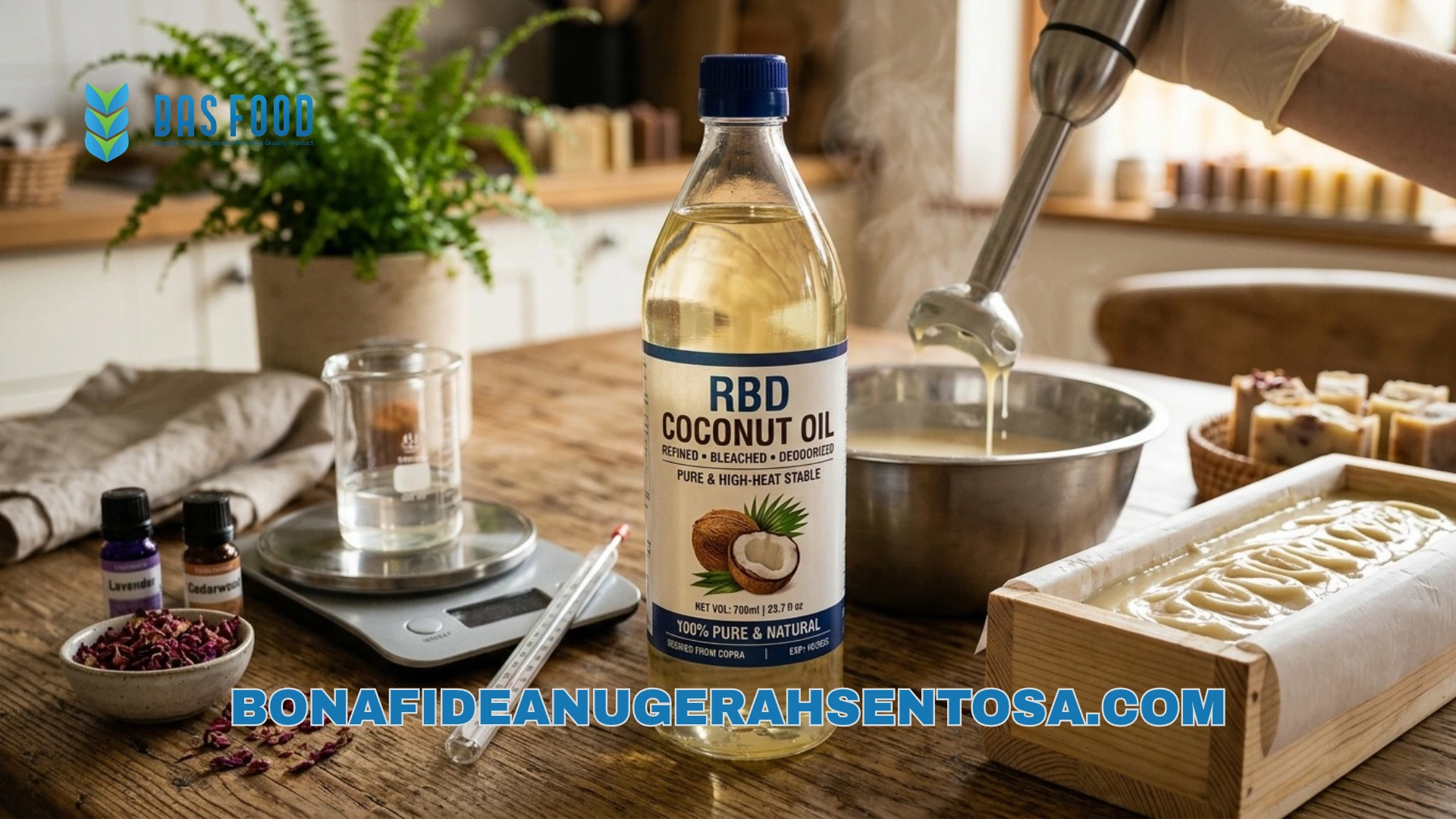
Why Use RBD Coconut Oil for Soap Making?
One reason manufacturers consider RBD coconut oil for soap making is its useful fatty acid composition. Lauric acid and other fatty acids in coconut oil can produce soap with strong cleansing properties and noticeable lather. These characteristics make coconut oil a common ingredient in many traditional and commercial soap formulations.
Another advantage is its refined sensory profile. Compared with less-refined coconut oil, properly deodorized RBD coconut oil generally has a more neutral odor. This can make it easier for formulators to develop soaps with specific fragrance profiles, especially when they want the perfume to remain the main scent of the finished product.
Consistency is also important in commercial manufacturing. A supplier that provides oil with a clear specification and consistent batches can help manufacturers reduce unwanted variation in their formulations. Even so, buyers should verify this consistency through documentation, supplier qualification, and, where appropriate, incoming quality checks.
RBD coconut oil can also fit into different manufacturing strategies. Some producers use it as one component of a multi-oil formula, while others develop products with a higher coconut oil content to achieve particular cleansing and foaming characteristics. The right proportion depends on the intended product and must be tested.
Nevertheless, more coconut oil does not always mean better soap. A high proportion can produce a strongly cleansing bar that some users may find drying, particularly when the formula does not account for the intended skin feel. Manufacturers should balance cleansing, foam, hardness, and mildness rather than focusing on one property alone.
Understanding the Role of Coconut Oil in Soap Chemistry
To understand how coconut oil works in soap, it helps to look at saponification. During this process, fats or oils react with an alkali to form soap. Sodium hydroxide is commonly used for solid bar soap, while potassium hydroxide is often used for liquid or softer soap formulations.
The amount of alkali required depends on the type and quantity of oil used. Different oils have different saponification values, which indicate how much alkali is needed to saponify a given amount of oil under specified conditions. Therefore, manufacturers should never assume that every vegetable oil requires the same amount of sodium hydroxide.
For RBD coconut oil, formulators should use a reliable saponification value appropriate to the actual oil specification. They should also use a validated formulation calculator or an established technical method, then verify the recipe through suitable quality checks. Small differences in oil composition and measurement can affect the final result.
Manufacturers sometimes formulate soap with a controlled amount of excess oil, commonly called superfatting in traditional soap making. This changes the balance of the recipe and can affect the finished product’s properties. However, excess oil is not a substitute for correct alkali calculation, process control, and testing.
The reaction also produces glycerol, which may remain in the soap depending on the manufacturing process. Some industrial processes recover glycerol as a separate product, while other methods retain it in the soap. The choice depends on the production system and the product being manufactured.
For commercial production, understanding this chemistry helps formulators create repeatable products. It also reinforces why each new oil source or specification should be evaluated before manufacturers make major changes to their recipe.
How RBD Coconut Oil Influences Foam, Cleansing, and Bar Hardness
Coconut oil is valued in soap making partly because of the cleansing properties of the soap it produces. Its lauric-rich fatty acid profile contributes to soaps that can create abundant lather, including in formulations designed for everyday cleaning. The exact foam quality depends on the recipe, water conditions, processing, and other ingredients.
Foam is an important product feature, but it does not automatically measure how effectively a soap cleans. Some consumers associate rich lather with a satisfying washing experience, so manufacturers may use coconut oil to help achieve a desired sensory profile. Still, the formula must deliver the intended cleansing performance without creating an unnecessarily harsh product.
Coconut oil can also contribute to bar hardness. However, the finished soap’s hardness depends on the combination of oils, water content, curing time, and production method. A soap bar made with coconut oil alone will not necessarily have the same texture or user experience as a bar formulated with coconut oil, olive oil, palm oil, or other fats.
Manufacturers can adjust the proportion of coconut oil and combine it with other oils to balance cleansing, lather, and skin feel. They should test the complete formulation instead of assuming that one ingredient determines every quality characteristic.
The most useful approach is to define measurable product targets. These may include bar hardness, lather volume, cleansing performance, fragrance retention, appearance, and stability during storage. Testing finished bars against those targets provides a stronger basis for formulation decisions than relying on ingredient descriptions alone.
RBD Coconut Oil as a Soap Manufacturing Oil for Different Products
The phrase soap manufacturing oil covers oils and fats used to create soap through saponification. Coconut oil is one of several options available to manufacturers, and RBD coconut oil may be suitable for different product categories when the selected grade meets the formulation requirements.
For example, a producer of household cleaning bars may prioritize cleaning performance, foam, hardness, and production cost. A personal care soap manufacturer may focus more closely on the balance between cleansing and mildness, fragrance compatibility, color, and the overall washing experience. Both businesses may consider coconut oil, but their ideal formulation can be very different.
Handmade soap businesses also use coconut oil in some recipes because it can contribute to abundant lather and a firm bar. However, small-scale producers and large factories may have different needs for packaging, batch consistency, technical support, and order quantities. A raw material that suits a small workshop may not meet the commercial requirements of an automated production line without further evaluation.
RBD coconut oil may also be considered in specialty formulations, including fragranced bars and certain cleansing products. Yet suitability depends on the complete ingredient system, processing conditions, and intended product claims. Cosmetic products require appropriate safety and stability evaluation, particularly when they are designed for sensitive skin or make specific performance claims.
Before selecting an oil, manufacturers should prepare a product brief. This document can define the intended use, target customer, formula requirements, production method, quality standards, and cost limits. The brief helps purchasing and formulation teams compare suppliers against the same criteria.
The Connection Between Coconut Oil, Cosmetic Ingredients, and Surfactant Production
Coconut oil has applications beyond traditional soap bars. In the wider personal care industry, it may be used in selected formulations, while its fatty acids and derivatives can serve as raw materials for other ingredients. The exact application depends on the required grade, chemical processing, and finished-product specification.
The term cosmetic ingredients covers a broad range of materials used in products such as cleansers, shampoos, body washes, and personal care creams. Not every cosmetic ingredient performs the same role. Some provide cleansing, others help stabilize emulsions, and some contribute texture or conditioning properties. RBD coconut oil should be evaluated for the specific function it is intended to perform.
Coconut-derived fatty acids can also be used in the production of certain surfactants. Surfactants help reduce surface tension and support functions such as cleansing, wetting, and emulsification. Depending on the process, coconut-derived raw materials may be converted into fatty acids, fatty alcohols, or other intermediates used to manufacture surfactants.
However, RBD coconut oil is not itself interchangeable with every finished surfactant. Surfactant production may require additional chemical reactions and carefully controlled processing. A manufacturer buying raw coconut oil for this purpose must confirm that the oil’s specification is appropriate for the intended conversion process.
This distinction matters for B2B procurement. A soap factory may be able to use a particular grade of coconut oil directly in a saponification process, while a surfactant manufacturer may have different requirements for impurities, moisture, free fatty acids, and other chemical properties.
Buyers should explain their intended application to the supplier before requesting a quotation. Clear communication helps prevent the purchase of a material that is technically unsuitable for the manufacturing process.
Quality Parameters to Check Before Buying RBD Coconut Oil
Raw material quality can affect production efficiency and finished-product consistency. For this reason, soap manufacturers should request a current technical specification and certificate of analysis, where available, before approving a supplier.
The precise parameters depend on the application and agreed product grade. Buyers may need to review the oil’s appearance, odor, moisture and volatile matter, free fatty acid level, relevant chemical quality values, and fatty acid profile. For soap formulation, the saponification value is particularly important because it supports accurate alkali calculations.
Manufacturers should also confirm that the documentation matches the actual product being offered. A general specification is useful for initial screening, but buyers may need batch-specific documentation for incoming quality control. If the factory has strict requirements, it should communicate the acceptable limits before placing an order.
A careful quality review helps manufacturers reduce the risk of production problems and makes it easier to compare suppliers on a consistent basis.
Storage, Handling, and Production Considerations
Coconut oil can become cloudy or solidify at cooler temperatures. This is a natural physical characteristic related to its fatty acid composition, not necessarily a sign that the product has deteriorated. However, it can create handling challenges in industrial settings.
Manufacturers should follow the supplier’s recommendations for storage and handling. If temperature control is required to maintain flow, the factory should ensure that its tanks, pumps, pipes, and transfer systems can handle the oil appropriately. Heating should be controlled to avoid unnecessary exposure to high temperatures that could affect quality.
Clean handling practices are equally important. Containers should remain protected from water, dust, and other contaminants. Storage areas should be suitable for the material, and staff should use clear batch identification and stock rotation procedures.
For soap producers, accurate weighing is essential. The formulation should account for the actual quantity of oil used, and operators should follow established procedures for preparing the alkali solution and mixing the ingredients. Suitable protective equipment, training, and chemical-handling procedures are necessary when working with sodium hydroxide or potassium hydroxide, as these substances can cause serious burns.
Production teams should also validate curing, drying, or other finishing stages appropriate to the chosen soap-making method. Finished products need suitable quality checks before release, including any relevant pH, stability, appearance, and performance assessments.
Good storage and handling practices protect the raw material and help the factory maintain repeatable results. They also make it easier to investigate quality issues when a batch does not meet expectations.
How to Compare Suppliers and Manage Procurement Costs
For B2B buyers, the cheapest quotation is not always the best deal. The total cost of RBD coconut oil includes the purchase price, transport, import costs where applicable, packaging, storage, handling, quality testing, and any changes needed in the production process.
A consistent raw material can help reduce formulation adjustments and production waste. However, manufacturers should verify consistency through actual supplier performance and quality records rather than relying on general promises. Requesting samples for evaluation may be useful when available, especially before a large order.
Purchasing teams should also confirm the commercial details in writing. These include the product specification, order quantity, packaging format, minimum order quantity, delivery lead time, shipment terms, payment conditions, and validity of the quotation. Export buyers should check which documents the supplier can provide and which documents the destination country requires.
Supply continuity is another consideration. Soap factories need to plan inventory around production demand and shipping lead times. A supplier’s ability to provide clear communication and realistic delivery information can be just as important as the initial price.
For a fair comparison, prepare a supplier evaluation sheet that scores technical suitability, quality documentation, commercial terms, communication, delivery performance, and overall cost. This creates a repeatable purchasing process and helps the business make decisions based on evidence rather than price alone.
Finding an Export Partner for Coconut-Derived Products
International buyers often look for suppliers that can explain their product portfolio, provide relevant documents, and communicate clearly about export arrangements. This is especially important when a business sources multiple coconut-derived commodities for different manufacturing needs.
CV Bonafide Anugerah Sentosa operates in Indonesia’s commodity export sector. Buyers interested in coconut-derived products can contact the company to confirm its current product availability, technical specifications, packaging options, minimum order quantities, and export terms. The availability of a particular RBD coconut oil grade should always be confirmed directly rather than assumed.
When approaching a potential supplier, share the intended application and required specification. For soap making, explain whether the oil will be used in solid bars, liquid soap, or another process. If the material is intended for further processing, such as the production of fatty acids or surfactants, communicate the relevant technical requirements.
This helps the supplier determine whether the requested product may fit the application and what documentation is needed for further evaluation. Buyers should also ask about samples, batch records, and shipment arrangements where relevant.
Clear product descriptions in inquiries, quotations, and purchase orders help avoid misunderstandings. A well-defined specification protects both buyer and supplier by ensuring that commercial discussions focus on the material the manufacturer actually needs.
Conclusion: Turning the Right Oil Into Better Soap
RBD coconut oil for soap making can be a useful raw material for manufacturers seeking specific cleansing, lathering, and formulation properties. Its lauric-rich fatty acid profile makes it valuable in many soap recipes, while refining helps provide a more controlled sensory profile.
However, successful soap production depends on more than the oil alone. Manufacturers must consider the complete formula, saponification value, alkali calculation, production method, storage conditions, finished-product testing, and target market requirements.
For B2B buyers, the most effective approach is to define the intended application, request the correct technical specification, conduct suitable formulation trials, and compare suppliers using both quality and commercial criteria. This creates a stronger foundation for consistent production and reliable procurement.
CV Bonafide Anugerah Sentosa can be contacted to discuss its current product portfolio and export capabilities. Buyers should confirm directly whether the required RBD coconut oil grade is available and request the documentation needed to evaluate its suitability.
With careful sourcing and sound formulation practices, manufacturers can make informed decisions about coconut oil and develop soap products that meet their performance, quality, and commercial goals.