
When buying coconut sugar syrup for commercial production, sweetness is only one part of the equation. Food manufacturers also need to know how the syrup flows, mixes, fills, pumps, and behaves during storage. This is where coconut sugar syrup viscosity becomes an important product characteristic. For a beverage producer, bakery manufacturer, sauce company, foodservice distributor, or private-label brand, syrup that is too thick or too thin can create practical challenges. It can affect dosing, production speed, packaging, mixing, and even the final texture of a product.
Therefore, understanding viscosity can help B2B buyers make better sourcing decisions. Instead of simply asking for coconut sugar syrup, buyers can discuss the desired liquid sweetener viscosity, syrup consistency, and viscosity specification with their supplier.
For international buyers sourcing from Indonesia, these details can also make communication with a coconut sugar exporter supplier much clearer. A reliable coconut sugar supplier should understand that different applications may require different syrup characteristics.
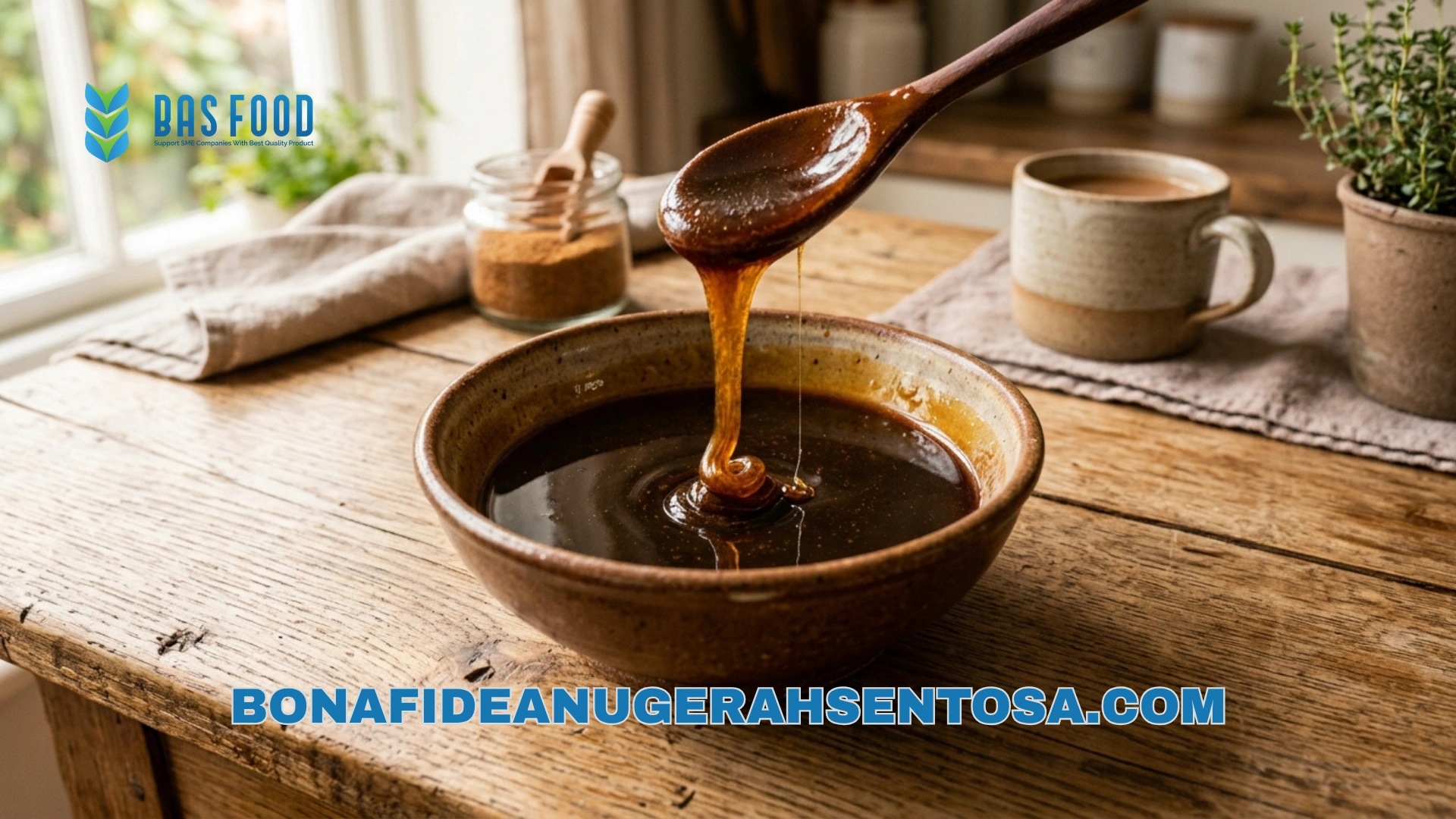
What Is Coconut Sugar Syrup Viscosity?
In simple terms, viscosity describes how resistant a liquid is to flowing. Water has low viscosity because it flows easily. Honey has much higher viscosity because it moves more slowly.
The same principle applies to coconut sugar syrup. A syrup with lower viscosity flows more easily, while a syrup with higher viscosity flows more slowly. The difference can be important when the syrup moves through pipes, pumps, filling machines, or mixing equipment.
However, viscosity is not the same as sweetness. Two syrups can have a similar sweet taste while having different flow characteristics. For commercial applications, manufacturers often need to consider both sensory properties and physical properties.
That is why coconut sugar syrup viscosity should be treated as a technical specification rather than simply a visual characteristic.
Why Viscosity Matters in B2B Food Production
For home use, pouring speed may not matter much. In an industrial facility, however, syrup may pass through tanks, pumps, pipes, dosing systems, and filling equipment.
If the syrup is more viscous than expected, pumps may need to work harder. Dosing can also become slower, especially when production lines operate at high speed. On the other hand, a syrup with very low viscosity may not provide the desired coating or consistency in certain applications.
Consequently, manufacturers should consider how the syrup will move through their existing production system.
This is especially important when a company is replacing another liquid sweetener. The new product may have a different liquid sweetener viscosity, even when the recipe uses a similar quantity. Testing can therefore help identify any required adjustments before full-scale production.
Understanding Liquid Sweetener Viscosity
The term liquid sweetener viscosity covers the flow behavior of liquid sweetening ingredients. Different sweeteners can have very different viscosity characteristics because of differences in sugar concentration, solids content, water content, temperature, and processing.
Coconut sugar syrup is no exception. Its viscosity can depend on how the product is produced and concentrated. As the concentration of dissolved solids changes, the syrup’s flow behavior can change as well.
For this reason, buyers should avoid comparing syrups based only on product names. Two products may both be marketed as coconut sugar syrup but behave differently during production.
A better approach is to request technical information and test the actual product under conditions similar to the buyer’s production environment.
Syrup Consistency and Product Performance
Syrup consistency describes how uniform and predictable the syrup feels and flows. For B2B buyers, consistency is particularly important because production formulas depend on repeatable ingredients.
Imagine a beverage manufacturer receives one shipment that flows easily but finds the next batch significantly thicker. The production team may need to adjust pumping, mixing, or dosing conditions.
Similarly, a bakery producer may expect a particular syrup to spread evenly across a product. If the consistency changes significantly, the application may also change.
Therefore, consistency should be considered together with viscosity. A good supplier should work toward stable product specifications so buyers can plan production with greater confidence.
What Affects Coconut Sugar Syrup Viscosity?
Several factors can influence coconut sugar syrup viscosity. Understanding these factors gives buyers a better idea of why viscosity may change and what information should be included in a product specification.
Common factors include:
- Sugar concentration
- Water content
- Temperature
- Raw material characteristics
- Processing conditions
- Heating and concentration
- Storage conditions
- Product age
- Packaging conditions
Among these factors, temperature deserves particular attention. A syrup can behave differently when it is warm compared with when it is stored in a cooler environment.
Therefore, viscosity measurements should always be interpreted together with the test temperature and measurement method.
Temperature and Syrup Flow
Temperature has a direct effect on how many liquid products flow. In general, warming a syrup reduces its resistance to flow, making it easier to pour or pump. Cooling can make the same syrup thicker.
This matters during international transportation and storage because the product may experience different temperatures from the production facility to the destination warehouse.
A syrup that moves easily in a warm production environment may behave differently in a cooler warehouse. Consequently, buyers should consider their own storage and processing conditions when evaluating the product.
For industrial users, it can be useful to discuss recommended handling conditions with the coconut sugar supplier. This helps the production team understand how the product should be handled before processing.
Sugar Concentration and Viscosity
Sugar concentration is another major factor affecting syrup flow. Generally, a more concentrated syrup contains less free water and more dissolved solids, which can increase resistance to flow.
This relationship is important because manufacturers may have different requirements depending on their application. A beverage formulation may require a syrup that mixes efficiently, while a topping application may benefit from a thicker consistency.
However, concentration alone does not tell the whole story. Buyers should evaluate the finished product using the relevant specification and actual application testing.
A professional coconut sugar exporter supplier should be able to communicate the product specification clearly and explain the relevant parameters that influence handling.
How Viscosity Is Measured
Viscosity is usually measured using specialized instruments called viscometers or rheometers. Different instruments and test methods can produce values under different testing conditions.
For that reason, a viscosity number without test conditions may not provide enough information for a technical buyer.
A useful viscosity specification should ideally identify the measurement conditions, such as temperature and test method. Depending on the supplier’s quality system and product specification, other relevant information may also be provided.
This allows buyers to make a more meaningful comparison between samples and batches.
When evaluating a supplier, manufacturers should therefore ask not only, “What is the viscosity?” but also, “Under what conditions was the viscosity measured?”
Viscosity Specification: What Should Buyers Request?
A viscosity specification provides a reference for acceptable product behavior. It can help buyers and suppliers establish a shared understanding of the product.
Depending on the application, buyers may want to discuss:
- Target viscosity range
- Measurement temperature
- Measurement method
- Product concentration
- Batch consistency
- Storage conditions
- Packaging format
- Recommended handling conditions
The exact specification should be agreed between the buyer and supplier based on the intended application. There is no universal viscosity value that is automatically suitable for every coconut sugar syrup application.
For example, a company producing a pourable beverage ingredient may have different requirements from a company using syrup as a dessert topping.
Coconut Sugar Syrup Viscosity for Beverages
Beverage manufacturers often work with automated dosing and mixing systems. Therefore, the physical behavior of a liquid sweetener can influence production efficiency.
Coconut sugar syrup may be considered for coffee beverages, specialty drinks, dessert beverages, smoothies, and other formulations where a liquid sweetener fits the recipe.
In these applications, the syrup needs to disperse properly within the formulation. If it is excessively thick, mixing and dosing may require additional attention. If it is too thin, the manufacturer may not achieve the intended formulation or handling properties.
As a result, beverage companies should test coconut sugar syrup using their own equipment whenever possible. Small-scale trials can reveal how the ingredient behaves before it reaches commercial production.
Coconut Sugar Syrup for Bakery Applications
Bakery manufacturers can also use coconut sugar syrup in selected recipes. It can contribute sweetness, moisture, color, and characteristic flavor to certain products.
However, viscosity can influence how the syrup is incorporated into a dough, batter, filling, glaze, or topping. A thicker syrup may behave differently from a thinner syrup during mixing and application.
For example, a manufacturer using syrup as a topping may value a consistency that allows the product to spread or drizzle in a controlled way.
On the other hand, a syrup used as part of a larger batter formulation may need to blend efficiently with other liquid ingredients.
Therefore, the ideal viscosity depends on the recipe and production process.
Viscosity in Sauces, Toppings, and Desserts
Sauces and dessert toppings often require controlled flow. Consumers expect the product to pour, drizzle, or spread in a predictable way.
Coconut sugar syrup can offer a characteristic sweet flavor and appearance in these applications. Its viscosity can also contribute to the way the syrup coats a surface.
However, the final behavior depends on the complete recipe. Ingredients such as fats, starches, proteins, water, and other sweeteners can change the texture and flow of the finished product.
Therefore, manufacturers should not evaluate coconut sugar syrup in isolation. They should also test the syrup within the actual formulation.
Does Higher Viscosity Mean Better Quality?
Not necessarily. A common mistake is to assume that a thicker syrup automatically represents higher quality.
Viscosity is a product characteristic, not a simple quality ranking. A thick syrup may be ideal for one application but inconvenient for another.
For example, a topping manufacturer may prefer a relatively thick product, while a beverage producer may prioritize easy mixing and dosing.
Therefore, buyers should focus on suitability and consistency rather than simply choosing the thickest available syrup.
The important question is whether the syrup meets the agreed specification and performs well in the intended application.
The Role of Processing in Viscosity Control
Production practices can influence the final viscosity of coconut sugar syrup. Raw material handling, concentration, heating, filtration, and other processing steps can affect the finished product.
Controlled processing helps suppliers produce a syrup with predictable characteristics. However, natural agricultural raw materials can also show variation, making quality control important throughout production.
For B2B customers, the goal is not simply to receive a syrup that looks good. The goal is to receive a product that consistently fits the agreed specification.
This is why buyers should consider a supplier’s quality control process when evaluating potential sourcing partners.
Why Samples Are Essential Before Bulk Orders
A product sample provides practical information that a specification sheet cannot provide by itself.
Manufacturers can test the sample for viscosity, flow, color, flavor, texture, and performance in their own production process. They can also determine whether the syrup works with existing pumps, filling equipment, and mixing systems.
This step becomes even more valuable when sourcing internationally. Shipping a large quantity of an ingredient before confirming its suitability can create unnecessary costs and production problems.
Therefore, requesting samples is a practical part of B2B sourcing.
How to Compare Coconut Sugar Suppliers
Price is important, but it should not be the only factor when comparing suppliers. A lower purchase price may not provide good value if the product creates additional processing problems.
Instead, buyers can compare suppliers based on:
- Product consistency
- Technical specifications
- Sample quality
- Production capacity
- Packaging options
- Quality control
- Communication
- Export experience
- Documentation
- Ability to meet agreed requirements
This approach creates a more complete supplier evaluation.
A dependable coconut sugar supplier should also be willing to discuss technical requirements instead of providing only a basic product description.
CV Bonafide Anugerah Sentosa as an Indonesian Supplier
CV Bonafide Anugerah Sentosa is an Indonesian exporter of coconut sugar and other coconut-derived products. For international businesses looking for coconut-based sweetening ingredients, the company can be included in the sourcing process.
When discussing coconut sugar syrup, buyers can share their intended application and technical requirements. Information about viscosity, packaging, order volume, and production use can help create a clearer product discussion.
This is particularly useful for B2B buyers because the right syrup characteristics depend heavily on how the product will be used.
A beverage producer, bakery manufacturer, foodservice company, and retail brand may all have different requirements even when purchasing the same general type of ingredient.
Questions to Ask Before Buying Coconut Sugar Syrup
Before placing a commercial order, buyers should have a clear discussion with their supplier.
Useful questions include:
- What is the target viscosity range?
- At what temperature is viscosity measured?
- What test method is used?
- How consistent is the viscosity between batches?
- What is the syrup concentration?
- What packaging formats are available?
- What storage conditions are recommended?
- Can the supplier provide a product sample?
- Can the supplier support regular export orders?
- What product documentation is available?
These questions help create a clearer technical agreement between both parties.
More importantly, they reduce the risk of receiving a product that technically qualifies as coconut sugar syrup but does not perform well in the buyer’s production system.
Building a Clear Product Specification
A good product specification should be practical and easy for both buyer and supplier to understand. Instead of relying on general descriptions such as “thick syrup,” buyers can discuss measurable specifications whenever possible.
A clear specification may include viscosity, test temperature, appearance, flavor, packaging, storage conditions, and other agreed parameters.
This makes quality checks easier after production and upon arrival.
It also creates a reference for future orders. When both parties understand the same requirements, communication becomes more efficient.
Final Thoughts on Coconut Sugar Syrup Viscosity
Coconut sugar syrup viscosity is an important consideration for B2B buyers because it affects how the syrup flows, mixes, pumps, fills, and performs in different food and beverage applications.
However, there is no single viscosity level that is perfect for every manufacturer. The right liquid sweetener viscosity depends on the application, equipment, formulation, storage conditions, and desired syrup consistency.
For this reason, buyers should request clear technical information, understand the viscosity specification, and test product samples before moving to larger orders.
Working with an experienced coconut sugar exporter supplier can also make international sourcing easier. Clear communication about technical requirements, packaging, samples, and production needs helps both sides establish realistic expectations.
For businesses evaluating Indonesian suppliers, CV Bonafide Anugerah Sentosa can be considered as part of the sourcing process for coconut sugar products. Ultimately, successful sourcing comes down to matching the right product characteristics with the right application and maintaining clear communication throughout the supply relationship.