
When food production grows, ingredient sourcing needs to grow with it. A small quantity of sweetener may be enough for product development or trial batches, but commercial manufacturing requires a more organized and dependable supply. This is where bulk coconut sugar syrup can become a practical option for food manufacturers, beverage companies, distributors, and ingredient buyers.
Coconut sugar syrup is a liquid sweetener made from coconut palm sap and processed into a concentrated liquid. Its liquid format can make it convenient for applications where manufacturers need easy dosing, blending, or pumping during production.
However, buying coconut sugar syrup in bulk is different from purchasing a small retail container. Bulk buyers need to consider product specifications, packaging, storage, transportation, production planning, and supply consistency.
For international businesses, the sourcing process also involves export logistics. Buyers need to work with a supplier that understands both the product and the practical requirements of cross-border trade.
This guide explores what buyers should know about bulk coconut sugar syrup, from product characteristics and applications to packaging, supplier evaluation, and international sourcing.
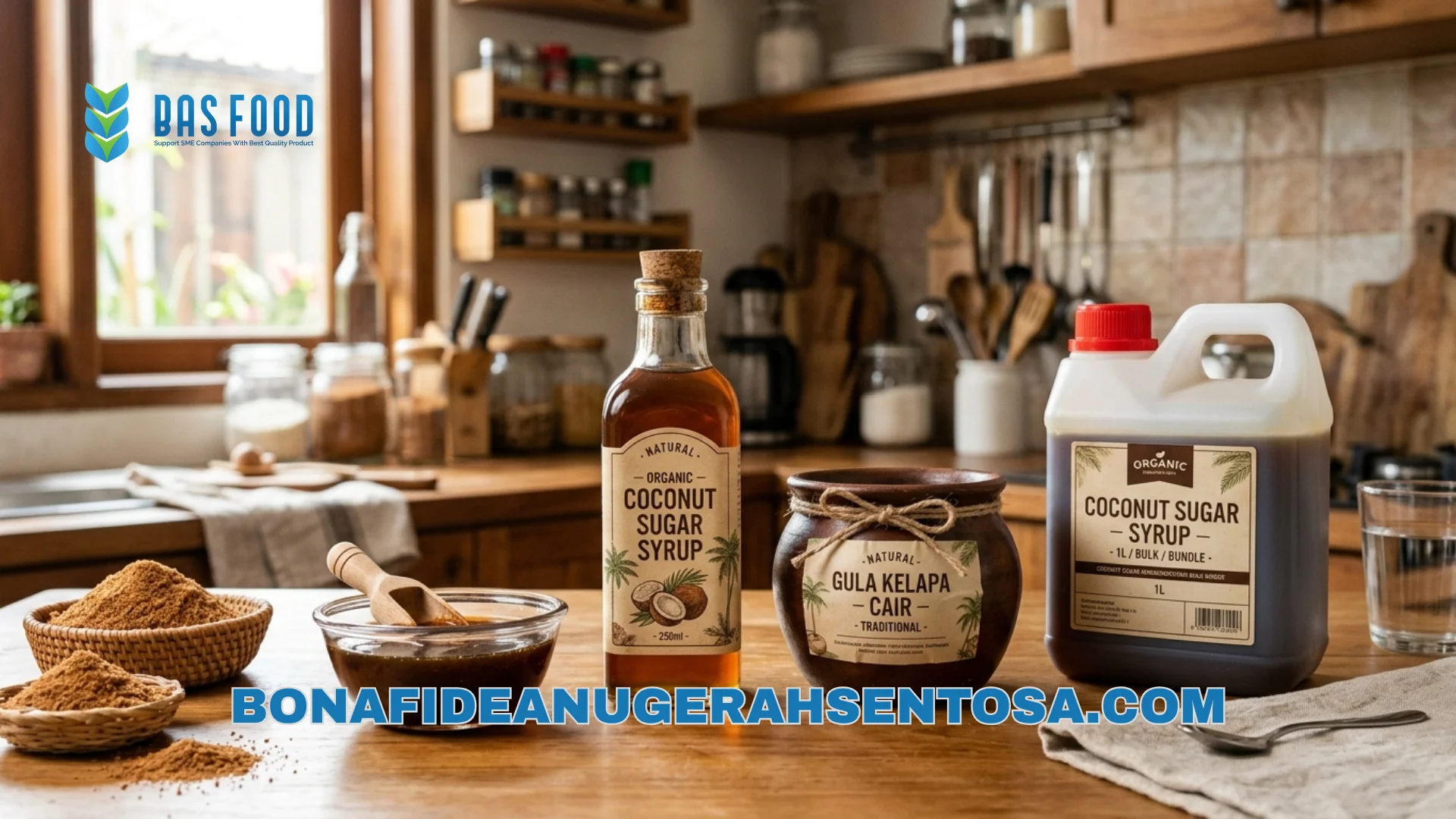
What Is Bulk Coconut Sugar Syrup?
Bulk coconut sugar syrup refers to coconut sugar syrup supplied in larger commercial quantities rather than small consumer-sized packages. It is generally intended for food manufacturers, beverage producers, distributors, foodservice businesses, and other B2B customers.
The syrup is produced by processing coconut palm sap into a concentrated liquid. The final product can vary in color, flavor, concentration, viscosity, and other characteristics depending on the production process and agreed specification.
For manufacturers, buying in bulk can make sense when the syrup is used regularly in production. Instead of purchasing small containers repeatedly, a business can arrange a larger supply that matches its production needs.
However, bulk purchasing should not be based on quantity alone. Buyers should first confirm that the product specification works with their formulation and manufacturing process.
Why Do Food Manufacturers Buy Coconut Sugar Syrup in Bulk?
Commercial food production requires a reliable flow of ingredients. If a sweetener is used regularly, a bulk purchasing strategy can simplify procurement and reduce the need for frequent small purchases.
Liquid ingredients can also offer practical benefits during manufacturing. Depending on the facility, syrup can be transferred, measured, mixed, or dosed using equipment designed for liquid ingredients.
This can be useful for beverage manufacturers, sauce producers, bakeries, dessert companies, and other food businesses.
However, the suitability of bulk syrup depends on the production system. Buyers should consider how the ingredient will be received, stored, handled, and introduced into the manufacturing process.
Therefore, bulk sourcing should begin with an assessment of the production facility as well as the ingredient itself.
Bulk Coconut Sugar Syrup for Different Food Applications
One advantage of coconut sugar syrup is its versatility. The liquid format can fit into many recipes where a sweetener is required.
Beverages
Beverage manufacturers may use liquid sweeteners because they can be easier to incorporate into liquid formulations. Coconut sugar syrup can be explored for specialty drinks, coffee beverages, tea products, flavored drinks, and other formulations.
Nevertheless, manufacturers should evaluate the syrup’s impact on sweetness, color, flavor, and total soluble solids. Every beverage formulation is different, so application testing remains important.
Bakery Products
Coconut sugar syrup can also be considered for selected bakery applications, including cakes, muffins, fillings, glazes, toppings, and desserts.
Because syrup adds liquid as well as sweetness, manufacturers should account for moisture balance. Recipe adjustments may be necessary to maintain the desired texture and processing characteristics.
Sauces and Dressings
Sauces, marinades, and dressings are another possible application. The liquid format can blend naturally with other liquid ingredients.
In these products, viscosity and flavor become especially relevant. Manufacturers should test the syrup within the complete formulation rather than evaluating it alone.
Desserts and Food Toppings
Coconut sugar syrup may also be explored for desserts, toppings, and specialty food products where a liquid sweetener fits the desired recipe.
The final application should determine the required syrup characteristics. A topping may need different flow behavior from a beverage ingredient, for example.
What Specifications Matter When Buying in Bulk?
Bulk purchasing requires a clear specification. This helps the buyer and supplier agree on exactly what will be delivered.
One important characteristic is concentration. Buyers may use Brix or another agreed measurement to define the concentration of soluble solids. The appropriate specification depends on the intended application.
Viscosity is another important consideration. A syrup’s flow behavior can influence pumping, filling, mixing, and dosing.
Color and flavor should also be considered. Coconut sugar syrup generally has a characteristic sweet flavor and brown color, but actual characteristics can vary.
Packaging is another part of the specification. Buyers need to know how the syrup will be packed and whether the packaging is suitable for the intended storage and transportation conditions.
Before confirming a bulk order, buyers should request a product specification sheet and, where appropriate, a sample for testing.
Understanding Viscosity in Bulk Liquid Sweetener
Viscosity describes how easily a liquid flows. For bulk syrup buyers, it can be an important practical characteristic.
A relatively thin syrup may move easily through certain pumps and filling systems, while a thicker product may require different handling conditions.
The appropriate viscosity depends on the product and manufacturing equipment. There is no single viscosity that works for every application.
For this reason, buyers should communicate their processing requirements to the supplier. If the syrup needs to pass through a specific pump or dosing system, that information may be useful during product selection.
A professional bulk liquid sweetener supplier should be able to provide relevant product information so the buyer can determine whether the syrup is compatible with the intended process.
Packaging Options for Bulk Coconut Sugar Syrup
Bulk syrup requires packaging that can safely contain the product during storage and transportation. The appropriate format depends on order volume, handling systems, destination, and buyer requirements.
For example, a manufacturer with liquid-handling equipment may have different needs from a distributor that manually handles containers.
The packaging should provide suitable protection from contamination and environmental exposure. It should also be properly sealed to reduce the risk of leakage during transportation.
International shipments require additional consideration. The product may move through factories, warehouses, trucks, ports, shipping containers, customs facilities, and destination warehouses.
Therefore, buyers should discuss packaging before placing a commercial order. Packaging should be part of the sourcing specification rather than an afterthought.
Storage and Handling of Bulk Syrup
Proper storage is an important part of maintaining the condition of liquid sweeteners. Buyers should follow the supplier’s recommended storage conditions for the specific product.
The storage area should be suitable for food ingredients and should protect the product from contamination and inappropriate environmental exposure.
Temperature can also influence liquid behavior. Depending on the product specification, changes in temperature may affect viscosity and handling.
For this reason, buyers should understand the supplier’s recommended handling conditions before receiving a bulk shipment.
Storage planning becomes even more important when purchasing large quantities. A company should make sure that it has enough suitable space and the appropriate equipment before confirming the order.
Wholesale Coconut Syrup vs. Bulk Industrial Supply
The terms wholesale and bulk are sometimes used interchangeably, but buyers should clarify what the supplier means by each term.
Wholesale coconut syrup may refer to larger quantities sold to distributors, foodservice businesses, retailers, or commercial customers. Bulk industrial supply can involve larger-volume purchasing designed specifically around manufacturing requirements.
The exact quantity, packaging, and commercial terms can vary from supplier to supplier. Therefore, buyers should discuss their expected order volume instead of assuming that a standard “bulk” package will meet their needs.
For manufacturers, the most important question is whether the supplier can support the required purchasing pattern while maintaining the agreed product specification.
How to Plan an International Bulk Purchase
International sourcing requires more planning than domestic purchasing. Buyers should consider the entire journey from supplier to destination warehouse.
First, define the product specification. This should include the characteristics that are important to the manufacturing process.
Next, confirm packaging and order quantity. The supplier should understand how much product the buyer needs and how it should be packed.
Then, discuss commercial terms and shipping arrangements. Depending on the transaction, these may include payment conditions, delivery terms, export documentation, and freight arrangements.
Finally, consider destination requirements. Import regulations, labeling requirements, customs procedures, and documentation can vary by market.
This is why international sourcing works best when both parties communicate clearly before the order is confirmed.
Choosing a Supplier for Bulk Coconut Sugar Syrup
Supplier selection should involve more than comparing quotations. Buyers should evaluate the supplier’s product, service, communication, and commercial capabilities together.
Start with product quality and specifications. Does the syrup meet the requirements of the intended formulation?
Then review samples. A sample can help the buyer evaluate the syrup before committing to a larger shipment.
Packaging should also be examined. Buyers should determine whether the proposed packaging works for their storage and production system.
Communication is another important factor. A supplier that communicates clearly can make international purchasing easier, particularly when questions arise during production or shipment.
Finally, consider whether the supplier is suitable for recurring orders. A bulk ingredient is often part of a longer-term procurement strategy, so future supply should be considered from the beginning.
Why Work With a Coconut Sugar Exporter Supplier?
International buyers may prefer to work directly with a coconut sugar exporter supplier because it can simplify communication between the origin and destination markets.
An exporter can coordinate product discussions, packaging, documentation, and shipping arrangements according to the transaction.
However, buyers should still conduct proper supplier evaluation. Export experience does not automatically mean that every product will meet every buyer’s requirements.
The buyer should confirm specifications, samples, packaging, order quantities, and commercial terms before placing an order.
A direct exporter relationship can become particularly useful when the buyer purchases coconut sugar syrup repeatedly and needs consistent communication over time.
CV Bonafide Anugerah Sentosa and Bulk Coconut Sugar Supply
CV Bonafide Anugerah Sentosa is an Indonesian supplier and exporter of coconut-based products serving B2B customers.
Businesses searching for bulk coconut sugar syrup can discuss their application, required specifications, packaging preferences, order volume, and destination directly with the company.
As a coconut sugar supplier, CV Bonafide Anugerah Sentosa can be considered by importers, food manufacturers, distributors, and other businesses looking to source coconut-derived sweeteners from Indonesia.
For commercial projects, buyers should confirm the exact product specifications and available supply options directly with the supplier. Packaging, quantity, documentation, production schedules, and shipping arrangements can also be discussed based on the individual order.
This approach allows the supplier and buyer to establish clear expectations before moving from product inquiry to commercial purchasing.
Sample Testing Before a Bulk Order
A large order should ideally follow a proper sample evaluation. This gives the buyer an opportunity to test the syrup before committing to a significant quantity.
The technical team can evaluate appearance, aroma, flavor, viscosity, concentration, and other relevant characteristics.
More importantly, the syrup can be tested in the actual product formulation. A beverage manufacturer can test it in its drink, while a sauce manufacturer can evaluate it within the complete recipe.
Application testing can reveal issues that may not be obvious when examining the syrup by itself.
Once the buyer approves the sample, the agreed specification can become a reference for the commercial order.
Common Mistakes When Buying Bulk Coconut Sugar Syrup
One common mistake is purchasing a large quantity before testing the product. A bulk shipment should ideally follow a sample approval process.
Another mistake is focusing only on price per kilogram or container. Buyers should consider the total commercial picture, including packaging, shipping, handling, storage, and product suitability.
Failing to define viscosity is another potential issue. If the syrup needs to work with specific pumps or filling equipment, the buyer should communicate this requirement in advance.
Packaging can also be overlooked. A container that works for one facility may not be convenient for another.
Finally, buyers sometimes fail to plan storage capacity. Bulk purchasing requires enough suitable space and appropriate handling arrangements at the destination.
Creating a Long-Term Bulk Supply Strategy
Bulk purchasing becomes more effective when it is part of a broader procurement strategy. Buyers should consider their expected production needs rather than placing orders only when inventory becomes critically low.
Demand planning can help businesses communicate their expected purchasing patterns to suppliers. This does not mean that every buyer needs a fixed long-term contract. Instead, it allows both parties to understand potential requirements.
Product specifications should also remain clear. If the buyer changes the formulation, packaging, or application, the supplier should be informed.
Over time, this communication can make recurring purchases easier. Both sides become familiar with the product requirements and commercial process.
For manufacturers, consistency is especially valuable because ingredient changes can affect production and finished-product quality.
Building a Better Relationship With Your Supplier
A successful B2B supply relationship depends on communication from both sides. Buyers should provide accurate information about their needs, while suppliers should communicate their capabilities clearly.
When a buyer has a new application, packaging request, or expected change in order volume, early communication gives the supplier more time to respond.
Likewise, suppliers should communicate any changes that could affect product specifications, production schedules, or shipping plans.
This two-way communication creates a stronger working relationship. It also reduces the chance of unexpected problems during future orders.
Ultimately, the supplier should be treated as a business partner in the sourcing process rather than simply as a company that provides a quotation.
Final Thoughts
Bulk coconut sugar syrup can be a practical ingredient option for food manufacturers and distributors that need a liquid sweetener in commercial quantities. Its liquid format can support applications ranging from beverages and bakery products to sauces, dressings, and desserts.
However, successful bulk sourcing requires careful planning. Buyers should define their specifications, evaluate samples, consider viscosity and concentration, select suitable packaging, plan storage, and discuss international logistics before confirming a commercial order.
For companies involved in international sourcing, working with an experienced Indonesian exporter can simplify communication between the production origin and the overseas market.
Businesses looking for a coconut sugar supplier can consider CV Bonafide Anugerah Sentosa as a potential Indonesian supply partner. Buyers should communicate their intended application, specifications, packaging requirements, quantity, and destination so that the appropriate supply options can be discussed.
In the long run, successful bulk purchasing is not simply about ordering more product. It is about building a supply system that connects product quality, manufacturing needs, packaging, logistics, and reliable business communication.