
Buying coconut sugar syrup for commercial production is different from buying a small bottle for household use. Food manufacturers, beverage companies, distributors, and ingredient importers often need larger quantities that fit their production schedule and supply chain.
That is where coconut sugar syrup MOQ becomes an important topic. MOQ means minimum order quantity, or the smallest quantity a supplier is willing to produce or sell for a particular order. Understanding MOQ before requesting a quotation can help buyers plan their budget, storage, production, and shipping more effectively.
However, MOQ is not simply a number on a quotation. It can be influenced by packaging, product specifications, production planning, destination, customization, and the supplier’s operating process. Therefore, buyers should understand what affects MOQ before comparing different suppliers.
For international buyers sourcing from Indonesia, this becomes even more important. The product may need to move through production, packaging, inland transportation, port handling, international shipping, customs, and destination delivery. A clear discussion about MOQ from the beginning can make the entire sourcing process easier.
This guide explains how coconut sugar syrup MOQ works, what can influence it, how it relates to bulk packaging and production lead time, and what buyers should ask a supplier before placing an order.
What Does Coconut Sugar Syrup MOQ Mean?
Coconut sugar syrup MOQ refers to the minimum quantity of coconut sugar syrup that a supplier accepts for a commercial order. In simple terms, it answers one basic question: how much product does the buyer need to order at minimum?
The MOQ can vary between suppliers. More importantly, it can also vary depending on the product specification and order requirements. A standard product packed in a supplier’s existing commercial packaging may have different requirements from a customized product with special packaging.
For example, a food manufacturer may want coconut sugar syrup with a particular specification and packaging format. If the supplier needs to prepare a special production batch or arrange customized packaging, the supplier may need a different minimum quantity to make the order practical.
Therefore, buyers should not assume that one MOQ applies to every coconut sugar syrup product. Instead, they should ask the supplier for the MOQ based on their specific requirements.
The best approach is to provide information about the intended application, estimated order volume, packaging preference, destination, and any special requirements. This gives the supplier enough context to explain the applicable minimum order quantity.
Why MOQ Matters for B2B Coconut Sugar Syrup Buyers
MOQ matters because it affects purchasing decisions. A company may like a particular coconut sugar syrup product, but the order may not be suitable if the required quantity is much higher than its current consumption.
For example, a small food manufacturer may only need a limited amount for initial production testing. Meanwhile, a large beverage company may need regular commercial volumes. Both businesses can be interested in the same ingredient, but their purchasing requirements are very different.
MOQ also affects inventory planning. If a buyer orders more syrup than it can use within a reasonable period, it needs enough storage capacity and a suitable inventory management system.
This is why buyers should calculate their expected consumption before contacting suppliers. Estimate monthly or quarterly usage, then compare that number with the supplier’s MOQ.
At the same time, buyers should not automatically assume that a lower MOQ is always better. A suitable MOQ should balance production needs, inventory, logistics, packaging, and purchasing efficiency.
What Factors Influence Coconut Sugar Syrup MOQ?
Several factors can influence coconut sugar syrup MOQ. The first is production planning. A supplier may need to prepare a production batch of a certain size to make the manufacturing process practical.
Production efficiency matters because food ingredients require raw materials, labor, processing, cleaning, quality checks, packaging, and handling. Producing very small quantities may not always fit efficiently into a supplier’s normal production schedule.
Packaging can also influence MOQ. Standard packaging that the supplier already uses may be easier to arrange than customized packaging. If the buyer requests special containers, labels, or packaging sizes, the supplier may need to purchase packaging materials specifically for that order.
Product specifications can have an impact as well. A standard product may be easier to produce than a customized syrup with specific characteristics. Therefore, buyers should discuss specifications before asking for a final MOQ.
Destination and logistics can also influence the commercial structure of an order. International shipments involve additional handling and transportation considerations, so buyers should provide their destination as early as possible.
Minimum Order Quantity and Production Economics
The concept of minimum order quantity is closely connected to production economics. Every production run requires resources, even when the final quantity is relatively small.
A supplier may need to prepare raw materials, production equipment, workers, processing time, quality control, cleaning procedures, packaging materials, and documentation. These activities create costs regardless of whether the buyer orders a small or large quantity.
As a result, an MOQ helps the supplier organize production more efficiently. It can also make commercial transactions more practical for both parties.
However, this does not mean that buyers should simply accept any MOQ without discussion. If the buyer is starting a new product line, it can explain that the first order is intended for market testing or product development.
The supplier may then be able to explain which options are available. The actual solution depends on the supplier’s production system and commercial policy.
Clear communication is therefore more useful than simply asking, “What is your MOQ?” A better question is, “We expect to use approximately this amount per month. What order quantity would be practical for this specification and packaging?”
How Bulk Packaging Affects MOQ
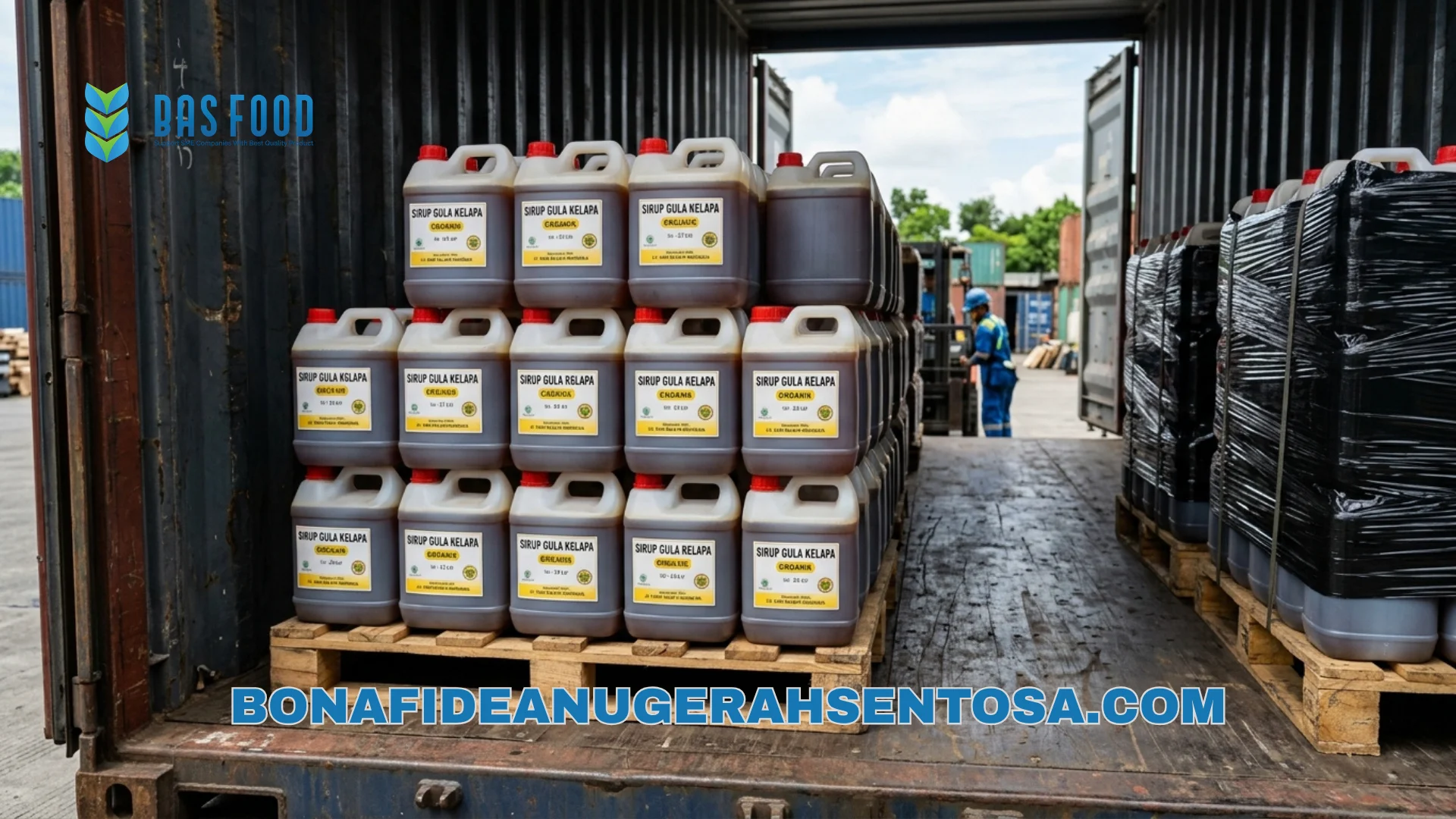
Bulk packaging can have a direct relationship with MOQ. Coconut sugar syrup is a liquid food ingredient, so packaging must be suitable for storage, transportation, handling, and the buyer’s production system.
A supplier may offer standard bulk packaging options for commercial customers. These formats can be easier to manage because the packaging materials are already part of the supplier’s normal operation.
On the other hand, customized packaging can introduce additional requirements. A buyer may request a particular container size, label design, packaging material, or private-label presentation.
In such cases, the supplier may need to order packaging materials specifically for the project. This can affect the minimum quantity needed to make the order commercially practical.
Therefore, buyers should discuss bulk packaging at the same time as MOQ. Ask which packaging formats are standard and which ones require customization.
This can help the buyer understand whether the MOQ applies to the syrup itself, the packaging format, or the complete production order.
MOQ and Production Lead Time Are Connected
Another important factor is production lead time. Lead time refers to the period required to prepare an order for shipment, from production planning through packaging and other necessary processes.
A larger order may require more production planning than a smaller standard order. Likewise, customized packaging or product specifications can require additional preparation.
For this reason, buyers should ask about production lead time together with MOQ. Knowing the minimum order quantity without understanding the expected preparation time does not provide a complete picture.
For example, a buyer may have a specific launch date for a beverage product. The purchasing team needs to know whether the supplier can produce and prepare the required quantity within the desired schedule.
The buyer should therefore provide an estimated purchasing timeline when requesting a quotation. This allows the supplier to explain the expected production schedule more accurately.
Production lead time can also change depending on the supplier’s production workload, raw material availability, packaging requirements, order volume, and shipping arrangements. Buyers should confirm the expected timeline for each commercial order.
Should Buyers Always Choose the Lowest MOQ?
Not necessarily. A low MOQ can be useful for product testing, small-scale manufacturing, or new product development. However, MOQ is only one part of supplier evaluation.
A supplier with a very low MOQ may not necessarily offer the product specification, packaging, production capacity, or export support that the buyer needs.
Similarly, a supplier with a higher MOQ may offer a commercial structure that works better for a buyer with regular production demand. The right choice depends on the buyer’s business model.
Therefore, buyers should compare MOQ together with product quality, specification, packaging, price, lead time, logistics, communication, and supply consistency.
The goal is not simply to find the smallest possible order. The goal is to find an order structure that fits the buyer’s actual business needs.
MOQ for Samples Versus Commercial Orders
Samples and commercial orders should be treated differently. A buyer may need only a small amount for laboratory testing or product development, while the supplier’s standard commercial MOQ may be much larger.
This is why buyers should clearly state that they are requesting a sample if they are not yet ready for a commercial order.
Sample evaluation allows buyers to examine the product before committing to a larger purchase. For coconut sugar syrup, testing may include appearance, aroma, flavor, viscosity, and performance in the intended formulation.
Once the sample has been approved, the buyer can discuss the commercial MOQ. At that stage, the supplier has more information about the actual product requirement.
For food manufacturers, it is particularly useful to test the syrup in the real production formula. A product may perform differently depending on the recipe, processing temperature, mixing method, and other ingredients.
MOQ and Customized Coconut Sugar Syrup
Some B2B buyers require customized products. Their needs may involve specific product characteristics, packaging, labels, or other commercial requirements.
Customization can influence MOQ because the supplier may need to organize a separate production process or purchase special packaging materials.
For example, a buyer requesting private-label packaging may need to order enough units to justify the packaging preparation. The actual requirement depends on the supplier’s process and the scope of customization.
Therefore, buyers should explain customization requirements at the beginning of the sourcing discussion. Waiting until after the quotation can create unnecessary changes to the order.
If the buyer does not need customization, choosing standard product and packaging options may provide a simpler starting point. Again, the most suitable approach depends on the buyer’s commercial strategy.
Understanding MOQ When Sourcing From Indonesia
Indonesia is an important source of coconut products, including coconut sugar. International buyers interested in Indonesian supply should evaluate both the product and the supplier’s export capability.
For buyers looking for an Indonesian coconut sugar supplier, MOQ should be discussed alongside production capacity, packaging, documentation, and shipping arrangements.
The supplier’s location is only one part of the sourcing decision. Buyers should also understand how the product is processed, packed, stored, and prepared for export.
International logistics can involve inland transportation, port handling, ocean freight, customs clearance, and destination delivery. Therefore, the order quantity can have implications for logistics planning as well.
By providing the destination and expected volume early, buyers can have a more complete discussion about the commercial order.
CV Bonafide Anugerah Sentosa and B2B Coconut Sugar Syrup Sourcing
For buyers exploring Indonesian suppliers, CV Bonafide Anugerah Sentosa can be considered as part of the supplier evaluation process for coconut sugar and coconut-derived products.
When discussing coconut sugar syrup MOQ, buyers should provide their actual requirements rather than relying on a generic MOQ figure. The relevant order quantity can depend on product specifications, packaging, order planning, and destination.
For example, a buyer can share the intended application, estimated monthly demand, desired packaging, destination, and expected purchasing schedule. This allows the supplier to understand the project more clearly.
For international B2B sourcing, communication is an important part of supplier evaluation. Buyers should look for clear information about product specifications, packaging, samples, production planning, and export arrangements.
The initial inquiry can therefore become the foundation for a longer-term commercial relationship.
Creating a Better Long-Term Supply Strategy
MOQ becomes easier to manage when it is part of a long-term purchasing plan. Businesses that regularly use coconut sugar syrup can monitor their consumption and create a forecast.
For example, purchasing teams can estimate monthly usage based on production plans. They can then discuss expected demand with the supplier.
This does not necessarily mean the buyer must commit to a fixed quantity. Instead, sharing demand information can help both parties plan production and supply more effectively.
Over time, the buyer can also document the approved product specification, packaging, and commercial requirements. This creates a reference for future orders.
A consistent purchasing process can reduce unnecessary communication and make repeat orders easier to manage.
Conclusion: Making Coconut Sugar Syrup MOQ Work for Your Business
Understanding coconut sugar syrup MOQ is an important part of B2B ingredient sourcing. MOQ affects purchasing volume, inventory, packaging, production planning, and logistics.
However, buyers should not evaluate MOQ by itself. A suitable order quantity should fit the buyer’s actual consumption, storage capacity, production schedule, packaging requirements, and shipping plan.
Bulk packaging and production lead time should also be discussed early because they can influence the overall structure of a commercial order. For international buyers, destination and export requirements should be included in the conversation as well.
For businesses searching for a reliable coconut sugar supplier, the best starting point is a clear and detailed inquiry. Explain the application, estimated quantity, packaging requirements, destination, and expected timeline.
CV Bonafide Anugerah Sentosa can be included in the sourcing process for buyers exploring Indonesian coconut sugar products. By discussing product requirements and commercial needs directly, buyers can determine whether the available supply arrangement fits their business.
Ultimately, MOQ should not be viewed as a barrier. It is a commercial planning factor. When buyers understand how MOQ connects with packaging, production, inventory, and logistics, they can approach coconut sugar syrup sourcing with greater clarity and confidence.