
When buying coconut sugar in bulk, product specifications matter. One detail that often appears in technical specifications is coconut sugar granule mesh 50. For buyers who are new to coconut sugar sourcing, the term may sound complicated. In reality, mesh size is simply one way to describe the particle size of a granulated ingredient. For food manufacturers, distributors, importers, and private-label brands, understanding mesh specifications can make purchasing much easier. The right particle size can affect how quickly coconut sugar dissolves, how it performs during processing, and how consistent the finished product looks and feels.
This guide explains what coconut sugar granule mesh 50 means, how it compares with other particle sizes, where it can be used, and what B2B buyers should discuss with a coconut sugar supplier before placing an order. We will also look at the relationship between granulated coconut sugar, gula kelapa semut, quality control, packaging, and export sourcing.
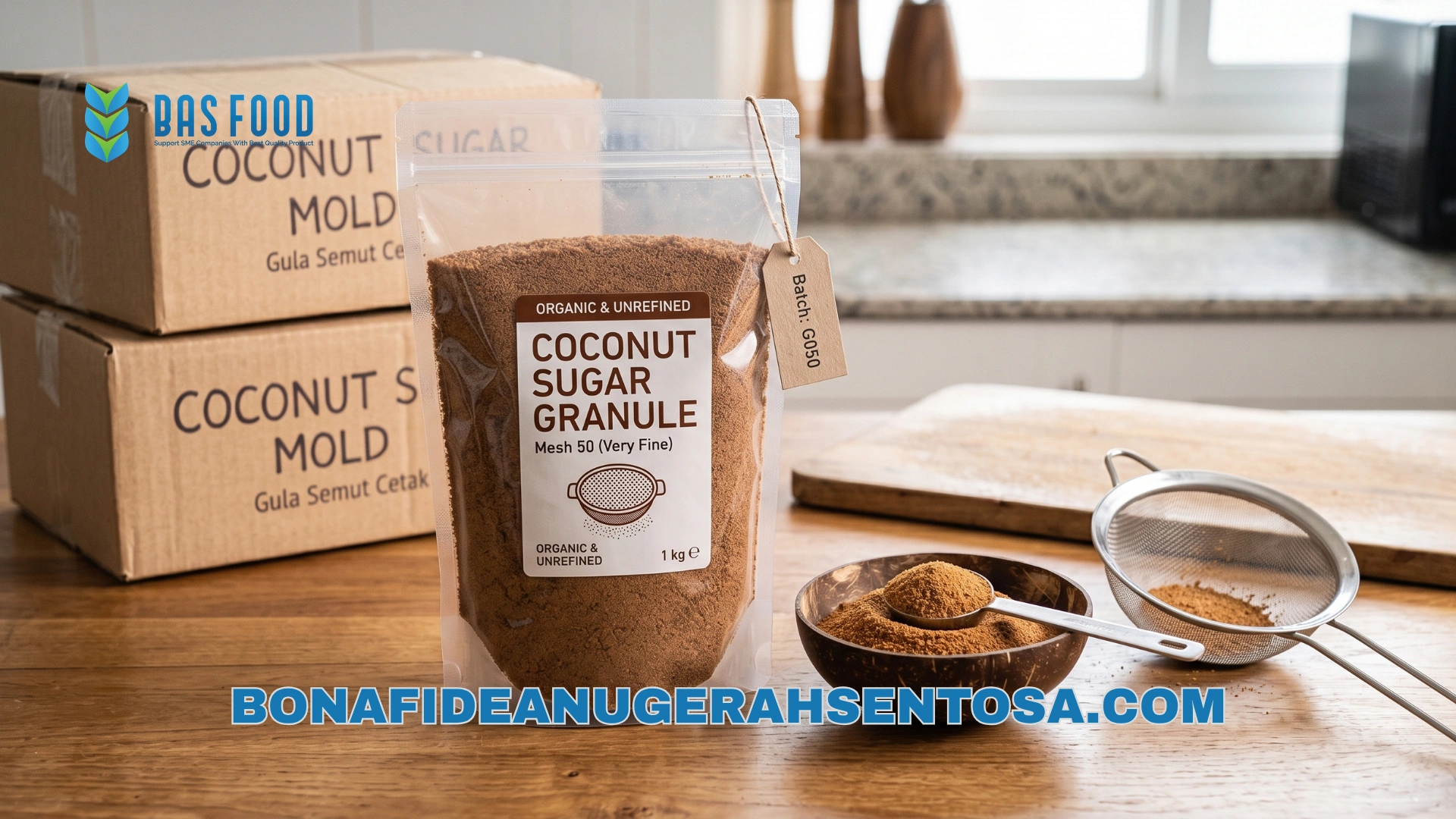
What Does Coconut Sugar Granule Mesh 50 Mean?
In simple terms, mesh refers to a sizing system used to classify particles according to their approximate size. A higher mesh number generally indicates smaller particles. Therefore, a coconut sugar granule mesh 50 specification usually refers to coconut sugar processed into relatively fine granules that can pass through a mesh screen of the specified size under the relevant testing method.
However, buyers should be careful when interpreting mesh numbers. Mesh does not always represent one exact particle diameter. The actual particle-size distribution can vary depending on the screening method, equipment, raw material, and supplier specification.
For that reason, a professional buyer should not evaluate coconut sugar only by the phrase “mesh 50.” Instead, ask the supplier for the complete particle-size specification. A technical sheet may provide information about the target mesh, particle distribution, moisture, color, taste, packaging, and other quality parameters.
Why Does Mesh Size Matter?
Particle size affects how a coconut sugar granule behaves during production. Fine granules can dissolve more quickly than larger granules, which can be useful for beverages, bakery mixes, sauces, instant products, and other applications where rapid dispersion is important.
Particle size can also influence the visual appearance of the product. A manufacturer producing a dry beverage mix may prefer a relatively fine granule because it blends more evenly with other powdered or granular ingredients. Meanwhile, a food producer making a topping or decorative ingredient may prefer a larger particle size for a different texture.
Therefore, mesh selection should always start with the final application. The best coconut sugar is not necessarily the finest one. The right specification is the one that performs well in the buyer’s manufacturing process.
Coconut Sugar Granule Mesh 50 vs. Other Particle Sizes
When sourcing coconut sugar, buyers may encounter specifications such as fine, medium, coarse, or specific mesh ranges. A mesh 50 product generally falls into the finer granulated category, but the exact classification depends on the supplier’s screening specification.
This is important because different manufacturers may use different terminology. One supplier’s “fine granule” may not have exactly the same particle distribution as another supplier’s fine granule. As a result, B2B buyers should request measurable specifications rather than relying only on product names.
For example, a food manufacturer may need a consistent particle size for an automated filling line. In that case, a supplier should explain how the product is screened and how particle-size consistency is controlled. This helps the buyer determine whether the coconut sugar will work with existing equipment.
Mesh 50 and Dissolution
One of the main reasons buyers consider finer coconut sugar granules is dissolution. Smaller particles generally provide more surface area relative to their volume. This can help them interact with liquid more quickly.
That characteristic can be useful in beverages, coffee mixes, tea products, sauces, syrups, and other applications. Still, dissolution does not depend on particle size alone. Temperature, moisture, formulation, liquid volume, mixing speed, and other ingredients can also affect how quickly coconut sugar dissolves.
Therefore, buyers should test the actual product rather than assuming that a particular mesh specification guarantees a certain dissolution time.
How Is Coconut Sugar Processed Into Granules?
Understanding the production process helps buyers understand why particle size can vary. Coconut sugar begins with sap collected from coconut blossoms. The sap is then processed to reduce its water content and produce coconut sugar.
Depending on the production method and product format, the sugar can be processed into granules through controlled drying, crushing, milling, sieving, or other appropriate steps. Screening helps separate particles according to their size.
For a product specified as coconut sugar granule mesh 50, screening is particularly important because the buyer needs a controlled particle-size profile. A consistent screening process helps reduce excessive variation between particles.
Why Screening Matters for B2B Buyers
Consistency is especially important for manufacturers purchasing coconut sugar in large quantities. If one shipment contains mostly fine particles while another contains significantly larger particles, the difference can affect production performance.
For example, a beverage manufacturer may notice differences in dissolution or mixing. A bakery producer may experience changes in ingredient distribution. A foodservice distributor may also receive a product that looks different from previous batches.
A reliable coconut sugar supplier should therefore have a clear process for controlling particle size. Buyers should ask whether the supplier can provide product specifications and samples before committing to a large purchase.
Coconut Sugar Granule Mesh 50 for Food and Beverage Applications
The versatility of coconut sugar granule mesh 50 makes it relevant to many food and beverage applications. Because it is a granulated sweetener, it can be incorporated into recipes and formulations without requiring the same handling as moulded sugar blocks.
One potential application is beverages. Fine coconut sugar granules can be used in coffee blends, tea products, chocolate drinks, instant beverage mixes, and other formulations. Their relatively small particle size can help with mixing and dissolution.
Another important application is baking. Coconut sugar can be incorporated into cookies, cakes, muffins, bread products, dessert mixes, and other bakery formulations. The appropriate mesh specification depends on the recipe and processing method.
Food Manufacturing
Food manufacturers often need ingredients that behave consistently from one batch to another. For this reason, particle size can be just as important as flavor and color.
A manufacturer producing a dry premix, for example, may want coconut sugar particles that distribute evenly throughout the formulation. Consistent particle size can help reduce segregation during handling and transportation, although the overall formulation and density of every ingredient also matter.
Coconut sugar granules may also be used in confectionery, sauces, breakfast products, snacks, and specialty food products. The final choice should always be based on formulation testing.
Coffee and Beverage Products
Coconut sugar has also become an interesting ingredient for coffee and beverage brands. It can provide sweetness along with the characteristic flavor profile associated with coconut sugar.
For products requiring quick mixing, a finer granule may be more practical than a large sugar block. This is where a specification such as coconut sugar granule mesh 50 can become useful for product developers.
However, the ideal particle size depends on the product format. An instant drink powder, for example, may require different specifications from a retail sugar product intended for consumers to spoon directly into coffee.
Gula Kelapa Semut and Coconut Sugar Granules
In Indonesia, coconut sugar granules are commonly associated with gula kelapa semut. The term “semut” refers to the granular form of coconut sugar, which visually resembles small particles.
While terminology can vary between domestic and international markets, the basic concept is similar: coconut sugar is produced and processed into granules instead of traditional moulded blocks.
For international B2B buyers, understanding this terminology can make communication with Indonesian suppliers easier. A buyer searching for coconut sugar granules may encounter suppliers describing their product as gula kelapa semut.
Why Granular Form Is Important
Granular coconut sugar offers practical advantages for handling and formulation. Compared with moulded sugar, granules can be easier to weigh, blend, portion, and incorporate into industrial recipes.
This makes granular sugar suitable for food manufacturers, ingredient distributors, cafes, beverage companies, bakeries, and private-label brands.
At the same time, not every granular product has the same specification. Color, moisture, particle size, flavor, packaging, and processing method can vary. Therefore, buyers should treat “gula kelapa semut” as a product format rather than a complete technical specification.
Choosing the Right Mesh for Your Production
There is no single mesh size that is ideal for every application. Instead, the right specification depends on how the ingredient will be used.
If the product needs to dissolve quickly, a finer granule may be worth considering. If the product is intended to provide texture or visible sugar particles, a coarser granule may be more appropriate.
For industrial buyers, it is useful to describe the application clearly when contacting a supplier. Instead of simply asking for “coconut sugar,” explain whether the ingredient will be used for beverages, bakery products, confectionery, sauces, retail packs, or another application.
Questions B2B Buyers Should Ask
Before purchasing coconut sugar granule mesh 50, consider asking the supplier:
- What is the actual particle-size distribution?
- What screening or sieving method is used?
- Is mesh 50 a target size or a guaranteed specification?
- What is the typical moisture level?
- What color specification is available?
- What packaging options are offered?
- Is private labeling available?
- What is the minimum order quantity?
- Can the supplier provide a product sample?
- What export documentation is available?
- How is batch consistency maintained?
These questions help turn a general product inquiry into a clear procurement specification.
Quality Control for Coconut Sugar Granule Mesh 50
Particle size is only one part of coconut sugar quality. A professional sourcing process should consider several characteristics at the same time.
Color and flavor are important because they influence the finished product. Moisture is also important because excessive moisture can affect storage stability, texture, and handling. In addition, foreign-material control, packaging quality, and batch consistency should be considered.
A good supplier should be able to explain how these characteristics are monitored. Depending on the supplier and destination market, buyers may also request laboratory testing or documentation relevant to their import requirements.
Product Samples Before Bulk Orders
Samples are particularly valuable when purchasing a specific mesh size. A sample lets the buyer evaluate the product under actual production conditions.
For example, a manufacturer can test how coconut sugar granule mesh 50 performs in a beverage, bakery recipe, premix, or other application. The buyer can also compare the supplier’s sample with an existing ingredient.
Sample approval can reduce the risk of receiving a bulk shipment that does not perform as expected. It also gives both parties a clear reference for future orders.
Working With a Coconut Sugar Supplier in Indonesia
Indonesia is an important origin for coconut-based ingredients, and international buyers can source coconut sugar in several formats from Indonesian suppliers.
When evaluating a coconut sugar supplier, however, price should not be the only consideration. Product consistency, communication, packaging, production capacity, documentation, and export experience are also important.
A supplier that understands international B2B requirements can make the purchasing process easier. Clear specifications are particularly important when the buyer requires a specific particle size such as mesh 50.
What to Look for in an Export Supplier
A reliable supplier should be able to discuss the product in practical terms. They should understand questions about particle size, packaging, order quantities, lead times, samples, and export requirements.
For buyers looking for multiple coconut sugar formats, it can also be useful to work with a company that understands both granulated and moulded products.
For example, CV Bonafide Anugerah Sentosa can be considered by buyers looking for an Indonesian business involved in coconut sugar and related export products. When evaluating any supplier, buyers should still confirm the latest specifications, production capabilities, documentation, and commercial terms directly with the supplier.
Coconut Sugar Mould Supplier vs. Granule Supplier
The terms “coconut sugar mould supplier” and “coconut sugar supplier” can refer to different sourcing needs. A mould supplier generally focuses on the equipment or mould format used to create shaped coconut sugar products, while a coconut sugar supplier may provide finished ingredients in formats such as granules, powder, syrup, or blocks.
This distinction matters when a buyer is developing a product range. A brand may need granulated coconut sugar for food manufacturing while also requiring moulded coconut sugar for retail or foodservice applications.
Working with a supplier that understands several product formats can make product development easier. Nevertheless, buyers should always confirm whether the supplier manufactures the product directly or sources it from another producer.
When Should You Choose Granules?
Choose a granular format when your application requires easy weighing, blending, portioning, or incorporation into a recipe.
For example, manufacturers of instant beverages, bakery mixes, confectionery products, sauces, and packaged foods may find granules easier to handle than blocks.
On the other hand, moulded coconut sugar can be more suitable when the product needs a specific shape, traditional presentation, or controlled portion format.
Packaging and Storage Considerations
After selecting the correct particle size, packaging becomes another important part of B2B sourcing. Coconut sugar should be protected from moisture and contamination during storage and transportation.
Packaging requirements can vary according to the destination market, order size, product format, and buyer’s distribution system. Bulk industrial packaging may be different from retail packaging.
For international shipments, buyers should discuss packaging materials, bag sizes, palletization, labeling, container loading, and storage conditions with the supplier before production begins.
Why Moisture Protection Matters
Granulated sugar can be affected by moisture. If it absorbs moisture during storage, the particles may become less free-flowing and can form lumps.
Therefore, buyers should store coconut sugar in suitable conditions and keep packaging properly sealed. Warehouses should also be clean, dry, and protected from excessive humidity.
This is particularly important for international shipments because products may spend considerable time in containers, warehouses, and distribution centers before reaching the final customer.
How to Buy Coconut Sugar Granule Mesh 50 in Bulk
For B2B purchasing, start with a clear product specification. Rather than requesting only “coconut sugar granules,” state that you are looking for coconut sugar granule mesh 50 and describe the intended application.
Next, request a technical specification and sample. Review particle size, appearance, flavor, moisture, packaging, and any other parameters that matter to your production.
After testing the sample, discuss commercial details such as MOQ, pricing, production lead time, packaging, shipping terms, payment terms, and documentation.
Build a Long-Term Supplier Relationship
Once a supplier passes your product and commercial evaluation, consistency becomes the next priority. Long-term buyers benefit from having a clear product specification that both parties can use as a reference.
Keep approved samples and technical documents as part of your purchasing records. When ordering again, refer to the approved specification rather than relying only on the product name.
This approach is particularly helpful when purchasing a specific particle size. It gives both buyer and supplier a common reference for future production.
Final Thoughts: Is Mesh 50 Right for Your Business?
Coconut sugar granule mesh 50 is a useful specification for buyers who need a relatively fine and controlled coconut sugar granule. It can be relevant to beverages, bakery products, confectionery, premixes, sauces, and other food applications where particle size affects handling and mixing.
However, mesh 50 should not be treated as a complete quality specification. Buyers should also evaluate particle distribution, moisture, color, flavor, packaging, production consistency, and the supplier’s ability to meet export requirements.
For businesses sourcing from Indonesia, understanding terms such as gula kelapa semut, coconut sugar granule, coconut sugar supplier, and coconut sugar mould supplier can also make supplier communication more effective.
Ultimately, the best sourcing decision comes from matching the particle specification with the final application. Request a sample, test the ingredient, confirm the technical details, and then move to bulk purchasing once the product meets your requirements.