
For food manufacturers, distributors, ingredient traders, and importers, buying sugar in bulk is not simply about finding the lowest price. Product form, consistency, packaging, shelf stability, logistics, and supplier reliability can all affect the final cost and production process. This is especially true when purchasing bulk coconut sugar blocks. Moulded coconut sugar offers a traditional product format that works well for food businesses that need coconut sugar in solid blocks rather than granules or powder. However, buyers need to understand the product before placing a large order.
So, what should importers look for when sourcing coconut sugar blocks? How does block sugar differ from granulated coconut sugar? What packaging works best for export? And how can buyers evaluate an Indonesian supplier?
This guide explores those questions in a practical way. It is designed to help international buyers understand the product, prepare their purchasing requirements, and work more effectively with an Indonesian coconut sugar supplier.
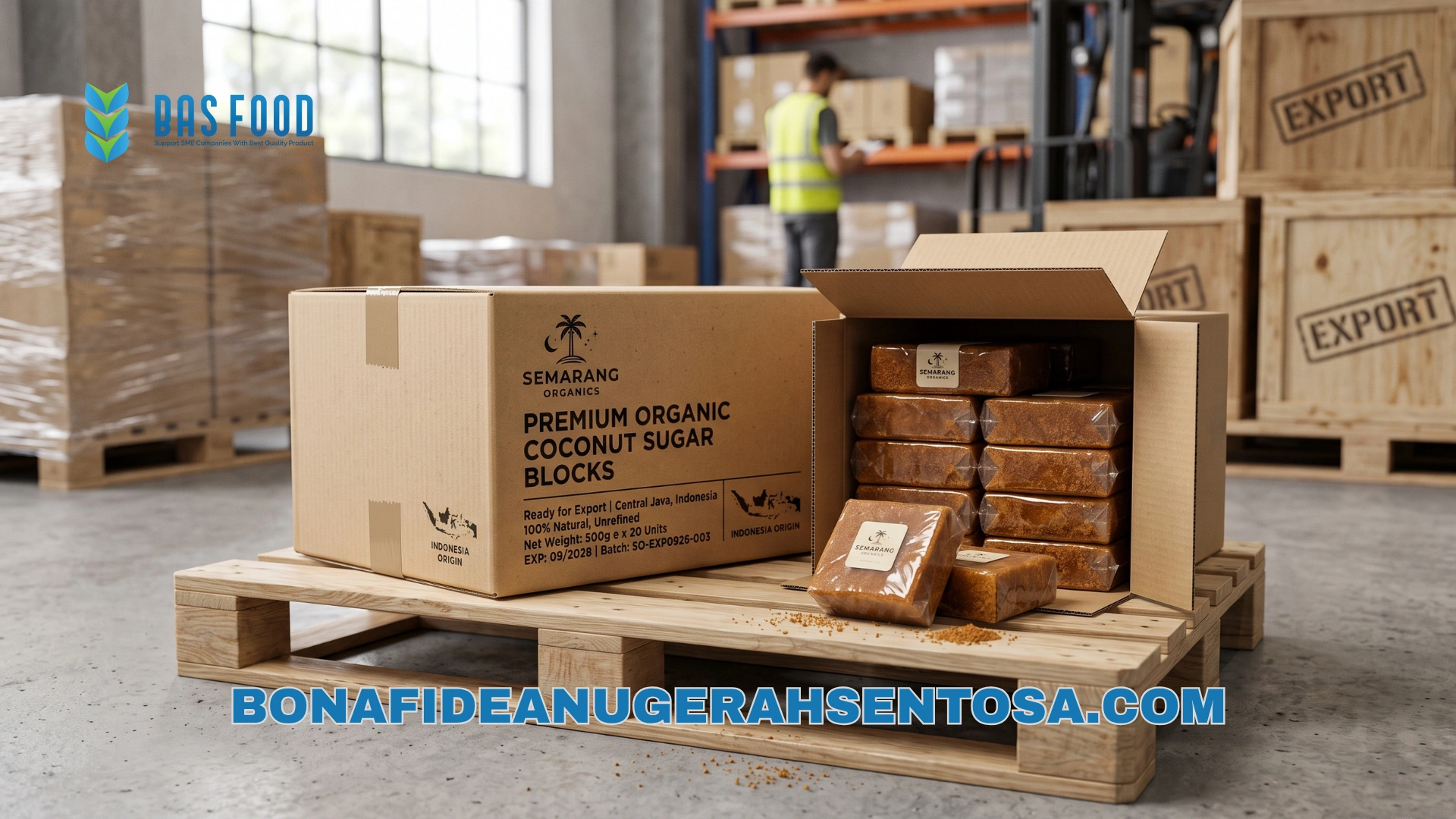
Understanding Bulk Coconut Sugar Blocks
Bulk coconut sugar blocks are coconut sugar products formed into solid pieces using moulds after the coconut sap has been processed into sugar. The sap comes from coconut flower blossoms and undergoes heating until much of its water evaporates and the liquid becomes concentrated. Producers then allow the concentrated sugar to cool and form it into specific shapes.
The final product can vary in size, weight, color, hardness, and shape depending on production methods and buyer specifications. Some markets prefer small blocks for household use, while food manufacturers may request larger blocks that they can process further before use. Therefore, the term “bulk” refers not only to the quantity purchased but also to a commercial supply arrangement.
For B2B buyers, the block format can be useful when the application does not require ready-to-use granules. A manufacturer may crush, grate, melt, or dissolve the blocks as part of its own production process. This gives the buyer more control over the final form of the ingredient.
At the same time, buyers should not assume that every moulded product has the same characteristics. Two suppliers may both offer coconut sugar blocks but produce noticeably different products. Differences can come from coconut sap quality, processing conditions, mould size, cooling practices, moisture control, and packaging.
That is why a clear product specification matters before a purchase order is confirmed.
Why Buyers Choose Wholesale Coconut Sugar Blocks
There are several reasons a food business may choose wholesale coconut sugar blocks instead of granulated coconut sugar. One major reason is flexibility. A block can be processed into smaller pieces, dissolved into a liquid, or used as an input for another ingredient.
For traditional food producers, this format can also fit existing production methods. Businesses making sauces, desserts, traditional sweets, beverages, or other food products may already have processes designed around solid sugar. In those cases, blocks can be practical and easy to handle.
Another consideration is purchasing volume. When an importer buys a large quantity directly from a producer or exporter, the business can plan supply more efficiently. Instead of repeatedly purchasing small retail packs, the buyer can establish a regular supply program based on production needs.
However, bulk purchasing requires better planning. A buyer should understand expected monthly or quarterly consumption, warehouse capacity, packaging requirements, and shipping schedules before placing a large order. This helps prevent both shortages and excessive inventory.
In addition, buyers should compare suppliers based on total value rather than unit price alone. A cheaper product may become more expensive if inconsistent block sizes, poor packaging, high breakage, or unreliable delivery create additional costs.
From Coconut Sap to Moulded Sugar
The quality of moulded coconut sugar starts with the raw material. Coconut sap is collected from coconut flower blossoms and brought into the processing stage. Producers then heat the sap to reduce its water content and concentrate its natural sugars.
During processing, producers need to manage heat and time carefully. Excessive heating can affect color, aroma, taste, and texture. On the other hand, insufficient processing can leave too much moisture in the product and make the sugar less stable.
Once the concentrated sugar reaches the appropriate stage, the producer transfers it into moulds. This is where bulk moulded sugar begins to take its final shape. The mould determines the physical dimensions of each block, while the cooling process helps the sugar become firm.
Although the process sounds simple, consistency requires experience. A professional producer needs to manage raw material variation, heating, cooling, moulding, handling, and packing as connected stages rather than treating each step separately.
For B2B buyers, asking about the production process can provide useful insight into supplier capability. However, buyers should focus on measurable product specifications as well. Questions about block weight, dimensions, moisture, packaging, and tolerances are often more useful than simply asking whether the product is “high quality.”
Block Size and Product Specifications Matter
When purchasing bulk coconut sugar blocks, block size should be discussed clearly before production begins. Buyers may require specific dimensions because their factory equipment, packaging line, or processing method works with a particular size.
For example, a buyer may need smaller blocks because workers manually handle the sugar during production. Another manufacturer may prefer larger blocks because it plans to crush the product mechanically. The right specification depends on the final application.
Block weight also deserves attention. If the product is sold or processed according to weight, consistent block weight makes inventory management easier. It can also make packing and quality checks more predictable.
However, buyers should allow for reasonable production tolerance. Natural food ingredients can show some variation, especially when produced from agricultural raw materials. Therefore, the purchasing specification should clearly state the expected target weight and acceptable tolerance.
Other important specifications can include color, aroma, taste, texture, moisture content, cleanliness, and foreign matter requirements. Depending on the destination market and application, buyers may also require documents related to food safety, quality systems, or regulatory compliance.
A good supplier should be able to discuss these points before production begins. Clear specifications reduce misunderstandings and help both parties evaluate whether the finished shipment meets expectations.
Bulk Packaging: Protecting Sugar During Export
Packaging becomes particularly important when purchasing bulk coconut sugar blocks for international trade. Coconut sugar can interact with moisture in the surrounding environment, so packaging should help protect the product from humidity, contamination, handling damage, and other external factors.
Export packaging can vary depending on the buyer’s requirements. Businesses may request food-grade inner packaging combined with stronger outer cartons, bags, or other commercial packaging formats. The correct solution depends on the shipment size, destination, storage conditions, and buyer’s packing process.
For container shipments, packaging also needs to withstand handling during loading, transportation, unloading, and warehouse storage. Weak packaging can lead to broken blocks, damaged cartons, or product exposure.
Therefore, packaging should be considered part of the product specification rather than an afterthought.
Before ordering, buyers should ask for packaging details such as the material used, net weight per package, number of packages per carton or pallet, pallet configuration if applicable, and protection against moisture.
It is also useful to request photographs or samples of the proposed export packaging. A sample can reveal details that are difficult to understand from a written specification alone.
Moisture Control Is Critical for Moulded Coconut Sugar
One of the main technical concerns with coconut sugar is moisture. Sugar products can absorb moisture from their surroundings when exposed to humid conditions. This can affect texture and may cause blocks to become softer or sticky.
For this reason, moisture control matters at several stages. The producer needs to manage the product during processing and cooling, while the buyer needs to maintain suitable warehouse conditions after receiving the shipment.
This becomes even more important in international trade because shipments may move through different climates. A product manufactured in a relatively dry environment may later enter a humid destination market.
Proper packaging can reduce exposure, but packaging alone does not solve every storage problem. Buyers should also consider warehouse ventilation, temperature, humidity, pallet placement, and how long the product will remain in storage.
Businesses should follow the storage instructions supplied by their manufacturer or exporter and use stock rotation practices. The first-in, first-out approach can help reduce unnecessary long-term storage.
In short, a good purchasing decision considers the entire supply chain, from production to the buyer’s warehouse.
Bulk Coconut Sugar Blocks vs Granulated Coconut Sugar
One common purchasing question is whether to choose blocks or granules. Bulk coconut sugar blocks are solid and moulded, while granulated coconut sugar consists of smaller particles that are ready for easier dosing and mixing.
Granulated coconut sugar can be convenient for industrial applications where the ingredient goes directly into a mixing or filling system. Its particle size can also be specified for certain applications. However, the best format depends on how the buyer uses the sugar.
Blocks can be more suitable when the manufacturer wants to control the next processing step. The blocks can be crushed, grated, melted, or dissolved depending on the recipe and equipment.
For example, a traditional food manufacturer may prefer blocks because the sugar will be manually processed. Meanwhile, a beverage manufacturer using automated dosing equipment may find granules more practical.
There is no universal winner between the two formats. Buyers should select the form that matches their production process.
For this reason, an experienced coconut sugar supplier should ask about the buyer’s intended application rather than automatically recommending one product format.
What to Look for in a Coconut Sugar Supplier
Finding a reliable coconut sugar supplier requires more than searching for a company with an attractive price. B2B buyers should evaluate production capability, product consistency, communication, packaging, documentation, and export experience.
A supplier should understand commercial specifications and be willing to discuss the buyer’s requirements in detail. This includes product form, block size, packaging, quantity, delivery schedule, and quality expectations.
Buyers should also evaluate whether the supplier acts as a producer, manufacturer, trader, or exporter. Each business model can offer advantages, but knowing who controls production can make communication easier when the buyer needs customized specifications.
For larger orders, supplier evaluation should ideally include samples. A sample allows the buyer to assess the product before committing to a larger shipment.
The buyer can check appearance, block shape, texture, aroma, taste, packaging quality, and general consistency. If laboratory testing is required, the sample can also be evaluated against the buyer’s internal standards.
This process may take more time at the beginning, but it can reduce the risk of costly problems later.
Why Work With an Indonesian Supplier?
Indonesia has a long tradition of producing coconut-based sweeteners. The country’s large coconut-growing areas support a supply chain involving farmers, processors, manufacturers, and exporters.
For international buyers, working with an Indonesian supplier can provide access to products made from locally sourced coconut sap. However, buyers should still evaluate each supplier individually because production capability and quality can differ from one company to another.
CV Bonafide Anugerah Sentosa is one Indonesian business that operates in the coconut sugar supply sector. For buyers interested in developing a supply relationship, discussing product requirements directly with the supplier can help determine whether the available product matches their specifications.
The same principle applies when sourcing a coconut sugar mould supplier. Buyers should confirm whether the supplier can provide the exact block format, dimensions, weight, packaging, and volume required for the project.
A supplier’s ability to communicate clearly about specifications is often a strong sign of B2B readiness.
Planning Large-Volume Purchases
Large-volume purchasing requires more than calculating how many kilograms of sugar the factory needs. Buyers should consider demand forecasts, production lead times, shipping schedules, warehouse capacity, and safety stock.
For a manufacturer, a supply interruption can be costly. Even if the sugar represents only one ingredient in the final product, a shortage can delay production. Therefore, businesses should discuss realistic supply schedules with their supplier.
At the same time, buyers should avoid ordering excessive quantities without considering storage conditions. Holding a large amount of product for too long may create unnecessary inventory costs and increase the risk of quality problems.
A balanced purchasing strategy can involve scheduled shipments rather than one very large delivery. The best arrangement depends on production demand, container utilization, destination, and supplier capacity.
This is where communication becomes especially important. A reliable supplier should be able to discuss expected production and shipment schedules rather than simply confirming an order quantity.
Turning a Supplier Into a Long-Term Partner
The best B2B relationships usually develop after several successful transactions. Once a supplier consistently meets product specifications, packaging requirements, and delivery expectations, buyers can work toward a more stable supply arrangement.
Regular communication helps both sides understand changing needs. A buyer may eventually need a different block size, new packaging, higher volume, or another product format such as granules.
A supplier that understands the buyer’s business can respond more effectively to these changes. In contrast, a relationship based only on individual transactions may require the buyer to explain the same specifications repeatedly.
For this reason, buyers should look beyond the first shipment. Ask whether the supplier has the capacity and willingness to support future growth.
This matters particularly for businesses expanding into new markets. A dependable Indonesian coconut sugar supplier can become an important part of the ingredient supply chain when quality and communication remain consistent.
The Smart Way to Source Bulk Coconut Sugar Blocks
Choosing bulk coconut sugar blocks should begin with the application, not the price. Once the buyer understands how the sugar will be used, it becomes easier to define the right block size, specifications, packaging, and quantity.
Next, evaluate potential suppliers carefully. Look for a supplier that can explain its production process, provide samples, communicate specifications clearly, and support export requirements.
For buyers sourcing from Indonesia, it is also useful to compare suppliers based on their ability to provide consistent products over time. A successful first shipment is important, but reliable repeat supply is even more valuable for a manufacturing business.
Finally, treat the product specification as a shared document between buyer and supplier. Clear information about block weight, dimensions, moisture, packaging, quantity, and delivery expectations creates a stronger foundation for international trade.
For businesses looking to develop a long-term coconut sugar supply chain, CV Bonafide Anugerah Sentosa can be considered as an Indonesian supplier to discuss product requirements, moulded formats, and commercial supply opportunities.
The right sourcing process does not need to be complicated. Start with clear specifications, test the product, evaluate the supplier, confirm the packaging, and build the relationship step by step. With that approach, buying coconut sugar in bulk becomes much easier to manage and more predictable for both sides.
Conclusion: Make Every Bulk Order Count
Bulk coconut sugar blocks can be a practical choice for food manufacturers, distributors, importers, and businesses that need a traditional solid coconut sugar format. Their flexibility makes them suitable for applications where the buyer wants to process the sugar further.
However, successful sourcing depends on more than the product itself. Block size, weight, moisture, packaging, storage, consistency, and supplier capability all influence the value of a bulk purchase.
By preparing a clear purchasing checklist and working closely with a qualified coconut sugar supplier, buyers can reduce sourcing risks and build a more reliable supply chain. For international buyers, an experienced Indonesian supplier can also provide a useful connection to the country’s established coconut sugar production network.
Whether your business needs moulded blocks today or may later expand into coconut sugar granules, choosing a supplier based on quality, communication, and long-term capability is a smart place to start.