
Coconut sugar has a long history in Southeast Asian food culture. Today, however, it is no longer limited to traditional kitchens. Food manufacturers, specialty brands, distributors, and international buyers increasingly use coconut sugar in modern food products.
One detail that often receives less attention is the shape of the final product. While granulated coconut sugar is popular for industrial applications, moulded coconut sugar remains important for traditional markets, foodservice, retail products, and certain culinary applications. The mould affects the shape, size, handling, and presentation of the finished sugar.
That is why choosing the right coconut sugar mould supplier can matter more than it first appears.
For a buyer, the mould is not simply a tool used to shape sugar. It is part of the production process and can influence consistency, production efficiency, hygiene, and final product appearance.
This guide explains what buyers should know about coconut sugar moulds, how moulding works, what to check when evaluating a supplier, and how a reliable Indonesian supplier can support long-term B2B sourcing.
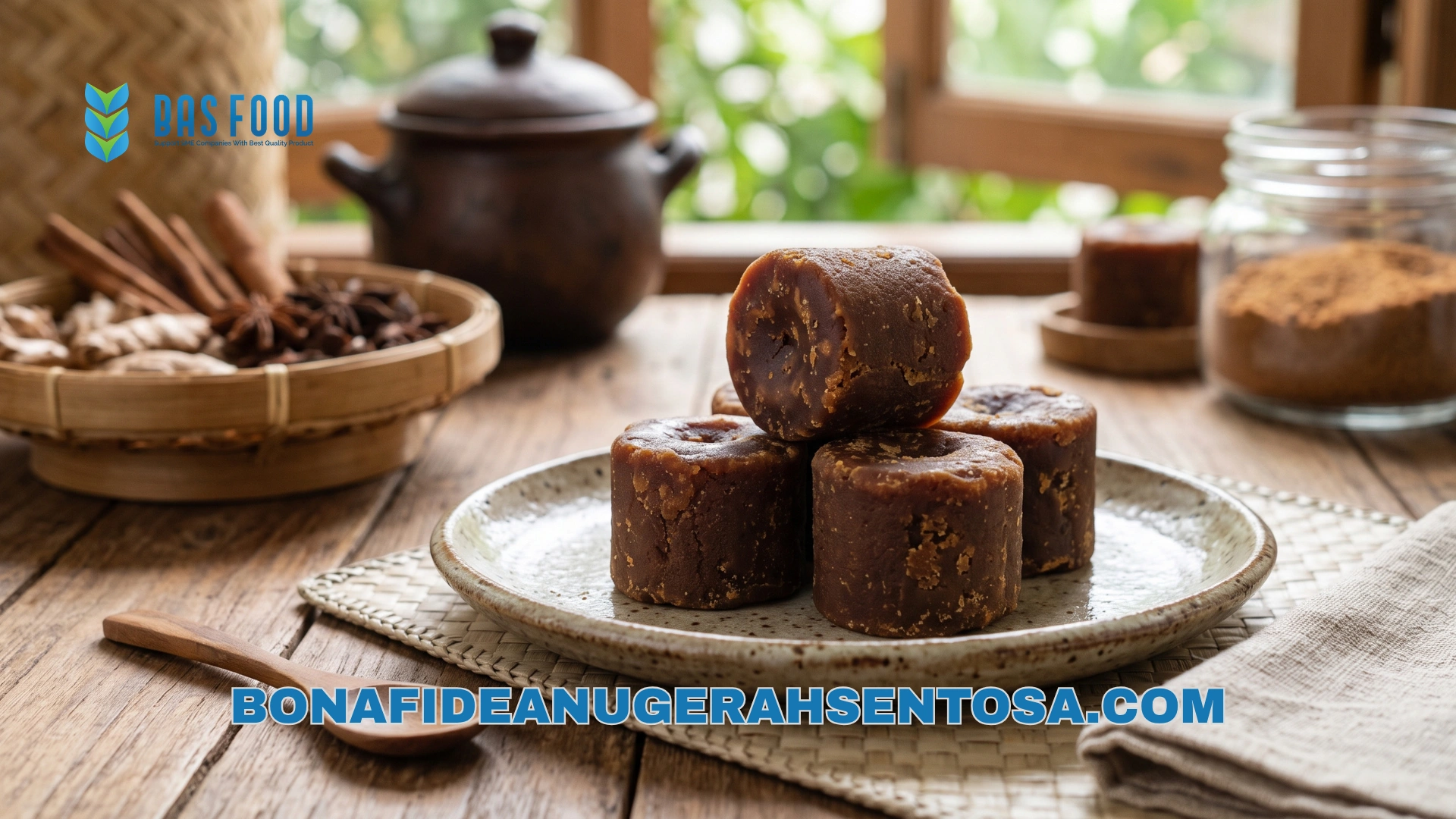
What Is a Coconut Sugar Mould?
A coconut sugar mould is a tool used to shape processed coconut sugar into a defined form. After coconut sap is collected and processed into a concentrated sugar mass, producers can place the hot or warm product into moulds so it can cool and solidify in a consistent shape.
Traditional moulds can produce round, block, disc, or other familiar forms. The exact shape depends on the production method, market requirements, and the equipment used by the producer.
For B2B buyers, the important point is consistency. If one batch produces significantly different shapes or sizes from another batch, the product may become harder to pack, count, transport, or present to customers.
Therefore, mould design should match the buyer’s product specification.
Why Mould Quality Matters in Coconut Sugar Production
A mould may look like a simple production component, but it works directly with the sugar product. Poor mould quality can make the production process less consistent and may create difficulties when removing the finished sugar.
A good mould should support repeatable production. It should help the producer achieve a similar shape and size across batches while allowing the product to be removed without unnecessary breakage.
In addition, the mould should be suitable for the production environment. Material selection, surface condition, durability, cleaning practices, and handling all deserve attention.
This is especially important for exporters because buyers may expect the same product specifications across multiple shipments.
From Coconut Sap to Moulded Sugar
Understanding the production process makes it easier to understand the role of the mould.
The process generally starts with collecting sap from coconut flower stalks. Producers then filter and heat the sap to reduce its water content. As the liquid becomes more concentrated, it develops the characteristic color, aroma, and flavor associated with coconut sugar.
Once the concentrated sugar reaches the required condition, the producer transfers it into moulds. The product then cools and becomes solid.
The mould therefore comes near the final stage of production. However, the final shape depends on more than the mould itself. Temperature, sugar consistency, filling method, cooling conditions, and handling can all affect the result.
Traditional Moulds Still Have an Important Role
Traditional moulding methods remain relevant in many coconut sugar-producing communities.
Local producers may use established mould shapes that have been passed down through generations. These shapes can be familiar to local consumers and may also support traditional culinary practices.
For some buyers, this traditional appearance is part of the product’s value.
It can communicate origin and authenticity in a way that highly processed or standardized sweeteners may not.
However, traditional production does not mean that quality control should be ignored. B2B buyers still need clear specifications, proper hygiene practices, and consistent product quality.
Different Mould Shapes for Different Markets
Not every market wants the same coconut sugar shape.
Some buyers may prefer small discs for retail packaging. Others may require larger blocks for foodservice or industrial kitchens. Certain traditional markets may have established preferences for particular shapes.
Therefore, buyers should define the required mould shape before starting commercial production.
A supplier should be able to discuss the available mould formats and determine whether an existing mould meets the requirement or whether a customized option is necessary.
This is particularly useful for private-label brands that want a recognizable product format.
Standard Moulds vs Customized Moulds
Standard moulds are usually easier to implement because the producer already understands the production process and does not need to develop a new design.
They can be a good option for buyers that simply need a proven shape and size.
Customized moulds, on the other hand, provide greater flexibility.
A buyer may request a specific diameter, weight, thickness, shape, or packaging fit. This can be useful when a product is designed around a particular retail package or foodservice format.
Before requesting customization, buyers should consider the commercial volume. A custom mould may make more sense for long-term orders than for a very small trial shipment.
Mould Material Is an Important Consideration
The material used for the mould matters because it comes into contact with the sugar during production.
A supplier should be able to explain what material is used and how the mould is handled during production.
The material should be suitable for the intended food-production environment and should support practical cleaning and maintenance procedures.
Buyers should avoid evaluating moulds only by appearance or price.
Instead, they should consider durability, ease of cleaning, production compatibility, and long-term usability.
Hygiene Should Never Be an Afterthought
Food production requires careful hygiene management, and moulds are no exception.
Because moulds come into contact with the sugar product, producers need appropriate cleaning and handling procedures.
Residue left inside a mould can create quality problems during subsequent production. Therefore, cleaning should be practical and consistent.
For B2B sourcing, buyers should ask suppliers how moulds are cleaned, stored, and maintained between production cycles.
This question can reveal how seriously a producer approaches food safety.
Consistent Weight Starts With Consistent Moulding
For commercial products, weight consistency is often important.
A retailer may sell coconut sugar in packages with a defined net weight. A foodservice customer may purchase blocks based on standardized units. In both cases, large variations can create operational problems.
Mould dimensions can help support consistent product sizing.
However, the mould alone cannot guarantee exact weight. The amount of sugar placed into each mould also needs to be controlled.
For that reason, good production practice combines suitable moulds with controlled filling and quality checks.
Why Product Size Affects Packaging
Packaging is closely connected to mould design.
A large block may require a different packaging format from a small disc. Likewise, products intended for retail shelves may need individual wrapping, while foodservice products may use larger bulk packs.
Before selecting a mould, buyers should consider the final packaging.
The ideal process works backward from the finished product:
Product format → weight → mould size → packaging → shipping configuration.
This approach can prevent problems later in the supply chain.
Moulded Coconut Sugar vs Granulated Coconut Sugar
Moulded and granulated coconut sugar serve different needs.
Mould sugar is often useful when the shape itself is part of the product experience or traditional format. It can work well in certain retail, foodservice, and culinary applications.
Granulated coconut sugar is generally more convenient for industrial formulation.
A coconut sugar granules supplier may provide specifications such as particle size, moisture, color, and packaging format for manufacturers that need to blend the sugar into recipes.
Neither format is universally better.
The right choice depends on the buyer’s application.
Why Some Buyers Prefer Granules
Food manufacturers often need ingredients that can be measured and blended efficiently.
Granulated coconut sugar can fit these requirements because it can be weighed, mixed, and distributed throughout a formulation more easily than large moulded blocks.
This makes granules relevant to bakery, beverages, snacks, chocolate, and other food applications.
For industrial buyers, the focus often shifts from traditional shape to technical specification.
Nevertheless, moulded sugar remains relevant where appearance, tradition, or specific culinary use matters.
How a Coconut Sugar Mould Supplier Supports B2B Buyers
A reliable coconut sugar mould supplier should do more than sell or provide a mould.
The supplier should understand the production requirements behind the mould.
For example, the supplier should be able to discuss:
- Desired product weight
- Shape and dimensions
- Production volume
- Mould material
- Cleaning requirements
- Product removal
- Packaging compatibility
- Storage conditions
- Production consistency
- Customization options
This type of communication helps prevent misunderstandings between buyer and producer.
Packaging for Moulded Coconut Sugar
Moulded coconut sugar needs packaging that protects its physical form during handling and transport.
The package should help prevent excessive exposure to moisture and protect the product from contamination and physical damage.
Packaging also needs to fit the buyer’s distribution model.
For retail products, presentation may be a major concern. For industrial or foodservice products, durability and handling efficiency may be more important.
A supplier should therefore discuss packaging together with the mould and product specifications.
Indonesia as a Coconut Sugar Sourcing Origin
Indonesia has a long history of coconut cultivation and traditional coconut sugar production.
This provides international buyers with access to established producing communities and experienced processors.
However, buyers should not assume that every Indonesian supplier offers identical quality.
Production methods, specifications, capacity, packaging, documentation, and export experience can vary significantly.
The best approach is to evaluate each supplier based on the buyer’s actual requirements.
Evaluating CV Bonafide Anugerah Sentosa
CV Bonafide Anugerah Sentosa can be considered by international buyers looking for Indonesian coconut sugar sourcing.
When evaluating the company, buyers should discuss the exact product format required, including moulded coconut sugar or granulated products.
For moulded products, the discussion can include available shapes, dimensions, weight, packaging, MOQ, production schedule, and customization requirements.
For granulated products, buyers may need to discuss particle size, moisture, packaging, and other product specifications.
As with any international supplier, current commercial information should be confirmed directly before placing an order.
Conclusion: The Right Mould Is Part of the Right Product
Choosing a coconut sugar mould supplier should not be treated as a small technical decision.
The mould can influence product shape, weight, consistency, packaging, handling, and production efficiency. For international B2B buyers, these factors can directly affect commercial performance.
A good sourcing process starts by defining the finished product. From there, buyers can determine the appropriate mould dimensions, material, production method, packaging, and quality requirements.
Indonesia offers an established origin for coconut sugar, but supplier evaluation remains essential.
For buyers considering CV Bonafide Anugerah Sentosa, the next step should be a direct discussion about current product availability, mould formats, specifications, production capacity, packaging, MOQ, documentation, and export terms.
Whether the goal is traditional moulded coconut sugar or modern granulated products, the same principle applies:
Start with the application, define the specification, and choose a supplier that can consistently deliver the result.