
Finding a reliable coconut sugar granules supplier is not simply about finding the lowest price. For food manufacturers, importers, distributors, and brands, the right supplier needs to deliver consistent quality, suitable particle size, reliable packaging, clear documentation, and dependable supply. Coconut sugar granules have become an interesting ingredient for businesses developing bakery products, beverages, snacks, confectionery, sauces, and other food applications. Their natural brown color and characteristic caramel-like flavor can add a different profile compared with conventional refined sugar.
However, international buyers face an important question: how do you choose the right supplier?
A good supplier should fit your product requirements, purchasing volume, quality standards, logistics needs, and target market. This guide explains what buyers should know before choosing a coconut sugar granules supplier, including the role of a coconut sugar manufacturer, sourcing from Indonesia, wholesale purchasing, quality checks, packaging, and export preparation.
Why Choosing the Right Coconut Sugar Supplier Matters
Coconut sugar may look like a simple commodity, but commercial food production requires consistency. A factory cannot easily change its formulation every time the color, moisture, texture, or particle size of its sweetener changes.
For that reason, supplier selection should start with the buyer’s technical requirements. Before contacting suppliers, define the intended application, required granule size, expected order volume, packaging format, quality specifications, and destination country.
A reliable supplier should then be able to respond to those requirements clearly. This creates a better starting point for long-term cooperation than simply asking, “What is your price per kilogram?”
For B2B buyers, consistency can ultimately be more valuable than a small difference in the initial purchase price.
Understanding the Role of a Coconut Sugar Manufacturer
A coconut sugar manufacturer plays an important role in controlling the production process.
The manufacturer is generally closer to the processing stage than a trading company that only buys and resells finished products.
This does not automatically mean that every manufacturer is better than every trader. What matters is whether the supplier can provide the quality, documentation, traceability, and supply reliability required by the buyer.
However, direct access to production can be valuable for B2B buyers.
It may make communication about particle size, packaging, production schedules, samples, and quality requirements easier.
When evaluating a manufacturer, buyers should ask where the product is processed, how batches are controlled, what quality checks are performed, and how production capacity is managed.
Why Indonesia Is an Important Sourcing Origin
Indonesia has a large agricultural sector and a long tradition of processing coconut and palm-based products.
For international buyers, Indonesia can therefore be an interesting sourcing origin for coconut sugar.
An Indonesia supplier can potentially provide access to coconut sugar from producing regions while also supporting export-oriented supply chains.
However, buyers should not assume that every Indonesian supplier offers the same quality.
Supplier capabilities can differ significantly in terms of processing, packaging, quality control, documentation, capacity, and export experience.
Therefore, “made in Indonesia” should be viewed as the beginning of the sourcing evaluation rather than the final quality guarantee.
What Makes a Good Indonesia Supplier?
A good Indonesian supplier should be able to explain its product clearly.
This includes information about product specifications, available granule sizes, packaging, MOQ, production capacity, shelf life, storage conditions, and quality documentation.
Communication is also important.
International purchasing often involves different time zones, languages, currencies, shipping requirements, and documentation.
A supplier that communicates clearly can make the purchasing process easier for both procurement and logistics teams.
Before placing a commercial order, buyers should also request samples and evaluate the product in their intended application.
Why Granule Size Matters
One of the most important technical considerations is particle size.
Coconut sugar granules can be produced in different sizes depending on the intended application.
A food manufacturer should not simply order “granulated coconut sugar” without defining the required physical specification.
Particle size can affect blending, flow, dissolution, texture, and processing.
For example, a dry beverage manufacturer may want a specific particle distribution for efficient mixing.
A bakery manufacturer may be more flexible.
A confectionery producer may require finer material for a smoother final texture.
This is why a professional coconut sugar granules supplier should be able to discuss particle-size requirements rather than offering only one generic product.
Fine, Medium, and Coarse Granules
Although terminology can differ between suppliers, coconut sugar can generally be discussed in terms of finer and coarser granules.
Fine granules may be suitable for applications where fast blending or a smoother texture is important.
Coarser granules may be useful in applications where the physical appearance and texture of the sugar are part of the product concept.
There is no universal “best” size.
The right granule size depends on the recipe, processing equipment, mixing method, and finished product requirements.
Therefore, buyers should provide their technical requirements to the supplier before requesting a quotation.
Quality Checks Buyers Should Consider
Quality evaluation should cover several characteristics.
Important factors may include:
- Color
- Aroma
- Taste
- Moisture
- Particle size
- Granule consistency
- Foreign matter control
- Packaging condition
- Batch identification
- Shelf life
The exact specification should be agreed between buyer and supplier.
A sample is useful, but one sample alone does not guarantee that every future batch will be identical.
That is why buyers should also ask how the supplier manages batch quality and whether a product specification or certificate of analysis can be provided where applicable.
Moisture Control and Storage
Moisture is an important consideration for granulated coconut sugar.
When exposed to humid conditions, coconut sugar can become sticky or form lumps.
This can affect handling and may create problems for factories using automated feeding or weighing systems.
Therefore, buyers should discuss moisture specifications and packaging with their supplier.
After arrival, the buyer also needs to maintain suitable warehouse conditions.
A well-protected shipment can still experience quality problems if it is stored in a highly humid environment with damaged or repeatedly opened packaging.
Packaging for Wholesale Coconut Sugar
Packaging should match the buyer’s order volume and supply chain.
A business purchasing wholesale coconut sugar may require large bags or palletized shipments rather than retail packaging.
The packaging should protect the product during transportation, warehouse storage, and factory handling.
Buyers should discuss bag size, inner liners, sealing, palletization, labeling, and container loading.
International shipments require additional attention because the product may spend weeks in transit.
The packaging should therefore be appropriate for the expected logistics conditions.
What Does Wholesale Coconut Sugar Mean for Buyers?
Wholesale purchasing generally involves larger quantities and commercial transactions.
The benefits can include better purchasing efficiency, more predictable supply planning, and packaging designed for industrial handling.
However, buying larger quantities also increases the importance of supplier evaluation.
A poor supplier decision can affect a much larger volume of inventory.
Before purchasing in bulk, buyers should test samples, confirm specifications, review documentation, and understand lead times.
It is better to identify potential issues with a small sample or pilot order than after receiving a large commercial shipment.
MOQ and Production Capacity
Minimum order quantity, or MOQ, is an important part of supplier selection.
Some suppliers may accept small trial orders, while others focus primarily on larger commercial volumes.
Buyers should ask about MOQ early in the procurement process.
Production capacity is equally important.
A company may be able to fulfill a small trial order but struggle to support much larger repeat orders.
For growing food brands, this can become a problem.
Therefore, procurement teams should consider both current demand and potential future demand when evaluating a supplier.
Why Consistent Supply Matters
A food factory depends on reliable ingredient availability.
If coconut sugar arrives late, production schedules may be affected.
If quality changes between batches, product consistency may suffer.
This is why buyers should evaluate supply reliability alongside product quality.
Ask suppliers about typical lead times, production schedules, shipping frequency, and how they manage larger orders.
Clear forecasting can also help.
If a buyer expects demand to increase, sharing an approximate purchasing forecast can help both parties plan production and logistics.
Export Experience Is a Major Advantage
An experienced exporter understands that international sales involve more than preparing the product.
Export transactions can involve commercial invoices, packing lists, certificates, shipping documents, customs requirements, labeling, and destination-market rules.
The exact documents depend on the destination country and transaction.
Therefore, buyers should ask whether the supplier has experience serving international customers.
A capable exporter should be able to communicate about shipping arrangements and provide the documents agreed for the transaction.
This can reduce avoidable delays.
How to Evaluate a Coconut Sugar Granules Supplier
A practical supplier evaluation can use five major areas.
1. Product
Does the supplier provide the required granule size, moisture level, flavor, color, and other specifications?
2. Production
Can the supplier handle the buyer’s expected volume?
3. Quality
Does the supplier have appropriate quality-control procedures and batch identification?
4. Logistics
Can the supplier provide suitable packaging and support international shipping requirements?
5. Communication
Does the supplier respond clearly and provide the information required for purchasing decisions?
This five-part framework can help buyers compare suppliers objectively.
Requesting Samples Before a Commercial Order
Samples are an important part of B2B ingredient sourcing.
A buyer should test the coconut sugar itself and, where possible, test it in the intended food formulation.
For bakery products, use it in the actual dough or batter.
For beverages, test it under the expected mixing conditions.
For confectionery, evaluate the particle size and final mouthfeel.
The goal is to determine whether the product works technically and commercially.
A supplier’s product specification can support the evaluation, but actual formulation testing provides additional information.
Traceability and Transparency
Food businesses increasingly want better visibility into their supply chains.
Traceability can help identify product batches and support quality management.
For coconut sugar, buyers may want to understand where the raw material comes from and how it moves through processing and export.
The level of traceability available depends on the supplier’s system.
Therefore, buyers should ask what batch information is maintained and what documentation can be provided.
This is especially useful for businesses serving markets with strict food safety and documentation requirements.
Certifications and Compliance
Certifications can be important depending on the buyer’s target market and product positioning.
However, buyers should distinguish between certifications that are actually held and general claims made in marketing material.
Ask suppliers to provide current certification information where relevant.
For organic products, buyers should verify that the specific product and supply chain meet the requirements applicable to the intended market.
The same principle applies to other claims.
Do not assume that a supplier’s entire product range automatically has the same certification status.
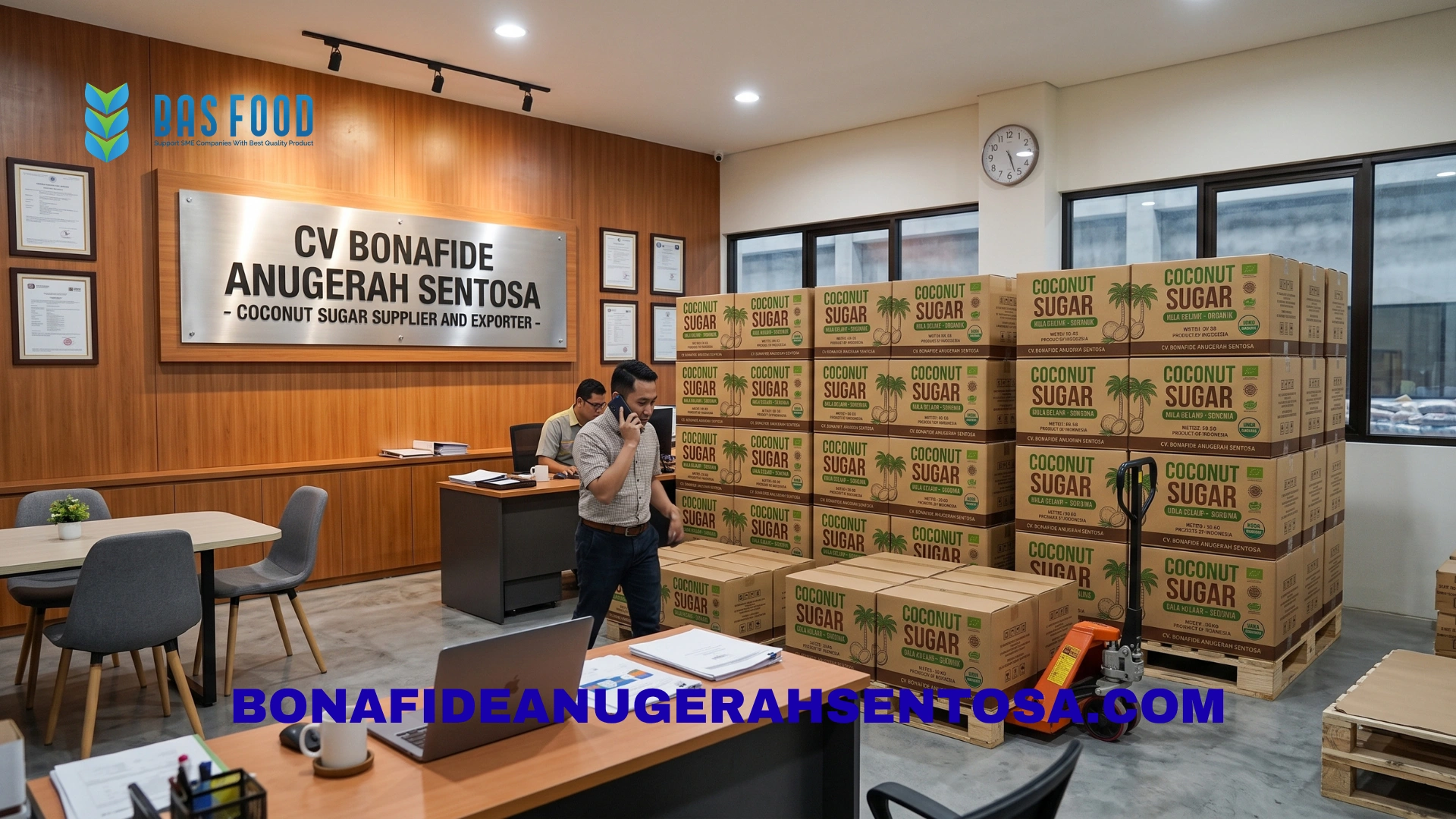
The Role of CV Bonafide Anugerah Sentosa
CV Bonafide Anugerah Sentosa can be considered by international businesses looking for an Indonesian source of coconut sugar and other agricultural products.
For buyers interested in working with the company, the most useful approach is to provide a clear purchasing brief.
Include the required coconut sugar form, granule size, application, estimated order quantity, packaging preference, destination country, and documentation requirements.
The supplier can then confirm the current product availability and commercial specifications.
Before making a purchasing decision, buyers should directly verify the latest information about product specifications, MOQ, production capacity, packaging, certifications where applicable, shelf life, export documentation, lead time, and commercial terms.
Building a Long-Term Supplier Relationship
A good supplier relationship develops over time.
The first order provides an opportunity to evaluate product quality, communication, packaging, logistics, and documentation.
If the order performs well, both parties can establish clearer specifications for future shipments.
Long-term cooperation can also improve purchasing planning.
The buyer can provide forecasts, while the supplier can plan production and packaging more effectively.
However, long-term relationships should still be supported by clear specifications and quality controls.
Good relationships work best when expectations are documented.
Conclusion: Choosing a Coconut Sugar Granules Supplier With Confidence
Finding the right coconut sugar granules supplier requires more than comparing prices.
Food manufacturers and international buyers need to consider product specifications, granule size, moisture, flavor, color, packaging, shelf life, production capacity, documentation, and export experience.
A capable coconut sugar manufacturer should be able to communicate clearly about how its product is produced and how it can meet the buyer’s requirements.
For international businesses, working with an Indonesia supplier can provide access to a major coconut-producing market. However, buyers should still evaluate each supplier individually because quality, capacity, processing systems, and export experience can differ.
For companies purchasing wholesale coconut sugar, supplier reliability becomes even more important.
A large order represents a significant inventory commitment, so buyers should test samples, confirm specifications, evaluate production capacity, and understand the supplier’s packaging and logistics system before committing to a long-term arrangement.
CV Bonafide Anugerah Sentosa can be considered as a potential Indonesian source for businesses looking for coconut sugar. Buyers should contact the company directly to confirm current product specifications, available granule sizes, MOQ, production capacity, packaging, certifications where applicable, shelf life, documentation, lead time, and export terms.
Ultimately, the best supplier is not necessarily the one with the lowest quotation.
It is the supplier that can consistently deliver the right product, in the right specification, at the right quantity, with the documentation and service needed to support your business.
For a food brand, manufacturer, importer, or distributor, that reliability can make coconut sugar sourcing much easier and create a stronger foundation for long-term growth.