
The beverage industry is constantly looking for ingredients that can deliver sweetness while also adding something distinctive to the final product. Today, buyers are not only interested in whether a sweetener can make a drink sweeter. They also want to know how it affects flavor, color, solubility, production efficiency, packaging, and supply consistency. This is where coconut sugar granules for beverages can become an interesting ingredient for beverage manufacturers. Made from coconut palm sap, granulated coconut sugar offers a characteristic brown color and warm flavor that can work well in coffee, tea, instant drink mixes, and other beverage applications.
For B2B buyers, however, selecting coconut sugar is not as simple as choosing a sweetener from a product list. Manufacturers need to consider particle size, moisture, dissolution behavior, product consistency, packaging, production capacity, and supplier reliability.
In other words, the right coconut sugar needs to work both in the cup and in the factory.
This guide explains how coconut sugar granules can be used in beverage products, what manufacturers should consider during product development, and how to evaluate a reliable coconut sugar supplier.
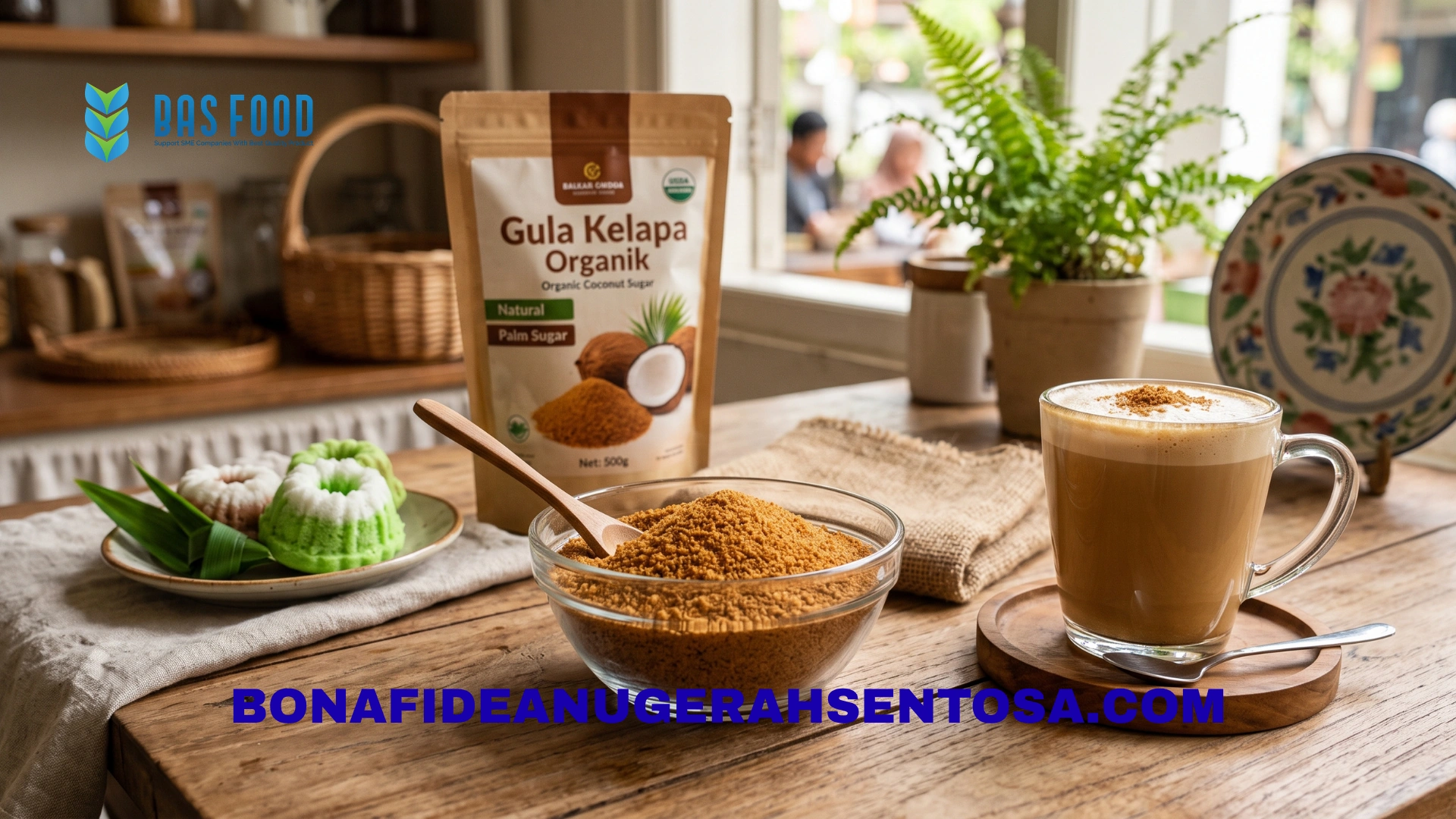
What Makes Coconut Sugar Suitable for Beverages?
Coconut sugar is produced from the sap of coconut palms. The collected sap is processed to reduce its water content and produce a concentrated sugar. Depending on the manufacturing process and intended application, the finished product can be supplied in several forms, including granules, powder, blocks, and syrup.
Granulated coconut sugar is particularly useful for beverage manufacturers because it can be measured, blended, packaged, and transported as a dry ingredient. Its brown color and characteristic caramel-like notes can also contribute to the sensory profile of a finished beverage.
However, beverage performance depends on more than sweetness.
When developing a drink, manufacturers need to consider how quickly the sugar dissolves, whether it creates sediment, how it affects color, and whether its flavor works with other ingredients. Therefore, the physical and sensory properties of the coconut sugar should be evaluated before commercial production.
Understanding Coconut Sugar Granules
The term “granules” describes the physical form of the sugar, but not every granular product has the same particle size.
A supplier may offer different grades based on particle size or processing specifications. Some products have relatively fine particles, while others contain larger granules.
This difference can matter in beverage production.
A smaller particle size may dissolve more easily under certain conditions. Larger particles may require more mixing time or different processing conditions. Therefore, beverage manufacturers should select a specification that matches their production system.
For this reason, buyers should request a product specification sheet from their supplier.
Useful information can include particle size, moisture, color, flavor, packaging, shelf life, and other technical parameters relevant to the intended beverage application.
Coconut Sugar as a Beverage Sweetener
A beverage sweetener needs to do more than provide sweetness.
It must work with the other ingredients in the formulation and fit the manufacturing process.
Coconut sugar can contribute both sweetness and its own characteristic flavor. This makes it different from a highly neutral sweetener.
That distinction can be useful for beverage brands that want a more distinctive sensory profile.
For example, the warm notes of coconut sugar may complement coffee, tea, cocoa, spices, or plant-based beverage formulations.
However, the flavor contribution should be tested carefully. A beverage with delicate flavors may require a different sweetener strategy from a strong coffee or chocolate drink.
Why Solubility Matters in Beverage Production
One of the most important considerations when using dry sugar in beverages is how it dissolves.
A beverage manufacturer may produce a hot drink, cold drink, powdered mix, concentrate, or ready-to-drink product. Each application can have different processing conditions.
Temperature, particle size, liquid volume, mixing speed, and formulation all influence dissolution.
Therefore, manufacturers should test coconut sugar under actual production conditions.
For an instant beverage powder, for example, the development team may evaluate how quickly the sugar disperses when consumers add water. For a ready-to-drink beverage, the manufacturer may evaluate dissolution during industrial mixing.
The right specification depends on the product.
Coconut Sugar Granules in Coffee
Coffee is one of the most interesting applications for coconut sugar.
Coconut sugar’s warm, caramel-like flavor can complement roasted coffee notes.
This makes it suitable for various coffee concepts, including sweetened coffee drinks, coffee mixes, instant coffee beverages, and specialty formulations.
The ingredient can also help create a different sensory profile from beverages sweetened with conventional white sugar.
However, coffee manufacturers should test the interaction between the sugar and the coffee.
The final flavor depends on coffee origin, roast level, acidity, milk or creamer, cocoa content, and other ingredients.
A supplier sample should therefore be tested in the actual beverage formula.
Coconut Sugar for Tea
Tea offers another potential application.
Some teas naturally have floral, fruity, earthy, or roasted notes. Coconut sugar can provide a deeper sweetness that may work particularly well with stronger tea varieties.
It can also complement spices and other ingredients used in tea-based beverage products.
For example, beverage manufacturers may explore coconut sugar in spiced tea, milk tea, herbal beverage blends, and other specialty drinks.
However, the natural brown color of coconut sugar should be considered.
If a manufacturer wants a very clear or light-colored tea beverage, the ingredient may produce a different visual result than a lighter-colored sweetener.
Coconut Sugar for Instant Drinks
Instant beverages require careful attention to dry ingredient performance.
A powdered drink mix needs ingredients that can be accurately blended and packed. The ingredients should also perform consistently when consumers prepare the drink.
This makes coconut sugar granules for beverages an interesting option for instant drink manufacturers.
Particle size becomes especially important here.
If the coconut sugar granules are too different in size from other dry ingredients, segregation may occur during handling or transportation. A well-designed formulation should therefore consider particle distribution across the entire dry mix.
Manufacturers should test both the factory process and the consumer preparation experience.
Coconut Sugar in Ready-to-Drink Beverages
Ready-to-drink beverages have different requirements because the sweetener is incorporated into a liquid production system.
The manufacturer needs to consider mixing, heating, filtration, filling, storage, and other processing conditions depending on the product.
Coconut sugar can contribute sweetness and flavor, but its color and other characteristics need to fit the beverage concept.
Product developers should evaluate the complete formulation rather than testing the sweetener by itself.
For example, acidity, milk, coffee, tea, cocoa, fruit ingredients, and stabilizers can all influence the final beverage.
Coconut Sugar and Beverage Flavor Development
One advantage of coconut sugar is that it can contribute a distinctive flavor.
This can help beverage companies create products with a recognizable sensory identity.
Instead of treating the sweetener as an invisible ingredient, product developers can consider it as part of the flavor profile.
This approach can work especially well for coffee and tea beverages where caramel-like notes can complement the base ingredients.
Nevertheless, consistency remains important.
The flavor of coconut sugar can vary depending on raw materials and processing. Therefore, manufacturers should work with a supplier that can provide a consistent product specification.
Color: An Important Beverage Consideration
Coconut sugar typically has a brown to golden-brown appearance.
That color can influence the final beverage.
For darker drinks such as coffee, cocoa, or some spiced beverages, this may fit naturally into the product concept.
For light-colored drinks, however, the effect may be more noticeable.
Manufacturers should therefore conduct visual testing during product development.
This is particularly important for brands that have strict color standards.
A small difference in sweetener color can sometimes affect the appearance of the finished beverage.
Fine vs. Coarse Coconut Sugar Granules
The granule size of coconut sugar can influence its behavior during manufacturing.
Fine granules generally provide a greater surface area relative to their particle size, which can support faster dissolution under suitable conditions.
Coarser granules may behave differently during mixing and handling.
Neither option is automatically better.
The best choice depends on the beverage application.
An instant drink manufacturer may have different requirements from a coffee producer using coconut sugar in a dry premix.
Therefore, buyers should explain the application to their supplier rather than simply ordering a generic granular product.
Moisture and Storage Considerations
Moisture is another important specification for dry beverage ingredients.
Excess moisture can affect the physical condition of sugar during storage. It may contribute to clumping or changes in handling.
For beverage manufacturers, this can create problems during weighing, blending, and automated feeding.
Proper packaging and storage can help protect the product.
The warehouse should keep coconut sugar in suitable dry conditions and protect opened packaging from humidity.
Buyers should also discuss recommended storage conditions with their supplier.
Coconut Sugar for Beverage Premixes
Dry beverage premixes often contain several ingredients.
These may include coffee, tea, cocoa, milk powder, creamer, spices, flavorings, or other functional ingredients.
When coconut sugar is added to such a mixture, particle size and density become important.
The ingredients need to remain reasonably well distributed during production and transportation.
This is why manufacturers should evaluate the complete premix rather than testing coconut sugar in isolation.
A production trial can reveal whether the blend remains uniform and whether the final drink has the desired taste and appearance.
Quality Control for Beverage-Grade Coconut Sugar
A professional beverage manufacturer should define its ingredient specification before purchasing.
The specification can cover physical, sensory, microbiological, chemical, and other parameters relevant to the application and applicable regulations.
The exact requirements depend on the market and product.
At a minimum, buyers should clearly define the characteristics that directly affect production.
These may include:
- Particle size
- Moisture
- Color
- Flavor
- Aroma
- Packaging
- Shelf life
- Lot identification
- Required documentation
The supplier should understand and consistently meet the agreed specification.
Why Sample Testing Comes First
Before placing a large commercial order, beverage manufacturers should test a supplier’s sample.
This is especially important when introducing coconut sugar into an existing formula.
A laboratory sample can tell you about the ingredient’s basic specifications. However, a production trial tells you how the ingredient actually behaves in your process.
Test it in coffee.
Test it in tea.
Test it in the instant beverage formula.
If the product is intended for a ready-to-drink application, conduct a trial under the relevant processing conditions.
Then compare the results against the existing sweetener.
Evaluating Supplier Production Capacity
A beverage brand can start with a small trial but eventually require substantial quantities.
That is why production capacity should be discussed early.
If your beverage becomes successful, you do not want to discover later that your supplier cannot support your growing demand.
Ask about current production capacity and typical lead times.
Also discuss how the supplier manages larger orders.
A coconut sugar supplier that understands B2B purchasing should be able to discuss commercial quantities and supply planning clearly.
Packaging for Beverage Manufacturers
Packaging needs depend on how the buyer uses the ingredient.
A small beverage company may require smaller bags.
A large manufacturer may prefer bulk packaging that can be handled efficiently in its warehouse and production area.
The packaging should protect the coconut sugar from moisture and contamination while also supporting transportation.
International buyers should discuss packaging specifications before production.
This can include bag size, inner liner, outer material, palletization, labeling, and other requirements.
The correct packaging can help protect the ingredient throughout the supply chain.
Export Considerations for International Beverage Buyers
International beverage manufacturers need to consider more than product quality.
The ingredient must also move through the export and import process correctly.
Buyers should discuss required documentation, product specifications, packaging labels, shipment terms, and other requirements with the supplier before ordering.
Destination-market requirements can differ.
Therefore, an exporter should understand the buyer’s destination and intended use.
Early communication can reduce the risk of documentation or packaging problems later.
Working With CV Bonafide Anugerah Sentosa
For companies sourcing Indonesian agricultural ingredients, CV Bonafide Anugerah Sentosa can be considered as a potential source of coconut sugar.
Beverage manufacturers interested in purchasing should provide detailed requirements when contacting the supplier.
For example, specify the desired form, granule size, quantity, packaging, destination country, intended beverage application, and expected purchasing frequency.
This gives the supplier a clearer understanding of the project.
Buyers should confirm current product specifications, sample availability, MOQ, production capacity, packaging, certifications where applicable, lead time, export documentation, pricing, and shipping terms directly with the company before placing a commercial order.
Common Mistakes When Buying Coconut Sugar for Beverages
One common mistake is selecting coconut sugar based only on its price.
A low-cost ingredient may create higher costs if it performs poorly in production.
Another mistake is ignoring particle size.
The product needs to match the beverage manufacturing process.
A third mistake is skipping sample testing.
Even if a supplier provides a technical specification, the ingredient should still be tested in the actual beverage formulation.
Finally, some buyers focus on the first shipment and forget about long-term supply.
For commercial beverage production, consistency matters just as much as the initial sample.
Conclusion: Choose the Sugar That Works Beyond the Label
Coconut sugar granules for beverages can be a useful ingredient for manufacturers looking to develop distinctive coffee, tea, instant drink, and specialty beverage products.
Its brown color and characteristic flavor can contribute more than sweetness. At the same time, beverage manufacturers need to consider particle size, moisture, dissolution, flavor, color, packaging, storage, and supply consistency.
The best purchasing approach is straightforward.
Start with a clear specification.
Request samples.
Test the coconut sugar in your actual beverage formula.
Evaluate the supplier’s production capacity and quality system.
Then review packaging, documentation, lead time, and export requirements before moving to a larger order.
For companies sourcing from Indonesia, CV Bonafide Anugerah Sentosa can be considered as a potential coconut sugar source. Buyers should confirm current product availability, specifications, capacity, packaging, MOQ, certifications where applicable, documentation, and commercial terms directly with the company.
A good coconut sugar supplier should not only sell an ingredient. The supplier should understand the buyer’s application and provide consistent products that can support commercial production.
Whether you are developing an instant coffee, specialty tea, powdered beverage, or another drink concept, the right coconut sugar specification can help you move from a promising recipe to a reliable commercial product.