
The demand for natural and organic ingredients continues to grow across the global food industry. If you are searching for an organic palm sugar supplier, it’s important to choose partners who understand cleaner product concepts while also meeting practical requirements for quality, supply, documentation, and cost. Food manufacturers, retailers, beverage companies, bakeries, and private-label brands are looking for ingredients that fit cleaner product concepts while also meeting practical requirements for quality, supply, documentation, and cost.
Palm sugar is one ingredient attracting attention in this market. Its warm caramel-like flavor and natural origin make it suitable for many applications, from beverages and bakery products to sauces, snacks, desserts, and confectionery.
However, sourcing organic palm sugar is more complicated than simply finding a product labeled “organic.” For B2B buyers, choosing the right organic palm sugar supplier requires a closer look at organic certification, raw material sourcing, processing, traceability, quality control, packaging, export capability, and supply consistency.
This guide explains what international buyers should consider when evaluating an organic palm sugar supplier, especially when sourcing from Indonesia.
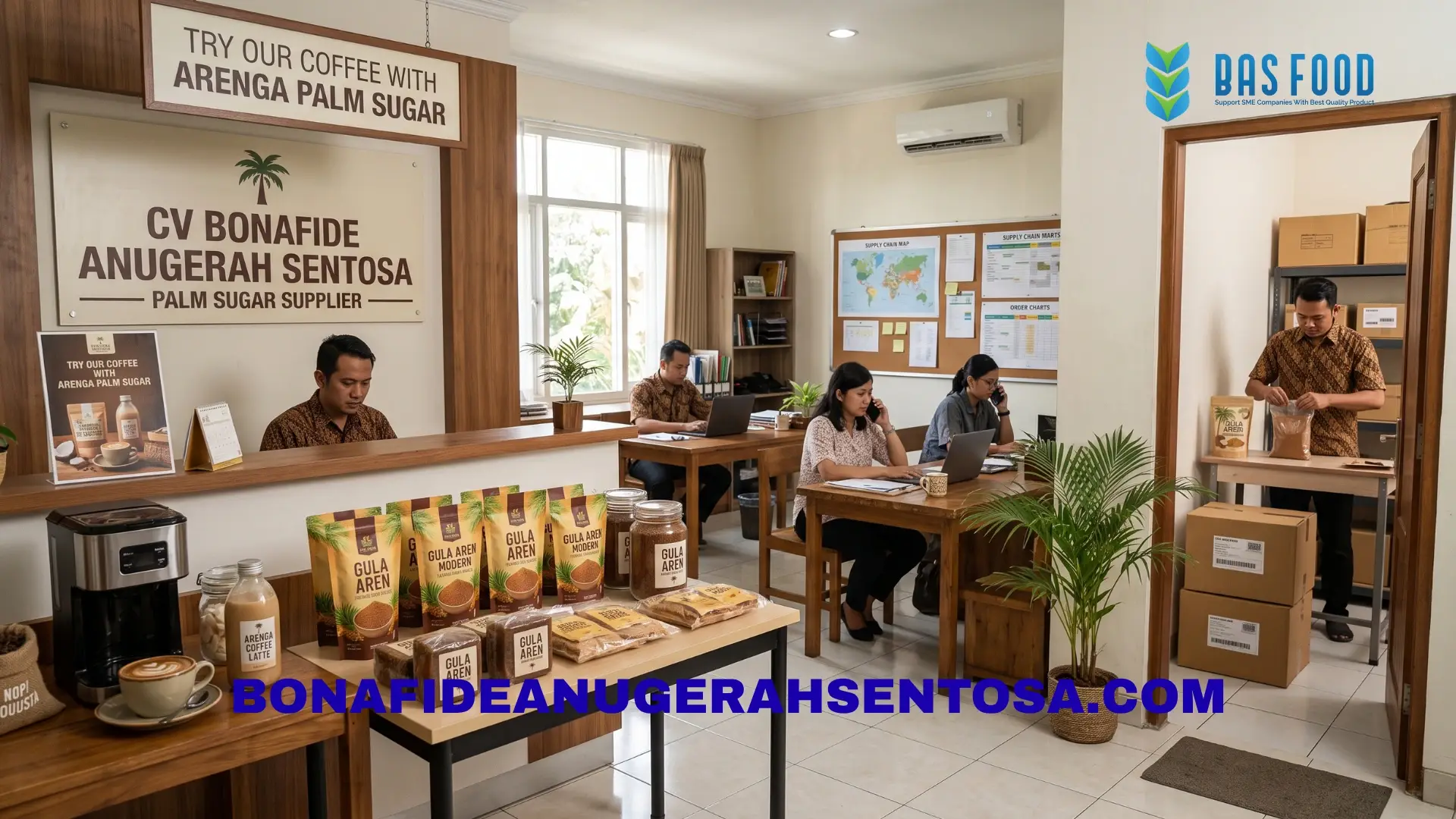
What Makes an Organic Palm Sugar Supplier Different?
An organic palm sugar supplier should be able to provide more than a natural-looking ingredient. The supplier needs to demonstrate that the product meets the organic requirements applicable to the intended market and certification system.
This distinction is important because “natural” and “organic” do not necessarily mean the same thing. A palm sugar product can be naturally derived without being certified organic. Organic claims usually involve specific production, handling, processing, documentation, and certification requirements.
For B2B buyers, the first step is therefore to define what “organic” means for the target market. European, U.S., and other markets can have different rules and certification requirements.
A supplier should be transparent about the certification status of its products. Buyers should also verify whether the certification applies to the specific product, facility, production process, and supply chain involved in the transaction.
Natural Palm Sugar vs Organic Palm Sugar
Natural palm sugar is produced from palm sap and may be processed without certain synthetic ingredients. However, this alone does not automatically make it an organic-certified product.
Organic palm sugar needs to meet the applicable organic production standards. The requirements may cover agricultural practices, permitted inputs, processing, handling, storage, and traceability.
Therefore, international buyers should avoid relying only on marketing terms. Documentation and certification are much more useful when qualifying an organic ingredient supplier.
Why Indonesia Is an Important Source of Palm Sugar
Indonesia has a long tradition of producing palm-based sweeteners. Palm trees grow across many parts of the country, and local communities have developed knowledge of sap collection and processing over generations.
This agricultural background gives Indonesia an established foundation for palm sugar production. Smallholder farmers and local processors can form an important part of the supply chain.
For international buyers, however, agricultural availability is only the beginning. Export supply also depends on processing capacity, quality management, packaging, logistics, documentation, and supplier organization.
A strong palm sugar exporter needs to connect local agricultural production with the technical requirements of international food manufacturers.
This connection is particularly important for organic products because the supply chain needs to maintain the required organic status through relevant stages of production and handling.
Understanding Organic Ingredients in the Palm Sugar Supply Chain
When buying organic ingredients, buyers should think about the complete supply chain rather than the final product alone.
The process begins with agricultural production. Farmers need to follow the applicable organic production requirements. Raw materials then move through collection, processing, storage, packaging, and transportation.
Each stage needs appropriate controls to protect the integrity of the organic product.
This is why traceability matters. A buyer may want to know where the palm sap comes from, how it is collected, where processing takes place, and how organic and conventional products are separated.
Good traceability can also make problem-solving easier. If an issue occurs with a particular batch, the supplier can use batch information to identify the relevant production and sourcing records.
Why Traceability Matters
Traceability is especially useful for food manufacturers selling products in regulated markets. It provides a documented connection between the finished ingredient and its source.
For an organic palm sugar buyer, this may include information about suppliers, production areas, processing facilities, batch numbers, and certification documents.
The exact requirements vary by market and certification program, so buyers should discuss them with their supplier before placing an order.
Organic Certification: What B2B Buyers Should Check
One of the first questions to ask an organic palm sugar supplier is whether the product is certified organic and under which certification system.
This is important because organic certification is not simply a marketing label. Certification normally involves an independent certification body and a defined set of production and handling requirements.
Buyers should ask for current certification documents and verify that the scope covers the product they intend to purchase.
They should also check the validity period and relevant product or facility information. If the product will be imported into a particular market, the buyer should confirm that the certification is accepted for that market.
Do Not Assume One Certificate Covers Every Market
A common procurement mistake is assuming that one organic certificate automatically satisfies every country’s requirements.
Organic regulations can differ between markets. A certification accepted for one destination may not automatically provide everything needed for another.
Therefore, buyers should communicate their destination market at the beginning of the sourcing process. The supplier can then explain what documentation and certification support may be available.
This is especially important for importers serving Europe, the United States, Saudi Arabia, Taiwan, or other markets with specific food and organic requirements.
Organic Food Production Requires Consistent Raw Materials
The quality of the final product starts with the raw material.
Palm sap naturally varies because it comes from an agricultural source. Weather, palm condition, harvesting practices, and local production conditions can influence the raw material.
For organic food production, the supplier needs to manage this variation while maintaining the required organic controls.
A strong sourcing network can help suppliers collect sufficient raw material while maintaining consistent purchasing and quality requirements.
However, buyers should understand that agricultural ingredients will naturally have some variation. The goal is not necessarily to eliminate every natural difference. Instead, the goal is to manage variation so the finished product remains within the agreed specification.
How Organic Palm Sugar Is Processed
Organic palm sugar generally starts with sap collected from palm trees. The fresh sap is handled and processed to concentrate its natural sugars.
Processing can involve filtration, heating, concentration, cooling, drying, sieving, and packaging depending on the final product form.
The process used for molded palm sugar may differ from the process used for granulated or powdered palm sugar.
For export markets, process control becomes especially important. Manufacturers often need a consistent ingredient that performs predictably in their own production lines.
Traditional Knowledge Meets Modern Quality Control
Palm sugar production has strong traditional roots. Farmers and processors have long used practical knowledge to collect and cook palm sap.
Modern B2B production can combine this knowledge with better equipment and quality systems. Temperature monitoring, moisture testing, particle-size control, hygienic processing, and batch tracking can help improve consistency.
For an organic palm sugar supplier, the challenge is to maintain the required organic integrity while also producing an ingredient that meets commercial specifications.
Choosing Between Granulated, Powdered, and Molded Palm Sugar
An organic palm sugar supplier may offer several product forms. Choosing the right form depends on the application.
Granulated palm sugar can be useful for beverage mixes, bakery products, dry blends, and other applications where controlled particle size is helpful.
Powdered palm sugar can provide easier incorporation into certain formulations. However, fine particles can be more sensitive to humidity, so packaging and storage become particularly important.
Molded palm sugar is a more traditional format. It can work well for food service, traditional recipes, and applications where the sugar will be dissolved or processed before consumption.
B2B buyers should therefore explain the final application before requesting a quotation. A supplier may be able to recommend the most suitable format based on the intended use.
Packaging and Storage for Organic Palm Sugar
Packaging plays an important role in protecting palm sugar during international transportation.
Palm sugar can be sensitive to moisture. Exposure to humid conditions can affect texture, flowability, and product appearance, particularly in granulated and powdered forms.
For this reason, buyers should discuss packaging requirements before confirming an order.
Bulk buyers may require large food-grade bags with suitable inner protection. Retail or private-label buyers may need smaller pouches or customized packaging.
Container Transportation Needs Planning
Export shipments can spend significant time in warehouses, ports, and containers. Temperature and humidity conditions can change during transportation.
Therefore, packaging should be selected with the expected transportation route in mind.
A good palm sugar exporter should be able to discuss practical packaging options and container loading procedures with buyers.
The Importance of Samples Before Bulk Orders
Samples are one of the most useful tools in ingredient procurement.
A product may look suitable on paper but perform differently in a real food formulation. Therefore, buyers should test the sample in the actual application whenever possible.
For example, a beverage company can evaluate dissolution and flavor. A bakery can test color, sweetness, moisture, and texture. A sauce manufacturer can assess flavor balance and processing performance.
Sample approval also creates a useful reference point for future orders.
Once the buyer approves a sample, the supplier can use the agreed specification as a reference for subsequent production.
Supply Stability and Organic Palm Sugar
Supply stability is an important concern for manufacturers. A food factory cannot easily stop production because an ingredient shipment is delayed.
Organic palm sugar can require additional supply-chain management because organic production must follow specific requirements.
A supplier needs sufficient access to compliant raw materials and appropriate processing capacity.
For buyers, forecasting can make a major difference. Sharing expected purchasing volumes with suppliers helps them plan production, raw material sourcing, packaging, and logistics.
Long-Term Purchasing Can Improve Planning
Long-term relationships can benefit both sides.
The buyer gains a supplier that understands its specifications and purchasing patterns. The supplier gains better visibility into future demand.
This does not mean every buyer needs a long-term contract. However, regular communication and realistic forecasts can reduce unexpected supply problems.
Organic Palm Sugar for Different Food Applications
Organic palm sugar can be used in a wide range of products.
Bakery
Granulated or powdered palm sugar can be used in cookies, cakes, muffins, breads, and other baked products.
Its warm flavor can complement chocolate, spices, coconut, nuts, and coffee.
Beverages
Palm sugar can be used in coffee, tea, powdered beverages, plant-based drinks, and other formulations.
Its flavor can create a more complex sweetness compared with plain refined sugar.
Sauces and Seasonings
Palm sugar is also useful in sauces, marinades, dressings, and seasoning systems where a deeper sweet note is desirable.
Snacks and Confectionery
Manufacturers can explore palm sugar in snack bars, fillings, desserts, and confectionery products.
The best format depends on the production process.
Organic Palm Sugar vs Conventional Palm Sugar
The main difference between organic and conventional palm sugar relates to the production and certification system rather than the basic idea of the ingredient.
Both products can come from palm sap and can be processed into similar formats.
However, organic products need to comply with the applicable organic production and handling standards.
For manufacturers, the choice may depend on the target market and product positioning.
An organic-certified ingredient can be particularly relevant for brands whose products are specifically marketed and certified as organic.
However, the buyer should always confirm that the ingredient certification fits the finished product’s certification requirements.
What Makes a Reliable Palm Sugar Exporter?
A reliable palm sugar exporter should understand more than international shipping.
The exporter should understand the product itself, including its raw material, processing, quality specifications, packaging, and storage requirements.
The supplier should also communicate clearly about production capacity and lead times.
For international buyers, export documentation is another important area. Depending on the destination and transaction, buyers may require commercial invoices, packing lists, certificates of origin, shipping documents, certificates of analysis, and organic certification documents.
The exact documentation will depend on the product, destination, and buyer requirements.
Evaluating CV Bonafide Anugerah Sentosa as a Potential Supplier
For businesses sourcing Indonesian natural sweeteners, CV Bonafide Anugerah Sentosa can be considered as one potential supplier for evaluation.
As with any B2B sourcing decision, buyers should confirm the exact organic product availability, certification status, product specifications, samples, packaging, MOQ, lead time, and export documentation before placing an order.
This step is particularly important for buyers who need organic ingredients for regulated markets.
A supplier relationship works best when both sides communicate clearly from the beginning. Buyers should provide their target market, intended application, technical specifications, packaging needs, and expected volume.
That information allows the supplier to determine whether the requested product can be supplied under the required conditions.
Palm Sugar Supplier or Coconut Sugar Supplier?
Companies looking for natural sweeteners may also compare palm sugar with coconut sugar.
A coconut sugar supplier can provide an alternative ingredient with a different raw material source and sensory profile.
Although both products can have caramel-like sweetness, buyers should not assume they are identical. Their botanical sources, production methods, flavor, color, texture, and specifications can differ.
The right choice depends on the final application.
For companies developing several product lines, working with a supplier that can provide both palm sugar and coconut-derived sweeteners may simplify procurement.
However, each product should still have separate specifications and quality approval.
Common Mistakes When Buying Organic Palm Sugar
One common mistake is assuming that every palm sugar product labeled “organic” has the same certification status.
Another mistake is focusing only on the product price while ignoring shipping, packaging, testing, documentation, and potential quality issues.
Some buyers also skip sample testing. This can become expensive if the ingredient does not perform as expected in the finished product.
Finally, buyers sometimes fail to communicate the destination market. Organic and food regulations can differ between countries, so the supplier needs to understand where the product will be sold.
Avoiding these mistakes can make the sourcing process much easier.
Final Thoughts: Choosing the Right Organic Palm Sugar Supplier
Finding the right organic palm sugar supplier requires more than searching for the lowest quotation. International buyers need to evaluate organic certification, sourcing, traceability, processing, quality, packaging, documentation, capacity, and communication.
Indonesia offers an interesting sourcing base because palm sugar production is supported by long-standing agricultural knowledge and established supply networks.
However, agricultural ingredients naturally require careful supply management. Buyers should work with suppliers that understand both traditional production and modern B2B requirements.
For food manufacturers, the ideal supplier is one that can provide a product that matches the required specification, supports the destination market’s requirements, communicates clearly, and maintains reliable supply.
Whether you are a food manufacturer, importer, distributor, retailer, or private-label brand, a structured supplier evaluation can help you make a better decision.
And if you are also sourcing other natural sweeteners, comparing a palm sugar supplier, palm sugar exporter, and coconut sugar supplier based on certification, quality, capacity, and export capability can help create a stronger long-term procurement strategy.