
Buying palm sugar for international trade is a significant investment. Whether you are a food manufacturer, importer, wholesaler, distributor, or private label brand, every purchasing decision affects product quality, customer satisfaction, and your company’s reputation. That is why experienced buyers rarely place a large order without first requesting palm sugar samples. A product sample provides much more than a first impression. It allows buyers to evaluate the product’s appearance, texture, flavor, aroma, moisture level, packaging quality, and overall consistency before committing to a commercial shipment. More importantly, samples help both buyers and suppliers confirm that the product specifications match the intended application.
In today’s competitive food industry, product quality must remain consistent from one shipment to the next. Sampling helps reduce purchasing risks while building confidence between buyers and suppliers. Instead of relying only on brochures or product photos, businesses can evaluate the actual product that will be delivered.
This guide explains why palm sugar samples are an essential part of international sourcing. We will also discuss the importance of product sampling, laboratory testing, supplier verification, and how choosing a trusted palm sugar supplier Indonesia can improve your long-term sourcing strategy.
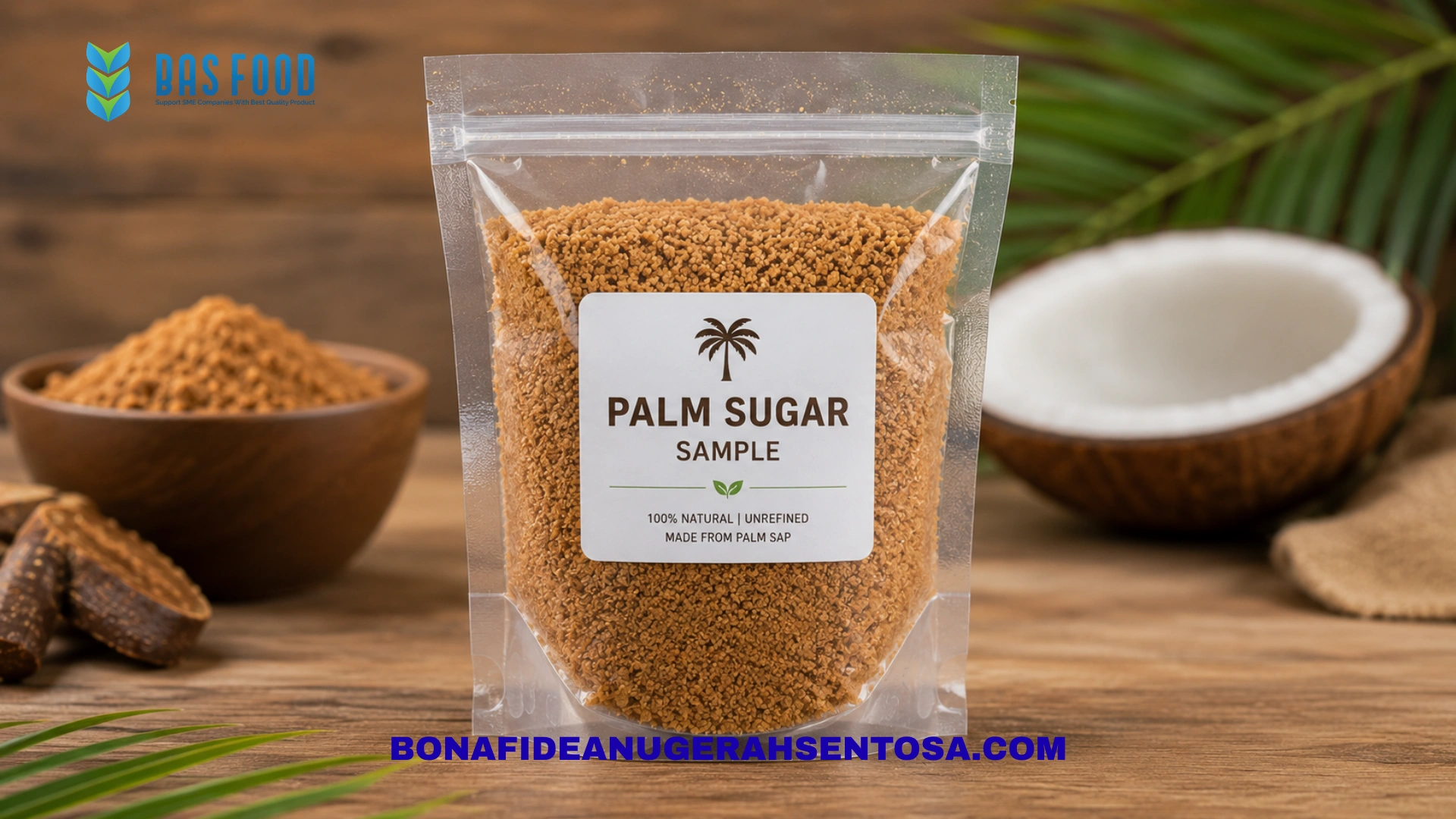
Why Palm Sugar Samples Matter Before Every Purchase
Every importer wants to receive products that meet their exact specifications. However, product descriptions alone cannot fully represent the actual characteristics of palm sugar. Color, aroma, granule size, sweetness, moisture content, and texture are best evaluated through physical samples.
Requesting palm sugar samples allows buyers to compare multiple suppliers before making a purchasing decision. This process reduces uncertainty and provides a realistic understanding of the product’s quality.
Samples are also valuable for internal product development. Food manufacturers often test new ingredients in their recipes before approving them for full-scale production. A small sample can reveal how palm sugar performs in baking, beverages, sauces, confectionery, or other food applications.
Instead of discovering problems after a full container arrives, buyers can identify any issues early and discuss improvements with the supplier before commercial production begins.
What Should Buyers Evaluate in Palm Sugar Samples?
Receiving a sample is only the first step. The next step is performing a careful evaluation based on clear quality criteria.
Visual appearance is often the first characteristic buyers examine. The color should match the agreed specification and remain reasonably consistent throughout the sample.
Texture is equally important. Depending on the product specification, palm sugar may be supplied as granules, powder, blocks, or syrup. Buyers should verify that the texture matches their production requirements.
Taste and aroma also deserve close attention. High-quality palm sugar should provide a pleasant natural sweetness with rich caramel notes and a clean aroma that complements food applications.
In addition, buyers should observe moisture levels, product cleanliness, and overall packaging quality.
Evaluating all of these characteristics together provides a more complete picture of product quality.
Product Sampling Helps Match Production Requirements
Every food manufacturer has unique production needs. Therefore, product sampling is an essential part of ingredient selection.
A bakery may require coarse granules for texture, while a beverage manufacturer may prefer fine powder for faster dissolution. Sauce manufacturers might prioritize consistent sweetness, whereas confectionery producers may focus on caramel flavor.
Testing samples in real production environments helps determine whether the product performs as expected.
Manufacturers can evaluate mixing behavior, solubility, sweetness, color contribution, and processing efficiency before approving commercial purchases.
This practical evaluation reduces production risks while improving confidence in future orders.
Laboratory Testing Supports Better Purchasing Decisions
Visual inspection alone cannot measure every quality characteristic. For this reason, many professional buyers also perform laboratory testing on palm sugar samples.
Laboratory analysis provides objective data that supports purchasing decisions.
Common laboratory evaluations may include:
- Moisture content
- Ash content
- Particle size
- Color consistency
- Microbiological analysis
- Heavy metal analysis
- Product purity
- Food safety parameters
These tests help buyers confirm that products meet both internal quality standards and destination market requirements.
Although laboratory testing requires additional time, it significantly reduces the risk of purchasing products that fail to meet technical specifications.
Supplier Verification Builds Long-Term Trust
Selecting the right supplier involves more than evaluating the product itself. Buyers should also perform proper supplier verification before establishing long-term partnerships.
Supplier verification helps determine whether a manufacturer can consistently deliver products that meet agreed specifications.
Important evaluation areas include:
- Manufacturing experience
- Production capacity
- Quality management systems
- Export experience
- Food safety practices
- Packaging capabilities
- Communication quality
Professional suppliers are usually willing to answer technical questions, provide product specifications, and support sample evaluations.
Transparent communication creates confidence while reducing misunderstandings during commercial production.
Samples Help Confirm Product Consistency
Consistency is one of the most important expectations in international food manufacturing.
Food companies rely on ingredients that perform similarly in every production batch. Even small variations can affect finished product quality.
Palm sugar samples allow buyers to compare multiple batches before placing large orders.
If several samples demonstrate consistent color, flavor, particle size, and moisture levels, buyers gain greater confidence in the supplier’s manufacturing process.
Reliable consistency supports efficient production while reducing costly product adjustments.
Packaging Evaluation Is Just as Important
Product quality extends beyond the ingredient itself. Packaging also deserves careful evaluation during sample review.
Good packaging protects palm sugar from moisture, contamination, and physical damage during storage and transportation.
When reviewing sample packaging, buyers should examine:
- Material quality
- Seal strength
- Label accuracy
- Printing quality
- Food-grade materials
- Moisture protection
If private label or OEM packaging is required, sample packaging also provides an opportunity to verify branding, artwork, and labeling before mass production begins.
This reduces packaging errors during commercial orders.
Questions to Ask Before Approving a Supplier
Requesting samples should always be accompanied by detailed discussions with the supplier.
Important questions include:
- What production method is used?
- How is product consistency maintained?
- What quality control procedures are followed?
- What packaging options are available?
- What is the average production lead time?
- Which export documents can be provided?
- Can specifications be customized?
Clear answers demonstrate the supplier’s technical knowledge and willingness to support customer requirements.
Open communication also creates stronger long-term business relationships.
Why Indonesia Is a Leading Source for Palm Sugar
Indonesia is one of the world’s largest producers of palm sugar and has developed a strong reputation among international buyers.
Its abundant natural resources, experienced farming communities, and long tradition of palm sugar production contribute to consistent product availability.
Many businesses searching for a reliable palm sugar supplier Indonesia choose export-oriented manufacturers because they understand international food safety standards, documentation requirements, and customized product specifications.
Modern Indonesian exporters combine traditional production knowledge with standardized quality management systems, helping them serve customers across Europe, North America, Asia, the Middle East, and Africa.
Their ability to provide samples, customized packaging, OEM services, and dependable export support makes Indonesia one of the most trusted sourcing destinations for palm sugar.
Best Practices for Working with Palm Sugar Suppliers
Successful sourcing begins with preparation.
Before requesting commercial quotations, clearly define your product specifications, packaging requirements, quality expectations, and estimated purchasing volume.
After receiving palm sugar samples, perform both internal evaluations and laboratory testing whenever appropriate.
Maintain open communication throughout the approval process and provide feedback if adjustments are needed.
Once the supplier consistently meets expectations, establish regular purchasing schedules and continue monitoring product quality through periodic sampling.
Long-term cooperation encourages continuous improvement and strengthens supply chain reliability.
Common Mistakes Buyers Should Avoid
Even experienced importers occasionally make avoidable mistakes during sourcing.
One common mistake is approving a supplier based only on price. Low pricing may become costly if product quality is inconsistent.
Another mistake is skipping sample evaluation because of tight purchasing deadlines.
Some buyers also overlook packaging quality or fail to verify technical specifications before production.
Ignoring supplier verification can create unnecessary risks related to production capacity, communication, and export experience.
By following a structured sourcing process, businesses can reduce these risks and make more confident purchasing decisions.
Conclusion
Requesting palm sugar samples is one of the most effective ways to reduce sourcing risks and ensure product quality before placing commercial orders. Through careful product sampling, buyers can evaluate flavor, aroma, texture, color, moisture content, and overall product performance in real manufacturing conditions.
Combining sample evaluation with laboratory testing provides objective quality data, while thorough supplier verification helps identify manufacturers capable of delivering consistent products and reliable service over the long term.
For businesses seeking a dependable palm sugar supplier Indonesia, partnering with an experienced exporter offers access to high-quality products, customized specifications, professional export support, and transparent communication. By making sampling an essential part of your sourcing strategy, you can build stronger supplier relationships, improve product consistency, and support sustainable business growth in international markets.