
The plant-based food industry continues to grow as consumers look for alternatives to traditional dairy and meat products. From creamy vegan desserts to dairy-free spreads, food manufacturers need ingredients that deliver the right texture, flavor, stability, and overall eating experience. One ingredient worth considering is RBD coconut oil for plant-based food.
RBD coconut oil stands for refined, bleached, and deodorized coconut oil. Manufacturers process this oil to reduce unwanted colors, odors, and flavors, making it a useful fat source for many food applications. Its fat composition and physical properties can support the development of plant-based products, although the results depend on the recipe, processing conditions, and desired product characteristics.
For B2B food manufacturers, choosing the right fat is an important step in product development. A suitable oil can help improve mouthfeel, support product structure, and create a more consistent experience for consumers. In this guide, we explore how RBD coconut oil fits into plant-based food production, what buyers should consider, and how to evaluate suppliers for long-term sourcing.
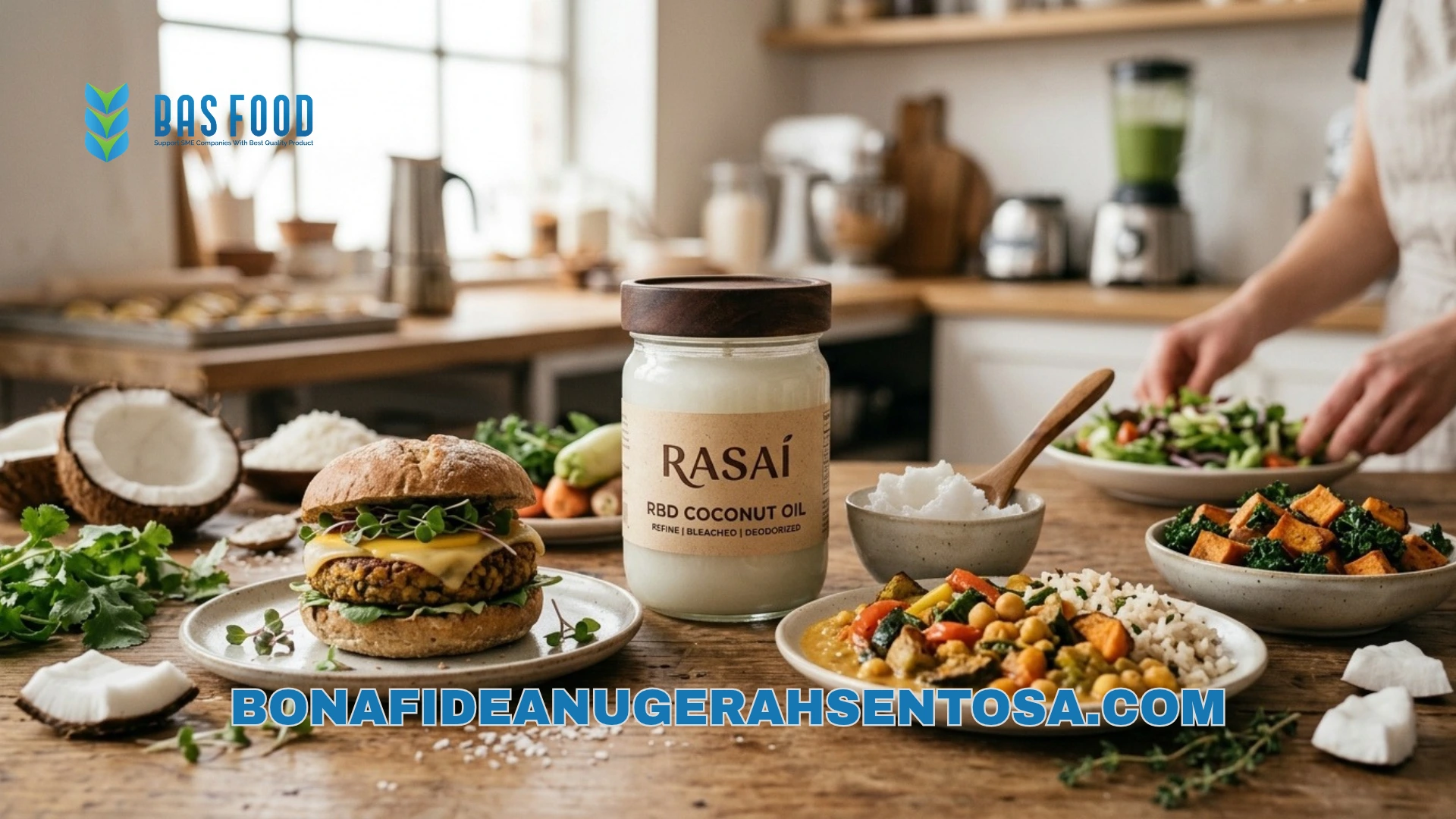
What Is RBD Coconut Oil for Plant-Based Food?
RBD coconut oil is coconut oil that has undergone three main processing stages: refining, bleaching, and deodorization. Refining helps remove impurities, bleaching reduces unwanted color compounds, and deodorization reduces odors and flavors that could affect the final product. The exact processing method and specifications vary by manufacturer.
Unlike virgin coconut oil, which typically retains more of coconut’s natural aroma and flavor, RBD coconut oil generally has a more neutral sensory profile. This characteristic can be helpful when a manufacturer wants the other ingredients to define the flavor of a product. For example, a company producing vanilla-flavored vegan cream may prefer a fat that does not introduce a noticeable coconut taste.
The properties of RBD coconut oil also make it relevant to plant-based formulations. Coconut oil contains a high proportion of saturated fatty acids, including lauric acid. As a result, it behaves differently from oils that remain liquid at typical room temperatures. Its melting and solidification behavior can influence the firmness, creaminess, and mouthfeel of finished foods.
However, RBD coconut oil is not a complete solution for every plant-based application. It does not automatically provide the water-binding, emulsifying, protein, or nutritional functions that other ingredients may offer. Manufacturers should evaluate it as one part of a complete formulation rather than expecting it to replace every function of dairy fat.
Why Plant-Based Food Manufacturers Need the Right Fat
Fat plays several roles in food production. It contributes to richness, carries flavor, affects lubrication in the mouth, and helps create the texture consumers expect. In some products, fat also influences how the food holds its shape during storage and how it behaves when heated or cooled.
For plant-based manufacturers, these functions can be challenging to reproduce. Dairy products contain a complex combination of fat, protein, water, and other components. Replacing dairy with plant-derived ingredients requires careful formulation because a simple one-to-one substitution may change the final product’s texture, stability, and flavor.
This is where plant-based fats become important. Food developers can select from coconut oil, palm-derived fats, sunflower oil, rapeseed oil, and other vegetable oils, depending on the application. Each option has different melting characteristics, fatty acid profiles, and processing requirements.
RBD coconut oil can contribute a firm or creamy texture in suitable formulations because of its fatty acid composition and temperature-dependent behavior. Nevertheless, it may not provide the same performance as every specialized dairy fat or commercial fat blend. The best choice depends on the intended product, its storage temperature, processing method, and target nutritional profile.
For manufacturers, the goal is not simply to replace animal-derived fat. It is to build a product that performs reliably throughout production, distribution, and consumer use.
Applications in Dairy Alternative Ingredients
The demand for dairy alternative ingredients has encouraged food producers to explore different combinations of vegetable oils, proteins, starches, fibers, stabilizers, and emulsifiers. These combinations help manufacturers develop products with a creamy mouthfeel and an appealing appearance without using conventional dairy ingredients.
RBD coconut oil may serve as a fat component in selected dairy-free formulations. Its relatively neutral flavor can make it suitable for products where manufacturers want to emphasize chocolate, vanilla, coffee, fruit, herbs, or other flavor ingredients. Depending on the recipe, it may also contribute to body and firmness.
Plant-based cream and whipping-style products
Some non-dairy cream formulations require a fat phase that supports a rich mouthfeel and helps produce the desired texture. RBD coconut oil may be considered as part of the fat blend, but its performance depends on the formulation’s emulsifiers, stabilizers, proteins, and processing conditions.
Whipping performance requires particular attention. A fat’s melting range and crystallization behavior can influence how well a product incorporates air and maintains its structure. Therefore, manufacturers should test the finished formulation under realistic storage and preparation conditions rather than assuming that coconut oil alone will create a stable whipped product.
Dairy-free spreads and cheese alternatives
Plant-based spreads and cheese-style products often need a balance between spreadability, firmness, and melt behavior. RBD coconut oil may help provide structure in some formulations, especially when the product needs to be firm when chilled but soften during use.
However, coconut oil can become firm at cooler temperatures and soften as temperatures rise. Manufacturers should assess whether this behavior matches the product’s intended use. A spread designed for refrigeration may require a different fat blend from a cheese alternative intended for cooking or melting.
Vegan desserts and frozen treats
Desserts such as dairy-free puddings, confectionery fillings, and selected frozen treats can benefit from carefully controlled fat content. RBD coconut oil may contribute richness and a fuller mouthfeel when combined with suitable ingredients.
For frozen applications, developers should also consider ice-crystal formation, freezing behavior, and temperature fluctuations during distribution. Coconut oil cannot independently control all these factors, so the complete formulation and manufacturing process remain essential.
Using RBD Coconut Oil in Vegan Food Formulation
Successful vegan food formulation involves more than selecting ingredients that come from plants. Manufacturers must consider functionality, flavor, nutrition, processing conditions, product labeling, and consumer expectations. Each ingredient needs to serve a clear purpose within the final recipe.
RBD coconut oil can be useful when a product requires a relatively neutral fat with particular melting characteristics. Nevertheless, its performance depends on the other ingredients and the way the product is processed. A formulation designed for a refrigerated dessert, for example, may behave very differently from one intended for a shelf-stable filling.
Match the oil to the product’s purpose
Start by defining the required properties of the finished food. Does it need to remain soft in the refrigerator? Should it melt quickly in the mouth? Must it hold its shape during transport? Will consumers cook, bake, freeze, or reheat it?
These questions help determine whether RBD coconut oil is appropriate or whether a blend of fats would perform better. A manufacturer producing a soft vegan spread may need a different fat profile from a company developing a firm plant-based confectionery filling.
Test emulsification and stability
Oil and water do not naturally form a stable mixture. Many plant-based foods therefore use emulsifiers and stabilizers to create and maintain the desired structure. RBD coconut oil supplies the fat phase, but it does not automatically prevent separation or guarantee a stable emulsion.
Manufacturers should test the complete recipe for separation, texture changes, and consistency during storage. Depending on the application, they may also need to evaluate the effect of mixing speed, processing temperature, cooling rate, and packaging.
Consider the nutrition label
Coconut oil contains a high proportion of saturated fat. Although it can offer useful functional properties, manufacturers should consider its nutritional contribution when designing products for consumers who monitor saturated fat intake.
The finished product’s nutrition profile depends on the full ingredient list and serving size. Businesses should calculate nutrition values using appropriate data or laboratory analysis and ensure that any nutrition claims comply with the regulations in their target markets.
How RBD Coconut Oil Influences Texture, Melting, and Mouthfeel
Texture is one of the most important factors in plant-based food acceptance. Consumers may appreciate a product’s ingredients, but they are unlikely to buy it repeatedly if it feels greasy, waxy, grainy, or too firm. Choosing the right fat can help manufacturers address these challenges.
RBD coconut oil has temperature-dependent physical properties. Depending on the grade and surrounding conditions, it may be solid or semi-solid at cooler temperatures and become liquid as it warms. This behavior can influence product firmness, melting, and the way fat is perceived in the mouth.
For example, a formulation with an unsuitable fat profile may become too hard after refrigeration. In another recipe, the product may soften excessively during warm-weather distribution. These outcomes can affect consumer satisfaction and create problems for manufacturers and retailers.
To manage these risks, product developers should assess the oil’s melting profile, solid fat characteristics where relevant, and performance across the intended temperature range. They should also test the final product after realistic storage, transport, and handling conditions.
It is equally important to distinguish between melting behavior and overall product performance. A fat that melts at a particular temperature will not necessarily create the desired creaminess or stability on its own. Protein structure, emulsifiers, starches, water content, and processing all contribute to the finished result.
RBD Coconut Oil Compared With Other Plant-Based Fats
Manufacturers have several options when choosing fats for plant-based foods. The right choice depends on functionality, cost, ingredient availability, nutritional targets, and the desired consumer experience.
Coconut oil, palm-derived fats, and liquid vegetable oils all have different characteristics. RBD coconut oil is often considered when manufacturers need a relatively neutral oil with a distinctive melting profile. Liquid oils, meanwhile, may be more suitable when a formulation requires fluidity at normal room temperatures.
Specialized fat blends can offer more controlled performance. By combining fats with different melting characteristics, manufacturers may achieve a specific firmness, spreadability, or melting profile. These blends can be helpful in products where pure coconut oil does not meet all technical requirements.
| Ingredient option | Potential advantage | Important consideration |
|---|---|---|
| RBD coconut oil | Relatively neutral flavor and useful temperature-dependent texture | High saturated fat content; performance varies with formulation and temperature |
| Liquid vegetable oils | Useful for fluid oil phases and soft products | May provide limited structure without other ingredients |
| Palm-derived fats | Available in grades with different functional properties | Sustainability, sourcing, and grade selection may be important |
| Specialized vegetable fat blends | Can be designed for specific melting and texture requirements | Specifications, cost, and compatibility need evaluation |
No single fat is ideal for every application. Manufacturers should compare technical specifications and test actual performance rather than selecting an ingredient based only on its name or origin.
Quality Specifications B2B Buyers Should Check
For food manufacturers, reliable ingredient sourcing begins with clear specifications. The term RBD coconut oil describes a processing category, but it does not guarantee that every product has identical characteristics. Buyers should confirm the exact grade and technical requirements before placing a commercial order.
Important specifications may include fatty acid composition, free fatty acid level, moisture and volatile matter, color, odor, melting characteristics, and oxidation-related quality indicators. The relevant parameters depend on the application and the supplier’s product specification. Buyers should request current technical documentation instead of relying on general descriptions.
Food safety documentation is also important. Depending on the market and intended use, buyers may need a certificate of analysis, product specification sheet, safety documentation where applicable, traceability information, and relevant regulatory or food-safety declarations. Any certification requirement should be verified with the supplier and checked against the buyer’s market rules.
Packaging and transport
Packaging should protect the oil from contamination, moisture, excessive heat, and other conditions that could affect quality. The appropriate packaging format depends on the supplier’s available options, order volume, transport method, and the buyer’s storage facilities.
International buyers should also confirm the shipping conditions, product identification, batch information, documentation, and expected lead time. If a business plans to use the oil in a commercial food production line, it should evaluate whether the packaging can be handled efficiently at the receiving facility.
Storage and handling
Store RBD coconut oil according to the supplier’s instructions. Keep it protected from contaminants, strong odors, excessive heat, and direct sunlight. Temperature changes can affect its physical state, so buyers should understand whether the product is expected to arrive as a solid, semi-solid, or liquid under the anticipated shipping conditions.
Before using the oil in production, check its appearance, odor, packaging integrity, and batch documentation. Follow the manufacturer’s recommendations for melting, handling, and storage, and avoid repeatedly heating the oil beyond the process requirements.
Sourcing RBD Coconut Oil From Indonesia
Indonesia is an important origin for coconut-based commodities, making it a market that international food manufacturers may consider when developing their sourcing strategy. However, the suitability of any supplier depends on the product specification, quality controls, documentation, order requirements, and consistency of service.
B2B buyers should provide suppliers with a clear purchasing brief. Include the intended application, required technical specifications, packaging preferences, expected order volume, destination country, and any regulatory or documentation needs. This helps suppliers determine whether their current offering matches the buyer’s requirements.
CV Bonafide Anugerah Sentosa operates in the Indonesian commodity export sector, with a business focus that includes coconut-derived products and sugar products. Buyers interested in RBD coconut oil should contact the company directly to confirm current availability, specifications, packaging options, minimum order quantities, and export terms. Do not assume that every coconut-derived product is available in every grade or at every point in time.
For a new business relationship, buyers may also want to request product documentation and discuss a sample or trial arrangement, if available. Any sample should be evaluated using the buyer’s actual application and quality criteria before moving to larger production volumes.
Coconut Oil and Coconut Sugar: Different Ingredients, Different Uses
Businesses that source coconut-based ingredients may also explore coconut sugar for sweetening applications. However, coconut oil and coconut sugar are different products and serve different functions in food manufacturing.
RBD coconut oil is a fat ingredient. Manufacturers may use it to contribute richness, texture, or structure in suitable formulations. Coconut sugar, by contrast, is a sweetener made from coconut palm sap. It contributes sweetness and its own color and flavor characteristics, which may affect the finished product.
For this reason, a company looking for a coconut sugar exporter supplier should clarify whether it needs coconut sugar, coconut oil, or both. Likewise, the search term coconut sugar supplier refers to a supplier of a sweetening ingredient and should not be treated as equivalent to a supplier of RBD coconut oil.
International buyers may also encounter the Spanish phrase exportador de azúcar de coco, which means coconut sugar exporter. It describes a coconut sugar export supplier rather than a specific grade of coconut oil. Using these terms accurately helps procurement teams find the right product and reduces confusion when requesting quotations.
CV Bonafide Anugerah Sentosa can be contacted to discuss its current coconut-derived product range and sugar offerings. Buyers should verify the availability of each product separately and request the relevant technical specifications before making purchasing decisions.
How to Evaluate RBD Coconut Oil Before Scaling Production
A successful ingredient trial should reflect the product’s real manufacturing conditions. Start with a small batch and follow the planned mixing, heating, cooling, filling, and packaging steps. Record the process conditions so the team can repeat the trial and compare results consistently.
Next, evaluate the finished food against clear acceptance criteria. Depending on the application, these may include firmness, spreadability, melting behavior, mouthfeel, flavor, appearance, emulsion stability, and performance after storage. If the product is designed for frozen or refrigerated distribution, include appropriate temperature and storage tests.
It is also useful to compare more than one formulation. A slightly different oil level or fat blend may improve the result, while adjustments to emulsifiers or stabilizers may address problems that oil selection alone cannot solve. Keep changes controlled so the team can identify which factors actually improve performance.
Before scaling up, confirm that the selected ingredient is commercially practical. Consider the supplier’s specifications, packaging, expected lead time, available documentation, and ability to meet the business’s requirements. A formulation is only commercially useful when the ingredient can be sourced and handled consistently.
Conclusion: Build Better Plant-Based Products With the Right Fat
RBD coconut oil for plant-based food can be a valuable ingredient when manufacturers need a relatively neutral coconut-derived fat with useful melting and texture characteristics. It may contribute to dairy-free spreads, selected cream-style products, vegan desserts, and other formulations, depending on the recipe and processing method.
However, successful formulation requires more than choosing a plant-derived ingredient. Manufacturers should evaluate the oil’s specifications, consider its saturated fat content, test the complete recipe, and assess product performance under realistic storage and distribution conditions. These steps help businesses develop products that meet both technical requirements and consumer expectations.
For B2B buyers, reliable sourcing is equally important. Request current documentation, clarify commercial requirements, and verify product availability before committing to a purchase. To discuss coconut-derived ingredients and related sugar products, contact CV Bonafide Anugerah Sentosa and confirm which products match your needs.
By combining careful formulation with informed procurement, food manufacturers can make better decisions about RBD coconut oil and develop plant-based products with the texture, quality, and consistency their customers expect.