
Buying a new food ingredient in bulk is a serious decision. A product may look good on a specification sheet, but that does not always mean it will perform well in your own production process. This is especially true for liquid sweeteners, where consistency, flavor, color, viscosity, packaging, and shelf stability can all affect the final product.
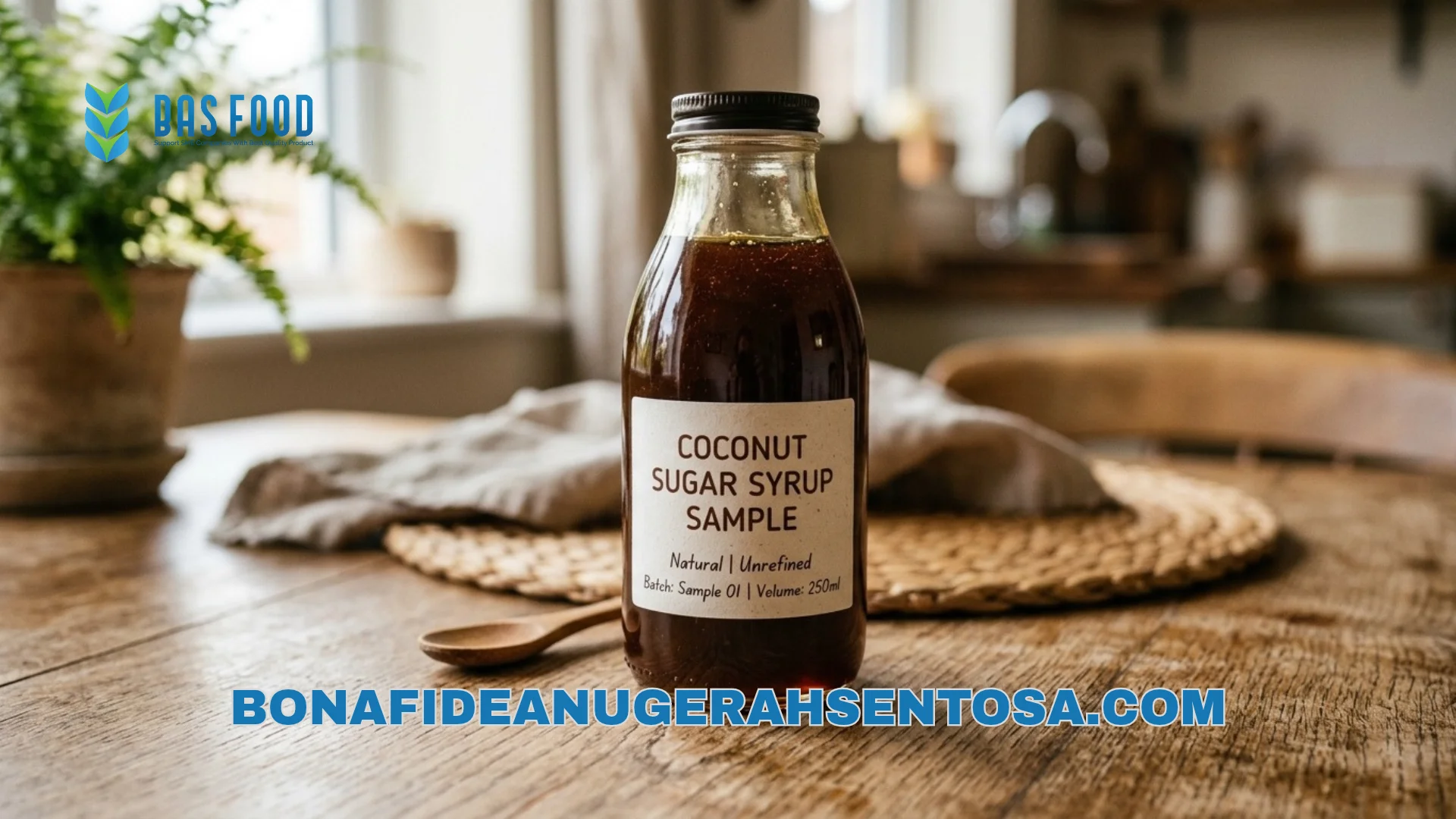
That is why coconut sugar syrup samples are valuable for importers, food manufacturers, distributors, beverage companies, bakeries, and foodservice businesses. A sample gives buyers a practical way to evaluate the product before committing to a larger commercial order.
For B2B buyers, sampling is not simply about tasting a sweetener. It is part of a structured purchasing process. Through product sampling, buyers can compare suppliers, test the syrup in real formulations, review technical characteristics, and identify potential issues before production begins.
In this guide, we will explain how to evaluate coconut sugar syrup samples, what to test, which questions to ask suppliers, and how sampling can support better supplier evaluation.
Why Coconut Sugar Syrup Samples Matter for B2B Buyers
A supplier’s product description can tell you a lot about an ingredient, but it cannot answer every practical question. For example, a specification may describe the product as a liquid coconut sweetener, yet you may still need to know how it behaves when mixed into your beverage, sauce, bakery formulation, or dessert.
This is where coconut sugar syrup samples become useful. The sample allows your technical or purchasing team to see the product firsthand. You can check its appearance, aroma, taste, consistency, packaging, and performance under your own production conditions.
Sampling also reduces purchasing risk. Instead of making a large order based only on a supplier’s quotation, you can first establish whether the product matches your requirements.
Moreover, samples create a common reference between buyer and supplier. Once both sides agree that a sample meets the required standard, it can become a useful reference when discussing future commercial batches.
What Exactly Should You Expect From a Coconut Sugar Syrup Sample?
A coconut sugar syrup sample is a smaller quantity of the supplier’s liquid sweetener provided for evaluation. The exact sample size and packaging can vary depending on the supplier, application, destination, and commercial discussion.
The sample should ideally represent the product that the supplier intends to provide commercially. This point is important. A buyer does not want to test one product and later receive a significantly different product in bulk.
For this reason, buyers should ask whether the sample represents the current commercial specification. They should also record the sample identification, production or batch information when available, packaging details, and the supplier’s specification sheet.
It is also useful to keep an approved reference sample for future comparison, where practical. This can help both the buyer and supplier discuss any perceived changes between batches.
The First Step: Define Your Product Requirements
Before requesting coconut sugar syrup samples, define what you actually need. Otherwise, you may receive several samples without having a clear way to compare them.
Start with the intended application. Are you making coffee beverages, ready-to-drink beverages, sauces, desserts, bakery products, toppings, or another food product? The answer can influence which syrup characteristics matter most.
Next, identify the basic product requirements. These may include color, flavor, sweetness profile, viscosity, solids content, packaging format, shelf life, storage conditions, and food safety requirements.
Your requirements do not need to be complicated. A simple product brief can give suppliers enough information to provide a more relevant sample.
For example, instead of asking only for “coconut sugar syrup,” a buyer could explain the intended application, expected order volume, target market, preferred packaging, and any important technical requirements.
This makes the sampling process much more useful.
Visual Evaluation: Start With Appearance
The first part of syrup testing can be surprisingly simple. Look at the sample before opening or using it. Check the packaging condition, seal, labeling, and general appearance.
After opening the container, observe the syrup’s color and visual consistency. Coconut sugar syrup may naturally have a brown appearance, but the exact shade can vary depending on the raw material and processing method.
If color is important to your finished product, establish an acceptable range with the supplier. A small difference may not matter in one application but could be important in another.
Also check whether the syrup appears uniform. Unusual separation, unexpected particles, or other visible issues should be discussed with the supplier before proceeding.
However, visual inspection is only the beginning. A good-looking sample still needs to pass technical and application testing.
Flavor and Aroma Testing
Flavor is one of the most important characteristics when evaluating a sweetener. Coconut sugar syrup can have a distinctive sweet profile, often associated with caramel-like or rich sugar notes.
However, the exact sensory profile can differ between products. Raw material handling and processing conditions can influence the final flavor and aroma.
Therefore, buyers should evaluate the sample both on its own and inside the intended formulation. A syrup that tastes pleasant by itself may behave differently when combined with coffee, cocoa, dairy ingredients, fruit, spices, or other components.
For professional product development, it can be helpful to record sensory observations in a simple evaluation sheet. Note the sweetness, aroma, aftertaste, color contribution, and overall compatibility with the recipe.
This creates a more objective basis for comparing different coconut sugar syrup samples.
Testing Viscosity and Consistency
Viscosity is another important factor, particularly for commercial applications. A syrup that is too thick or too thin may create handling or production challenges.
For example, a beverage manufacturer may need a syrup that mixes easily with other liquid ingredients. A sauce producer, on the other hand, may have different requirements related to texture and flow.
The right viscosity depends on the intended application. Therefore, buyers should not simply ask for a syrup that is “thick” or “thin.” Instead, discuss the desired consistency with the supplier.
Where a specific viscosity measurement is important, the buyer and supplier should agree on the test method and relevant specification. Testing methods can affect reported results, so both sides should use compatible procedures when comparing samples.
This is particularly useful when moving from product development to commercial production.
Checking Solids Content and Other Technical Parameters
Depending on the application, buyers may need to review technical parameters such as soluble solids, moisture, pH, viscosity, color, and microbiological quality.
Not every parameter will be equally important for every buyer. A beverage manufacturer may focus heavily on consistency and solubility, while a sauce producer may place greater emphasis on viscosity and flavor.
The key is to connect the specification to the actual production process. Ask the supplier for the available technical specification and identify which values matter to your application.
Do not assume that terminology is standardized across every supplier. For example, different producers may describe similar products using terms such as liquid coconut sugar or coconut syrup sweetener.
The technical specification should therefore be the main reference when comparing samples.
Test the Sample in Your Actual Product
One of the biggest mistakes in product sampling is evaluating the syrup only by itself. A food ingredient is rarely purchased simply to be consumed on its own. It is purchased because it needs to perform inside another product.
For this reason, application testing should be part of the process. Use the sample in your actual recipe or a representative laboratory formulation.
For beverages, check mixing, sweetness, color, flavor, and stability. For bakery products, examine flavor, color, texture, and the effect on the recipe. For sauces and toppings, consider viscosity, appearance, flavor, and processing behavior.
Keep the formulation and test conditions consistent when comparing suppliers. If every sample is tested under different conditions, it becomes difficult to determine which differences come from the syrup and which come from the testing process.
A simple controlled test can provide much more useful information than a casual tasting.
Supplier Evaluation Goes Beyond the Product
A good sample does not automatically mean that a supplier is suitable for long-term business. Supplier evaluation should consider both product quality and business reliability.
Start by reviewing how clearly the supplier communicates. Can they explain the product specification? Can they answer technical questions? Can they provide relevant documentation? Can they explain available packaging and commercial options?
Production capacity also matters. A supplier may be able to provide a small sample but struggle to support regular bulk orders.
For international buyers, export experience is another useful consideration. Shipping, documentation, packaging, customs requirements, and delivery schedules all become part of the relationship.
In other words, the sample evaluates the product, while supplier qualification evaluates the business behind the product.
Packaging Should Be Part of the Sample Evaluation
Packaging is sometimes overlooked during sampling. However, it can become a major consideration when the product moves into commercial quantities.
When evaluating the sample, inspect the container, closure, labeling, and general protection. Consider whether the format is practical for your laboratory, production facility, warehouse, or foodservice operation.
For international shipments, packaging needs to withstand transportation and handling conditions. Buyers should therefore discuss the available export packaging with the supplier before placing a bulk order.
The final packaging may differ from the sample packaging because commercial orders often use larger containers or different formats. Even so, the sample discussion should establish the basic packaging requirements.
Shelf Life and Storage Evaluation
Shelf life is another important topic when evaluating liquid sweeteners. Buyers should ask the supplier for available shelf-life information and recommended storage conditions.
Storage conditions can influence product quality over time. Temperature, exposure to unsuitable conditions, packaging integrity, and handling practices may affect the product.
Where shelf stability is important to the buyer’s application, a basic storage or stability test may be useful. The exact testing program should depend on the product, formulation, market requirements, and technical team.
Do not assume that a sample’s condition after a few days automatically proves its long-term stability. Commercial shelf-life claims should be supported by appropriate supplier information and testing.
From Sample Approval to Bulk Order
Once a sample meets your requirements, the next step is to turn the sample evaluation into a clear commercial specification.
Document the characteristics that have been approved. This may include appearance, flavor, viscosity, packaging, technical parameters, and other application-specific requirements.
Then discuss the commercial order with the supplier. Confirm quantity, packaging, production schedule, shipping terms, documentation, and any other requirements before production begins.
It is also useful to clarify how future batches will be controlled. If the product is intended for regular supply, both sides should understand the agreed quality reference.
This approach creates a smoother transition from product development to procurement.
Choosing a Coconut Sugar Supplier for Long-Term Supply
A reliable coconut sugar supplier should be able to support more than one successful sample. Long-term supply requires consistency, communication, production planning, and clear specifications.
Buyers should therefore evaluate whether the supplier has the capacity to support repeat orders. Ask about production planning, quality control, packaging, lead times, and export procedures.
For distributors and importers, consistency can be especially important because the ingredient may be supplied to multiple downstream customers. Variations between shipments can create additional work and customer complaints.
A strong supplier relationship begins with a clear sample process. When both sides understand the product requirements from the beginning, future orders can become easier to manage.
Working With an Indonesian Coconut Sugar Exporter Supplier
Indonesia is a major source of coconut-based ingredients, making Indonesian suppliers relevant to international buyers looking for coconut sugar products.
When choosing an Indonesian coconut sugar exporter supplier, buyers should evaluate the same fundamentals used for any international ingredient partner: product quality, documentation, packaging, production capacity, communication, and export capability.
The advantage of a structured sample process is that it gives the buyer a practical starting point. Rather than relying only on a website or sales quotation, the buyer can evaluate the actual ingredient.
For international procurement teams, this can make supplier comparison more transparent and help identify which suppliers are able to meet the required specifications.
CV Bonafide Anugerah Sentosa and Coconut Sugar Syrup Sampling
CV Bonafide Anugerah Sentosa is an Indonesian supplier and exporter of coconut sugar and other coconut-derived products. For buyers exploring coconut sugar syrup, the sampling process can be used to discuss product requirements before moving toward commercial sourcing.
A B2B buyer can communicate the intended application, preferred product characteristics, packaging needs, and estimated purchasing requirements. This gives the supplier a clearer understanding of what the buyer needs.
As with any ingredient sourcing process, buyers should evaluate samples against their own formulation and technical requirements. If the sample performs well, the next step is to confirm the commercial specification and order conditions.
This approach creates a practical bridge between product development and international procurement.
Common Mistakes When Testing Coconut Sugar Syrup Samples
One common mistake is testing a sample without defining the purpose of the test. If buyers do not know which characteristics matter, the evaluation can become subjective.
Another mistake is comparing samples from different suppliers under different formulation conditions. Keep the recipe, dosage, mixing method, and testing environment as consistent as possible.
Buyers should also avoid judging the product only by price. A slightly higher product cost may be offset by better consistency, packaging, technical support, or supply reliability. The complete commercial picture matters.
Finally, do not approve a sample without documenting the result. Record what was tested, what was accepted, and what specification should apply to the future commercial order.
Final Thoughts: Why Sampling Should Come Before Bulk Sourcing
Coconut sugar syrup samples give B2B buyers a practical opportunity to evaluate an ingredient before making a larger commitment. The process can reveal important details about flavor, color, viscosity, packaging, application performance, and overall product suitability.
More importantly, sampling is part of a broader supplier evaluation process. A supplier should not only provide an attractive sample. It should also demonstrate the ability to maintain specifications, communicate clearly, support commercial orders, and handle export requirements.
For importers, distributors, food manufacturers, and beverage companies, the safest approach is straightforward. Define your requirements, request representative samples, test them under real conditions, document the results, and then discuss the commercial order.
Whether you are looking for a first shipment or developing a long-term supply relationship, a well-managed sample process can help create clearer expectations between buyer and supplier.
When sourcing from Indonesia, buyers can also discuss their requirements with CV Bonafide Anugerah Sentosa and evaluate whether its coconut sugar products match their technical and commercial needs.