
Finding the right Indonesia coconut sugar syrup supplier can be an important step for food manufacturers, beverage companies, distributors, importers, and ingredient traders looking for a reliable source of liquid sweetener. At first, supplier sourcing may look simple. A buyer searches for coconut sugar syrup, compares several prices, requests samples, and chooses a supplier. In practice, however, international B2B sourcing involves many more details. Buyers need to understand product specifications, packaging, quality assurance, production capacity, documentation, shipping, and communication.
Coconut sugar syrup is also not a one-size-fits-all ingredient. Different food applications can require different product characteristics. A beverage manufacturer, for example, may pay close attention to viscosity and consistency, while a sauce manufacturer may have different requirements for flavor, color, and handling.
Therefore, choosing a supplier should begin with the buyer’s actual needs. The goal is not simply to find an Indonesian company selling coconut sugar syrup. The goal is to find an Indonesia coconut sugar syrup supplier whose product, processes, communication, and export capabilities fit the buyer’s business.
This guide explains what international buyers should consider when evaluating Indonesian coconut sugar syrup suppliers and how to build a more organized sourcing process.
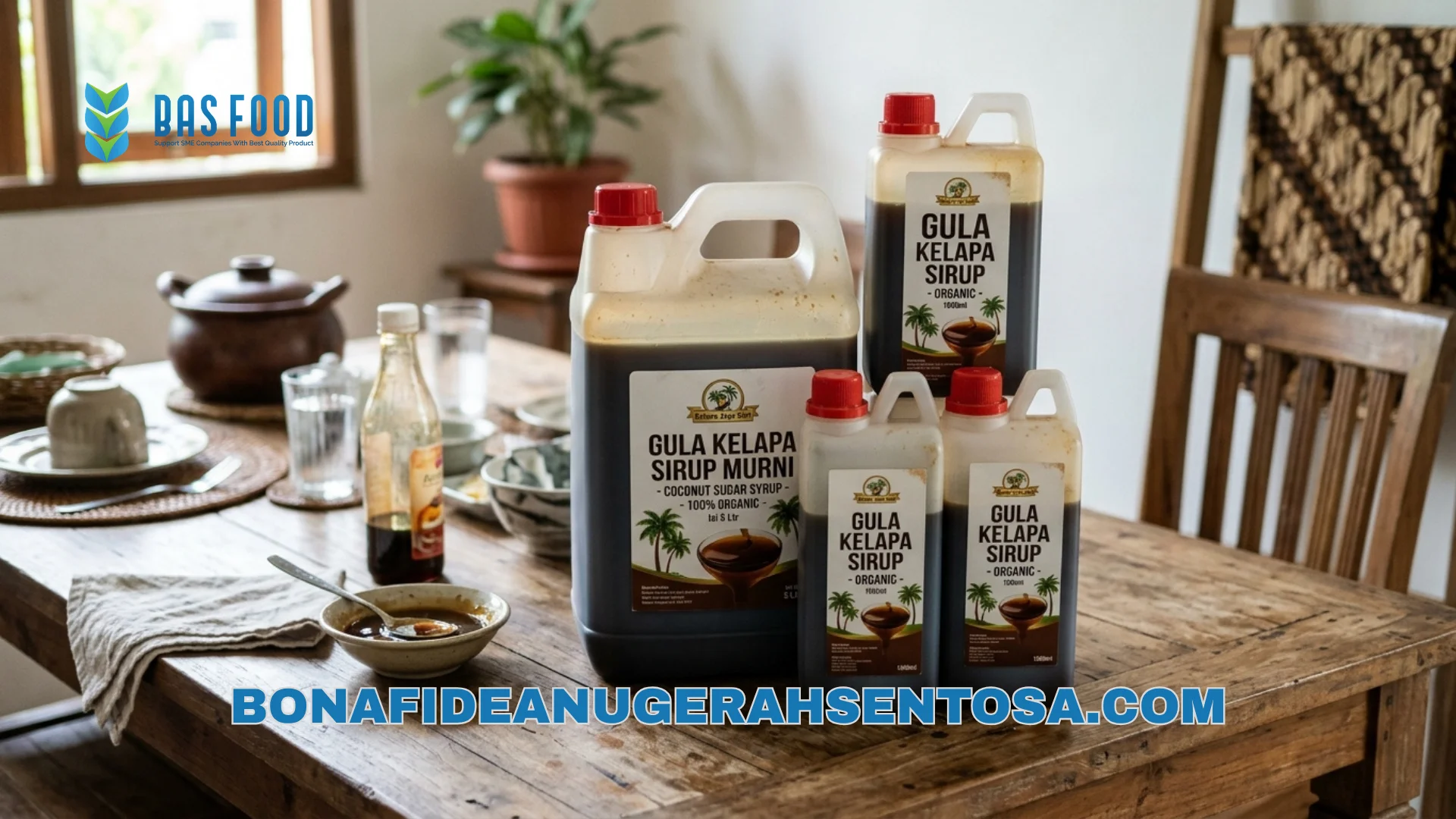
Why Source Coconut Sugar Syrup From Indonesia?
Indonesia is well known for its coconut-producing regions and wide range of coconut-derived products. Coconut sap can be processed into coconut sugar, which can then be supplied in different forms, including syrup.
For international buyers, Indonesia can therefore be an interesting sourcing market. However, the country’s large production base does not mean every supplier offers the same product or service. Buyers still need to evaluate each supplier carefully.
The advantage of sourcing directly from an Indonesian supplier is that buyers can establish a business relationship closer to the production source. This can support clearer communication about raw materials, product specifications, packaging, and production requirements.
At the same time, international sourcing requires a broader evaluation. A supplier should understand not only how to produce the product but also how to prepare commercial orders for export.
This is especially important for importers. A supplier may have a suitable product but limited experience with international shipments. Therefore, buyers should evaluate both the product and the supplier’s export readiness.
What Is Coconut Sugar Syrup?
Coconut sugar syrup is a liquid sweetener made from coconut-derived sugar material. It has a liquid texture and is commonly considered for applications where a liquid sweetening ingredient is easier to handle than dry sugar.
The syrup format can be useful for food and beverage manufacturers because liquid ingredients can be incorporated into certain formulations without first dissolving a dry sweetener.
Depending on the formulation and specification, coconut sugar syrup can be considered for beverages, sauces, bakery products, desserts, toppings, dressings, and other food applications.
However, the actual suitability depends on the product specification and the manufacturer’s formulation. Buyers should not assume that every coconut sugar syrup will behave in exactly the same way.
Factors such as concentration, viscosity, color, flavor, moisture, packaging, and processing conditions can influence how the syrup performs in a finished product.
What Makes a Good Indonesia Coconut Sugar Syrup Supplier?
A good Indonesia coconut sugar syrup supplier should be able to explain its product clearly. Buyers need access to useful information before making a commercial decision.
The supplier should be able to discuss the product specification, packaging, available quantities, production process, sample availability, and export arrangements. Clear communication is especially important when the buyer and supplier operate in different countries.
Quality consistency is another important factor. A supplier should have a practical approach to checking its products and maintaining agreed specifications.
This does not mean that every supplier needs to use exactly the same quality system. Instead, buyers should ask how the supplier controls its product and how it handles quality requirements.
Export capability also matters. An international buyer may require documents, shipping coordination, labels, packaging, and other commercial details that differ from domestic orders.
Therefore, supplier evaluation should cover the complete business process rather than focusing only on the product price.
Understanding Product Specification Before Ordering
A clear product specification is one of the most important documents for B2B buyers. It helps the buyer understand exactly what is being offered.
For coconut sugar syrup, relevant information can include appearance, color, flavor, viscosity, concentration or Brix where applicable, moisture, and other product-specific parameters.
The right specification depends on the intended application. A beverage producer may have different requirements from a bakery manufacturer or sauce producer.
Therefore, buyers should explain their application when contacting the supplier. This gives the supplier context and allows both parties to discuss whether the product is suitable.
It is also important to distinguish between a standard product and a customized product. A standard specification may be easier to supply consistently, while customized requirements may need additional discussion.
Before placing a commercial order, buyers should confirm the agreed specification in writing. This creates a useful reference for production and future orders.
Quality Assurance: What Should Buyers Ask?
Quality assurance is a key part of international ingredient sourcing. Buyers want confidence that the product they receive matches the product they approved.
When evaluating a supplier, ask how the company checks its coconut sugar syrup. Buyers can request information about product inspection, batch consistency, testing, handling, and other relevant quality procedures.
The purpose is not to collect unnecessary documents. Instead, buyers should identify the quality information that actually matters for their product.
For example, if viscosity is important to the buyer’s production process, the buyer should clearly communicate the required range or specification. If color or flavor consistency matters, those characteristics should also be discussed.
Samples can provide another useful quality checkpoint. The buyer can evaluate the sample internally and determine whether it works in the intended formulation.
Once the product is approved, the agreed specifications should become a reference for future orders. This can help both buyer and supplier maintain clearer expectations.
Why Samples Matter for International Buyers
Ordering a sample before a commercial shipment is a practical step when evaluating a new supplier. A sample allows buyers to see and test the actual product rather than relying only on a description.
For coconut sugar syrup, buyers can evaluate characteristics such as appearance, aroma, flavor, texture, viscosity, and performance in their formulation.
Food manufacturers should ideally test the syrup in the actual application. For example, a beverage producer can test how the syrup integrates into a drink formula, while a bakery company can evaluate how it behaves in a specific recipe.
Sample testing can also reveal whether the packaging is practical for handling and storage.
Once the sample is approved, the buyer can move to the next stage of discussing commercial quantities, packaging, pricing, and production schedules.
Packaging and Storage Considerations
Packaging is more than a way to contain the product. For an exported liquid ingredient, packaging must also support handling, transportation, storage, and protection throughout the supply chain.
When evaluating an Indonesia coconut sugar syrup supplier, buyers should ask what packaging options are available for commercial orders.
The appropriate format depends on the buyer’s production process, storage capacity, handling equipment, order volume, and destination.
Sealing is also important. The packaging should be appropriate for the product and transportation conditions.
Buyers should discuss labeling as well, particularly when importing food ingredients. The exact requirements can vary by destination, so buyers should confirm applicable rules before shipment.
Storage conditions should also be communicated clearly. The buyer’s warehouse should be suitable for the product and follow the supplier’s recommendations.
Production Capacity and Supply Consistency
A supplier may be able to provide samples but still need to demonstrate that it can support regular commercial orders.
This is why buyers should ask about production capacity and supply planning when they expect recurring purchases.
A food manufacturer, for example, may need coconut sugar syrup every month. If the supplier cannot maintain a suitable production schedule, the buyer may experience difficulties even if the initial sample was satisfactory.
Supply consistency involves more than production volume. It also includes raw material planning, quality control, packaging availability, production scheduling, and logistics coordination.
Buyers should therefore explain whether they are looking for a one-time purchase or a recurring supply relationship.
This information can help the supplier understand the expected commercial arrangement and discuss an appropriate supply plan.
Evaluating the Export Capability of a Supplier
International buyers should distinguish between a domestic supplier and a supplier experienced in export transactions.
An experienced coconut sugar exporter supplier should understand the practical requirements of international shipments. These can include export documentation, packaging preparation, freight coordination, and communication with logistics partners.
The supplier should also be able to discuss the destination country or port. This is important because shipping arrangements and import requirements can differ between markets.
Buyers should ask what export documents the supplier can provide. Depending on the destination and transaction, documents may include commercial invoices, packing lists, shipping documents, product specifications, and other relevant paperwork.
However, importers should also verify their own destination-country requirements. Exporters and importers have different responsibilities, and the buyer should confirm local import rules with the appropriate authorities or professionals.
CV Bonafide Anugerah Sentosa as an Indonesian Supplier Option
For buyers searching for an Indonesia coconut sugar syrup supplier, CV Bonafide Anugerah Sentosa can be included in the supplier evaluation process.
The company operates in the Indonesian commodity export sector and supplies coconut sugar and other coconut-derived products.
For a B2B buyer, the most useful approach is to provide clear purchasing requirements when starting a conversation. These requirements can include intended application, product specification, estimated quantity, packaging, destination, and expected delivery schedule.
This allows the supplier to understand the project rather than responding to a generic request.
Buyers can also ask about available samples, product specifications, packaging options, production lead time, and export documentation.
As with any international supplier, buyers should evaluate the product based on their own requirements and confirm the commercial terms before placing an order.
Comparing Several Coconut Sugar Suppliers
It is often useful to compare several suppliers rather than immediately selecting the first quotation.
However, buyers should make sure they compare equivalent products. A lower price does not necessarily mean a better commercial offer if the product specification or packaging is different.
Create a comparison table using factors such as product specification, quality assurance, sample results, packaging, MOQ, lead time, price, shipping, documentation, and communication.
Sample testing should receive particular attention. If two suppliers offer similar specifications, the buyer can evaluate how each product performs in the intended application.
Communication can also reveal important differences. A supplier that provides clear and complete information can make the procurement process easier to manage.
The goal is to identify which supplier meets the buyer’s stated requirements, rather than simply choosing based on one factor.
Common Mistakes When Choosing an Indonesian Supplier
One common mistake is focusing only on the supplier’s location. Being located in Indonesia does not automatically mean a supplier will be suitable for every buyer.
Another mistake is accepting a product description without reviewing the actual specification. Buyers should understand the product characteristics that matter to their formulation.
Skipping sample testing can also create problems. A syrup may look suitable but behave differently in the buyer’s production process.
Buyers should also avoid leaving packaging discussions until the last minute. Packaging affects transportation, storage, handling, and sometimes production planning.
Finally, buyers should not assume that export documentation will be identical for every destination. The importer should verify its own country’s requirements and communicate relevant needs to the supplier.
Building a Long-Term Relationship With a Coconut Sugar Supplier
Once a buyer finds a suitable coconut sugar supplier, the relationship can become part of its long-term procurement strategy.
The buyer can document the approved product specification, packaging format, quality requirements, and other commercial details.
For recurring orders, communication about expected demand can also help both sides plan. The buyer does not necessarily need to provide a fixed commitment, but sharing a general purchasing forecast can improve planning.
If the buyer changes its formulation or requires a different product specification, that change should be discussed before production.
A good B2B relationship depends on clear expectations. Both sides benefit when specifications, timelines, packaging, and commercial requirements are communicated before each order.
Conclusion: Choosing the Right Indonesia Coconut Sugar Syrup Supplier
Finding an Indonesia coconut sugar syrup supplier requires more than searching for a product and comparing prices. International buyers should evaluate the supplier’s product specification, quality assurance, packaging, production capacity, export capability, and communication.
A practical supplier checklist can make this process easier. Start by defining the intended application and required product specification. Then request samples, evaluate quality, discuss packaging, and review production lead time.
For buyers exploring Indonesian supply, CV Bonafide Anugerah Sentosa can be included in the supplier evaluation process. Buyers can begin with a detailed inquiry covering their product requirements, expected quantity, packaging needs, destination, and delivery schedule.
The right supplier relationship should support both the immediate order and future purchasing needs. Therefore, look beyond the quotation and evaluate the complete supply process.
With clear specifications, practical quality assurance, proper packaging, and good communication, international buyers can create a more organized approach to sourcing coconut sugar syrup from Indonesia.