
When food manufacturers buy a liquid sweetener, the product name alone does not tell the whole story. Two coconut sugar syrups may look similar, yet behave differently during processing, mixing, storage, or final product development. For this reason, professional buyers need to look beyond the quotation and understand the technical details behind the product. This is where coconut sugar syrup specifications become important. A clear specification sheet gives buyers a practical way to understand the product before they place a commercial order. It can cover characteristics such as Brix, viscosity, moisture, color, flavor, food-grade requirements, packaging, and other quality parameters.
For food and beverage manufacturers, these specifications are especially useful during product development. They help R&D teams determine whether a syrup can fit a particular formulation, while purchasing teams can use them to compare suppliers and define commercial requirements.
In this guide, we will explore the key specifications buyers should understand when sourcing coconut sugar syrup. We will also discuss sampling, quality control, storage, export considerations, and how to communicate effectively with a coconut sugar supplier or coconut sugar exporter supplier.
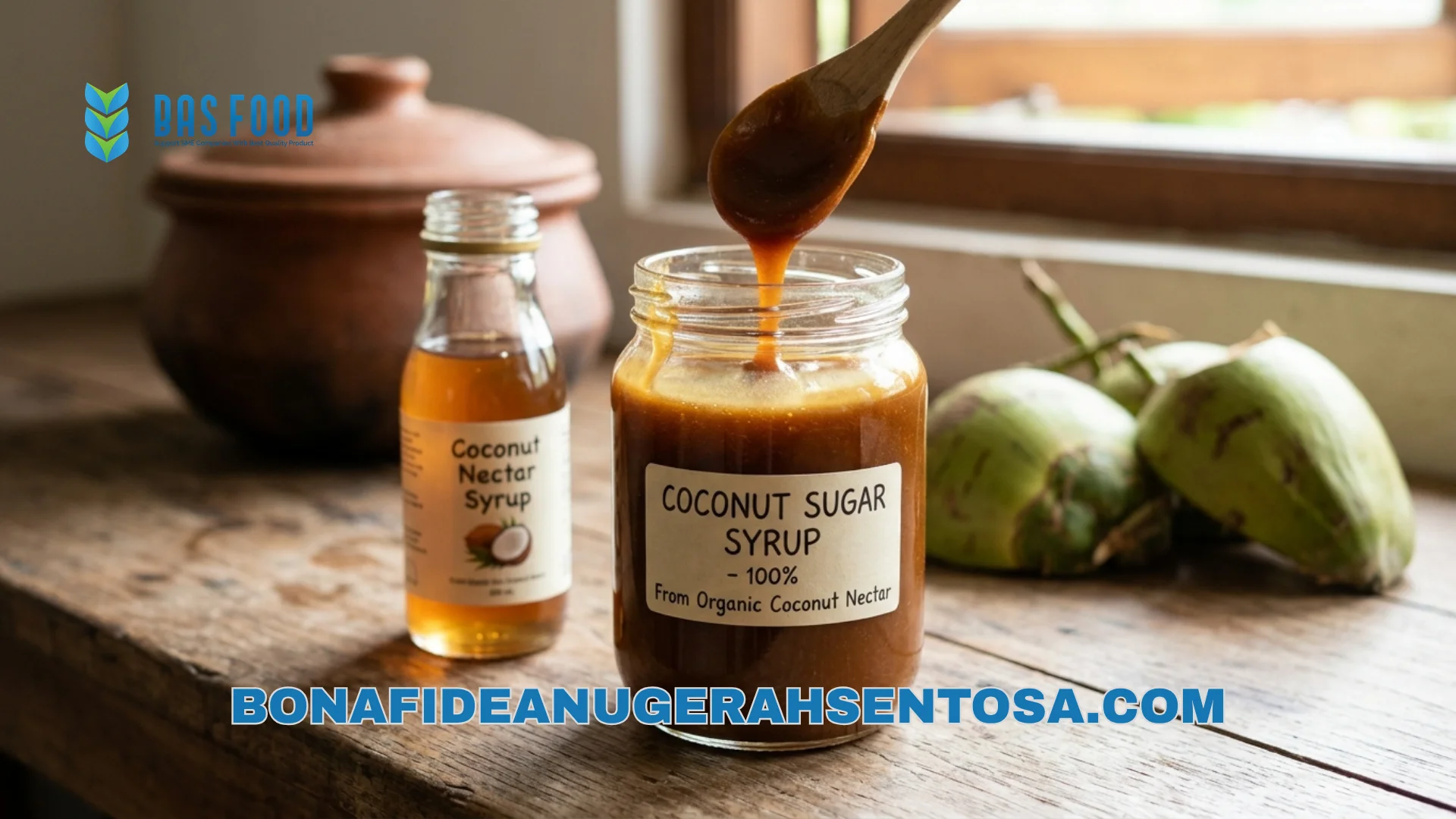
What Are Coconut Sugar Syrup Specifications?
Coconut sugar syrup specifications are the defined technical and quality characteristics used to describe a particular coconut sugar syrup product. They help buyers understand what they are purchasing and give suppliers a reference for maintaining product consistency.
A specification may cover physical, chemical, sensory, microbiological, packaging, and handling requirements, depending on the product and the buyer’s needs. Not every buyer will require exactly the same specifications.
For example, a beverage manufacturer may focus heavily on Brix, flavor, color, and viscosity. A sauce manufacturer may pay closer attention to viscosity and color. Meanwhile, an industrial food manufacturer may require a broader specification covering several quality and safety parameters.
Therefore, the right specification is application-specific. Buyers should explain how they intend to use the syrup so the supplier can provide the most relevant technical information.
Why Specifications Matter for B2B Buyers
For consumers, a sweetener may simply be an ingredient. For a food manufacturer, it becomes part of a production system.
A manufacturer needs to know how the ingredient will behave when it enters a recipe. If the syrup is more concentrated than expected, for example, the formulation may need adjustment. If the viscosity differs significantly from the production requirement, pumping and dosing may become more difficult.
Specifications also help purchasing teams establish consistency between orders. When a manufacturer receives regular shipments, a defined specification provides a reference for evaluating whether the incoming product meets the agreed requirements.
This becomes even more important for international trade. Export shipments can involve longer transportation and multiple handling stages. Clear specifications help the buyer and supplier communicate expectations before the product leaves the origin country.
Brix: Understanding Syrup Concentration
Brix is one of the most commonly discussed measurements for liquid sweeteners. In simple terms, it is a measurement associated with the soluble solids concentration of a solution, traditionally expressed as degrees Brix.
For coconut sugar syrup buyers, Brix can help provide an indication of how concentrated the syrup is. This information can be useful when developing a formulation because the concentration affects the amount of syrup required to achieve a particular result.
However, buyers should not treat Brix as a complete description of syrup quality. A Brix value does not tell you everything about flavor, color, viscosity, or other product characteristics.
The measurement method and product composition should also be understood. Depending on the syrup formulation, soluble solids may come from more than one component. Therefore, buyers should review Brix together with the rest of the product specification.
Why Brix Matters in Formulation
Suppose a food manufacturer is developing a beverage and wants a specific level of sweetness. The concentration of the syrup affects how much ingredient needs to be added.
A more concentrated syrup and a less concentrated syrup may therefore require different dosing levels to reach the same formulation target.
This is why Brix information can be useful during recipe development, costing, and production planning.
Brix and Batch Consistency
For regular commercial production, consistent concentration helps manufacturers maintain a repeatable formulation.
If the syrup concentration changes significantly from one batch to another, the manufacturer may need to adjust dosing or reformulate the product.
Consequently, buyers should discuss the supplier’s normal specification and acceptable variation rather than focusing only on a single Brix number.
Viscosity: How Easily the Syrup Flows
Viscosity describes how resistant a liquid is to flow. For a liquid ingredient, this characteristic can have a direct effect on handling and processing.
A coconut sugar syrup with higher viscosity may flow more slowly, while a lower-viscosity syrup may move more easily through pumps and dosing systems. However, viscosity is also influenced by factors such as temperature and concentration.
For industrial buyers, this specification can be particularly important. The syrup may need to travel through pipes, pumps, valves, or dosing equipment before reaching the mixing tank.
Therefore, manufacturers should compare the syrup’s viscosity characteristics with their existing production equipment.
Why Temperature Matters
A syrup’s flow behavior can change with temperature. In many liquid products, warmer conditions can reduce resistance to flow, while cooler conditions can make the product more viscous.
For this reason, a viscosity value should ideally be understood together with the conditions under which it was measured.
When requesting a specification sheet, buyers can ask the supplier how viscosity is measured and under what conditions. This provides a more useful comparison between products.
Viscosity and Product Application
Different applications may require different syrup flow characteristics.
For example, a beverage manufacturer may want easy dosing into a liquid formulation. A sauce producer may have different handling requirements. A bakery manufacturer may use the syrup in a formulation where the liquid contribution matters more than pumping speed.
As a result, there is no universal viscosity value that automatically suits every application.
Moisture: An Important Quality Parameter
Moisture is another important consideration when evaluating coconut sugar syrup specifications.
Because syrup is a liquid product, moisture forms part of its overall composition. However, buyers should distinguish between moisture content and total soluble solids. These parameters describe different aspects of the product.
Moisture can influence formulation, concentration, storage behavior, and the overall balance of ingredients. Therefore, it should be considered alongside Brix and other relevant specifications.
For food manufacturers, this information can help product developers calculate the contribution of the syrup to the final recipe.
Moisture and Food Formulation
When a manufacturer adds coconut sugar syrup to a formulation, the ingredient contributes both sweet solids and liquid.
This matters particularly in products where water balance affects texture or stability. Bakery products, sauces, fillings, and concentrates can all respond differently to changes in liquid content.
Consequently, product developers should use the supplier’s technical information when calculating formulations rather than assuming the syrup behaves like dry sugar.
Moisture and Storage
Storage conditions should always follow the specific supplier’s recommendations. Buyers should not assume that all coconut sugar syrups have identical storage requirements.
The packaging system, formulation, temperature, handling, and storage environment can all influence product condition.
For this reason, storage instructions should be included as part of the buyer’s technical documentation.
Color: More Than an Appearance
Color can be an important specification for coconut sugar syrup because the ingredient may influence the appearance of the finished product.
A deeper syrup color may work well in products such as dark sauces, caramel-style desserts, chocolate formulations, or certain beverages. On the other hand, manufacturers producing light-colored products may need tighter control over color contribution.
Color should therefore be evaluated both visually and in the final formulation.
A supplier may provide a general color description or another form of specification. Buyers should discuss the preferred range and determine whether it is suitable for their application.
Why Color Consistency Matters
Imagine a manufacturer producing the same sauce every month. If the incoming syrup changes significantly in color, the finished product may also look different.
Even when the recipe remains unchanged, ingredient variation can affect the final appearance.
Therefore, color consistency can be relevant for brands that need a uniform product appearance across production batches.
Flavor: The Sensory Side of the Specification
Technical numbers are important, but flavor is equally relevant.
Coconut sugar syrup can contribute its own characteristic taste. Depending on the product and processing, buyers may detect sweet, caramel-like, earthy, or other characteristic notes.
Whether those notes are desirable depends on the finished application.
A chocolate dessert may benefit from a deeper flavor profile, while a delicate beverage may require a more carefully balanced taste. The manufacturer should therefore evaluate the syrup through sensory testing.
Flavor Should Be Tested in the Final Product
Tasting the syrup by itself can provide useful information, but it does not tell the complete story.
The syrup may taste different once combined with cocoa, spices, fruit, dairy ingredients, coffee, acids, or other components.
For this reason, product developers should test the ingredient in the actual formulation whenever possible.
Sensory Consistency
Flavor consistency also matters for repeat production.
If the syrup’s sensory characteristics vary noticeably between batches, the finished product may change as well.
A clear product specification and supplier quality-control process can help buyers manage this risk.
Food Grade: What Buyers Should Understand
The term food grade is important, but buyers should understand that it should not be treated as a complete technical specification by itself.
A food-grade ingredient should be suitable for its intended food application and handled according to applicable food safety and regulatory requirements. However, specific requirements can differ between countries, products, and end uses.
For international buyers, the relevant regulations in the destination market should be considered alongside the supplier’s documentation.
Buyers should therefore ask for appropriate technical and food safety documentation and confirm that the product meets their own market requirements.
Documentation Matters
A B2B buyer may need documentation related to the product specification, ingredients, packaging, batch information, and other quality requirements.
The exact documentation depends on the buyer, destination, application, and commercial agreement.
Instead of assuming which documents are available, buyers should discuss their requirements with the supplier before placing the order.
Other Specifications Buyers Should Review
Brix, viscosity, moisture, color, and flavor are important, but they are not the only factors that may appear in a coconut sugar syrup specification sheet.
Depending on the product and buyer, additional information may include ingredient composition, pH, microbiological parameters, density, packaging details, storage instructions, batch identification, and other quality or safety requirements.
Not every parameter will be equally important for every application.
For example, a beverage producer may prioritize concentration and sensory characteristics, while a sauce manufacturer may focus heavily on viscosity and flavor.
The best approach is to create a specification that reflects the actual production process.
How to Read a Coconut Sugar Syrup Specification Sheet
A specification sheet can look technical at first. However, buyers can make the process easier by reviewing it category by category.
Start with the product identity and ingredient information. Then review physical characteristics such as appearance, color, Brix, viscosity, and other relevant measurements.
Next, examine sensory information. Does the flavor profile fit the intended product? Does the appearance match the manufacturer’s expectations?
After that, review food safety and quality information, followed by packaging, storage, and handling instructions.
Finally, compare the specification with the manufacturer’s internal requirements.
If something is unclear, ask the supplier before approving the product.
Samples and Specifications Should Work Together
A specification sheet provides measurable information, while a sample allows the buyer to evaluate the product in practice.
Both are important.
A manufacturer can use the specification to determine whether the product appears technically suitable. Then, the R&D team can use the sample to evaluate flavor, color, viscosity, mixing behavior, and finished-product performance.
For example, a sauce manufacturer can test the syrup in a pilot batch. A beverage producer can evaluate it at different inclusion levels. A bakery manufacturer can examine how it affects moisture and texture.
This combined approach gives buyers a more complete understanding of the ingredient before moving to bulk procurement.
Why Specifications Matter When Comparing Suppliers
When buyers compare multiple suppliers, it can be tempting to compare only price.
However, price without specification context can be misleading.
One supplier may offer a different concentration, packaging format, viscosity, or product specification from another. The products may therefore require different usage rates or processing conditions.
A better procurement process compares suppliers using a defined technical specification.
This helps purchasing teams evaluate products on a more consistent basis and gives suppliers a clear target to meet.
Choosing a Coconut Sugar Exporter Supplier
For international procurement, a coconut sugar exporter supplier needs to consider both product quality and export logistics.
The product must be prepared and packed appropriately for the journey from the production facility to the buyer’s location. Depending on the destination, the shipment may involve inland transport, port handling, ocean freight, customs clearance, and final delivery.
Clear communication becomes essential throughout this process.
International buyers should discuss product specifications, packaging, labeling, documentation, lead times, and shipment planning before confirming an order.
This helps both sides establish realistic expectations.
Coconut Sugar Syrup Specifications and Quality Consistency
Quality consistency is one of the biggest concerns in commercial food manufacturing.
A manufacturer does not simply need a good product once. It needs an ingredient that can continue to meet its agreed requirements across repeated orders.
This is why specifications are valuable. They create a reference point for quality control and communication.
However, buyers should also understand acceptable variation. Food ingredients are not necessarily defined by one absolute number. Specifications often include defined ranges or tolerances appropriate to the product.
Therefore, buyers should discuss both the target value and acceptable variation with the supplier.
How CV Bonafide Anugerah Sentosa Can Support B2B Sourcing
CV Bonafide Anugerah Sentosa is an Indonesian exporter involved in agricultural commodities and coconut-derived products.
For buyers exploring coconut sugar syrup, the most useful approach is to communicate the intended application and technical requirements clearly. Instead of requesting a generic syrup, buyers can explain whether the product will be used for beverages, sauces, bakery products, desserts, or another food application.
This information helps create a more focused sourcing discussion around specifications, samples, packaging, order requirements, and export arrangements.
As with any B2B ingredient purchase, buyers should review the actual product documentation and confirm specifications before making a commercial decision.
Final Thoughts on Coconut Sugar Syrup Specifications
Understanding coconut sugar syrup specifications helps B2B buyers make more informed sourcing and formulation decisions.
Brix provides useful information about concentration. Viscosity helps buyers understand flow and processing behavior. Moisture affects formulation balance, while color and flavor influence the final sensory characteristics of the product.
Food-grade requirements and supporting documentation are also important, particularly for manufacturers selling into regulated markets.
However, no specification sheet should replace practical testing. The best procurement process combines technical documentation with product samples and application trials.
For international buyers, working closely with a capable coconut sugar supplier or coconut sugar exporter supplier can make the process easier. By clearly communicating the required specifications, application, packaging, and destination, buyers can build a more precise sourcing process.
Ultimately, the goal is simple: find a coconut sugar syrup that matches the manufacturer’s formulation, processing system, quality requirements, and commercial needs, then establish clear specifications that can support consistent supply over time.