
When sourcing coconut sugar in bulk, buyers often come across terms such as mesh 40, mesh 60, mesh 80, fine granules, or coarse granules. At first, these terms may seem technical. However, understanding them can make a big difference when choosing the right product for your food business.
One specification that often attracts attention is coconut sugar mesh 80. Buyers may see it on a product specification sheet and assume that “mesh 80” automatically means the product has one exact particle size. In practice, mesh terminology needs to be understood carefully because screening systems, testing methods, and supplier specifications can vary.
For importers, distributors, food manufacturers, and private-label brands, the important point is not simply to ask for mesh 80. Instead, buyers should understand what the supplier means by the specification and how consistently the product meets it.
This article explains coconut sugar mesh 80 in simple terms. It also covers particle size, screening, quality control, applications, packaging, samples, and the questions B2B buyers should ask before ordering.
What Does Coconut Sugar Mesh 80 Mean?
The term mesh generally refers to a screening system used to classify particles according to size. A mesh screen contains openings through which smaller particles can pass while larger particles are retained.
Therefore, when a supplier describes coconut sugar as mesh 80, the term usually relates to the screen used during particle-size classification.
However, mesh number should not be treated as a universal statement that every particle in the product has exactly the same dimension. A batch can contain a distribution of particle sizes depending on the production and screening process.
This distinction is important for B2B buyers. A buyer may request mesh 80 because they need a relatively fine coconut sugar product, but the actual acceptable particle distribution should still be confirmed with the supplier.
Why Mesh Terminology Can Be Confusing
Mesh numbers can be misunderstood because the relationship between mesh number and particle size is not simply “higher number equals exactly one specific particle size.”
The actual opening size can depend on the screen standard, wire diameter, and testing method. As a result, two suppliers using the term “mesh 80” may not necessarily describe their products in exactly the same way.
For this reason, buyers should request the supplier’s particle-size specification and, when necessary, ask how the mesh classification is measured.
A sample is also useful because it allows the buyer to see and test the actual product rather than relying on terminology alone.
Why Particle Size Matters in Coconut Sugar
Particle size is a major part of coconut sugar granule quality. It can influence how the sugar is handled, measured, blended, packaged, and used in food production.
For example, a manufacturer using coconut sugar in a dry beverage mix may have different requirements from a bakery manufacturer. A distributor selling the sugar to restaurants may also prefer a different granule profile from a retail brand.
Therefore, particle size should always be considered in relation to the final application.
A buyer should ask not only, “Do you supply coconut sugar mesh 80?” but also, “What particle-size distribution does your mesh 80 product have?”
Consistency Is More Important Than the Label
The mesh number provides useful information, but consistency across batches is even more important for many B2B applications.
Imagine a manufacturer approves one coconut sugar sample for production. If later shipments contain significantly different particle characteristics, the sugar may behave differently during mixing or processing.
That can create additional work for the production team and make the finished product less consistent.
A reliable supplier should therefore have suitable screening and quality-control procedures to help maintain the agreed particle characteristics.
How Coconut Sugar Is Screened
To understand mesh 80, it helps to understand the basic screening process.
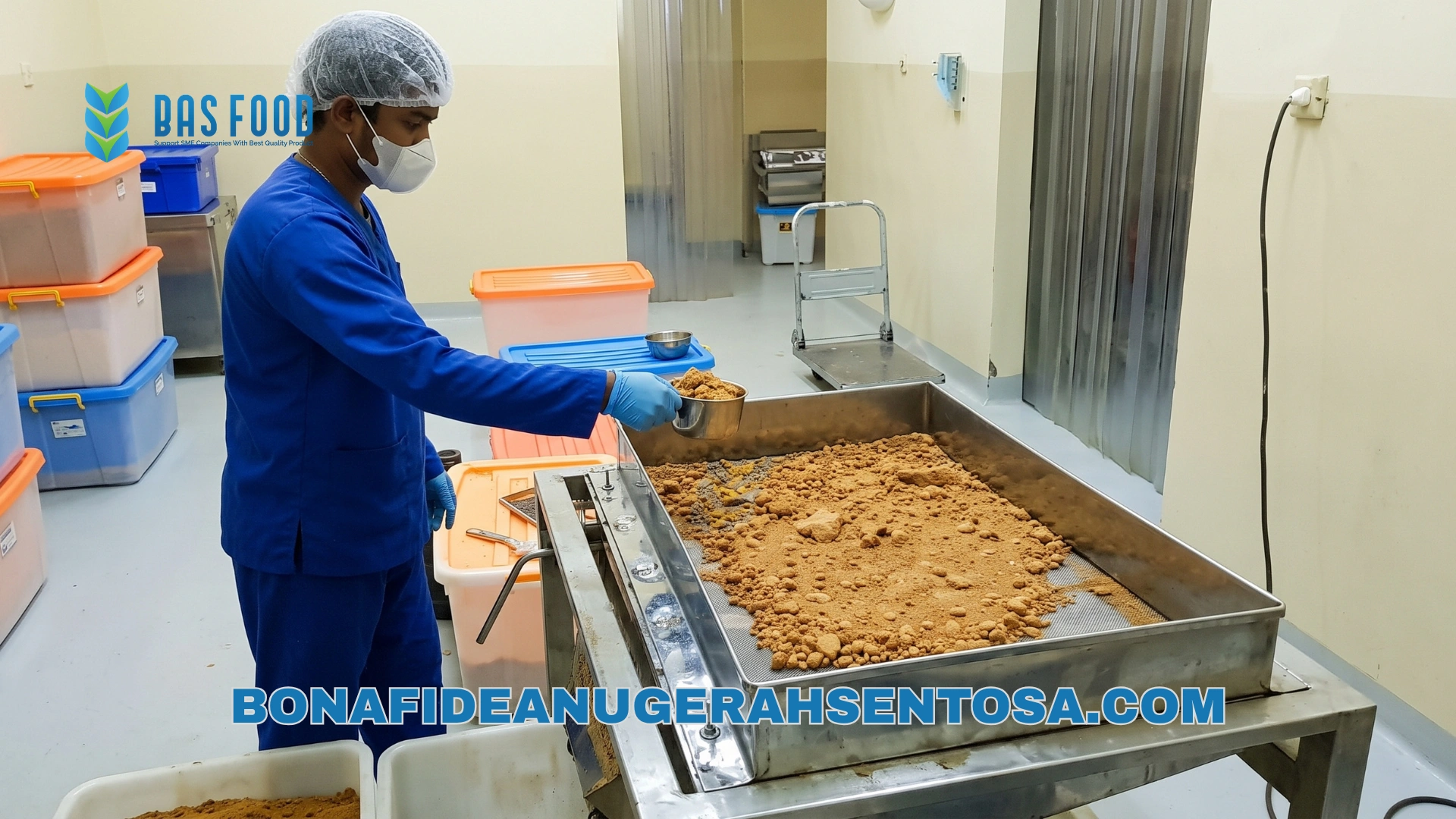
After coconut sugar is processed into granulated form, the product can be passed through screens with defined openings. The screening process separates particles according to their size.
Smaller particles can pass through the screen, while larger particles may remain above it. Suppliers can use this process to create a more consistent granulated product.
However, the exact production process can differ between manufacturers. Therefore, buyers should ask the supplier how the final particle size is controlled.
Screening Does Not Mean Every Particle Is Identical
A common misconception is that a mesh specification means every particle has exactly the same size.
In reality, a commercial food ingredient can contain a range of particle sizes. The important question is whether that range falls within the agreed specification.
For industrial buyers, particle-size distribution may therefore be more informative than a mesh number alone.
If particle size is critical to your application, ask the coconut sugar supplier for details about its screening standard, acceptable variation, and testing method.
Coconut Sugar Mesh 80 and Fine Granules
In many sourcing discussions, mesh 80 is associated with a relatively fine granulated product. However, buyers should confirm this directly with the supplier because terminology can vary.
Fine coconut sugar can be useful for applications where smaller particles are preferred. It may be easier to measure and incorporate into certain dry blends or food formulations.
Still, fine does not automatically mean better.
The correct particle size depends on the manufacturing process and final product. A bakery manufacturer, beverage producer, confectionery company, and retail packer may all have different preferences.
Fine Does Not Mean Powder
Another important distinction is between fine granules and powder.
Although fine granules contain smaller particles than coarse granules, they are not necessarily the same as a powdered product. Buyers should clearly specify whether they need granulated coconut sugar or coconut sugar powder.
This matters because particle characteristics can affect handling and processing.
If your purchasing team needs a specific format, describe the intended application and ask the supplier to provide a sample alongside the technical specification.
Coconut Sugar Mesh 80 for Food and Beverage Applications
One reason buyers search for coconut sugar mesh 80 is the need for a relatively fine ingredient for food or beverage production.
Coconut sugar granules can be used in a variety of applications, including beverages, bakery products, desserts, confectionery, sauces, dry mixes, and other food formulations.
However, the suitability of mesh 80 depends on the specific production process.
For example, a manufacturer may have equipment designed around a particular particle range. In that case, changing the particle size may affect mixing, dosing, or other production steps.
Beverage Applications
In beverage production, particle size can be one of several factors that influence how an ingredient behaves during processing.
A manufacturer producing powdered beverage mixes may have specific requirements for ingredient particle size. Meanwhile, a company using coconut sugar in a liquid formulation may have different processing conditions.
Therefore, buyers should test the actual coconut sugar in their own formulation whenever particle behavior is important.
The supplier can provide the sample, but the buyer’s production team should make the final application assessment.
Coconut Sugar Mesh 80 and Bakery Products
Bakery manufacturers use sweeteners in many different formulations, including cakes, cookies, breads, fillings, toppings, and other products.
Coconut sugar can contribute sweetness and its characteristic color and flavor profile. The particle size may also influence how the ingredient is incorporated into a recipe.
For a commercial bakery, consistency matters because recipes are often produced repeatedly at larger scale.
If the approved ingredient changes noticeably between shipments, the production team may need to make adjustments.
Choosing the Right Particle Size for Bakery Production
There is no single particle size that is ideal for every bakery application.
A manufacturer should consider the mixing system, recipe, other dry ingredients, processing time, and desired final product.
This is why the best approach is to provide the supplier with your application requirements and then evaluate a representative sample.
If mesh 80 is being considered, compare the sample with your current ingredient or formulation requirements before approving the specification.
How Moisture Can Affect Fine Coconut Sugar
Particle size is not the only quality parameter that matters.
Moisture is also important because coconut sugar can interact with moisture from its surroundings. This can influence how granules behave during storage and handling.
Fine particles can be particularly important to evaluate because the product has a different physical structure from larger granules.
If moisture conditions are not properly managed, coconut sugar can become more difficult to handle and may develop clumping.
Packaging and Moisture Protection
For international shipments, packaging should be considered together with the product specification.
The coconut sugar may travel through different environments before reaching the buyer’s warehouse. Temperature and humidity can change during transportation and storage.
Therefore, B2B buyers should discuss packaging material, inner liners, sealing, storage conditions, and shipping arrangements with the supplier.
The exact packaging configuration should be selected according to the product, order size, destination, and buyer requirements.
Color, Aroma, and Taste Still Matter
A focus on mesh 80 should not make buyers forget about other quality characteristics.
Coconut sugar is generally known for its brown color and characteristic sweet, caramel-like sensory profile. However, the exact appearance and sensory characteristics can vary between products.
A buyer should establish expectations using a product specification and approved sample.
This becomes especially important for food brands where the color and flavor of coconut sugar are part of the final product experience.
Compare Samples Before Bulk Purchasing
A sample provides an opportunity to check several parameters at the same time.
A buyer can evaluate:
- Particle appearance
- Color
- Aroma
- Taste
- Texture
- Granule uniformity
- Packaging suitability
- Performance in the intended application
If the product is approved, the buyer and supplier can use the sample as a practical reference alongside the written specification.
Quality Control for Coconut Sugar Mesh 80
A professional coconut sugar exporter supplier should be able to explain how it controls particle size and other quality characteristics.
Quality control should not happen only after the product has been packed. It should be considered throughout production.
Raw material handling, cooking, drying, granulation, screening, storage, and packing can all influence the final product.
Controlling Particle-Size Consistency
Screening is one part of particle-size control, but production consistency also matters.
If the raw material and production conditions vary significantly, the final granules may also vary.
Therefore, suppliers need appropriate process controls and inspection procedures.
For B2B buyers, the key question is whether the supplier can consistently produce the agreed product specification over repeated orders.
What Buyers Should Request From a Coconut Sugar Supplier
When requesting a quotation for coconut sugar mesh 80, buyers should ask for more than a price.
A useful inquiry can include:
- Product name
- Mesh specification
- Particle-size information
- Moisture specification
- Color description
- Sensory characteristics
- Food-grade status
- Packaging options
- Available documentation
- Sample availability
- Order quantity
- Production lead time
- Shipping terms
This gives the supplier enough information to provide a more relevant quotation.
Ask for the Actual Specification
If the supplier says it offers mesh 80, ask what that means in its own specification.
Questions can include:
“What screen standard do you use?”
“How do you verify particle size?”
“What particle-size distribution can you provide?”
“Can I receive a sample before placing a bulk order?”
These questions are simple, but they can prevent confusion later.
Why Samples Are Important for B2B Buyers
A product specification provides technical information, but a physical sample allows the buyer to evaluate the product directly.
This is particularly useful for particle-size requirements because buyers can compare the sample with their existing ingredients or production requirements.
A sample can also help the purchasing and quality teams agree on what the product should look like.
Approving a Reference Sample
For repeat business, buyers can keep an approved reference sample together with the agreed specification.
This creates two useful references:
- The written specification
- The physical approved sample
Together, they make quality communication easier.
The buyer can then evaluate future shipments based on the agreed requirements rather than starting the discussion from scratch every time.
Choosing an Indonesian Coconut Sugar Supplier
Indonesia is an important origin for coconut products, including coconut sugar. For overseas buyers, choosing the right Indonesian supplier requires attention to both product and business capability.
A good supplier should be able to communicate clearly about product specifications, packaging, samples, production, and shipping.
For an importer, supplier communication is particularly important because technical questions often need to be resolved before production starts.
What Makes a Supplier Suitable?
A suitable coconut sugar supplier should be able to discuss your requirements rather than simply offering one standard product.
For example, if your business requires mesh 80, explain why you need that specification. The supplier can then determine whether the requested product fits its available production and screening capabilities.
This approach is more effective than selecting a supplier based only on a product name.
Working With CV Bonafide Anugerah Sentosa
For buyers looking for an Indonesian source, CV Bonafide Anugerah Sentosa can be considered as a potential business partner for coconut sugar and other coconut-derived products.
B2B sourcing can begin by discussing the required product format, particle size, packaging, quantity, destination, and documentation.
If coconut sugar mesh 80 is required, the buyer should clearly communicate that requirement and request the applicable product specification and sample.
This creates a practical starting point for evaluating whether the product is suitable for the buyer’s manufacturing or distribution needs.
Coconut Sugar Granules vs. Moulded Coconut Sugar
Coconut sugar is available in several forms, and granules are only one option.
Some buyers may prefer moulded or block coconut sugar because of their particular market, retail concept, or culinary application.
In those situations, a coconut sugar mould supplier may be relevant.
Granulated coconut sugar, however, can be more convenient for buyers that need an ingredient for weighing, blending, formulation, or repacking.
Which Format Should You Choose?
The answer depends on the application.
Before ordering, consider:
- Final product
- Processing equipment
- Particle-size requirement
- Packaging
- Storage
- Consumer usage
- Order volume
- Retail or industrial market
Once these factors are clear, it becomes easier to determine whether mesh 80 granules, another granule size, powder, blocks, or moulded pieces are appropriate.
Final Thoughts: Look Beyond the Mesh Number
Coconut sugar mesh 80 can be a useful particle-size specification for B2B buyers, but the mesh number alone does not tell the entire quality story.
Buyers should understand how the supplier defines mesh 80, how the product is screened, what particle-size distribution is expected, and how the supplier maintains consistency between batches.
At the same time, other characteristics such as moisture, color, aroma, taste, cleanliness, food-grade requirements, packaging, and documentation should also be considered.
The best sourcing process starts with a clear requirement. Request the specification, evaluate a sample, test the product in the intended application, and agree on the quality standard before moving into regular bulk supply.
For companies looking for an Indonesian coconut sugar exporter supplier, this structured approach can make international purchasing easier and reduce avoidable quality misunderstandings.
Whether you need coconut sugar mesh 80, another particle size, or a moulded format through a coconut sugar mould supplier, the most important step is to define the product clearly and work with a coconut sugar supplier that understands your requirements.
With clear specifications and good communication, coconut sugar sourcing can become a more reliable part of your long-term ingredient supply chain.