
Moulded coconut sugar has a familiar shape, rich color, and deep caramel-like aroma that makes it popular in many food applications. From traditional recipes to modern food manufacturing, coconut sugar blocks can offer a practical way to handle and store this natural sweetener. However, good product quality does not end when the sugar leaves the production facility. Proper moulded coconut sugar storage is equally important. For B2B buyers, storage becomes even more important because coconut sugar may spend weeks or months in warehouses before reaching production lines or retail customers. During that time, heat, humidity, moisture, packaging, and handling can affect the condition of the product. A well-made coconut sugar block can still develop unwanted changes if the storage environment is not suitable.
The good news is that most storage problems can be reduced with a few practical controls. Buyers can protect product quality by choosing suitable packaging, controlling moisture, keeping the warehouse clean and dry, and following a sensible stock rotation system.
This guide explains how to store moulded coconut sugar correctly, what affects coconut sugar shelf life, how moisture control works, and what B2B buyers should discuss with a coconut sugar supplier before purchasing in bulk.
Understanding Moulded Coconut Sugar Before Storage
Moulded coconut sugar is made by concentrating coconut sap until it reaches the desired consistency and then placing the concentrated sugar into moulds. As the product cools and sets, it forms blocks, discs, cakes, or other shapes depending on the production method and buyer requirements.
Unlike granulated coconut sugar, moulded sugar has a compact physical structure. This makes it easy to stack, pack, transport, and portion for certain applications. However, the same compact structure means buyers need to pay attention to moisture and packaging because changes in the surrounding environment can affect the surface and texture of the blocks.
The exact shape and dimensions can vary between producers. Therefore, buyers should not assume that every moulded coconut sugar product has identical specifications. Before placing a commercial order, it is useful to confirm the product’s size, weight, packaging, moisture specification, and intended storage conditions.
Why Storage Matters
Storage is not simply about finding a place to keep the product. It is part of maintaining the quality agreed between the supplier and buyer.
If coconut sugar blocks absorb moisture, their surface can become sticky. Over time, blocks may soften, become harder to separate, or develop changes in texture. In a poorly managed warehouse, these changes can happen faster.
For B2B buyers, that can lead to additional handling work and potentially affect production efficiency. Therefore, good sugar storage practices should begin as soon as the shipment arrives.
What Affects Moulded Coconut Sugar Shelf Life?
Coconut sugar shelf life depends on several factors rather than one single number. Product composition, processing conditions, moisture content, packaging, transportation, and storage environment can all influence how long the sugar maintains its expected characteristics.
A supplier may provide a recommended shelf-life period based on its product specifications and storage requirements. However, buyers should understand that shelf life assumes the product is stored under suitable conditions.
For example, a sealed package stored in a cool, dry warehouse can behave very differently from an opened package kept in a warm, humid production area. Therefore, shelf life should always be considered together with storage conditions.
Product Quality Starts at the Factory
Storage cannot correct poor manufacturing quality. The product needs to enter the supply chain in a stable condition.
During production, coconut sap is concentrated through controlled heating. The resulting sugar mass is then formed into moulds. Consistency during this process helps create a more predictable finished product.
For this reason, buyers should work with a supplier that understands process control and can provide clear specifications.
A professional coconut sugar supplier should be able to discuss the product’s moisture characteristics, packaging, recommended storage, and expected shelf life.
Moisture Control: The Most Important Storage Factor
When discussing moulded coconut sugar storage, moisture control deserves special attention.
Coconut sugar can absorb moisture from the surrounding environment. This behavior becomes especially relevant in tropical or humid regions where relative humidity can remain high for long periods.
Once moisture enters the product or packaging, the surface of the sugar can become softer or stickier. In some cases, this may lead to changes in texture or make individual blocks more difficult to handle.
How Moisture Enters the Product
Moisture can reach coconut sugar through several routes.
The most obvious route is damaged or poorly sealed packaging. However, moisture can also enter when workers repeatedly open and close bulk packaging in a humid environment.
Temperature changes can create another problem. When a cold package moves into a warm and humid area, condensation may form. If the packaging does not provide sufficient protection, that moisture can affect the product.
Therefore, moisture control involves both packaging and warehouse practices.
Practical Moisture Control
B2B buyers should consider these basic practices:
- Keep coconut sugar in sealed packaging.
- Avoid storing bags or boxes directly on wet floors.
- Use clean pallets or suitable shelving.
- Keep the warehouse dry.
- Protect products from rain and water leaks.
- Minimize unnecessary package opening.
- Reseal opened packages properly.
- Avoid storing sugar near wet ingredients.
- Monitor warehouse humidity where practical.
- Inspect packaging regularly.
These simple actions can make a meaningful difference.
Choosing the Right Warehouse for Sugar Storage
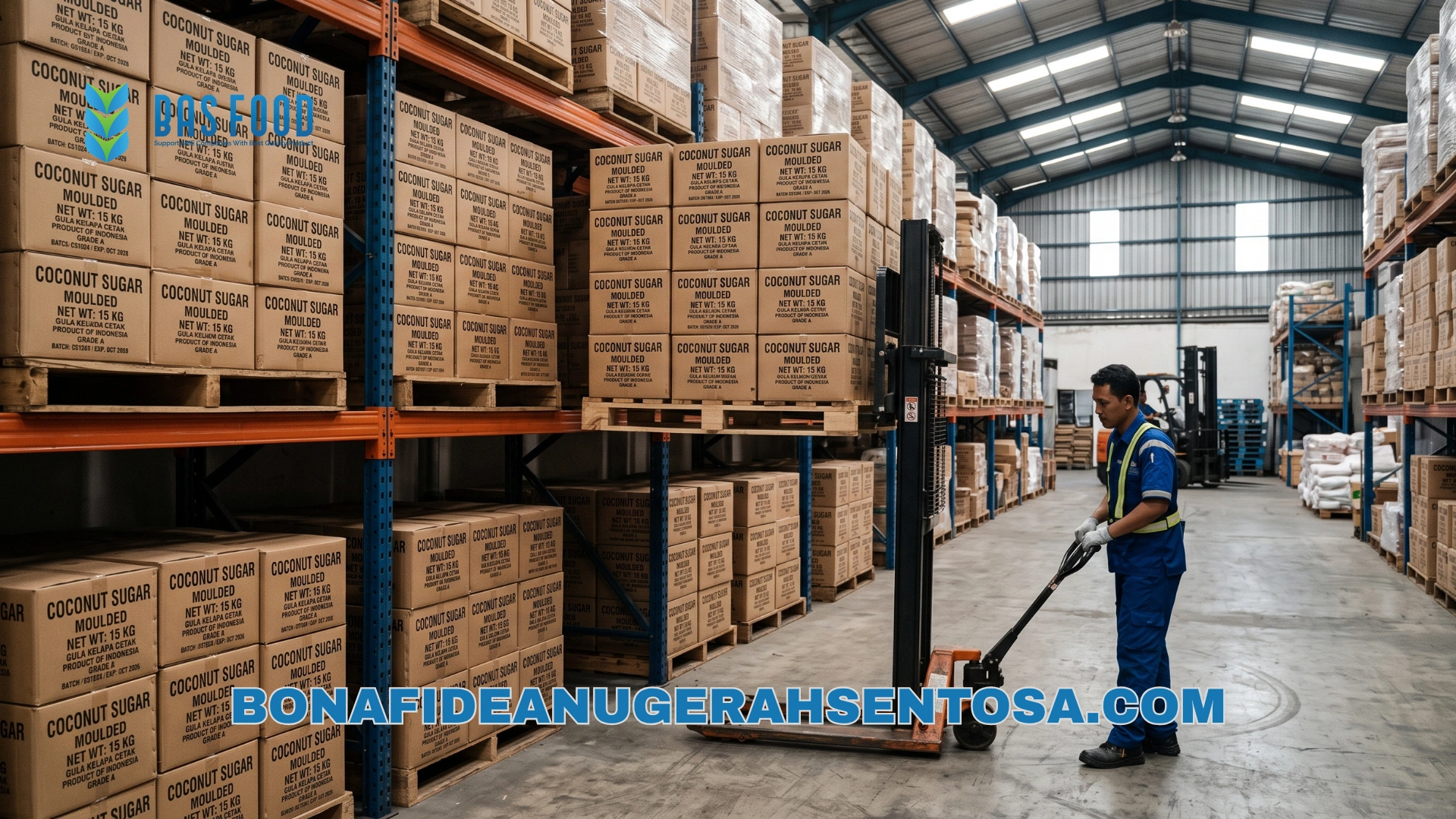
The warehouse plays a major role in maintaining moulded coconut sugar quality. A suitable storage area should be clean, dry, well maintained, and protected from direct exposure to water.
Ideally, the product should not sit directly on the floor. Pallets can create a physical barrier between the packaging and the floor while also making inspection and stock movement easier.
The storage area should also have good housekeeping practices. Dust, standing water, damaged packaging, and poor ventilation can increase quality risks.
Keep Heat and Humidity Under Control
High temperature alone does not necessarily destroy coconut sugar. However, high heat combined with humidity can create a less favorable environment for long-term storage.
Sudden temperature changes should also be avoided where possible. Stable environmental conditions generally make it easier to maintain consistent product quality.
For businesses operating in humid climates, warehouse monitoring can provide useful information. Measuring temperature and relative humidity helps warehouse teams identify conditions that may increase moisture-related risks.
Avoid Common Warehouse Mistakes
Several common mistakes can reduce storage performance:
Storing directly on the floor: This increases exposure to moisture and makes cleaning and inspection more difficult.
Placing products near water: Even a small leak can damage packaging and affect an entire shipment.
Leaving packages open: Open packaging allows the product to interact directly with humid air.
Ignoring damaged bags: Small holes or weak seals can allow moisture into the package.
Overcrowding the warehouse: Excessive stacking can make inspection, ventilation, and stock rotation more difficult.
Good warehouse management does not need to be complicated. Consistency is the key.
Packaging Is the First Barrier Against Moisture
Packaging protects moulded coconut sugar from the external environment. For international B2B shipments, packaging becomes even more important because the product may travel through different climates and handling environments.
The correct packaging depends on the product format, order volume, destination, transport method, storage duration, and buyer’s requirements.
A retail package and an industrial bulk package do not necessarily need the same packaging design.
What Buyers Should Ask About Packaging
Before purchasing, buyers can ask their supplier:
- What packaging material is used?
- What is the standard package weight?
- Is inner packaging available?
- How is the package sealed?
- Is export packaging available?
- How should opened packaging be stored?
- Can packaging be customized?
- What conditions are recommended during transportation?
These questions help buyers understand how the supplier protects the product.
Packaging During International Shipping
International shipping can expose coconut sugar to changing temperatures and humidity.
Therefore, the export packaging should be selected for the entire logistics journey, not just for the time spent inside the factory.
A reliable supplier should understand the importance of protecting the product from production through delivery.
At the same time, buyers should inspect packages when they arrive. Damaged packaging should be identified early so that appropriate action can be taken.
How to Store Moulded Coconut Sugar After Receiving a Shipment
Once a shipment arrives, the buyer should inspect it before moving everything into long-term storage.
Check the packaging for tears, holes, wet spots, broken seals, or signs of water exposure. If the shipment has experienced unusual transportation conditions, record the condition of the packaging before opening it.
After inspection, move the product into a suitable warehouse as soon as practical.
A Simple Receiving Procedure
A useful receiving process can include:
Step 1: Inspect the outer packaging.
Look for damage, moisture, or contamination.
Step 2: Check product condition.
Open selected packages according to your quality-control procedure and inspect the blocks.
Step 3: Confirm specifications.
Check product weight, appearance, texture, and other agreed specifications.
Step 4: Record the batch.
Keep batch or lot information for traceability.
Step 5: Move the product into proper storage.
Use pallets or suitable shelving and keep the product away from moisture.
Step 6: Apply stock rotation.
Use older stock first where appropriate.
This process creates a simple quality-control record that can help identify problems later.
Why FIFO Matters for Coconut Sugar Storage
The FIFO method, or First In, First Out, is a useful stock-management system for food ingredients.
Under FIFO, the inventory received first is used first. This reduces the risk of older products remaining in storage while newer shipments are consumed.
For coconut sugar businesses, FIFO can support better inventory management and help maintain consistent product rotation.
However, buyers should still follow the supplier’s stated shelf-life guidance and their own food safety procedures.
Keep Batch Information Clear
Every shipment should have clear identification.
Depending on the buyer’s system, this may include:
- Supplier name
- Product name
- Batch number
- Production date
- Receiving date
- Quantity
- Packaging format
- Recommended storage conditions
Good records make it easier to track product movement and investigate quality issues.
For large food manufacturers and distributors, traceability is especially important because one shipment may be divided across several production or sales channels.
Common Problems During Moulded Coconut Sugar Storage
Even when buyers follow basic procedures, storage problems can still happen. Understanding the most common issues makes them easier to prevent.
One common problem is surface stickiness. This may occur when the product is exposed to moisture or high humidity.
Another issue is texture change. The blocks may become softer, harder, or more difficult to separate depending on the conditions.
Watch for These Warning Signs
B2B warehouse teams should pay attention to:
- Sticky surfaces
- Unusual softening
- Excessive hardening
- Water-damaged packaging
- Unusual odor
- Visible mold
- Significant discoloration
- Broken packaging
- Condensation
- Unexplained changes between batches
Not every texture variation indicates a safety problem. However, unusual changes should be investigated rather than ignored.
If there are signs of contamination or significant deterioration, the affected product should be isolated and assessed according to the buyer’s food safety procedures.
Moulded Coconut Sugar Storage in Tropical Climates
Tropical environments present a particular challenge because temperature and humidity can remain relatively high.
Indonesia, for example, has many regions with warm and humid conditions. Therefore, storage planning becomes especially important for coconut sugar businesses operating in these environments.
A warehouse that appears dry during a short inspection may still experience high humidity during certain times of the day or season.
Practical Steps for Humid Environments
Businesses can reduce risk by:
- Keeping storage areas protected from rain.
- Checking for roof and wall leaks.
- Keeping products elevated.
- Limiting unnecessary package opening.
- Using appropriate ventilation.
- Monitoring environmental conditions where practical.
- Maintaining clean warehouse floors.
- Rotating inventory regularly.
The goal is not to create a complicated warehouse system. Instead, the goal is to prevent unnecessary moisture exposure.
Working With a Reliable Coconut Sugar Supplier
Good storage begins with good purchasing.
When selecting a coconut sugar supplier, buyers should evaluate more than price. Product specifications, consistency, packaging, communication, production capability, and export experience all matter.
Ask for samples before committing to a large commercial order. A sample allows the buyer to evaluate the product and confirm whether it fits the intended application.
Questions to Ask Your Supplier
Consider asking:
- What is the product’s moisture specification?
- What is the standard mould size?
- What packaging options are available?
- What is the recommended storage temperature and humidity?
- What shelf-life guidance is provided?
- How is each batch controlled?
- What export markets does the supplier serve?
- What documentation accompanies the shipment?
- What is the minimum order quantity?
- How does the supplier handle quality concerns?
These questions can help establish expectations before the first commercial shipment.
Why Supplier Communication Matters
B2B relationships work best when both sides understand the product requirements.
For example, a buyer may need coconut sugar blocks for industrial processing and have strict packaging and storage requirements. A supplier should know these requirements before production and shipment.
CV Bonafide Anugerah Sentosa can be evaluated by businesses looking for an Indonesian coconut sugar supplier and exporter. Buyers should communicate their required specifications, quantity, packaging format, destination, and application directly when discussing supply.
Coconut Sugar Mould Supplier and Product Consistency
A coconut sugar mould supplier is involved in an important part of moulded sugar production. The mould determines the physical shape and dimensions of the finished product.
Consistent mould dimensions can help manufacturers produce blocks with more predictable weight and shape. This becomes useful for buyers who use the product in standardized packaging or food-production processes.
However, mould consistency is only one part of overall product quality.
Mould Quality and Storage
The mould itself does not determine how well coconut sugar will survive storage. Processing, moisture control, packaging, and warehouse conditions remain important.
Still, consistent moulding can support more uniform packaging and stacking.
For this reason, buyers interested in moulded coconut sugar should consider both the physical specification and the storage requirements.
A clear product specification might include mould dimensions, average block weight, packaging format, moisture requirements, appearance, and shelf-life guidance.
Moulded Coconut Sugar Storage for Food Manufacturers
Food manufacturers have additional reasons to manage storage carefully.
Production lines often depend on consistent ingredient handling. If coconut sugar blocks become difficult to separate or process, workers may need additional preparation before the product enters manufacturing.
This can slow production and create unnecessary labor.
For this reason, manufacturers should communicate their production requirements to their coconut sugar supplier.
Match the Product to the Application
Different applications may require different coconut sugar formats.
A bakery may prefer one block size, while a food processor may want another. Some manufacturers may use moulded sugar as an ingredient that they further process into smaller pieces or granules.
Therefore, purchasing decisions should consider:
- Intended application
- Block size
- Weight per unit
- Moisture specification
- Packaging
- Storage period
- Production volume
Matching the product to the application helps reduce unnecessary handling.
Conclusion: Protect the Sugar After It Leaves the Factory
Good moulded coconut sugar storage is not complicated, but it does require consistency.
The most important principles are simple: keep the product dry, protect it from moisture, use suitable packaging, maintain a clean warehouse, keep products off the floor, inspect shipments when they arrive, and rotate inventory sensibly.
For B2B buyers, the process should begin before the purchase. Discuss specifications, packaging, shelf life, and storage requirements with the supplier. Then make sure the warehouse team understands how to protect the product after delivery.
A reliable coconut sugar supplier should provide clear product information and help buyers understand suitable storage practices. Meanwhile, buyers have an important role in maintaining the product once it enters their supply chain.
Ultimately, good storage protects more than the physical appearance of coconut sugar. It helps businesses maintain consistent production, reduce waste, improve inventory control, and get better value from every shipment.
When the right product meets the right packaging and the right storage conditions, moulded coconut sugar can remain a practical and reliable ingredient for food manufacturers, distributors, retailers, and other B2B buyers.