
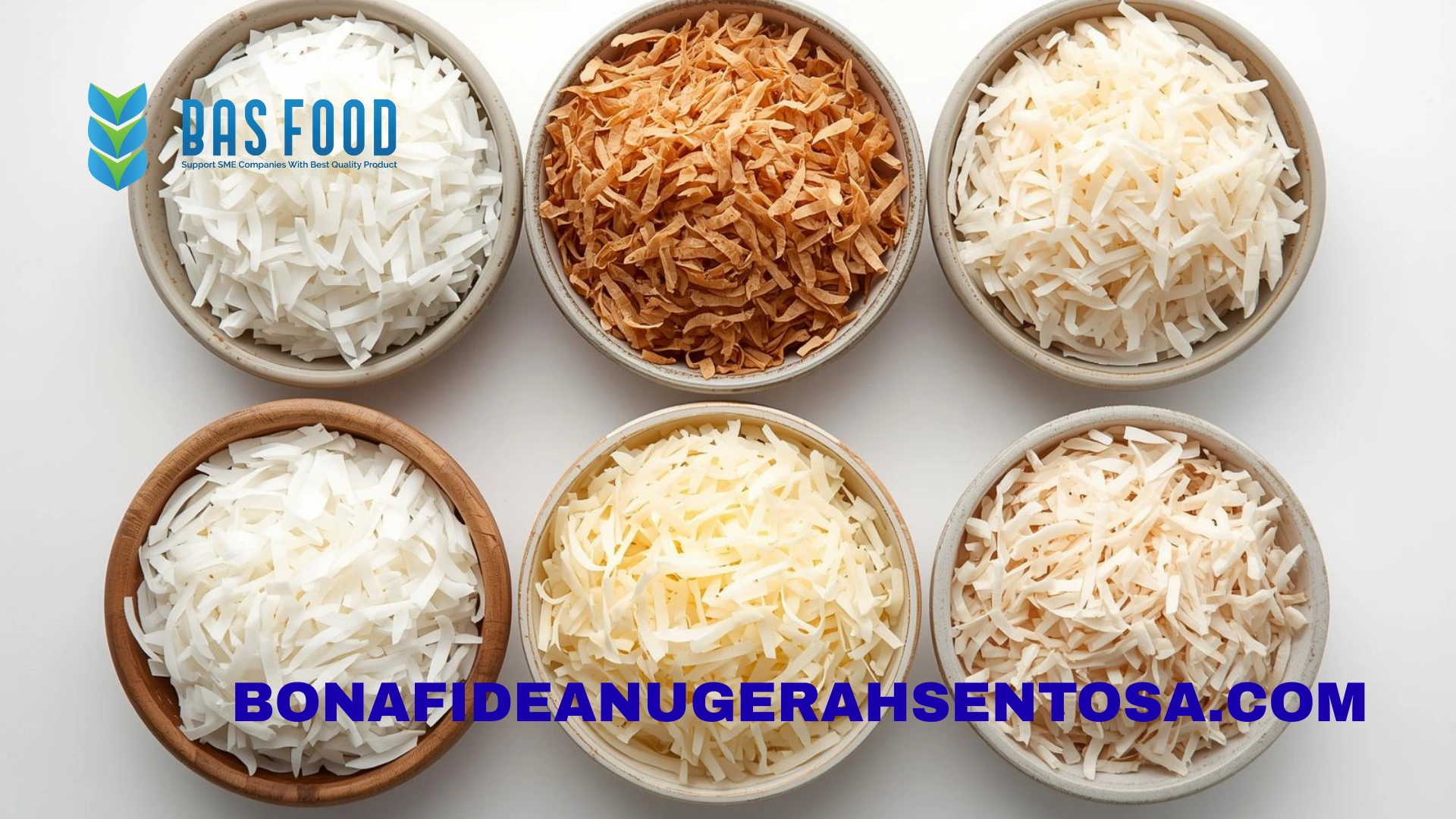
Understanding shredded coconut types is essential for food manufacturers and R&D teams that develop consistent formulations. Different coconut cuts affect texture, moisture absorption, and processing behavior in finished products.
Manufacturers often evaluate shredded coconut types when selecting ingredients for bakery, confectionery, and snack applications. Therefore, choosing the right size and format helps ensure product consistency, processing efficiency, and quality control.
This article explains the main types of shredded coconut, their production process, regulatory considerations, and how buyers can select the right specification for industrial use.
What Is Shredded Coconut?
Shredded coconut refers to coconut meat that has been grated, dried, and processed into specific particle sizes. Producers typically use mature coconuts to ensure proper oil content and texture.
After processing, the coconut is dried to reduce moisture content. As a result, the product becomes shelf-stable and suitable for global distribution.
Because of its versatility, shredded coconut is widely used in food manufacturing across multiple product categories.
Overview of Shredded Coconut Types
The classification of shredded coconut types depends mainly on particle size and cut format.
Manufacturers generally categorize shredded coconut into three main types: fine, medium, and flakes. Each type offers different functional properties for processing and formulation.
Therefore, selecting the right type depends on the intended application and desired product texture.
Fine Shredded Coconut
Fine shredded coconut consists of very small particles. It has a soft texture and integrates easily into doughs and batters.
Because of its size, it distributes evenly throughout the product. As a result, manufacturers often use it in baked goods such as cakes and cookies.
Additionally, fine coconut absorbs moisture quickly. This property helps maintain product softness in certain formulations.
Medium Shredded Coconut
Medium shredded coconut has a slightly larger particle size compared to fine coconut.
It provides more visible texture while still blending well into formulations. Therefore, manufacturers use it in products where both structure and distribution matter.
For example, medium cuts are common in granola, snack bars, and confectionery fillings.
Coconut Flakes
Coconut flakes are larger and flatter pieces of coconut meat.
Because of their size, flakes create a distinct visual appearance and texture. Therefore, they are often used as toppings or inclusions in food products.
In addition, flakes provide a more noticeable bite compared to finer cuts. This makes them suitable for premium or specialty food applications.
Processing Methods and Size Control
Producers control shredded coconut size through cutting and grading processes.
First, coconut meat is cleaned and shredded using industrial equipment. Then, the product passes through sieves to separate particle sizes.
Finally, drying reduces moisture to safe levels for storage and export. This process ensures consistent product quality across batches.
Functional Differences in Food Manufacturing
Different shredded coconut types behave differently during processing.
Fine coconut integrates fully into formulations, while medium coconut provides balanced texture. In contrast, flakes remain visible and contribute to product structure.
Therefore, manufacturers must align coconut type with product design goals. This decision directly affects texture, appearance, and processing behavior.
International Standards and Food Safety
Shredded coconut must comply with international food safety and quality standards.
Organizations such as the Codex Alimentarius Commission provide guidelines for processed coconut products.
These standards define parameters such as moisture content, microbiological limits, and labeling requirements.
As a result, exporters must ensure that products meet destination market regulations.
Quality Control in Coconut Processing
Quality control ensures that shredded coconut meets industrial requirements.
Producers test moisture levels, microbial safety, and particle size distribution. These parameters help maintain product consistency.
Moreover, many facilities follow HACCP-based systems to manage food safety risks. Therefore, buyers can verify product quality through laboratory reports.
Export Supply Chain and Compliance
Global distribution of coconut products requires strong logistics and documentation systems.
Exporters must manage packaging, labeling, and shipping conditions carefully. Although shredded coconut is shelf-stable, proper handling prevents contamination.
Companies with experience in global trade often manage multiple product categories. For example, exporters handling seafood such as Bluefin Tuna must follow strict cold chain logistics and documentation rules.
While shredded coconut does not require cold chain systems, the same discipline in export compliance applies.
Exporters such as CV Bonafide Anugerah Sentosa supply coconut products, spices, cocoa ingredients, and seafood. Their experience supports consistent compliance with international trade standards.
Risks in Selecting the Wrong Coconut Type
Choosing the wrong coconut cut can affect product quality and performance.
For example, using flakes instead of fine coconut may change texture and processing behavior. As a result, the final product may not meet formulation expectations.
Additionally, inconsistent particle size can affect mixing and distribution. Therefore, buyers must clearly define specifications before sourcing.
Best Practices for Ingredient Selection
Manufacturers can improve product outcomes by selecting the correct shredded coconut type.
First, define the required particle size based on product formulation. This step helps align ingredient selection with processing needs.
Second, request detailed product specifications from suppliers. These documents confirm size distribution and moisture content.
Finally, work with experienced exporters to ensure consistent quality and reliable supply.
Conclusion
Understanding shredded coconut types helps food manufacturers select the right ingredient for their applications.
Fine, medium, and flakes each provide different functional properties. Therefore, choosing the correct type supports consistent product quality and processing efficiency.
When buyers consider particle size, quality control, and export compliance, they can make better sourcing decisions for industrial food production.
FAQ
What are the main shredded coconut types?
The main types include fine, medium, and flakes, each with different particle sizes and applications.
Which shredded coconut type is best for baking?
Fine shredded coconut is commonly used in baking because it blends evenly into dough and batter.
What is the difference between medium and flakes coconut?
Medium coconut provides balanced texture, while flakes are larger and more visible in finished products.
How do manufacturers control shredded coconut size?
Producers use shredding equipment and sieving processes to separate coconut into different particle sizes.
Why is moisture control important in shredded coconut?
Low moisture helps prevent spoilage and ensures longer shelf life during storage and export.
Contact CV Bonafide Anugerah Sentosa how we can provide the best solutions for you. WhatsApp: +62 8213 4505 737, Email: info@bonafideanugerahsentosa.com / bas.mdir@gmail.com.